Category

Hong Kong

Brief Hong Kong: Screening the Silk Road: (Small-)Mid Cap Free Cash Flow and more

By | Hong Kong

In this briefing:

  1. Screening the Silk Road: (Small-)Mid Cap Free Cash Flow
  2. Climate Action – School Strikes Hit a Spot, Carbon Emitters Face Heat. Investors Take Note
  3. Jinxin Fertility (锦欣生殖) Pre-IPO: Strong Foothold in Sichuan but Weak Sentiment for Sector
  4. TRADE IDEA – PCCW (8 HK) Stub: The Li Legacy Lives On
  5. Dali Foods (3799:HK) FY18 Results: Revenue Growth Collapses in H2, But Margins Hold Up So Far

1. Screening the Silk Road: (Small-)Mid Cap Free Cash Flow

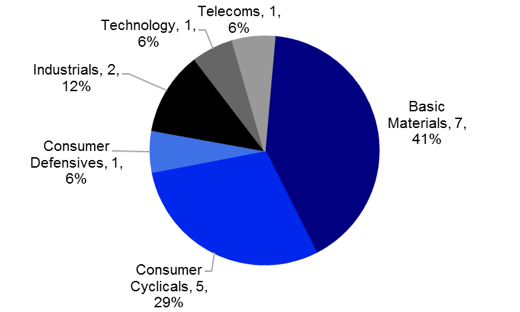
Chart%203%20 %20chart%203 %20sector%20composition%20of%20high risk%20names

In April 2018, we published a FCF screen with the sole aim of identifying potential names which could prove to be strong candidates in a Small-Mid Cap portfolio. We move to update this list with a strong bias to the mid-cap stocks appearing.

This screen performs well with markets where the value style is in favour. Given the market appears to be trending back to this style, we believe the Small-Mid Cap universe should capitalise on this over the next 12-months. We identify within the screen some high trading liquidity deep value candidates across the Asia Pacific universe.

Our updated 2019 list of names contains 17 stocks, with a more diversified spread of countries and sectors, compared to April 2018. A point to note is that basic material stocks have strengthened within the composition. Interestingly, the style of stock which has increased its presence amongst the list is the contrarian style, highlighting an opening up in value.

2. Climate Action – School Strikes Hit a Spot, Carbon Emitters Face Heat. Investors Take Note

Sea%20level

On Friday, March 15th, an estimated 1.6 million students in over 120 countries (source: Time magazine) walked out of classrooms and took to streets demanding radical climate action. Climate change activism rarely grabbed headlines or wider public attention as it is doing now. Rising climate activism will continue to train the spotlight on industries/businesses associated with carbon-emission making it increasingly difficult for them to expand capacities or secure funding. Large institutional investors – sovereign funds, pension funds, insurance companies – have begun to incorporate climate risk into investment policy and are limiting exposure to sectors that directly contribute to carbon emissions – primarily coal, crude oil producers and power plants based on them. Expect sector devaluation; active investors may well look beyond juicy near term earnings and dividend yield.

Even as scientists and meteorological organisations keep warning of dire consequences unless concrete action is taken to limit carbon emissions to stall climate change, political establishment/regulators in most countries are in denial while others are doing little more than lip service.  If so, should corporates care? even though businesses are the ones that play a direct role in escalating carbon emissions. With rising consumer awareness and activism, several industries associated with carbon emissions are already facing operational and funding challenges; we believe, it pays for all businesses to be above par on ‘climate action’ – it would be in their own self-interest, not just general good. And do Investors bother? Under the aegis of Climate Action 100+, an investor initiative with 320 signatories having more than USD33 trillion in assets collectively under management, they have been engaging companies on improving governance, curbing emissions and strengthening climate-related financial disclosures. It has listed out Oil & Gas, Mining, Utilities and Auto manufacturers as target sectors. Investors have already been making an impact – by vote or exit. It sure makes logical sense to effect positive change and minimise climate risk when you have a long term investment horizon.

In the detailed note below we

  • discuss how rising consumer/investor activism and/or political/regulatory changes are posing challenges to key sectors –Coal, Oil & Gas, Automobiles/Aviation, Consumer goods –  that are associated with carbon emissions. 
  • analyse how rising climate activism is negatively impacting growth prospects and valuation of companies in these sectors.
  • highlight the opportunities for businesses to capitalise on changing consumer preferences for products that minimise carbon footprint and differentiate themselves by being on the right side of climate action.
  • present a quick primer on climate change and lay down the key facts and data on climate change as presented by World Meteorological Organisation, NASA and IPCC. 

However, the report does NOT discuss potential risks to businesses from the aftermath of Climate change. Unlike our recently released report Fast Fashion in Asia: Trendy Clothing’s Toxic Trails – Investors Beware that looked into sector’s environmental violations and attempted to estimate potential earnings/growth/valuation downside as leading textile players adopt sustainable practices, we believe the impact of unpredictable climate change poses a threat that is not easy to identify or quantify.  

3. Jinxin Fertility (锦欣生殖) Pre-IPO: Strong Foothold in Sichuan but Weak Sentiment for Sector

Revenue%20mix%202

Jinxin Fertility, a leading privately owned assisted reproductive service provider in China and the US, refiled to list in Hong Kong. Per news reports, the company planned to raise up to USD 500 million. In this insight, we will cover the following topics:

  • Business lines and its hospitals
  • The assisted reproductive service industry
  • Key risks
  • Shareholders and use of proceeds
  • Our early thoughts on valuation

4. TRADE IDEA – PCCW (8 HK) Stub: The Li Legacy Lives On

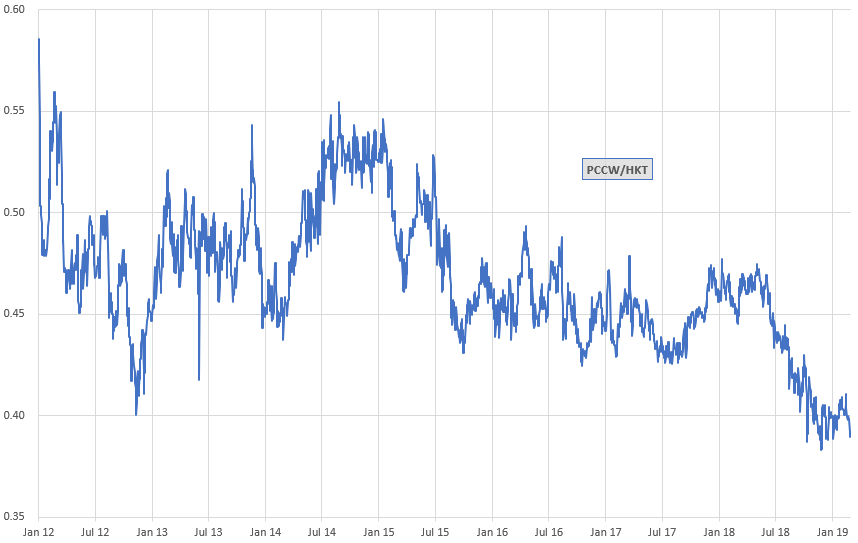
Capture1

Have you ever wondered how a company secures the Chinese lucky number “8” as their ticker in Hong Kong? I’ll explain later on, but let’s just say that being the son of Li Ka Shing helps. 

Li Ka Shing is a name that hardly needs introduction in Hong Kong and Richard Li, Li Ka Shing’s youngest son and Chairman of PCCW Ltd (8 HK), follows suit. After being born into Hong Kong’s richest family, Richard Li was educated in the US where he worked various odd jobs at McDonald’s and as a caddy at a local golf course before enrolling at Menlo College and eventually withdrawing without a degree. As fate would have it, Mr. Li went on to set up STAR TV, Asia’s satellite-delivered cable TV service, at the tender age of 24. Three years after starting STAR TV, Richard Li sold the venture, which had amassed a viewer base of 45 million people, to Rupert Murdoch’s News Corp (NWS AU) for USD 1 billion in 1993. During the same year, Mr. Li founded the Pacific Century Group and began a streak of noteworthy acquisitions. 

You may be starting to wonder what all of this has to do with a trade on PCCW Ltd (8 HK) and I don’t blame you. In the rest of this insight I will:

  • finish the historical overview of the Li family and PCCW
  • present my trade idea and rationale
  • give a detailed overview of the business units of PCCW and the associated performance of each
  • recap ALL of my stub trades on Smartkarma and the performance of each  

5. Dali Foods (3799:HK) FY18 Results: Revenue Growth Collapses in H2, But Margins Hold Up So Far

We launched coverage of Dali Foods Group (3799 HK) in February with a Sell rating and a HK$4.18 target price. FY18 financial results, which were released late Tuesday March 26th, appear to confirm at least half of our negative thesis (slowing revenue growth), though the other half (margin compression) has failed to materialize so far.

Dali Foods appears to have met — just — the FY18 consensus EPS target of HK$0.307 per share. The company cut its Final dividend from HK$0.10 to HK$0.075 per share. 

However, the pace of revenue growth plummeted in H218. From solid growth of +11.4% YoY in H118, H218 revenues actually declined by -0.6% YoY in the latter half of the year. This result was beyond even our pessimistic view and we believe bulls on the company will be forced to revisit their overly optimistic assumptions about double-digit revenue growth in 2019e.

Besides assuming slower revenue growth going forward, the other leg of our negative thesis on Dali Foods was the expectation of margin compression due to rising raw materials costs, specifically for paper and key food and beverage ingredients. Although H218 gross margin declined versus H217 (to 37.7% from 37.8%), it did so only marginally, and probably due to a change in product mix (ie, a decline in high-margin beverage sales). 

After reviewing FY and H218 results, we see no reasons to change our negative view of Dali Foods, and our HK$4.18 price target (-26% potential downside) and Sell rating remain unchanged.

Get Straight to the Source on Smartkarma

Smartkarma supports the world’s leading investors with high-quality, timely, and actionable Insights. Subscribe now for unlimited access, or request a demo below.


Brief Hong Kong: Hanergy’s Hobson’s Choice and more

By | Hong Kong

In this briefing:

  1. Hanergy’s Hobson’s Choice
  2. StubWorld: PCCW Is “Cheap” but Stub Ops Are Deteriorating

1. Hanergy’s Hobson’s Choice

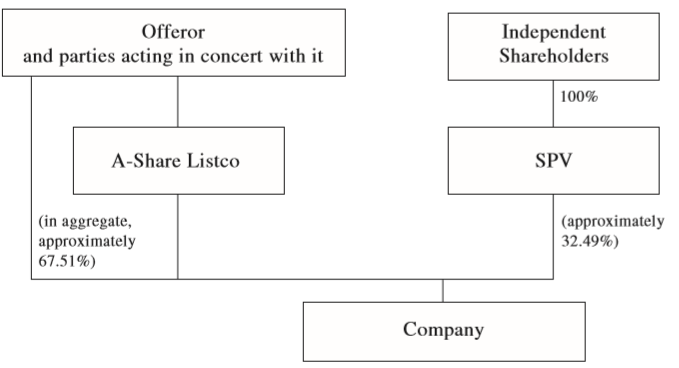
Spv

On the 23 October last year, the Board of Hanergy Mobile Energy Holdings Group Limited (HMEH), Hanergy Thin Film Power (566 HK)‘s majority shareholder, announced an intention to privatise the company at “no less than HK$5/share” via cash or scrip. Over a full week later, Hanergy acknowledged the proposal.

Following this privatisation, Hanergy would be listed on China’s A-share market. The indicative offer valued Hanergy at ~US$27bn.  Hanergy has been suspended since 20 May 2015 and last traded at $3.91/share.

Hanergy has now announced the intention of HMEH to privatise the company by way of a Scheme. The ultimate intention of HMEH still remains the listing of Hanergy’s business in China.

The rub is that the consideration under the Scheme will be in the form of one special purpose vehicle share (SPV) per Hanergy share.  To this: 

it is not certain whether the A-Share Listing can be achieved. If the A-Share Listing cannot be completed, the Independent Shareholders will be holding onto unlisted SPV Shares for which there is no exchange platform for transfers. Even if the A-Share Listing is completed, there is no certainty as to
(a) when and how the SPV will be able to dispose of the A-Share Listco Shares;
(b) at what price the A-Share Listco Shares can be sold; and
(c) when the cash exit can be available to the Independent Shareholders, via the proposed A-Share Listing.

Upon consultation with the Executive and given the above uncertainties, the Offeror is required not to attribute any monetary value to
(i) the Proposal and
(ii) any potential cash exit for the Independent Shareholders.

The announcement does not stipulate the jurisdiction of the SPV, only that it may be established in a jurisdiction apart from Hong Kong. That itself is a risk.

Long-suffering shareholders, who comprise 32.49% of shares out, have the dubious honour of holding SPV  shares which may remain in A-share pre-listing purgatory; or should the Scheme fail/lapse, hold unlisted shares if Hanergy fails to resume trading by end-July 2019, as per recently introduced HKEx guidelines. Such an outcome affords HMEH the flexibility to squeeze out minorities at a bargain price.

(A Hobson’s choice is a free choice in which only one thing is offered. In this instance, each outcome is undesirable.)

2. StubWorld: PCCW Is “Cheap” but Stub Ops Are Deteriorating

8%206823

This week in StubWorld …

  • Select media ops (Free TV and OTT), together with substantial losses booked to other businesses and eliminations, continue to weigh heavily on PCCW Ltd (8 HK)‘s stub ops.

Preceding my comments on PCCW and other stubs are the weekly setup/unwind tables for Asia-Pacific Holdcos.

These relationships trade with a minimum liquidity threshold of US$1mn on a 90-day moving average, and a % market capitalisation threshold – the $ value of the holding/opco held, over the parent’s market capitalisation, expressed in percent – of at least 20%.

Get Straight to the Source on Smartkarma

Smartkarma supports the world’s leading investors with high-quality, timely, and actionable Insights. Subscribe now for unlimited access, or request a demo below.


Brief Hong Kong: StubWorld: PCCW Is “Cheap” but Stub Ops Are Deteriorating and more

By | Hong Kong

In this briefing:

  1. StubWorld: PCCW Is “Cheap” but Stub Ops Are Deteriorating
  2. CStone Pharma (基石药业) Post-IPO: Strong Debut but Lacks near Term Catalysts

1. StubWorld: PCCW Is “Cheap” but Stub Ops Are Deteriorating

8%206823

This week in StubWorld …

  • Select media ops (Free TV and OTT), together with substantial losses booked to other businesses and eliminations, continue to weigh heavily on PCCW Ltd (8 HK)‘s stub ops.

Preceding my comments on PCCW and other stubs are the weekly setup/unwind tables for Asia-Pacific Holdcos.

These relationships trade with a minimum liquidity threshold of US$1mn on a 90-day moving average, and a % market capitalisation threshold – the $ value of the holding/opco held, over the parent’s market capitalisation, expressed in percent – of at least 20%.

2. CStone Pharma (基石药业) Post-IPO: Strong Debut but Lacks near Term Catalysts

Summary%20of%20biotech%20listing%202

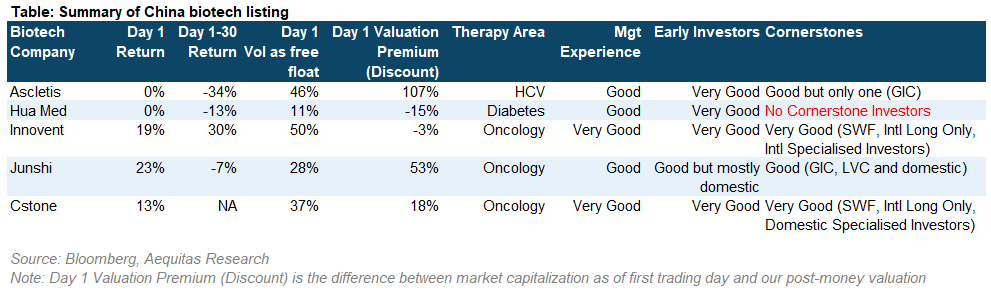
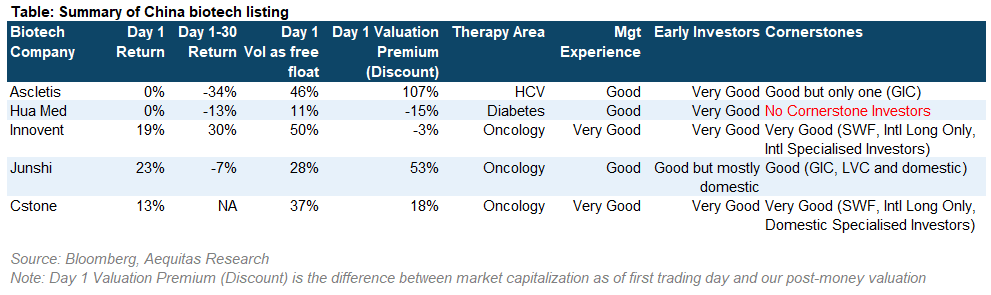
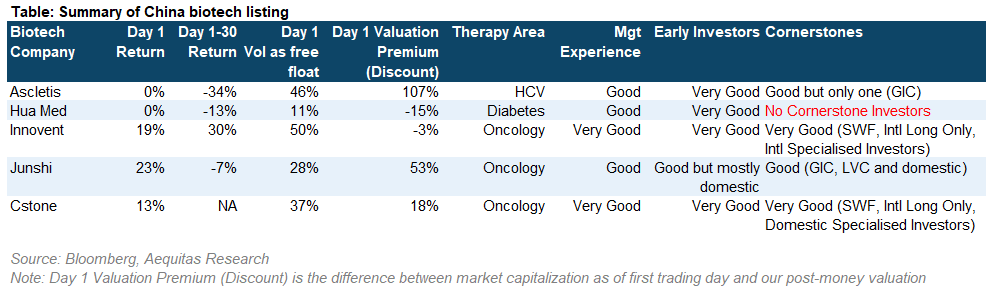
CStone Pharma’s IPO was priced at HKD 12.00/share and started trading today. In this insight, we summarize the allocation, the use of proceeds and recap our view on our valuation. We also look at past few biotech listings and discuss our thoughts on the market sentiments. We are of the view that despite a strong debut performance, CStone lacks near term catalysts that can continue to drive performance after the first day. 


Our Previous Coverage of CStone

Get Straight to the Source on Smartkarma

Smartkarma supports the world’s leading investors with high-quality, timely, and actionable Insights. Subscribe now for unlimited access, or request a demo below.


Brief Hong Kong: Climate Action – School Strikes Hit a Spot, Carbon Emitters Face Heat. Investors Take Note and more

By | Hong Kong

In this briefing:

  1. Climate Action – School Strikes Hit a Spot, Carbon Emitters Face Heat. Investors Take Note
  2. Jinxin Fertility (锦欣生殖) Pre-IPO: Strong Foothold in Sichuan but Weak Sentiment for Sector
  3. TRADE IDEA – PCCW (8 HK) Stub: The Li Legacy Lives On
  4. Dali Foods (3799:HK) FY18 Results: Revenue Growth Collapses in H2, But Margins Hold Up So Far
  5. StubWorld: Naspers Embeds Another Layer Into Tencent

1. Climate Action – School Strikes Hit a Spot, Carbon Emitters Face Heat. Investors Take Note

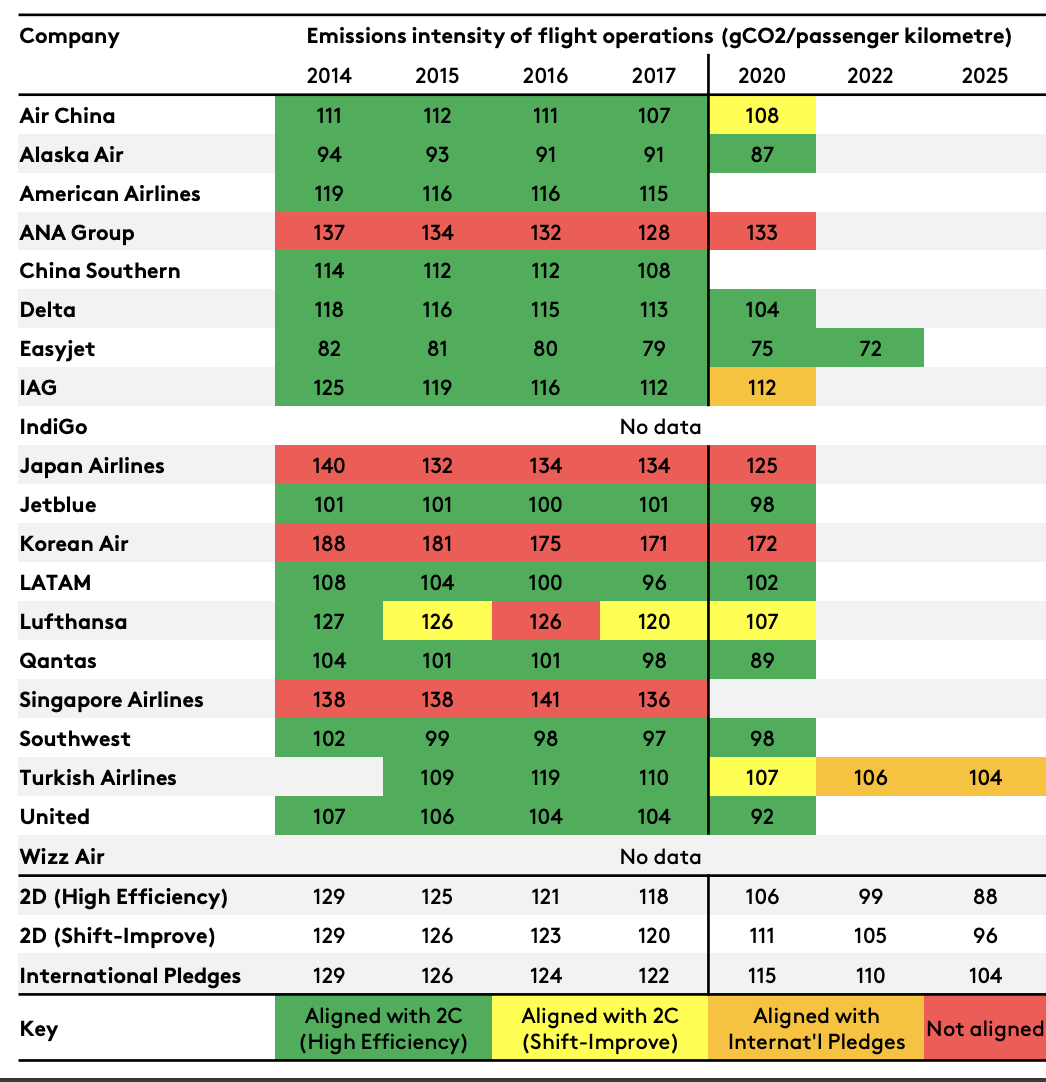
Airline%20emission%20intensity

On Friday, March 15th, an estimated 1.6 million students in over 120 countries (source: Time magazine) walked out of classrooms and took to streets demanding radical climate action. Climate change activism rarely grabbed headlines or wider public attention as it is doing now. Rising climate activism will continue to train the spotlight on industries/businesses associated with carbon-emission making it increasingly difficult for them to expand capacities or secure funding. Large institutional investors – sovereign funds, pension funds, insurance companies – have begun to incorporate climate risk into investment policy and are limiting exposure to sectors that directly contribute to carbon emissions – primarily coal, crude oil producers and power plants based on them. Expect sector devaluation; active investors may well look beyond juicy near term earnings and dividend yield.

Even as scientists and meteorological organisations keep warning of dire consequences unless concrete action is taken to limit carbon emissions to stall climate change, political establishment/regulators in most countries are in denial while others are doing little more than lip service.  If so, should corporates care? even though businesses are the ones that play a direct role in escalating carbon emissions. With rising consumer awareness and activism, several industries associated with carbon emissions are already facing operational and funding challenges; we believe, it pays for all businesses to be above par on ‘climate action’ – it would be in their own self-interest, not just general good. And do Investors bother? Under the aegis of Climate Action 100+, an investor initiative with 320 signatories having more than USD33 trillion in assets collectively under management, they have been engaging companies on improving governance, curbing emissions and strengthening climate-related financial disclosures. It has listed out Oil & Gas, Mining, Utilities and Auto manufacturers as target sectors. Investors have already been making an impact – by vote or exit. It sure makes logical sense to effect positive change and minimise climate risk when you have a long term investment horizon.

In the detailed note below we

  • discuss how rising consumer/investor activism and/or political/regulatory changes are posing challenges to key sectors –Coal, Oil & Gas, Automobiles/Aviation, Consumer goods –  that are associated with carbon emissions. 
  • analyse how rising climate activism is negatively impacting growth prospects and valuation of companies in these sectors.
  • highlight the opportunities for businesses to capitalise on changing consumer preferences for products that minimise carbon footprint and differentiate themselves by being on the right side of climate action.
  • present a quick primer on climate change and lay down the key facts and data on climate change as presented by World Meteorological Organisation, NASA and IPCC. 

However, the report does NOT discuss potential risks to businesses from the aftermath of Climate change. Unlike our recently released report Fast Fashion in Asia: Trendy Clothing’s Toxic Trails – Investors Beware that looked into sector’s environmental violations and attempted to estimate potential earnings/growth/valuation downside as leading textile players adopt sustainable practices, we believe the impact of unpredictable climate change poses a threat that is not easy to identify or quantify.  

2. Jinxin Fertility (锦欣生殖) Pre-IPO: Strong Foothold in Sichuan but Weak Sentiment for Sector

Pre ipo%20investors

Jinxin Fertility, a leading privately owned assisted reproductive service provider in China and the US, refiled to list in Hong Kong. Per news reports, the company planned to raise up to USD 500 million. In this insight, we will cover the following topics:

  • Business lines and its hospitals
  • The assisted reproductive service industry
  • Key risks
  • Shareholders and use of proceeds
  • Our early thoughts on valuation

3. TRADE IDEA – PCCW (8 HK) Stub: The Li Legacy Lives On

Capture1

Have you ever wondered how a company secures the Chinese lucky number “8” as their ticker in Hong Kong? I’ll explain later on, but let’s just say that being the son of Li Ka Shing helps. 

Li Ka Shing is a name that hardly needs introduction in Hong Kong and Richard Li, Li Ka Shing’s youngest son and Chairman of PCCW Ltd (8 HK), follows suit. After being born into Hong Kong’s richest family, Richard Li was educated in the US where he worked various odd jobs at McDonald’s and as a caddy at a local golf course before enrolling at Menlo College and eventually withdrawing without a degree. As fate would have it, Mr. Li went on to set up STAR TV, Asia’s satellite-delivered cable TV service, at the tender age of 24. Three years after starting STAR TV, Richard Li sold the venture, which had amassed a viewer base of 45 million people, to Rupert Murdoch’s News Corp (NWS AU) for USD 1 billion in 1993. During the same year, Mr. Li founded the Pacific Century Group and began a streak of noteworthy acquisitions. 

You may be starting to wonder what all of this has to do with a trade on PCCW Ltd (8 HK) and I don’t blame you. In the rest of this insight I will:

  • finish the historical overview of the Li family and PCCW
  • present my trade idea and rationale
  • give a detailed overview of the business units of PCCW and the associated performance of each
  • recap ALL of my stub trades on Smartkarma and the performance of each  

4. Dali Foods (3799:HK) FY18 Results: Revenue Growth Collapses in H2, But Margins Hold Up So Far

We launched coverage of Dali Foods Group (3799 HK) in February with a Sell rating and a HK$4.18 target price. FY18 financial results, which were released late Tuesday March 26th, appear to confirm at least half of our negative thesis (slowing revenue growth), though the other half (margin compression) has failed to materialize so far.

Dali Foods appears to have met — just — the FY18 consensus EPS target of HK$0.307 per share. The company cut its Final dividend from HK$0.10 to HK$0.075 per share. 

However, the pace of revenue growth plummeted in H218. From solid growth of +11.4% YoY in H118, H218 revenues actually declined by -0.6% YoY in the latter half of the year. This result was beyond even our pessimistic view and we believe bulls on the company will be forced to revisit their overly optimistic assumptions about double-digit revenue growth in 2019e.

Besides assuming slower revenue growth going forward, the other leg of our negative thesis on Dali Foods was the expectation of margin compression due to rising raw materials costs, specifically for paper and key food and beverage ingredients. Although H218 gross margin declined versus H217 (to 37.7% from 37.8%), it did so only marginally, and probably due to a change in product mix (ie, a decline in high-margin beverage sales). 

After reviewing FY and H218 results, we see no reasons to change our negative view of Dali Foods, and our HK$4.18 price target (-26% potential downside) and Sell rating remain unchanged.

5. StubWorld: Naspers Embeds Another Layer Into Tencent

26%20mar%202019%20uw

This week in StubWorld …

Preceding my comments on Naspers are the weekly setup/unwind tables for Asia-Pacific Holdcos.

These relationships trade with a minimum liquidity threshold of US$1mn on a 90-day moving average, and a % market capitalisation threshold – the $ value of the holding/opco held, over the parent’s market capitalisation, expressed in percent – of at least 20%.

Get Straight to the Source on Smartkarma

Smartkarma supports the world’s leading investors with high-quality, timely, and actionable Insights. Subscribe now for unlimited access, or request a demo below.


Brief Hong Kong: CStone Pharma (基石药业) Post-IPO: Strong Debut but Lacks near Term Catalysts and more

By | Hong Kong

In this briefing:

  1. CStone Pharma (基石药业) Post-IPO: Strong Debut but Lacks near Term Catalysts

1. CStone Pharma (基石药业) Post-IPO: Strong Debut but Lacks near Term Catalysts

Summary%20of%20biotech%20listing%202

CStone Pharma’s IPO was priced at HKD 12.00/share and started trading today. In this insight, we summarize the allocation, the use of proceeds and recap our view on our valuation. We also look at past few biotech listings and discuss our thoughts on the market sentiments. We are of the view that despite a strong debut performance, CStone lacks near term catalysts that can continue to drive performance after the first day. 


Our Previous Coverage of CStone

Get Straight to the Source on Smartkarma

Smartkarma supports the world’s leading investors with high-quality, timely, and actionable Insights. Subscribe now for unlimited access, or request a demo below.


Brief Hong Kong: CStone Pharma (基石药业) Post-IPO: Strong Debut but Lacks near Term Catalysts and more

By | Hong Kong

In this briefing:

  1. CStone Pharma (基石药业) Post-IPO: Strong Debut but Lacks near Term Catalysts
  2. Continuing Positive Outlook for Last Mile Industrial Real Estate Supports New Financings Globally

1. CStone Pharma (基石药业) Post-IPO: Strong Debut but Lacks near Term Catalysts

Summary%20of%20biotech%20listing%202

CStone Pharma’s IPO was priced at HKD 12.00/share and started trading today. In this insight, we summarize the allocation, the use of proceeds and recap our view on our valuation. We also look at past few biotech listings and discuss our thoughts on the market sentiments. We are of the view that despite a strong debut performance, CStone lacks near term catalysts that can continue to drive performance after the first day. 


Our Previous Coverage of CStone

2. Continuing Positive Outlook for Last Mile Industrial Real Estate Supports New Financings Globally

Re12%20segro%20slide%20current%20market%20conditions%20remain%20supportive

  • We published a series of Insights explaining our positive outlook for the industrial segment of the global Real Estate sector.
  • Currently, companies in this segment are capitalizing on strong fundamentals to raise new equity capital. They are using the proceeds from these deals to fund property acquisitions and developments, and to deleverage their balance sheets, thereby setting the stage for continuing growth.
  • This trend is especially notable because it is taking place in a range of geographic locations, around the world.

Get Straight to the Source on Smartkarma

Smartkarma supports the world’s leading investors with high-quality, timely, and actionable Insights. Subscribe now for unlimited access, or request a demo below.


Brief Hong Kong: CStone Pharma (基石药业) Post-IPO: Strong Debut but Lacks near Term Catalysts and more

By | Hong Kong

In this briefing:

  1. CStone Pharma (基石药业) Post-IPO: Strong Debut but Lacks near Term Catalysts
  2. Continuing Positive Outlook for Last Mile Industrial Real Estate Supports New Financings Globally
  3. Notes from the Silk Road: Nine Dragons Paper Holdings (2689.HK) – Potential Volatility Risk

1. CStone Pharma (基石药业) Post-IPO: Strong Debut but Lacks near Term Catalysts

Summary%20of%20biotech%20listing%202

CStone Pharma’s IPO was priced at HKD 12.00/share and started trading today. In this insight, we summarize the allocation, the use of proceeds and recap our view on our valuation. We also look at past few biotech listings and discuss our thoughts on the market sentiments. We are of the view that despite a strong debut performance, CStone lacks near term catalysts that can continue to drive performance after the first day. 


Our Previous Coverage of CStone

2. Continuing Positive Outlook for Last Mile Industrial Real Estate Supports New Financings Globally

Re12%20segro%20slide%20current%20market%20conditions%20remain%20supportive

  • We published a series of Insights explaining our positive outlook for the industrial segment of the global Real Estate sector.
  • Currently, companies in this segment are capitalizing on strong fundamentals to raise new equity capital. They are using the proceeds from these deals to fund property acquisitions and developments, and to deleverage their balance sheets, thereby setting the stage for continuing growth.
  • This trend is especially notable because it is taking place in a range of geographic locations, around the world.

3. Notes from the Silk Road: Nine Dragons Paper Holdings (2689.HK) – Potential Volatility Risk

Chart%201%20 %20china%20waste%20paper%20index

On the eve of the Chinese New Year holiday Nine Dragon Paper (NDP) released a profit warning regarding their H1 FY19 fiscal earnings. This warning came ahead of the 26th February 2019 Board Meeting.

Management guidance calls for a decrease for H1-2019 of approximately 45% YoY and revenue line of not less than RMB2.4bn. NDP cites an increase in raw materials and a decrease in the selling price of the products. 

Despite the negative news, the share price has rallied 15% since the announcement. We examine the implications.

Get Straight to the Source on Smartkarma

Smartkarma supports the world’s leading investors with high-quality, timely, and actionable Insights. Subscribe now for unlimited access, or request a demo below.


Brief Hong Kong: CStone Pharma (基石药业) Post-IPO: Strong Debut but Lacks near Term Catalysts and more

By | Hong Kong

In this briefing:

  1. CStone Pharma (基石药业) Post-IPO: Strong Debut but Lacks near Term Catalysts
  2. Continuing Positive Outlook for Last Mile Industrial Real Estate Supports New Financings Globally
  3. Notes from the Silk Road: Nine Dragons Paper Holdings (2689.HK) – Potential Volatility Risk
  4. Asia’s External Balances Signal Safety for Investors

1. CStone Pharma (基石药业) Post-IPO: Strong Debut but Lacks near Term Catalysts

Summary%20of%20biotech%20listing%202

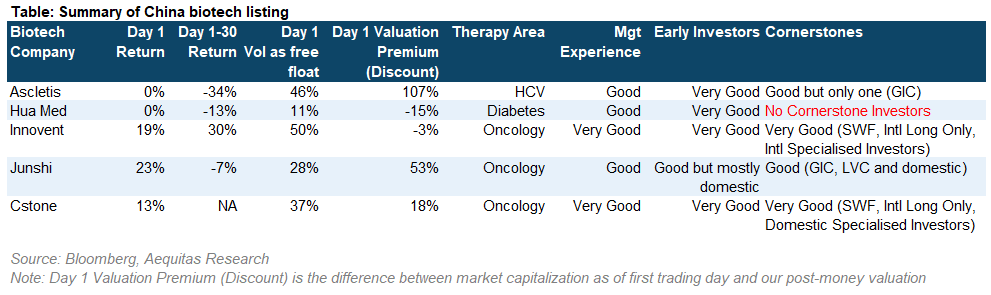
CStone Pharma’s IPO was priced at HKD 12.00/share and started trading today. In this insight, we summarize the allocation, the use of proceeds and recap our view on our valuation. We also look at past few biotech listings and discuss our thoughts on the market sentiments. We are of the view that despite a strong debut performance, CStone lacks near term catalysts that can continue to drive performance after the first day. 


Our Previous Coverage of CStone

2. Continuing Positive Outlook for Last Mile Industrial Real Estate Supports New Financings Globally

Re12%20segro%20slide%20current%20market%20conditions%20remain%20supportive

  • We published a series of Insights explaining our positive outlook for the industrial segment of the global Real Estate sector.
  • Currently, companies in this segment are capitalizing on strong fundamentals to raise new equity capital. They are using the proceeds from these deals to fund property acquisitions and developments, and to deleverage their balance sheets, thereby setting the stage for continuing growth.
  • This trend is especially notable because it is taking place in a range of geographic locations, around the world.

3. Notes from the Silk Road: Nine Dragons Paper Holdings (2689.HK) – Potential Volatility Risk

Chart%201%20 %20china%20waste%20paper%20index

On the eve of the Chinese New Year holiday Nine Dragon Paper (NDP) released a profit warning regarding their H1 FY19 fiscal earnings. This warning came ahead of the 26th February 2019 Board Meeting.

Management guidance calls for a decrease for H1-2019 of approximately 45% YoY and revenue line of not less than RMB2.4bn. NDP cites an increase in raw materials and a decrease in the selling price of the products. 

Despite the negative news, the share price has rallied 15% since the announcement. We examine the implications.

4. Asia’s External Balances Signal Safety for Investors

Fig%206%20policy%20rates

Asian currencies are, in general, well supported by economic fundamentals in the form of external surpluses and interest rate differentials. Indeed, most Asian currencies display an appreciating bias, contrary to perceptions in 2018 when all of them lost ground to the US dollar. Over the last year the underlying external strength has been reflected in Asian currency appreciation against the US dollar.

Get Straight to the Source on Smartkarma

Smartkarma supports the world’s leading investors with high-quality, timely, and actionable Insights. Subscribe now for unlimited access, or request a demo below.


Brief Hong Kong: HK Connect Discovery Weekly: Geely, Great Wall Motor and Sands China (2019-02-22) and more

By | Hong Kong

In this briefing:

  1. HK Connect Discovery Weekly: Geely, Great Wall Motor and Sands China (2019-02-22)
  2. Hopewell’s Egregiously Bad Offer, But What Can You Do?

1. HK Connect Discovery Weekly: Geely, Great Wall Motor and Sands China (2019-02-22)

Smid%20cap%20by%20inflow

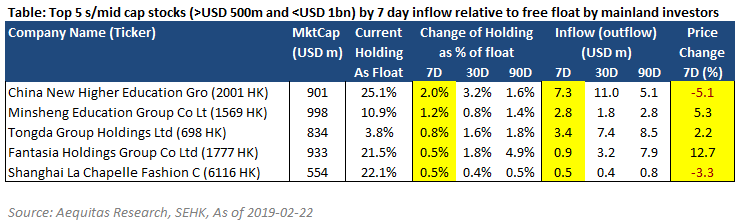
In our Discover HK Connect series, we aim to help our investors understand the flow of southbound trades via the Hong Kong Connect, as analyzed by our proprietary data engine. We will discuss the stocks that experienced the most inflow and outflow by mainland investors in the past seven days.

We split the stocks eligible for the Hong Kong Connect trade into three groups: component stocks in the HSCEI index, stocks with a market capitalization between USD 1 billion and USD 5 billion, and stocks with a market capitalization between USD 500 million and USD 1 billion.

In this week’s HK Connect Discovery, we highlight the strong inflow to automobile stocks and Sands China. 

2. Hopewell’s Egregiously Bad Offer, But What Can You Do?

Price2

The Scheme Document for the privatisation of Hopewell Holdings (54 HK) has been dispatched. The court meeting will be held on the 21 March. The consideration will be paid (on or before) the 14 May.  The IFA (China Tonghai Capital) considers the $38.80/share Offer to be fair & reasonable. The Scheme is conditional on ≥75% for, ≤10% against from disinterested shareholders. As Hopewell is HK-incorporated, there is no “head count ” test.  The full timetable is as follows:

Date 

Data in the Date

6-Dec-18
Announcement
24-Feb-19
Scheme document
13-Mar-19
Last time for lodging shares to qualify to vote
15-Mar-19
Meeting record date
19-Mar-19
Court/EGM meeting
2-May-19
Effective date
14-May-19
Cheques dispatched
Source: Hopewell

Substantial Shareholders

Mn

%

The Wu family & concert parties
                         320.7
                     36.93
Non-consortium Offeror concert parties
                        31.7
                     3.65
Total
352.5
40.48
Disinterested Shareholders 
516.1
59.42

After hearing conflicting opinions on what constitutes a blocking stake, a chat with the banker confirmed the blocking stake, as per the Companies Ordinance, is tied to 63.07% of shares out (i.e. Scheme shareholders – see page 95); whereas the Takeovers Code is tied to 59.42% of shares out. Effectively there are two assessments on the blocking stake and the more stringent (the 59.42% out in this case) prevails. 

With the Offer Price representing a 43% discount to NAV, wider than the largest discount precedent in past nine years (the Glorious Property (845 HK) offer, which incidentally was voted down), the IFA creatively argues that extenuating factors such as the premium to historical price needs to also be taken into account. Hardly original, but that is where investors must decide whether this is as good as it’s going to get – given the Wu family’s control, there will not be a competing offer – or to hold out for a superior price longer term. This is a final offer and it will not be increased.

What the IFA fails to discuss is that the widest successful discount to NAV privatisation was 29.4% for New World China Land (917 HK) in 2016. And all precedent transactions (successful or otherwise) are PRC (mainly) property development related; except for Wheelock which operated property in Hong Kong (like Hopewell) and in Singapore, which was privatised at a 12.1% discount to NAV.

Therein lies the dilemma – what is a fair and reasonable discount to NAV for a Hong Kong investment property play? With limited precedents, it is challenging to categorically reach an opinion. And that is the disingenuous conclusion from the IFA that the premium to last close and with reference to historical pricing, is in effect the overriding reason to conclude the Offer is reasonable. I would argue the Wu family has made a low-ball offer for what is essentially an investment property play with quantifiable asset value.

A blocking sake is 5.9% or 51.6mn shares. First Eagle, which recently voted down the Guoco Group Ltd (53 HK) privatisation that was pitched at a ~25% discount to NAV, holds 2.7% (according to CapIQ).

Trading at a wide gross/annualised return of 7%/37.5%, reflecting the risk to completion, and the significant downside should the scheme be voted down. Tough one – the premium to last close and with reference to the 10-year price performance, should be sufficient to get it over the line, and the basis for this “bullish” insight. But only for the brave.

Get Straight to the Source on Smartkarma

Smartkarma supports the world’s leading investors with high-quality, timely, and actionable Insights. Subscribe now for unlimited access, or request a demo below.


Brief Hong Kong: Jinxin Fertility (锦欣生殖) Pre-IPO: Strong Foothold in Sichuan but Weak Sentiment for Sector and more

By | Hong Kong

In this briefing:

  1. Jinxin Fertility (锦欣生殖) Pre-IPO: Strong Foothold in Sichuan but Weak Sentiment for Sector
  2. TRADE IDEA – PCCW (8 HK) Stub: The Li Legacy Lives On
  3. Dali Foods (3799:HK) FY18 Results: Revenue Growth Collapses in H2, But Margins Hold Up So Far
  4. StubWorld: Naspers Embeds Another Layer Into Tencent
  5. ESR Cayman Pre-IPO- First Stab at Valuation

1. Jinxin Fertility (锦欣生殖) Pre-IPO: Strong Foothold in Sichuan but Weak Sentiment for Sector

Valuation%20comp%20march%2026th%20v2

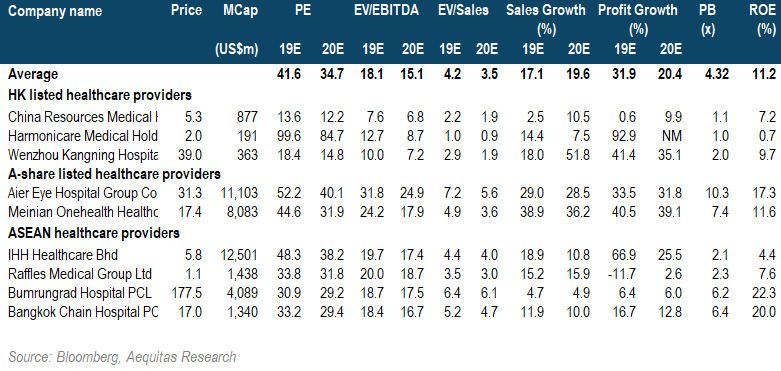
Jinxin Fertility, a leading privately owned assisted reproductive service provider in China and the US, refiled to list in Hong Kong. Per news reports, the company planned to raise up to USD 500 million. In this insight, we will cover the following topics:

  • Business lines and its hospitals
  • The assisted reproductive service industry
  • Key risks
  • Shareholders and use of proceeds
  • Our early thoughts on valuation

2. TRADE IDEA – PCCW (8 HK) Stub: The Li Legacy Lives On

Capture2

Have you ever wondered how a company secures the Chinese lucky number “8” as their ticker in Hong Kong? I’ll explain later on, but let’s just say that being the son of Li Ka Shing helps. 

Li Ka Shing is a name that hardly needs introduction in Hong Kong and Richard Li, Li Ka Shing’s youngest son and Chairman of PCCW Ltd (8 HK), follows suit. After being born into Hong Kong’s richest family, Richard Li was educated in the US where he worked various odd jobs at McDonald’s and as a caddy at a local golf course before enrolling at Menlo College and eventually withdrawing without a degree. As fate would have it, Mr. Li went on to set up STAR TV, Asia’s satellite-delivered cable TV service, at the tender age of 24. Three years after starting STAR TV, Richard Li sold the venture, which had amassed a viewer base of 45 million people, to Rupert Murdoch’s News Corp (NWS AU) for USD 1 billion in 1993. During the same year, Mr. Li founded the Pacific Century Group and began a streak of noteworthy acquisitions. 

You may be starting to wonder what all of this has to do with a trade on PCCW Ltd (8 HK) and I don’t blame you. In the rest of this insight I will:

  • finish the historical overview of the Li family and PCCW
  • present my trade idea and rationale
  • give a detailed overview of the business units of PCCW and the associated performance of each
  • recap ALL of my stub trades on Smartkarma and the performance of each  

3. Dali Foods (3799:HK) FY18 Results: Revenue Growth Collapses in H2, But Margins Hold Up So Far

We launched coverage of Dali Foods Group (3799 HK) in February with a Sell rating and a HK$4.18 target price. FY18 financial results, which were released late Tuesday March 26th, appear to confirm at least half of our negative thesis (slowing revenue growth), though the other half (margin compression) has failed to materialize so far.

Dali Foods appears to have met — just — the FY18 consensus EPS target of HK$0.307 per share. The company cut its Final dividend from HK$0.10 to HK$0.075 per share. 

However, the pace of revenue growth plummeted in H218. From solid growth of +11.4% YoY in H118, H218 revenues actually declined by -0.6% YoY in the latter half of the year. This result was beyond even our pessimistic view and we believe bulls on the company will be forced to revisit their overly optimistic assumptions about double-digit revenue growth in 2019e.

Besides assuming slower revenue growth going forward, the other leg of our negative thesis on Dali Foods was the expectation of margin compression due to rising raw materials costs, specifically for paper and key food and beverage ingredients. Although H218 gross margin declined versus H217 (to 37.7% from 37.8%), it did so only marginally, and probably due to a change in product mix (ie, a decline in high-margin beverage sales). 

After reviewing FY and H218 results, we see no reasons to change our negative view of Dali Foods, and our HK$4.18 price target (-26% potential downside) and Sell rating remain unchanged.

4. StubWorld: Naspers Embeds Another Layer Into Tencent

26%20mar%202019%20su

This week in StubWorld …

Preceding my comments on Naspers are the weekly setup/unwind tables for Asia-Pacific Holdcos.

These relationships trade with a minimum liquidity threshold of US$1mn on a 90-day moving average, and a % market capitalisation threshold – the $ value of the holding/opco held, over the parent’s market capitalisation, expressed in percent – of at least 20%.

5. ESR Cayman Pre-IPO- First Stab at Valuation

Valuation%20 %20investment%20properties

ESR Cayman (ESR HK) aims to raise up to US$1.5bn in its planned Hong Kong listing, as per media reports. The company is backed by Warburg Pincus and counts APG, the Netherlands’ largest pension provider, as one of its main investors.

In my earlier insights: I touched upon the company’s business model and provided an overview of its operations, ESR Cayman Pre-IPO – A Giant in the Making and talk about the financials and the drivers for each of the three segments, ESR Cayman Pre-IPO – Earnings and Segment Analysis.

In this insight, I’ll look at valuing each of the segments.

Get Straight to the Source on Smartkarma

Smartkarma supports the world’s leading investors with high-quality, timely, and actionable Insights. Subscribe now for unlimited access, or request a demo below.