Category

Consumer

Daily Consumer: Maruti Suzuki- Q2FY19 Results Update and more

By | Consumer

In this briefing:

  1. Maruti Suzuki- Q2FY19 Results Update
  2. COM7 (COM7 TB): Acquisition to Support Aggressive Expansion
  3. TRACKING TRAFFIC/Chinese Express & Logistics: Parcel Pricing Weak, Again
  4. Last Week in Event SPACE: Familymart, Takeda, Harbin Electric, Motherson, Young Poong, NTT
  5. EM Relative Strength Is Bottoming: Overweight

1. Maruti Suzuki- Q2FY19 Results Update

Trend%20in%20model

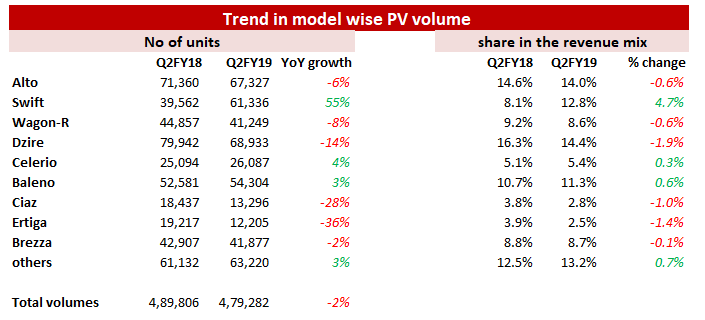
Maruti Suzuki’s Q2FY19 results were below our expectations. Sales grew by only 2% YoY in Q2FY19 led by a 3.7% increase in realization per unit. But the volumes declined by 1.5% YoY in the same period. We analyze the results.

2. COM7 (COM7 TB): Acquisition to Support Aggressive Expansion

  • Improving asset turnover, good risk adjusted price momentum, and relatively strong analyst recommendations relative to its sector
  • Larger distribution channel through acquisition of DNA Retail Link to add 95 more stores to current 518 stores
  • New mobile product launches in 4Q18 and COM7’s focus on high margin products, such as Android smartphones, should support high earnings growth which was up 56% YoY in 3Q18
  • Attractive at a 19CE* PEG of 0.9 versus ASEAN sector at a PEG of 2.7
  • Risks: Lower-than-expected demand for new IT products, slower-than-expected store expansions

* Consensus Estimates

3. TRACKING TRAFFIC/Chinese Express & Logistics: Parcel Pricing Weak, Again

Nov main exp

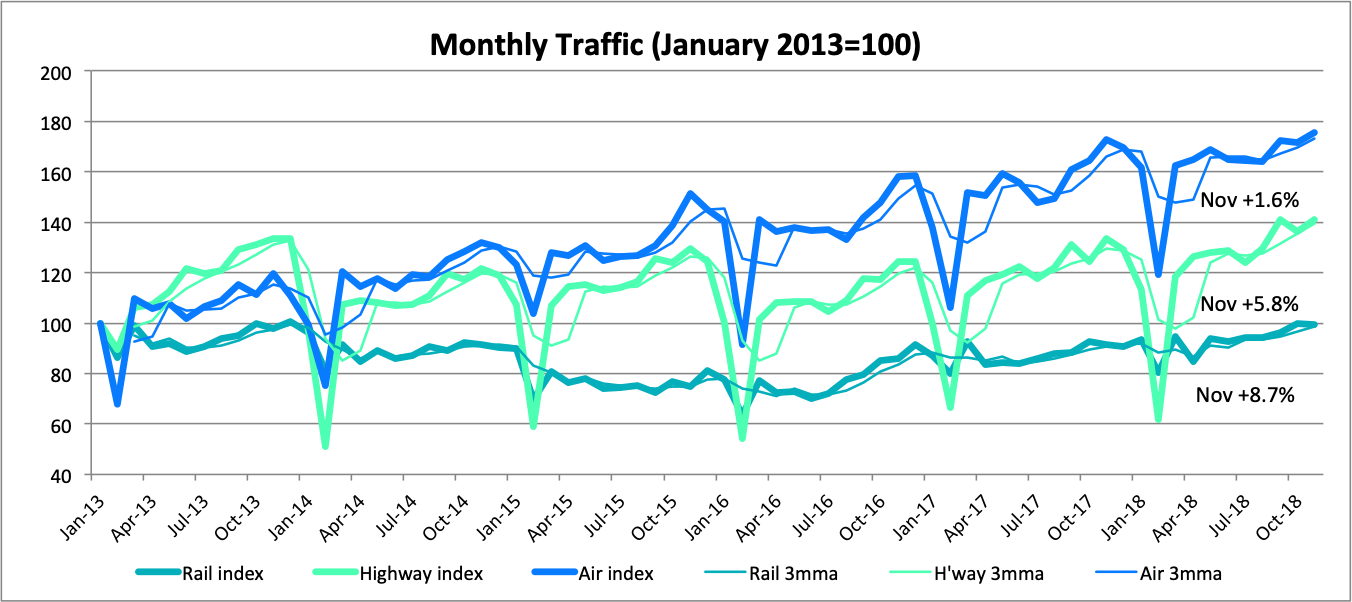
Tracking Traffic/Chinese Express & Logistics is the hub for our research on China’s express parcels and logistics sectors. Tracking Traffic/Chinese Express & Logistics features analysis of monthly Chinese express and logistics data, notes from our conversations with industry players, and links to company and thematic notes. 

This month’s issue covers the following topics:

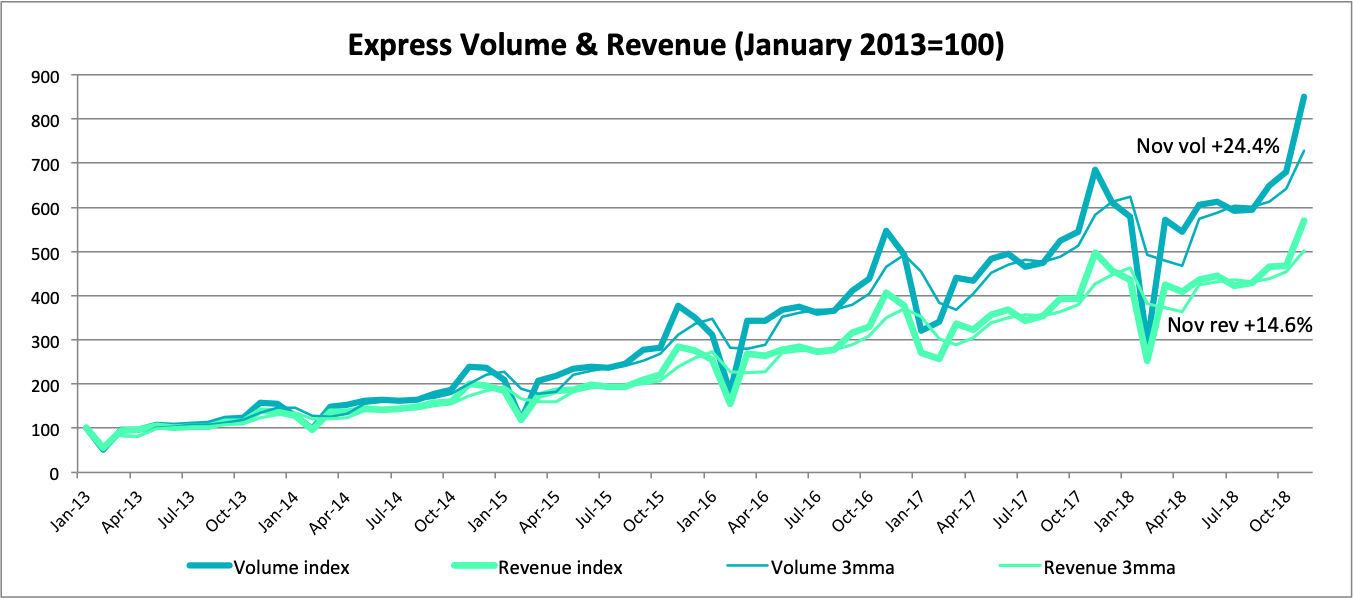
  1. November express parcel pricing remained weak. Average pricing per express parcel fell by 7.8% Y/Y to just 11.06 RMB per piece. November’s average price represents a new all-time low for the industry, and November’s Y/Y decline was the steepest monthly decline in over two years (excluding Lunar New Year months, which tend to be distorted by the timing of the holiday).
  2. Express parcel revenue growth dipped below 15% last month. Weak per-parcel pricing pulled express sector Y/Y revenue growth down to just 14.6% in November, the worst on record (again excluding distorted Lunar New Year comparisons). Chinese e-commerce demand has slowed and we suspect ‘O2O’ initiatives, under which online purchases are fulfilled via local stores, are also undermining express demand growth. 
  3. Intra-city pricing (ie, local delivery) remains firm relative to inter-city. Relative to weak inter-city express pricing (where ZTO Express (ZTO US) and the other listed express companies compete), pricing for local, intra-city express deliveries remained firm. In the first 11 months of 2018, express pricing rose 1.7% Y/Y versus a -2.9% decline in inter-city shipments (international pricing fell sharply, -14.5% Y/Y). Relatively firm pricing on local shipments may make it hard for local food delivery companies like Meituan Dianping (3690 HK) and Alibaba Group Holding (BABA US) ‘s ele.me to beat down unit operating costs. 
  4. Underlying domestic transport demand held up well again in November. Although demand for speedy, relatively expensive express service (and air freight) appears to be moderating, demand for rail and highway freight transport has held up well. The relative strength of rail and water transport (slow, cheap, industry-facing) versus express and air freight (fast, expensive, consumer-oriented) suggests a couple of things: a) upstream industrial activity is stronger than downstream retail activity and b) the people in charge of paying freight are shifting to cheaper modes of transport when possible.

We retain a negative view of China’s express industry’s fundamentals: demand growth is slowing and pricing appears to be falling faster than costs can be cut. Overall domestic transportation demand, however, remains solid and shows no signs of slowing. 

4. Last Week in Event SPACE: Familymart, Takeda, Harbin Electric, Motherson, Young Poong, NTT

22%20dec%20%202018

Last Week in Event SPACE …

(This insight covers specific insights & comments involving Stubs, Pairs, Arbitrage, share Classification and Events – or SPACE – in the past week)

M&A – ASIA-PAC

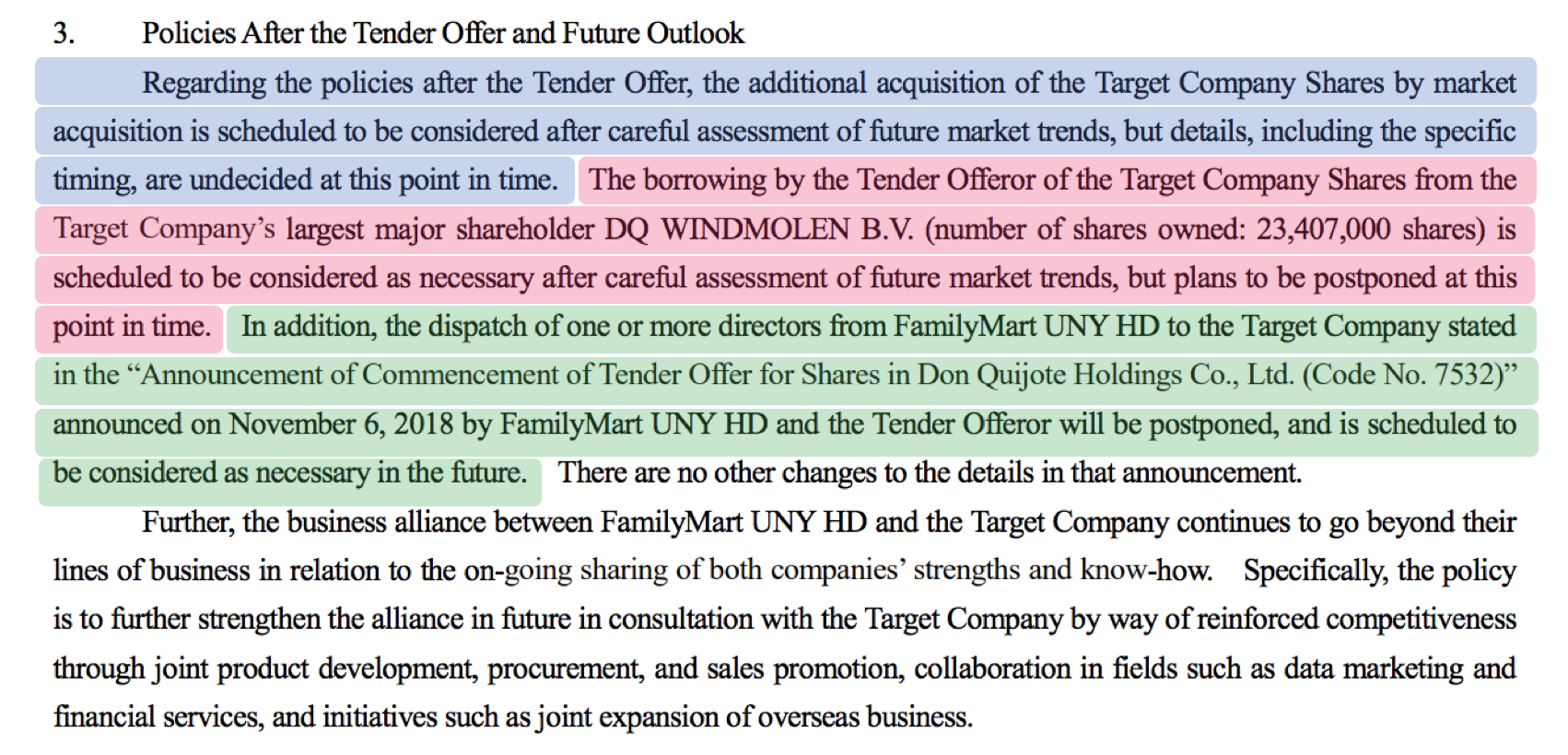
Recapping the original plan: when Familymart Uny Holdings (8028 JP) (“FM”) sold the remaining 60% of UNY to Don Quijote Holdings (7532 JP) (DQ), it entered into an agreement to buy 20+% in DQ, for one of two reasons; 1) a company wants to prove to the employees of a division being sold that they are maintaining a watchful eye over them, or (as is now evident) 2) the buyer wants to gain an equity method affiliate and the income from it (including the placeholder for frontrunner status to future capital events). 

  • FM launched a Partial Tender Offer at a 20% premium to last in order to buy these shares, and in the MOU to launch the tender offer there was a clause which said that if FM did not reach the full 20%, it had made arrangements to borrow shares in order to get to 20% of the voting rights. And if FM did not manage to get to the full 20%, there was an agreement between DQ which allowed FM to buy shares in the market to get to a 20% (but not larger) position. 
    • If FM managed to get the shares, it was going to buy from the weak hands.  Growth stock managers don’t like selling growth stocks until the growth stops growing. DQ is still growing, and with UNY, DQ may grow faster than previously expected. The upshot is that everyone decided they’d stand pat – FM got nothing in the tender (0.08% of the total desired).
  • Shares in DQ could fall because of a lack of hard strategy announced by FM to buy all the shares at a higher price immediately. That shouldn’t be a big worry – it wasn’t going to happen.
  • Travis Lundy sees DQ having a performance skew which includes a “cushion of sorts” in the ¥5500-6600/share zone where he would expect FM to acquire shares. He does not see a cushion for the shares of FM, and expects them to be volatile. 

(link to Travis’ insight: FamilyMart Tender Offer for Don Quijote Misses The Mark as Mr. Partridge Stands Pat)  


Harbin Electric Co Ltd H (1133 HK) (Mkt Cap: $546mn; Liquidity: $0.4mn)

Power generation equipment manufacturer Harbin Electric Co Ltd H (1133 HK) is currently suspended pursuant to Hong Kong’s Codes on Takeovers and Mergers and Share Buy-backs, suggesting a privatisation offer from parent Harbin Electric Corporation (“HEC”) is pending. As HE is PRC incorporated, a privatisation by way of a merger by absorption may be proposed, similar to Advanced Semiconductor Mfg Corp Ltd. (3355 HK) as discussed in ASMC’s Merger By Absorption. 

  • It is possible this suspension is not in relation to a takeover, but a major sale of assets, for example, from the parent to the sub. This would make sense given the recent share purchase by HEC (completed in January this year), and the fact HE is playing catch-up to Dongfang Electric Corporation (1072 HK) Shanghai Electric Group Company (2727 HK). Arguably, launching a takeover shortly after subscribing for more shares is unusual.  Then again, when the two SOE railway behemoths CNR and CSR merged in 2015, a merger was disputed (at the time) when both were suspended on account of the fact CNR was only listed (on the HK exchange) in 2Q14.
  • HE has perennially traded at discount to net cash. As at its last traded price, the discount to net cash (using the 2018 interim figure of HK$12.4bn, or HK$7.27/share) was 65%.
  • “Fair” pricing to me would be something like the distribution of net cash to zero then taking over the company on PER. I simply don’t see this happening. And if it doesn’t, the fiduciary duty of independent directors will be tested/scrutinised if they recommend an offer to shareholders at any price less than the net cash/share of the company.

(link to my insight: Harbin Electric Expected To Be Privatised)  


Motherson Sumi Systems (MSS IN) (Mkt Cap: $7.7bn; Liquidity: $1.6mn)

Reportedly Motherson has entered merger/acquisition talks with Leoni AG (LEO GR), a leading provider of cables and cable systems for the automotive sector and other industries. Motherson has made four acquisitions so far in this business segment with the latest being PKC in 2017.

  • Motherson has always aimed at strengthening this business area internationally, therefore the news about a merger with Leoni comes as no surprise and was mentioned as a potential acquisition target in LightStream Research‘s earlier insight Two More Acquisitions on the Way for Motherson Sumi
  • Motherson has a strong balance sheet that could support this acquisition, although its ability to make further acquisitions in the short-to-medium term may be hampered – Leoni would be at the higher end of the price range for recent acquisitions. Should the acquisition go through, the company will be very well positioned to reach its US$18bn revenue target by 2020E, given that the combined revenue for FY2017 alone is ~US$13bn.
  • Currently, Motherson is trading at an FY1 EV/EBITDA of 10x, slightly above peers such as Mahindra Cie Automotive (MACA IN) (9x) and below peers such as Bosch Ltd (BOS IN) (25x). If the deal goes through, Motherson’s FY1 EV/EBITDA of ~12x would be at a slight premium to local players, but still reasonable compared to international players. 

(link to Aqila Ali ‘s insight: Motherson In Merger Talks with One of Our Previously Short-Listed Candidates – Leoni)  


MYOB Group Ltd (MYO AU) (Mkt Cap: $1.2bn; Liquidity: $7mn)

Kohlberg Kravis Roberts reduced its indicative offer to $3.40 from $3.77 on Thursday after sifting through MYOB’s books, with MYOB announcing:

Following completion of due diligence and finalisation of debt funding commitments, KKR has revised the offer price to $3.40 per share. …  The board has informed KKR that it is not in a position to recommend the revised proposal, however it remains in discussions with KKR regarding its proposal. (my emphasis)

(link to my insight: Friday Deadline Looms As MYOB Snubs KKR’s Reduced Offer)

EVENTS

NTT (Nippon Telegraph & Telephone) (9432 JP) (Mkt Cap: $75bn; Liquidity: $181mn)

The Nikkei carried an article noting that the Japanese government’s FY2019 budget currently being formed proposes a sale of ¥160bn of shares in NTT to help fund any revenue impact from the upcoming consumption tax rate hike from 8% to 10% next October. The article helpfully notes that they plan on selling when NTT is buying back shares. One of the longstanding features of buybacks for NTT is that NTT is subject to the NTT Law which requires (for the moment) that the government hold at least one-third of the shares outstanding in NTT.

  • Travis estimates NTT has ~1.95bn shares outstanding, or ~1.917bn shares outstanding ex-Treasury shares, after recent buybacks. If NTT cancelled the shares it has bought back prior to buying back shares from the government, this would allow NTT to buy back 59mm shares from the government (assuming those shares are also cancelled). If it did not, it would mean NTT could only buy back about 42-43mm shares. 59mm shares backs out ¥250bn; 43mm shares at a 10% discount would be  ¥180bn. That means there is about 10% leeway in stock price to buy ¥160bn from the government IF shares repurchased under the current buyback are not cancelled.
  • But that also means that there would be no more buybacks from the government after that until the company buys back more shares from the market. If the company wanted to buy back another ¥200bn from the government, ceteris paribus it would have to buy back something like ¥400-450bn first from the market in order to reduce the denominator. Travis concludes there is still more on-market buying to do.
  • At an NTT/ NTT Docomo Inc (9437 JP) ratio of 1.80x, buybacks coming, expected ongoing strong dividend policy (and lots of headroom to do so, unlike perhaps Softbank Corp (9434 JP)), and investor suspicion of what comes next for Docomo, NTT is the home of the cashflow.

(link to Travis’ insight: NTT Buybacks Will Roll On)  


Takeda Pharmaceutical (4502 JP) Softbank Corp (9434 JP)

The IPO of Softbank Corp and the Merger of Takeda and Shire Pharmaceuticals create significant changes in TOPIX, MSCI, and FTSE because of the addition of roughly ¥5tn of “new” market capitalization in major Japan indices. Pure passive investors have something like ¥1.35tn of Softbank Corp and Takeda Pharmaceutical to buy.

  • However, after Travis’ initial note (Softbank Corp, Takeda, and Newton’s Three Laws of Motion), TSE unhelpfully changed their mind on timing (for Takeda) based on an unhelpful change by the LSE. With the changes at FTSE and now TOPIX and JPX Nikkei 400, we no longer have quite the same clarity of forces on the bodies, and therefore less clarity on the resulting motion. The LSE’s announced market change appears to have led the MSCI to change its deletion date for Shire as well, now also (along with FTSE) deleting Shire at the close of the 21st. The new schedule is:
    Index DeletionShire
    (shs mm)
    Index InclusionTakeda
    (shs mm)
    Index Effect
    (US$ bn)
    Net Delta
    (US$bn)
    21 DecMSCI -50MSCI JP+75– $0.3bn+$1.3bn
    21 DecFTSE UK, All-Share,-100-130FTSE JP+15-$5.2bn+– $2.1bn

    rest of December – end of a pretty bad year for hedge funds, but illiquid

    all of January

    30 JanTOPIX-$1.9bnTOPIX, JPXN400

    +60

    +$2.1bn+$2.1bn
    30 JanTOPIX-$3.5bnTOPIXSoftbank+$3.5bn+$3.5bn
    all of February
    27 FebTOPIX, JPXN400+60+$2.1bn+$2.1bn
  • It doesn’t change the amounts but a lot more time allows for more risk and preparation and there will no longer be any potential settlement issues on the TOPIX side. There is still the same amount of Takeda to buy in TOPIX and JPX Nikkei 400. 
  • In principle, Travis would want to be long Takeda at the close of the year of 2018, but given the LSE and TSE changes there is less support to give and the payoff is substantially more distant. 

links to Travis’ insights
Softbank Corp, Takeda, and Newton’s Three Laws of Motion
Takeda: Move Over Newton! Now It’s Spooky Action At a Distance


Dic Corp (4631 JP) (Mkt Cap: $2.8bn; Liquidity: $15mn)

Speciality steel maker Nisshin Steel (5413 JP) is slated to merge with parent company Nippon Steel & Sumitomo Metal (5401 JP) as of January 1, 2019. For that, Nisshin Steel will be delisted on December 26th (i.e. the last day of trading is the 25th) and that means the Nikkei Inc was obliged to choose a replacement for Nisshin Steel in the Nikkei 225 and other indices. On December 11th, the Nikkei Inc announced Itoham Yonekyu Holdings Inc (2296 JP) would take Nisshin’s place in the Nikkei 500 Index; announced that Japan Post Holdings (6178 JP) would join the Nikkei 300 Index; and announced that Dic Corp (4631 JP) would replace Nisshin Steel in the Nikkei Stock Average, better known as the Nikkei 225.

  • Nisshin Steel’s deletion is a nothing-burger. 
  • The possibility of a DIC addition was well-flagged as early as May when sell-side brokers started compiling Annual and Ad Hoc Review lists for the Nikkei 225 changes to come in September and as a result of the Nisshin Steel merger. Travis would rather be long DIC than short DIC through the close of December 21st or probably December 25th. 

(link to Travis’ insight: Small Potatoes Nikkei 225 Changes on Christmas Day)

STUBS/HOLDCOS

Young Poong (000670 KS) / Korea Zinc (010130 KS)

YP appeared “cheap” back in April when I last discussed this Holdco, and is now cheaper, with its holding in KZ accounting for near-on 200% of its market cap.  I can’t think of any other parent/subsidiary relationship – one which is essentially a single stock structure – with such a deep discount. Especially one where the stub ops operate in a similar space to that of the listed holding. 

  • On the negative front, an investigation into YP’s Seokpo zinc smelter remains ongoing on account of perceived environmental transgressions. The Seokpo smelter is located in a national park on the Nakdong river. Wastewater containing above-legal limits of certain chemicals (fluoride and selenium) allegedly flowed downstream to residents, who are heavily reliant on this water.
  • YP’s stub and KZ are in the same business, but there are differences. YP does not have a balanced product mix as KZ does, with around 84% of its revenue coming from zinc-related production (for the 9M18 period), compared to 42.5% (on a revenue basis) for KZ, followed by lead (20.4%), silver (20.2%), and gold (7.6%).
  • However, YP and KZ remain inextricably intertwined and the current discount is unjustifiably steep. Just that YP’s liquidity, uncertainty on Seokpo, and lack of a near-term catalyst make for a difficult stub set-up.

(link to my insight: StubWorld: Young Poong Blows Out, Again)  


Softbank Group (9984 JP) / Softbank Corp (9434 JP)

A forgettable trading debut for Japan’s largest-ever IPO, with Softbank Corp, closing at ¥1,282/share, down from the IPO price of ¥1,500, and closing at ¥1,316/share on Friday, the same day as its FTSE inclusion.

TOPIX INCLUSIONS!

With seven stocks promoted/reassigned from TSE2, MOTHERS, and JASDAQ in November 2018 leading to the same seven stocks being included in TOPIX at the end of December, Travis tested 340+ TOPIX inclusions over the past five years to see what really happens around TOPIX inclusions?

  • If you own all but the smallest stocks (with a market cap of less than ¥15bn), odds are that, ON AVERAGE, they will underperform TOPIX from inclusion date or the day after, for many months.
  • The larger the market cap, the more marked the AVERAGE underperformance immediately following inclusion. 
  • For names in the ¥25-50bn sweet spot of “large enough to be “small cap” with somebody paying attention to it”, outperformance vs underperformance in the next 10 days is a 47/53 proposition. That is a bigger risk. It may be data-idiosyncratic, but it is not clear.
  • In the case of the 7 names going into TOPIX at month-end this month, the averages would suggest one could still be long the four largest (at the time of Travis’ insight), but one would not want to be long the others; and one could sell long positions in all the names as of the close of the 27th or 28th and have it be an ex-ante expected net positive outcome vs TOPIX over the following 10-60 trading days.

(link to Travis’ insight: Historical TOPIX Inclusions:  How Do They Do Around Inclusion Date?)

SHARE CLASSIFICATIONS

Ke Yan, CFA, FRM provided an update on the HK Connect/southbound flow. Fullshare Holdings (607 HK)Shandong Gold Mining Co Ltd (1787 HK) and Shanghai Fosun Pharmaceutical (Group) (2196 HK) rounded out the top three inflows relative to their free float in the past seven days.  Shandong Gold remained in the top inflow list for the third consecutive week. Top outflows relative to the free float are Wuxi Biologics (Cayman) Inc (2269 HK), China Southern Airlines (1055 HK) and Sino Biopharmaceutical (1177 HK)

(link to Ke Yan’s insight: Discover HK Connect: Mainlanders Are Buying Shandong Gold, and Pharmaceuticals (2018-12-17))  


Briefly …

OTHER M&A UPDATES

  • LCY Chemical Corp (1704 TT).  MOEA (Ministry of Economic Affairs) approval has now been received and LCY has applied for the delisting from the TWSE. The last trading day is the 23 Jan 2019 and the stock delists on the 30 Jan.  The settlement is expected to take place mid-Feb.
  • Healthscope Ltd (HSO AU). In an ASX announcement on Friday Brookfield said: “based on its enquiries and financing discussions to date, it has no reason to believe it will not be willing and able to proceed with the proposal“. The exclusivity provisions have been extended to 18 January. Separately, Healthscope has also received correspondence from the BGH-AustralianSuper Consortium that it has indicated it is able to commence due diligence immediately. HSO’s board stated it will consider the correspondence. These are both positive developments.

CCASS

My ongoing series flags large moves (~10%) in CCASS holdings over the past week or so, moves which are often outside normal market transactions.  These may be indicative of share pledges.  Or potential takeovers. Or simply help understand volume swings. 

Often these moves can easily be explained – the placement of new shares, rights issue, movements subsequent to a takeover, amongst others. For those mentioned below, I could not find an obvious reason for the CCASS move.   

Name

% change

Into

Out of

Comment

11.53%
CMBC
China Sec
37.50%
Kingston
Outside CCASS
17.24%
UBS
Outside CCASS
Source: HKEx

5. EM Relative Strength Is Bottoming: Overweight

Untitled

Relative strength for MSCI EM is bottoming vs. MSCI EAFE despite continued global equity market weakness.  Although the MSCI EM’s price index remains in a downtrend, we are seeing signs of outperformance ona a relative strength basis and would add incremental exposure. In this report we highlight attractive and actionable themes within EM.

Daily Consumer: TRACKING TRAFFIC/Chinese Express & Logistics: Parcel Pricing Weak, Again and more

By | Consumer

In this briefing:

  1. TRACKING TRAFFIC/Chinese Express & Logistics: Parcel Pricing Weak, Again
  2. Last Week in Event SPACE: Familymart, Takeda, Harbin Electric, Motherson, Young Poong, NTT
  3. EM Relative Strength Is Bottoming: Overweight
  4. FamilyMart: A Shrewd Head-Fake?
  5. FamilyMart Tender Offer for Don Quijote Misses The Mark as Mr. Partridge Stands Pat

1. TRACKING TRAFFIC/Chinese Express & Logistics: Parcel Pricing Weak, Again

Nov main exp

Tracking Traffic/Chinese Express & Logistics is the hub for our research on China’s express parcels and logistics sectors. Tracking Traffic/Chinese Express & Logistics features analysis of monthly Chinese express and logistics data, notes from our conversations with industry players, and links to company and thematic notes. 

This month’s issue covers the following topics:

  1. November express parcel pricing remained weak. Average pricing per express parcel fell by 7.8% Y/Y to just 11.06 RMB per piece. November’s average price represents a new all-time low for the industry, and November’s Y/Y decline was the steepest monthly decline in over two years (excluding Lunar New Year months, which tend to be distorted by the timing of the holiday).
  2. Express parcel revenue growth dipped below 15% last month. Weak per-parcel pricing pulled express sector Y/Y revenue growth down to just 14.6% in November, the worst on record (again excluding distorted Lunar New Year comparisons). Chinese e-commerce demand has slowed and we suspect ‘O2O’ initiatives, under which online purchases are fulfilled via local stores, are also undermining express demand growth. 
  3. Intra-city pricing (ie, local delivery) remains firm relative to inter-city. Relative to weak inter-city express pricing (where ZTO Express (ZTO US) and the other listed express companies compete), pricing for local, intra-city express deliveries remained firm. In the first 11 months of 2018, express pricing rose 1.7% Y/Y versus a -2.9% decline in inter-city shipments (international pricing fell sharply, -14.5% Y/Y). Relatively firm pricing on local shipments may make it hard for local food delivery companies like Meituan Dianping (3690 HK) and Alibaba Group Holding (BABA US) ‘s ele.me to beat down unit operating costs. 
  4. Underlying domestic transport demand held up well again in November. Although demand for speedy, relatively expensive express service (and air freight) appears to be moderating, demand for rail and highway freight transport has held up well. The relative strength of rail and water transport (slow, cheap, industry-facing) versus express and air freight (fast, expensive, consumer-oriented) suggests a couple of things: a) upstream industrial activity is stronger than downstream retail activity and b) the people in charge of paying freight are shifting to cheaper modes of transport when possible.

We retain a negative view of China’s express industry’s fundamentals: demand growth is slowing and pricing appears to be falling faster than costs can be cut. Overall domestic transportation demand, however, remains solid and shows no signs of slowing. 

2. Last Week in Event SPACE: Familymart, Takeda, Harbin Electric, Motherson, Young Poong, NTT

22%20dec%20%202018

Last Week in Event SPACE …

(This insight covers specific insights & comments involving Stubs, Pairs, Arbitrage, share Classification and Events – or SPACE – in the past week)

M&A – ASIA-PAC

Recapping the original plan: when Familymart Uny Holdings (8028 JP) (“FM”) sold the remaining 60% of UNY to Don Quijote Holdings (7532 JP) (DQ), it entered into an agreement to buy 20+% in DQ, for one of two reasons; 1) a company wants to prove to the employees of a division being sold that they are maintaining a watchful eye over them, or (as is now evident) 2) the buyer wants to gain an equity method affiliate and the income from it (including the placeholder for frontrunner status to future capital events). 

  • FM launched a Partial Tender Offer at a 20% premium to last in order to buy these shares, and in the MOU to launch the tender offer there was a clause which said that if FM did not reach the full 20%, it had made arrangements to borrow shares in order to get to 20% of the voting rights. And if FM did not manage to get to the full 20%, there was an agreement between DQ which allowed FM to buy shares in the market to get to a 20% (but not larger) position. 
    • If FM managed to get the shares, it was going to buy from the weak hands.  Growth stock managers don’t like selling growth stocks until the growth stops growing. DQ is still growing, and with UNY, DQ may grow faster than previously expected. The upshot is that everyone decided they’d stand pat – FM got nothing in the tender (0.08% of the total desired).
  • Shares in DQ could fall because of a lack of hard strategy announced by FM to buy all the shares at a higher price immediately. That shouldn’t be a big worry – it wasn’t going to happen.
  • Travis Lundy sees DQ having a performance skew which includes a “cushion of sorts” in the ¥5500-6600/share zone where he would expect FM to acquire shares. He does not see a cushion for the shares of FM, and expects them to be volatile. 

(link to Travis’ insight: FamilyMart Tender Offer for Don Quijote Misses The Mark as Mr. Partridge Stands Pat)  


Harbin Electric Co Ltd H (1133 HK) (Mkt Cap: $546mn; Liquidity: $0.4mn)

Power generation equipment manufacturer Harbin Electric Co Ltd H (1133 HK) is currently suspended pursuant to Hong Kong’s Codes on Takeovers and Mergers and Share Buy-backs, suggesting a privatisation offer from parent Harbin Electric Corporation (“HEC”) is pending. As HE is PRC incorporated, a privatisation by way of a merger by absorption may be proposed, similar to Advanced Semiconductor Mfg Corp Ltd. (3355 HK) as discussed in ASMC’s Merger By Absorption. 

  • It is possible this suspension is not in relation to a takeover, but a major sale of assets, for example, from the parent to the sub. This would make sense given the recent share purchase by HEC (completed in January this year), and the fact HE is playing catch-up to Dongfang Electric Corporation (1072 HK) Shanghai Electric Group Company (2727 HK). Arguably, launching a takeover shortly after subscribing for more shares is unusual.  Then again, when the two SOE railway behemoths CNR and CSR merged in 2015, a merger was disputed (at the time) when both were suspended on account of the fact CNR was only listed (on the HK exchange) in 2Q14.
  • HE has perennially traded at discount to net cash. As at its last traded price, the discount to net cash (using the 2018 interim figure of HK$12.4bn, or HK$7.27/share) was 65%.
  • “Fair” pricing to me would be something like the distribution of net cash to zero then taking over the company on PER. I simply don’t see this happening. And if it doesn’t, the fiduciary duty of independent directors will be tested/scrutinised if they recommend an offer to shareholders at any price less than the net cash/share of the company.

(link to my insight: Harbin Electric Expected To Be Privatised)  


Motherson Sumi Systems (MSS IN) (Mkt Cap: $7.7bn; Liquidity: $1.6mn)

Reportedly Motherson has entered merger/acquisition talks with Leoni AG (LEO GR), a leading provider of cables and cable systems for the automotive sector and other industries. Motherson has made four acquisitions so far in this business segment with the latest being PKC in 2017.

  • Motherson has always aimed at strengthening this business area internationally, therefore the news about a merger with Leoni comes as no surprise and was mentioned as a potential acquisition target in LightStream Research‘s earlier insight Two More Acquisitions on the Way for Motherson Sumi
  • Motherson has a strong balance sheet that could support this acquisition, although its ability to make further acquisitions in the short-to-medium term may be hampered – Leoni would be at the higher end of the price range for recent acquisitions. Should the acquisition go through, the company will be very well positioned to reach its US$18bn revenue target by 2020E, given that the combined revenue for FY2017 alone is ~US$13bn.
  • Currently, Motherson is trading at an FY1 EV/EBITDA of 10x, slightly above peers such as Mahindra Cie Automotive (MACA IN) (9x) and below peers such as Bosch Ltd (BOS IN) (25x). If the deal goes through, Motherson’s FY1 EV/EBITDA of ~12x would be at a slight premium to local players, but still reasonable compared to international players. 

(link to Aqila Ali ‘s insight: Motherson In Merger Talks with One of Our Previously Short-Listed Candidates – Leoni)  


MYOB Group Ltd (MYO AU) (Mkt Cap: $1.2bn; Liquidity: $7mn)

Kohlberg Kravis Roberts reduced its indicative offer to $3.40 from $3.77 on Thursday after sifting through MYOB’s books, with MYOB announcing:

Following completion of due diligence and finalisation of debt funding commitments, KKR has revised the offer price to $3.40 per share. …  The board has informed KKR that it is not in a position to recommend the revised proposal, however it remains in discussions with KKR regarding its proposal. (my emphasis)

(link to my insight: Friday Deadline Looms As MYOB Snubs KKR’s Reduced Offer)

EVENTS

NTT (Nippon Telegraph & Telephone) (9432 JP) (Mkt Cap: $75bn; Liquidity: $181mn)

The Nikkei carried an article noting that the Japanese government’s FY2019 budget currently being formed proposes a sale of ¥160bn of shares in NTT to help fund any revenue impact from the upcoming consumption tax rate hike from 8% to 10% next October. The article helpfully notes that they plan on selling when NTT is buying back shares. One of the longstanding features of buybacks for NTT is that NTT is subject to the NTT Law which requires (for the moment) that the government hold at least one-third of the shares outstanding in NTT.

  • Travis estimates NTT has ~1.95bn shares outstanding, or ~1.917bn shares outstanding ex-Treasury shares, after recent buybacks. If NTT cancelled the shares it has bought back prior to buying back shares from the government, this would allow NTT to buy back 59mm shares from the government (assuming those shares are also cancelled). If it did not, it would mean NTT could only buy back about 42-43mm shares. 59mm shares backs out ¥250bn; 43mm shares at a 10% discount would be  ¥180bn. That means there is about 10% leeway in stock price to buy ¥160bn from the government IF shares repurchased under the current buyback are not cancelled.
  • But that also means that there would be no more buybacks from the government after that until the company buys back more shares from the market. If the company wanted to buy back another ¥200bn from the government, ceteris paribus it would have to buy back something like ¥400-450bn first from the market in order to reduce the denominator. Travis concludes there is still more on-market buying to do.
  • At an NTT/ NTT Docomo Inc (9437 JP) ratio of 1.80x, buybacks coming, expected ongoing strong dividend policy (and lots of headroom to do so, unlike perhaps Softbank Corp (9434 JP)), and investor suspicion of what comes next for Docomo, NTT is the home of the cashflow.

(link to Travis’ insight: NTT Buybacks Will Roll On)  


Takeda Pharmaceutical (4502 JP) Softbank Corp (9434 JP)

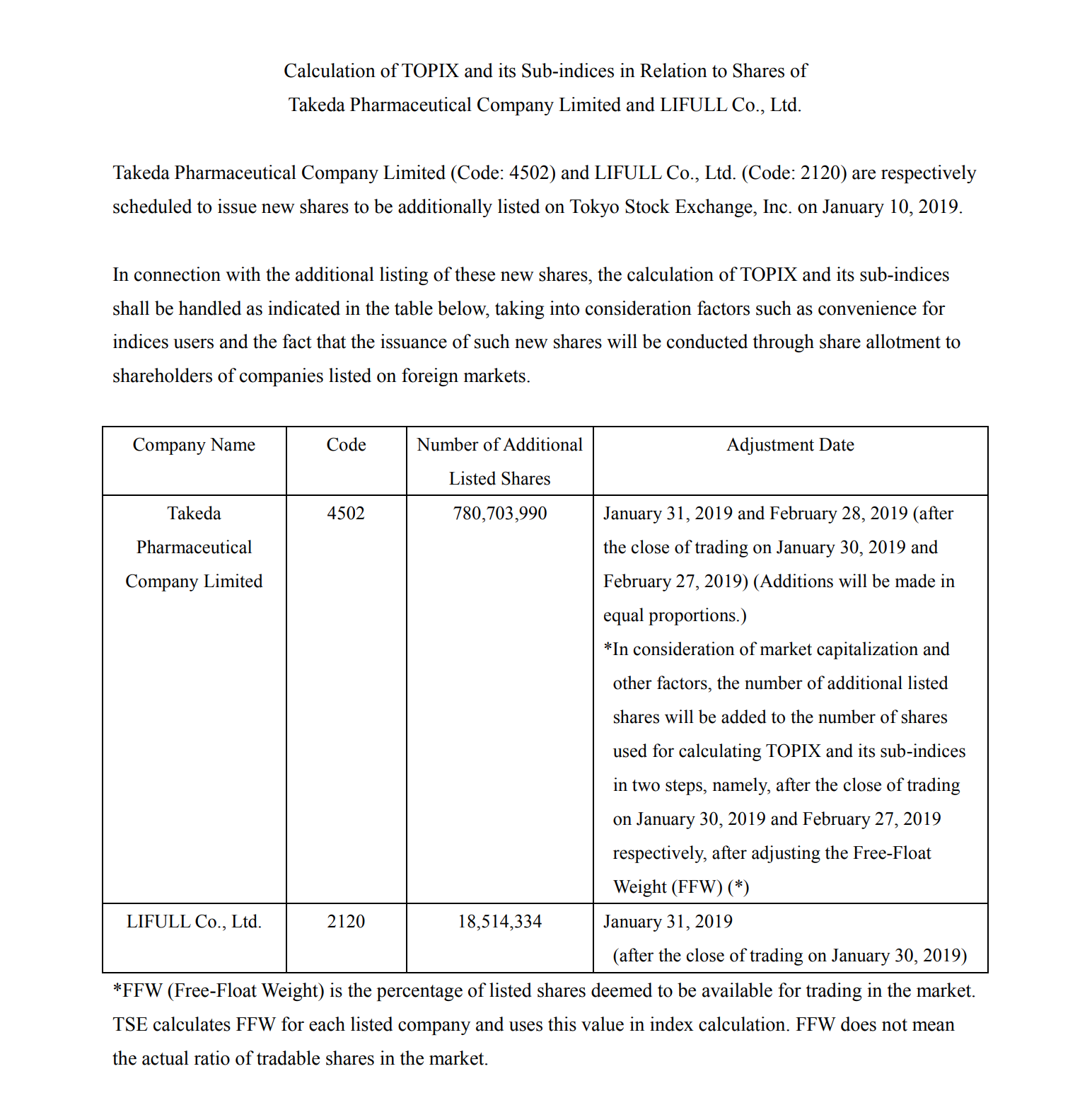
The IPO of Softbank Corp and the Merger of Takeda and Shire Pharmaceuticals create significant changes in TOPIX, MSCI, and FTSE because of the addition of roughly ¥5tn of “new” market capitalization in major Japan indices. Pure passive investors have something like ¥1.35tn of Softbank Corp and Takeda Pharmaceutical to buy.

  • However, after Travis’ initial note (Softbank Corp, Takeda, and Newton’s Three Laws of Motion), TSE unhelpfully changed their mind on timing (for Takeda) based on an unhelpful change by the LSE. With the changes at FTSE and now TOPIX and JPX Nikkei 400, we no longer have quite the same clarity of forces on the bodies, and therefore less clarity on the resulting motion. The LSE’s announced market change appears to have led the MSCI to change its deletion date for Shire as well, now also (along with FTSE) deleting Shire at the close of the 21st. The new schedule is:
    Index DeletionShire
    (shs mm)
    Index InclusionTakeda
    (shs mm)
    Index Effect
    (US$ bn)
    Net Delta
    (US$bn)
    21 DecMSCI -50MSCI JP+75– $0.3bn+$1.3bn
    21 DecFTSE UK, All-Share,-100-130FTSE JP+15-$5.2bn+– $2.1bn

    rest of December – end of a pretty bad year for hedge funds, but illiquid

    all of January

    30 JanTOPIX-$1.9bnTOPIX, JPXN400

    +60

    +$2.1bn+$2.1bn
    30 JanTOPIX-$3.5bnTOPIXSoftbank+$3.5bn+$3.5bn
    all of February
    27 FebTOPIX, JPXN400+60+$2.1bn+$2.1bn
  • It doesn’t change the amounts but a lot more time allows for more risk and preparation and there will no longer be any potential settlement issues on the TOPIX side. There is still the same amount of Takeda to buy in TOPIX and JPX Nikkei 400. 
  • In principle, Travis would want to be long Takeda at the close of the year of 2018, but given the LSE and TSE changes there is less support to give and the payoff is substantially more distant. 

links to Travis’ insights
Softbank Corp, Takeda, and Newton’s Three Laws of Motion
Takeda: Move Over Newton! Now It’s Spooky Action At a Distance


Dic Corp (4631 JP) (Mkt Cap: $2.8bn; Liquidity: $15mn)

Speciality steel maker Nisshin Steel (5413 JP) is slated to merge with parent company Nippon Steel & Sumitomo Metal (5401 JP) as of January 1, 2019. For that, Nisshin Steel will be delisted on December 26th (i.e. the last day of trading is the 25th) and that means the Nikkei Inc was obliged to choose a replacement for Nisshin Steel in the Nikkei 225 and other indices. On December 11th, the Nikkei Inc announced Itoham Yonekyu Holdings Inc (2296 JP) would take Nisshin’s place in the Nikkei 500 Index; announced that Japan Post Holdings (6178 JP) would join the Nikkei 300 Index; and announced that Dic Corp (4631 JP) would replace Nisshin Steel in the Nikkei Stock Average, better known as the Nikkei 225.

  • Nisshin Steel’s deletion is a nothing-burger. 
  • The possibility of a DIC addition was well-flagged as early as May when sell-side brokers started compiling Annual and Ad Hoc Review lists for the Nikkei 225 changes to come in September and as a result of the Nisshin Steel merger. Travis would rather be long DIC than short DIC through the close of December 21st or probably December 25th. 

(link to Travis’ insight: Small Potatoes Nikkei 225 Changes on Christmas Day)

STUBS/HOLDCOS

Young Poong (000670 KS) / Korea Zinc (010130 KS)

YP appeared “cheap” back in April when I last discussed this Holdco, and is now cheaper, with its holding in KZ accounting for near-on 200% of its market cap.  I can’t think of any other parent/subsidiary relationship – one which is essentially a single stock structure – with such a deep discount. Especially one where the stub ops operate in a similar space to that of the listed holding. 

  • On the negative front, an investigation into YP’s Seokpo zinc smelter remains ongoing on account of perceived environmental transgressions. The Seokpo smelter is located in a national park on the Nakdong river. Wastewater containing above-legal limits of certain chemicals (fluoride and selenium) allegedly flowed downstream to residents, who are heavily reliant on this water.
  • YP’s stub and KZ are in the same business, but there are differences. YP does not have a balanced product mix as KZ does, with around 84% of its revenue coming from zinc-related production (for the 9M18 period), compared to 42.5% (on a revenue basis) for KZ, followed by lead (20.4%), silver (20.2%), and gold (7.6%).
  • However, YP and KZ remain inextricably intertwined and the current discount is unjustifiably steep. Just that YP’s liquidity, uncertainty on Seokpo, and lack of a near-term catalyst make for a difficult stub set-up.

(link to my insight: StubWorld: Young Poong Blows Out, Again)  


Softbank Group (9984 JP) / Softbank Corp (9434 JP)

A forgettable trading debut for Japan’s largest-ever IPO, with Softbank Corp, closing at ¥1,282/share, down from the IPO price of ¥1,500, and closing at ¥1,316/share on Friday, the same day as its FTSE inclusion.

TOPIX INCLUSIONS!

With seven stocks promoted/reassigned from TSE2, MOTHERS, and JASDAQ in November 2018 leading to the same seven stocks being included in TOPIX at the end of December, Travis tested 340+ TOPIX inclusions over the past five years to see what really happens around TOPIX inclusions?

  • If you own all but the smallest stocks (with a market cap of less than ¥15bn), odds are that, ON AVERAGE, they will underperform TOPIX from inclusion date or the day after, for many months.
  • The larger the market cap, the more marked the AVERAGE underperformance immediately following inclusion. 
  • For names in the ¥25-50bn sweet spot of “large enough to be “small cap” with somebody paying attention to it”, outperformance vs underperformance in the next 10 days is a 47/53 proposition. That is a bigger risk. It may be data-idiosyncratic, but it is not clear.
  • In the case of the 7 names going into TOPIX at month-end this month, the averages would suggest one could still be long the four largest (at the time of Travis’ insight), but one would not want to be long the others; and one could sell long positions in all the names as of the close of the 27th or 28th and have it be an ex-ante expected net positive outcome vs TOPIX over the following 10-60 trading days.

(link to Travis’ insight: Historical TOPIX Inclusions:  How Do They Do Around Inclusion Date?)

SHARE CLASSIFICATIONS

Ke Yan, CFA, FRM provided an update on the HK Connect/southbound flow. Fullshare Holdings (607 HK)Shandong Gold Mining Co Ltd (1787 HK) and Shanghai Fosun Pharmaceutical (Group) (2196 HK) rounded out the top three inflows relative to their free float in the past seven days.  Shandong Gold remained in the top inflow list for the third consecutive week. Top outflows relative to the free float are Wuxi Biologics (Cayman) Inc (2269 HK), China Southern Airlines (1055 HK) and Sino Biopharmaceutical (1177 HK)

(link to Ke Yan’s insight: Discover HK Connect: Mainlanders Are Buying Shandong Gold, and Pharmaceuticals (2018-12-17))  


Briefly …

OTHER M&A UPDATES

  • LCY Chemical Corp (1704 TT).  MOEA (Ministry of Economic Affairs) approval has now been received and LCY has applied for the delisting from the TWSE. The last trading day is the 23 Jan 2019 and the stock delists on the 30 Jan.  The settlement is expected to take place mid-Feb.
  • Healthscope Ltd (HSO AU). In an ASX announcement on Friday Brookfield said: “based on its enquiries and financing discussions to date, it has no reason to believe it will not be willing and able to proceed with the proposal“. The exclusivity provisions have been extended to 18 January. Separately, Healthscope has also received correspondence from the BGH-AustralianSuper Consortium that it has indicated it is able to commence due diligence immediately. HSO’s board stated it will consider the correspondence. These are both positive developments.

CCASS

My ongoing series flags large moves (~10%) in CCASS holdings over the past week or so, moves which are often outside normal market transactions.  These may be indicative of share pledges.  Or potential takeovers. Or simply help understand volume swings. 

Often these moves can easily be explained – the placement of new shares, rights issue, movements subsequent to a takeover, amongst others. For those mentioned below, I could not find an obvious reason for the CCASS move.   

Name

% change

Into

Out of

Comment

11.53%
CMBC
China Sec
37.50%
Kingston
Outside CCASS
17.24%
UBS
Outside CCASS
Source: HKEx

3. EM Relative Strength Is Bottoming: Overweight

Untitled

Relative strength for MSCI EM is bottoming vs. MSCI EAFE despite continued global equity market weakness.  Although the MSCI EM’s price index remains in a downtrend, we are seeing signs of outperformance ona a relative strength basis and would add incremental exposure. In this report we highlight attractive and actionable themes within EM.
4. FamilyMart: A Shrewd Head-Fake?

Net%20debt%20ebitda

We think the failed tender but continued asset sale between Familymart Uny (8028 JP) and Don Quijote (7532 JP)  is astutely beneficial for Familymart Uny Holdings (8028 JP) and parent Itochu Corp (8001 JP) . More details below 

5. FamilyMart Tender Offer for Don Quijote Misses The Mark as Mr. Partridge Stands Pat

Familymartdq%20strategy

In October, the Nikkei leaked and Familymart Uny Holdings (8028 JP) immediately thereafter announced that Familymart would sell the rest of its GMS (and financing) subsidiary UNY to Don Quijote Holdings (7532 JP) (which bought 40% of the company in 2017) and would conduct a Tender Offer later in 2018 at a 20% premium to the then-current price to buy a stake in Don Quijote of just over 20%. The Tender Offer was announced November 6th. Familymart had arranged to borrow shares it did not manage to buy in the tender so that at the next record date it will have 20% of the voting rights by hook or by crook. 

Don Quijote shares jumped to the Tender Offer price the same day and then spent a day there before investors decided that the news and structure of the deal was better news for Don Quijote than Familymart had priced in. 

Results of the Tender Offer have just been announced. Familymart had been trying to buy 32,108,700 shares for JPY 212 billion. They just missed. They got 0.08% of the total desired, or 24,721 shares for just over JPY 163 million.

THEY GOT NOTHING.

I expect Familymart had zero idea this would happen. I expect their bankers are surprised as well. They should not have been. They analysed this badly. There was a decent chance they would find it difficult to dislodge shares from owners. 

In FamilyMart Tender for Don Quijote – Elmer vs Mr. Partridge? I recalled how “Old Turkey” (from Edwin Lefevre’s Reminiscences of a Stock Operator) did not want to lose his position while Elmer was eager to take profits.

I couldn’t think of selling that stock.” “You couldn’t?” asked Elmer, beginning to look doubtful himself. It is a habit with most tip givers to be tip takers. “Why not?” And Elmer drew nearer. “Why, this is a bull market!” The old fellow said it as though he had given a long and detailed explanation. 

Growth stock managers don’t like selling growth stocks until the growth stops growing. Don Quijote is still growing. And with UNY, Don Quijote may grow faster than previously expected. 

The announcement at the end of the Tender Offer Results announcement is also VERY telling. There was a plan to make Don Quijote an equity-method affiliate by buying in the Tender Offer, buying in the market, or borrowing lots of shares. There was a plan for Familymart to appoint directors to DQ.

There was a clearly-available trading strategy based on that. 

The new announcement puts that strategy into question. And Mr. Partridge might not be so inclined to call it a bull market. Since the launch of the deal, the markets have started the trip to Gehenna in a trug. From the one-month average prior to the Familymart bid news, Don Quijote is up 25%. Familymart is up 40%, the Nikkei 225 is down 10.7%, the TOPIX retail sector is down 5.5% but Familymart and Don Quijote have influenced that performance (without those two names, average performance is worse).

Daily Consumer: GUNKUL (GUNKUL TB): Solar to Drive Top-Line Growth and more

By | Consumer

In this briefing:

  1. GUNKUL (GUNKUL TB): Solar to Drive Top-Line Growth
  2. ASAP: Weak Profitability Priced In, While Growth Still Intact
  3. New Pride Rights Offer: Tempting but Tricky
  4. Maruti Suzuki- Q2FY19 Results Update
  5. COM7 (COM7 TB): Acquisition to Support Aggressive Expansion

1. GUNKUL (GUNKUL TB): Solar to Drive Top-Line Growth

  • Good payout ratio, good growth in core profit, and strong long-term sales growth relative to its sector
  • Acquisition of 49% stake in a 30MW solar farm in Malaysia with a commercial operation date (COD) set for 1Q20 to support revenue growth
  • High volume of solar rooftop installation projects planned for Charoen Pokphand Foods Pub (CPF TB) and other private firms to boost GUNKUL’s construction revenue
  • Attractive at 19CE* PEG ratio of 0.5 relative to ASEAN Industry at 1.6
  • Risk: Lower than expected electricity demand, unfavorable weather conditions

* Consensus Estimates

2. ASAP: Weak Profitability Priced In, While Growth Still Intact

Picture1

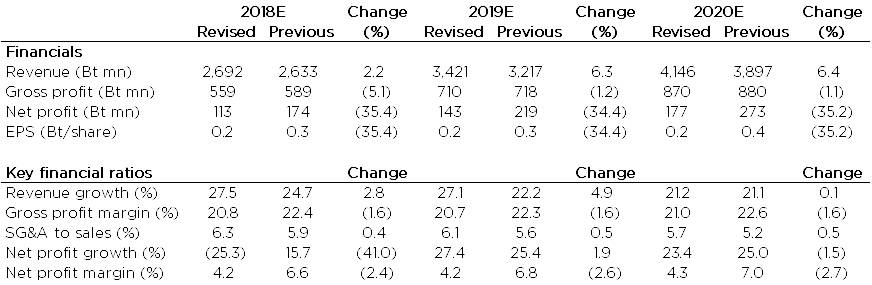
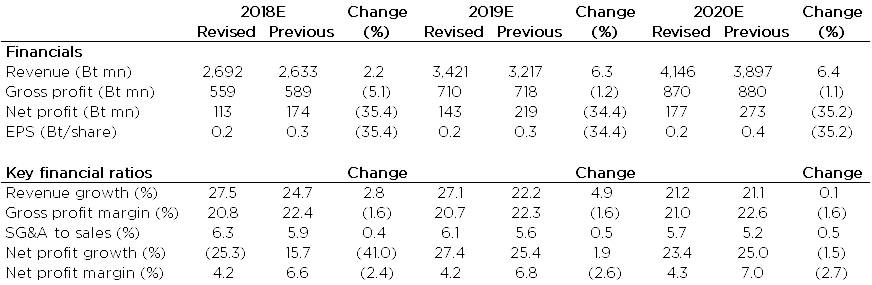
We maintain a BUY rating on ASAP with new 2019E target price of Bt3.80 (from Bt6.50), derived from 19.6xPE, which is 1.0x PEG of earnings growth in 2019-20E.

The story:

  • Trimmed 2018-20F earnings forecast by 35%
  • Not a falling knife, but fallen angel
  • Potential disruptor in car rental industry
  • Expect a 20% CAGR for earnings in 2019-20E

Risks:

  • Contract termination of airport space leases
  • Participating in a highly competitive industry
  • Cash-flow management will be a challenge in a growth phase

3. New Pride Rights Offer: Tempting but Tricky

1

  • New Pride Corp (900100 KS) announced a ₩36.2bil rights offer. This is a public offering, so there won’t be subscription rights to trade. Pricing will be done as 3-day VWAP on Jan 9~11 at a 30% discount.
  • Supposedly, we can have ample opportunity to arb trade. This may be what the company is hoping. Simply, we wait until Jan 16~17 (subscription period) and see the spread. At this much discount, there must be a huge spread opening.
  • Proration risk can be much more annoying than a usual stockholder offering. In the previous public offering event by New Pride, subscription rate went as high as 370 to 1. It should be way much lower this time. But still this is risky enough.

4. Maruti Suzuki- Q2FY19 Results Update

Trend%20in%20model

Maruti Suzuki’s Q2FY19 results were below our expectations. Sales grew by only 2% YoY in Q2FY19 led by a 3.7% increase in realization per unit. But the volumes declined by 1.5% YoY in the same period. We analyze the results.

5. COM7 (COM7 TB): Acquisition to Support Aggressive Expansion

  • Improving asset turnover, good risk adjusted price momentum, and relatively strong analyst recommendations relative to its sector
  • Larger distribution channel through acquisition of DNA Retail Link to add 95 more stores to current 518 stores
  • New mobile product launches in 4Q18 and COM7’s focus on high margin products, such as Android smartphones, should support high earnings growth which was up 56% YoY in 3Q18
  • Attractive at a 19CE* PEG of 0.9 versus ASEAN sector at a PEG of 2.7
  • Risks: Lower-than-expected demand for new IT products, slower-than-expected store expansions

* Consensus Estimates

Daily Consumer: Takeda: Move Over Newton! Now It’s Spooky Action At a Distance and more

By | Consumer

In this briefing:

  1. Takeda: Move Over Newton! Now It’s Spooky Action At a Distance
  2. Discovery Management Will Likely Soon Be Helping Narrow the Share Class Spread
  3. Satellite Companies Securing Agreements to Sell C-Band Spectrum
  4. Nio Surged 31% in November; Will Momentum Continue Through 2019?

1. Takeda: Move Over Newton! Now It’s Spooky Action At a Distance

Screenshot%202018 12 17%20at%2011.45.41%20pm

Over the weekend I published Softbank Corp, Takeda, and Newton’s Three Laws of Motion. Newton’s Three Laws helpfully guide one to understanding the nature of interaction of forces and bodies and the motion which results. Later, Euler’s laws of motion applied a framework for rigid and continuum bodies, and since then “action at a distance” has been replaced be Einstein’s Theory of General Relativity.

After I wrote the bit about one part of the index impact, FTSE unhelpfully changed their mind on timing based on an unhelpful change by the LSE. On Monday, the TSE exercised its discretion – clearly stated in the TOPIX Index Guidebook on p4 (2nd sentence of the opening paragraph) as something it may do – to go its own course in how it will adapt index changes to the first couple of increases in share count due to mergers with foreign corporations.

If an event not specified in this document occurs, or if TSE determines that it is difficult to use the methods described in this document, TSE may use an alternative method of index calculation as it deems appropriate.

So with the changes at FTSE and now TOPIX and JPX Nikkei 400, we no longer have quite the same clarity of forces on the bodies, and therefore less clarity on the resulting motion. The LSE’s announced market change appears to have led the MSCI to change its deletion date for Shire as well, now also (along with FTSE) deleting Shire at the close of the 21st (announcement early this AM Asia time).

Investors have prepared based on the idea that there was a reasonably tight relationship – helped because it was a lot of force applied in a short period (selling and buying all done in a short period in January) between the particles. Now that relationship is being stretched. A lot. 

The problem resembles that which Einstein famously pooh-poohed as “Spooky Action At a Distance”. Schrödinger called this entanglement – and it turns out to be one of the weirder branches of quantum mechanics – a field broken wide open by Bell’s Theorem a decade after Einstein shuffled off this mortal coil* – and about which John Wheeler famously said, “If you are not completely confused by quantum mechanics, you do not understand it.”

I cheerfully say quantum mechanics completely baffles me. 

I less cheerfully say this whole episode with Takeda and index providers has baffled me too.

But it is important to note that the timing and implications are vastly different than expected just two trading days ago. And the difference is worth thinking about. When the FTSE/MSCI net sell of risk was just 3 days apart, there was a clear connection across that three day distance. Now, the 6-10 week spread of time between the FTSE/MSCI events, the weird two weeks of SETSqx illiquid purgatory just as everyone is full up of risk, then the walk through the Valley of the Shadow of Flowback before we get the first really good net index inclusion to cover the Shire risk people have been dumping for months means that the certainty of understanding the movement of the particle on the other side is substantially lower.

If it all works out well, it might just be Spooky Action At a Distance.

*And there, of course, you have the third Hamlet reference this month… I haz all your Shakespeares!

2. Discovery Management Will Likely Soon Be Helping Narrow the Share Class Spread

As share class trades go, Discovery has presented several opportunities over the years to take advantage of index changes, corporate events, and a management that has aggressively repurchased nonvoting DISCK shares versus voting DISCA shares.

3. Satellite Companies Securing Agreements to Sell C-Band Spectrum

Satellite companies attempting to convince the Federal Communications Commission to allow them to sell C-band spectrum they license from the U.S. have begun talks to secure customers, sources told CTFN.

4. Nio Surged 31% in November; Will Momentum Continue Through 2019?

A

  • NIO Inc (NIO US) surged 30.7% in November after reporting steady growth in production and following certain notable investors such as Baillie Gifford & Co (largest investor in Tesla Motors (TSLA US) after Elon Musk) acquiring a stake in the company creating a bullish view on the company.
  • The EV start-up delivered 3,089 vehicles in November, registering a more than 96% increase from October, indicating a smooth flow in its production line of ES8. The latter was something its rival, Tesla, took long to establish. The company has reached a total production of more than 10,000 units thus far.
  • On the 15th of December which is the company’s ‘Nio Day’, Nio hopes to launch its ES6, a 5-seater, two-row, high-performance premium electric SUV that will have a longer range and at a lower price than its three-row seven-passenger ES8. Production and delivery of ES6 are expected to begin in 2019.
  • Q3 FY2018 results although slightly below the company’s expectations was an improvement compared to the previous quarter and acted as a tailwind in increasing investor confidence in the company. Sales increased to USD214m in Q3 from USD 46 in Q2. Though the company has not yet generated any profits, operating losses as a % of revenues have declined to -191.2% in Q3 cf.-4,077% in Q2.
  • For Q4 FY2019E the company expects to deliver 6,700 to 7,000 vehicles more than double the total deliveries during Q3, forecasting revenue between USD 418.5-436 m, at 95-100% increase from Q3. The company has not guided on OP.
  • Although the company is still fighting for profits, which seems to be normal for a start-up, it should be noted that the company has a quite steady cash reserve to fund its operation and ramp up production of its to-be-released ES6 model. In our opinion, if the launch of ES6 is as successful as ES8 and the company avoids production delays like Tesla, then it may break even or even make profits within a shorter time period than which Tesla took (almost 8 years). That said, Nio’s stock is likely to witness further surges through 2019 following its recovery since November.

Daily Consumer: Lawson’s New Online Service Is Working, Doubles Coverage and more

By | Consumer

In this briefing:

  1. Lawson’s New Online Service Is Working, Doubles Coverage

1. Lawson’s New Online Service Is Working, Doubles Coverage

Lawson

Lawson (2651 JP) Fresh Pick is the convenience store operator’s new e-commerce solution for food launched earlier this year, and replacing various other less successful experiments.

Unlike competing services, Lawson’s service is limited to just 600 SKUs (stock keeping units), all fresh foods, and Lawson offers no home delivery, only click-and-collect.

In the nine months since launch, the service has expanded from 200 to 1,200 stores, currently concentrated in west Tokyo and Kanagawa.

It is a model that will expand rapidly across the rest of the country because Lawson has to invest so little to make this happen.

Daily Consumer: ASAP: Weak Profitability Priced In, While Growth Still Intact and more

By | Consumer

In this briefing:

  1. ASAP: Weak Profitability Priced In, While Growth Still Intact
  2. New Pride Rights Offer: Tempting but Tricky
  3. Maruti Suzuki- Q2FY19 Results Update
  4. COM7 (COM7 TB): Acquisition to Support Aggressive Expansion
  5. TRACKING TRAFFIC/Chinese Express & Logistics: Parcel Pricing Weak, Again

1. ASAP: Weak Profitability Priced In, While Growth Still Intact

Picture1

We maintain a BUY rating on ASAP with new 2019E target price of Bt3.80 (from Bt6.50), derived from 19.6xPE, which is 1.0x PEG of earnings growth in 2019-20E.

The story:

  • Trimmed 2018-20F earnings forecast by 35%
  • Not a falling knife, but fallen angel
  • Potential disruptor in car rental industry
  • Expect a 20% CAGR for earnings in 2019-20E

Risks:

  • Contract termination of airport space leases
  • Participating in a highly competitive industry
  • Cash-flow management will be a challenge in a growth phase

2. New Pride Rights Offer: Tempting but Tricky

1

  • New Pride Corp (900100 KS) announced a ₩36.2bil rights offer. This is a public offering, so there won’t be subscription rights to trade. Pricing will be done as 3-day VWAP on Jan 9~11 at a 30% discount.
  • Supposedly, we can have ample opportunity to arb trade. This may be what the company is hoping. Simply, we wait until Jan 16~17 (subscription period) and see the spread. At this much discount, there must be a huge spread opening.
  • Proration risk can be much more annoying than a usual stockholder offering. In the previous public offering event by New Pride, subscription rate went as high as 370 to 1. It should be way much lower this time. But still this is risky enough.

3. Maruti Suzuki- Q2FY19 Results Update

Domestic%20pv%20market%20share

Maruti Suzuki’s Q2FY19 results were below our expectations. Sales grew by only 2% YoY in Q2FY19 led by a 3.7% increase in realization per unit. But the volumes declined by 1.5% YoY in the same period. We analyze the results.

4. COM7 (COM7 TB): Acquisition to Support Aggressive Expansion

  • Improving asset turnover, good risk adjusted price momentum, and relatively strong analyst recommendations relative to its sector
  • Larger distribution channel through acquisition of DNA Retail Link to add 95 more stores to current 518 stores
  • New mobile product launches in 4Q18 and COM7’s focus on high margin products, such as Android smartphones, should support high earnings growth which was up 56% YoY in 3Q18
  • Attractive at a 19CE* PEG of 0.9 versus ASEAN sector at a PEG of 2.7
  • Risks: Lower-than-expected demand for new IT products, slower-than-expected store expansions

* Consensus Estimates

5. TRACKING TRAFFIC/Chinese Express & Logistics: Parcel Pricing Weak, Again

Nov main exp

Tracking Traffic/Chinese Express & Logistics is the hub for our research on China’s express parcels and logistics sectors. Tracking Traffic/Chinese Express & Logistics features analysis of monthly Chinese express and logistics data, notes from our conversations with industry players, and links to company and thematic notes. 

This month’s issue covers the following topics:

  1. November express parcel pricing remained weak. Average pricing per express parcel fell by 7.8% Y/Y to just 11.06 RMB per piece. November’s average price represents a new all-time low for the industry, and November’s Y/Y decline was the steepest monthly decline in over two years (excluding Lunar New Year months, which tend to be distorted by the timing of the holiday).
  2. Express parcel revenue growth dipped below 15% last month. Weak per-parcel pricing pulled express sector Y/Y revenue growth down to just 14.6% in November, the worst on record (again excluding distorted Lunar New Year comparisons). Chinese e-commerce demand has slowed and we suspect ‘O2O’ initiatives, under which online purchases are fulfilled via local stores, are also undermining express demand growth. 
  3. Intra-city pricing (ie, local delivery) remains firm relative to inter-city. Relative to weak inter-city express pricing (where ZTO Express (ZTO US) and the other listed express companies compete), pricing for local, intra-city express deliveries remained firm. In the first 11 months of 2018, express pricing rose 1.7% Y/Y versus a -2.9% decline in inter-city shipments (international pricing fell sharply, -14.5% Y/Y). Relatively firm pricing on local shipments may make it hard for local food delivery companies like Meituan Dianping (3690 HK) and Alibaba Group Holding (BABA US) ‘s ele.me to beat down unit operating costs. 
  4. Underlying domestic transport demand held up well again in November. Although demand for speedy, relatively expensive express service (and air freight) appears to be moderating, demand for rail and highway freight transport has held up well. The relative strength of rail and water transport (slow, cheap, industry-facing) versus express and air freight (fast, expensive, consumer-oriented) suggests a couple of things: a) upstream industrial activity is stronger than downstream retail activity and b) the people in charge of paying freight are shifting to cheaper modes of transport when possible.

We retain a negative view of China’s express industry’s fundamentals: demand growth is slowing and pricing appears to be falling faster than costs can be cut. Overall domestic transportation demand, however, remains solid and shows no signs of slowing. 

Daily Consumer: Snippets #17: PTTEP’s Winner Curse, Huawei’s Crisis and more

By | Consumer

In this briefing:

  1. Snippets #17: PTTEP’s Winner Curse, Huawei’s Crisis

1. Snippets #17: PTTEP’s Winner Curse, Huawei’s Crisis

Soy

December turned out to be more eventful than expected. Guess not everyone is waiting peacefully at home for Santa to hop by. Here’s a quick run-down on stories that have impact (at least indirectly) on Thai equities.

  • Winning bids, losing confidence. PTTEP crushes Chevron in a mighty bid to secure the Bongkot and Erawan fields, but investors responded by driving their shares down 6%. Energy guru Manoon Siriwan pushes back on the bears saying that while costs are high, getting Erawan field on a greenfield basis should more than outweigh the negatives.
  • Huawei and trade wars. Trump’s trade wars take a strange turn following the arrests of Huawei CFO and Canadian citizens in China. As commerce and politics gets mixed up, talks abound about Apple moving production to Vietnam or…Thailand?
  • ERC puts the final nail to Glow’s coffin. This is lamest ruling ever! ERC rejects GPSC’s appeal saying that other industrial estates are already monopolies, and they don’t wanna turn MapTaPhut into another one. Their reasoning defies logic and forced us to capitulate on our Glow position.
  • End of the LTF era. As the tax exemptions from LTFs are phased out, critics point that equities-based programs favor the rich over the poor, while the Puay Ungpakorn Institute points out that insurance companies could benefit from this unfortunate event.
  • CP Group Routs the Mighty BTS in its bid for the high speed railway project, though their victory still predicates on the terms of government subsidy. Though this CP Group entity isn’t listed and many consortium members are foreign, two listed Thai consortium members include BEM and ITD, the country’s biggest construction company.

Daily Consumer: FamilyMart Tender Offer for Don Quijote Misses The Mark as Mr. Partridge Stands Pat and more

By | Consumer

In this briefing:

  1. FamilyMart Tender Offer for Don Quijote Misses The Mark as Mr. Partridge Stands Pat
  2. BAUTO (BAUTO MK): New Models to Keep Strong Sales Momentum
  3. Anmol Industries Pre-IPO Quick Take – No Growth, Generous Payments to Founders
  4. LG Holdings Stub Trade: Current Status & Trade Approach
  5. Belluna: Growing by Selling Gentility to the Expanding Older Market in Japan

1. FamilyMart Tender Offer for Don Quijote Misses The Mark as Mr. Partridge Stands Pat

Familymartdq%20strategy

In October, the Nikkei leaked and Familymart Uny Holdings (8028 JP) immediately thereafter announced that Familymart would sell the rest of its GMS (and financing) subsidiary UNY to Don Quijote Holdings (7532 JP) (which bought 40% of the company in 2017) and would conduct a Tender Offer later in 2018 at a 20% premium to the then-current price to buy a stake in Don Quijote of just over 20%. The Tender Offer was announced November 6th. Familymart had arranged to borrow shares it did not manage to buy in the tender so that at the next record date it will have 20% of the voting rights by hook or by crook. 

Don Quijote shares jumped to the Tender Offer price the same day and then spent a day there before investors decided that the news and structure of the deal was better news for Don Quijote than Familymart had priced in. 

Results of the Tender Offer have just been announced. Familymart had been trying to buy 32,108,700 shares for JPY 212 billion. They just missed. They got 0.08% of the total desired, or 24,721 shares for just over JPY 163 million.

THEY GOT NOTHING.

I expect Familymart had zero idea this would happen. I expect their bankers are surprised as well. They should not have been. They analysed this badly. There was a decent chance they would find it difficult to dislodge shares from owners. 

In FamilyMart Tender for Don Quijote – Elmer vs Mr. Partridge? I recalled how “Old Turkey” (from Edwin Lefevre’s Reminiscences of a Stock Operator) did not want to lose his position while Elmer was eager to take profits.

I couldn’t think of selling that stock.” “You couldn’t?” asked Elmer, beginning to look doubtful himself. It is a habit with most tip givers to be tip takers. “Why not?” And Elmer drew nearer. “Why, this is a bull market!” The old fellow said it as though he had given a long and detailed explanation. 

Growth stock managers don’t like selling growth stocks until the growth stops growing. Don Quijote is still growing. And with UNY, Don Quijote may grow faster than previously expected. 

The announcement at the end of the Tender Offer Results announcement is also VERY telling. There was a plan to make Don Quijote an equity-method affiliate by buying in the Tender Offer, buying in the market, or borrowing lots of shares. There was a plan for Familymart to appoint directors to DQ.

There was a clearly-available trading strategy based on that. 

The new announcement puts that strategy into question. And Mr. Partridge might not be so inclined to call it a bull market. Since the launch of the deal, the markets have started the trip to Gehenna in a trug. From the one-month average prior to the Familymart bid news, Don Quijote is up 25%. Familymart is up 40%, the Nikkei 225 is down 10.7%, the TOPIX retail sector is down 5.5% but Familymart and Don Quijote have influenced that performance (without those two names, average performance is worse).

2. BAUTO (BAUTO MK): New Models to Keep Strong Sales Momentum

  • Improving asset turnover, relatively strong analyst recommendations, and slow asset growth relative to its sector
  • New launches in FY2019-20 e.g. CX-3 facelift and 7-seat SUV CX-8 should stimulate sales going forward. Sales were up by 24% in 1QFY19 YoY
  • Equity income from JV with Mazda Motor (7261 JP) should increase as production volume ramps up to meet strong ASEAN demand. Production up by 40% YoY in FY2018
  • Attractive at a 19CE* 0.4 PEG ratio versus ASEAN Consumer Discretionary at a PEG of 0.9 and BAUTO is net cash
  • Risks: Regulations and sluggish consumer demand, FX risk JPY and PHP

* Consensus Estimates

3. Anmol Industries Pre-IPO Quick Take – No Growth, Generous Payments to Founders

Sales%20dependance%20on%20bihar%20up%20odisha

Anmol Industries (ANMOL IN) plans to raise US$100m+ in its India IPO via a sell-down of secondary shares. As per Frost & Sullivan, Anmol is the fourth largest biscuit manufacturer in India, behind the likes of Britannia Industries (BRIT IN), Parle and Sunfeast (owned by ITC Ltd (ITC IN)).

In FY17, the company undertook a restructuring wherein it merged three of its operating entities and demerged its treasury operations. Owing to this one can’t really come up with a clear picture of its past performance.

The picture on the demerger is a lot clearer though, as it led to the founders getting US$38m worth of liquid investments. Furthermore, the founder’s employment arrangements seem to be designed in such a way to let them take 12% of the PATMI each year, with no strings attached and additional 13% of FY17 PATMI as salary.

4. LG Holdings Stub Trade: Current Status & Trade Approach

4

  • LG Holdings (003550 KS) is mainly made up of LG Group’s 4 major listed subsidiaries. The four account for 76.85% of NAV, and 90.18% of holdings assets. The MC scatter chart shows that Holdings and the four are integrated.
  • I initiated a stub trade on Sep 26, LG Group Restructuring: Holdings a CLEAR ‘LONG’ & LGE ‘Short’ in Market Neutral Setup. I went long Holdings and short Elec. This trade is delivering a 8.40% yield. Short-term wise on a 20D MA, a reverse stub trade seems to make sense. Holdings is now at +1 σ.
  • I’d rather hunt for mean reversion on a longer horizon. Holdings breakup is now a distant possibility. Yearend dividend factor should be another plus. As a hedge, I’d go short Chem. It has fallen relatively less. Struggle in the Chinese battery market will be getting more attention.

5. Belluna: Growing by Selling Gentility to the Expanding Older Market in Japan

Image2 1

While Nissen and Senshukai (8165 JP) have hit new lows in the past five years, Belluna (9997 JP) has gone from strength to strength by sticking with printed catalogues and tying these to e-commerce and retail store expansion.

The company’s strategy is also helped by the core customer demographic being women over the age of 50, one of the few population segments that is still growing.

As a result, group sales have risen by 28.8% in five years and operating profit has almost doubled from ¥7.8 billion to ¥13 billion.

The acquisition of Sagami, a kimono retailer that suffered from lack of attention under Uny’s management, could also result in a boost to profits in the next year.

Daily Consumer: COM7 (COM7 TB): Acquisition to Support Aggressive Expansion and more

By | Consumer

In this briefing:

  1. COM7 (COM7 TB): Acquisition to Support Aggressive Expansion
  2. TRACKING TRAFFIC/Chinese Express & Logistics: Parcel Pricing Weak, Again
  3. Last Week in Event SPACE: Familymart, Takeda, Harbin Electric, Motherson, Young Poong, NTT
  4. EM Relative Strength Is Bottoming: Overweight
  5. FamilyMart: A Shrewd Head-Fake?

1. COM7 (COM7 TB): Acquisition to Support Aggressive Expansion

  • Improving asset turnover, good risk adjusted price momentum, and relatively strong analyst recommendations relative to its sector
  • Larger distribution channel through acquisition of DNA Retail Link to add 95 more stores to current 518 stores
  • New mobile product launches in 4Q18 and COM7’s focus on high margin products, such as Android smartphones, should support high earnings growth which was up 56% YoY in 3Q18
  • Attractive at a 19CE* PEG of 0.9 versus ASEAN sector at a PEG of 2.7
  • Risks: Lower-than-expected demand for new IT products, slower-than-expected store expansions

* Consensus Estimates

2. TRACKING TRAFFIC/Chinese Express & Logistics: Parcel Pricing Weak, Again

Nov nbsc cargo

Tracking Traffic/Chinese Express & Logistics is the hub for our research on China’s express parcels and logistics sectors. Tracking Traffic/Chinese Express & Logistics features analysis of monthly Chinese express and logistics data, notes from our conversations with industry players, and links to company and thematic notes. 

This month’s issue covers the following topics:

  1. November express parcel pricing remained weak. Average pricing per express parcel fell by 7.8% Y/Y to just 11.06 RMB per piece. November’s average price represents a new all-time low for the industry, and November’s Y/Y decline was the steepest monthly decline in over two years (excluding Lunar New Year months, which tend to be distorted by the timing of the holiday).
  2. Express parcel revenue growth dipped below 15% last month. Weak per-parcel pricing pulled express sector Y/Y revenue growth down to just 14.6% in November, the worst on record (again excluding distorted Lunar New Year comparisons). Chinese e-commerce demand has slowed and we suspect ‘O2O’ initiatives, under which online purchases are fulfilled via local stores, are also undermining express demand growth. 
  3. Intra-city pricing (ie, local delivery) remains firm relative to inter-city. Relative to weak inter-city express pricing (where ZTO Express (ZTO US) and the other listed express companies compete), pricing for local, intra-city express deliveries remained firm. In the first 11 months of 2018, express pricing rose 1.7% Y/Y versus a -2.9% decline in inter-city shipments (international pricing fell sharply, -14.5% Y/Y). Relatively firm pricing on local shipments may make it hard for local food delivery companies like Meituan Dianping (3690 HK) and Alibaba Group Holding (BABA US) ‘s ele.me to beat down unit operating costs. 
  4. Underlying domestic transport demand held up well again in November. Although demand for speedy, relatively expensive express service (and air freight) appears to be moderating, demand for rail and highway freight transport has held up well. The relative strength of rail and water transport (slow, cheap, industry-facing) versus express and air freight (fast, expensive, consumer-oriented) suggests a couple of things: a) upstream industrial activity is stronger than downstream retail activity and b) the people in charge of paying freight are shifting to cheaper modes of transport when possible.

We retain a negative view of China’s express industry’s fundamentals: demand growth is slowing and pricing appears to be falling faster than costs can be cut. Overall domestic transportation demand, however, remains solid and shows no signs of slowing. 

3. Last Week in Event SPACE: Familymart, Takeda, Harbin Electric, Motherson, Young Poong, NTT

22%20dec%20%202018

Last Week in Event SPACE …

(This insight covers specific insights & comments involving Stubs, Pairs, Arbitrage, share Classification and Events – or SPACE – in the past week)

M&A – ASIA-PAC

Recapping the original plan: when Familymart Uny Holdings (8028 JP) (“FM”) sold the remaining 60% of UNY to Don Quijote Holdings (7532 JP) (DQ), it entered into an agreement to buy 20+% in DQ, for one of two reasons; 1) a company wants to prove to the employees of a division being sold that they are maintaining a watchful eye over them, or (as is now evident) 2) the buyer wants to gain an equity method affiliate and the income from it (including the placeholder for frontrunner status to future capital events). 

  • FM launched a Partial Tender Offer at a 20% premium to last in order to buy these shares, and in the MOU to launch the tender offer there was a clause which said that if FM did not reach the full 20%, it had made arrangements to borrow shares in order to get to 20% of the voting rights. And if FM did not manage to get to the full 20%, there was an agreement between DQ which allowed FM to buy shares in the market to get to a 20% (but not larger) position. 
    • If FM managed to get the shares, it was going to buy from the weak hands.  Growth stock managers don’t like selling growth stocks until the growth stops growing. DQ is still growing, and with UNY, DQ may grow faster than previously expected. The upshot is that everyone decided they’d stand pat – FM got nothing in the tender (0.08% of the total desired).
  • Shares in DQ could fall because of a lack of hard strategy announced by FM to buy all the shares at a higher price immediately. That shouldn’t be a big worry – it wasn’t going to happen.
  • Travis Lundy sees DQ having a performance skew which includes a “cushion of sorts” in the ¥5500-6600/share zone where he would expect FM to acquire shares. He does not see a cushion for the shares of FM, and expects them to be volatile. 

(link to Travis’ insight: FamilyMart Tender Offer for Don Quijote Misses The Mark as Mr. Partridge Stands Pat)  


Harbin Electric Co Ltd H (1133 HK) (Mkt Cap: $546mn; Liquidity: $0.4mn)

Power generation equipment manufacturer Harbin Electric Co Ltd H (1133 HK) is currently suspended pursuant to Hong Kong’s Codes on Takeovers and Mergers and Share Buy-backs, suggesting a privatisation offer from parent Harbin Electric Corporation (“HEC”) is pending. As HE is PRC incorporated, a privatisation by way of a merger by absorption may be proposed, similar to Advanced Semiconductor Mfg Corp Ltd. (3355 HK) as discussed in ASMC’s Merger By Absorption. 

  • It is possible this suspension is not in relation to a takeover, but a major sale of assets, for example, from the parent to the sub. This would make sense given the recent share purchase by HEC (completed in January this year), and the fact HE is playing catch-up to Dongfang Electric Corporation (1072 HK) Shanghai Electric Group Company (2727 HK). Arguably, launching a takeover shortly after subscribing for more shares is unusual.  Then again, when the two SOE railway behemoths CNR and CSR merged in 2015, a merger was disputed (at the time) when both were suspended on account of the fact CNR was only listed (on the HK exchange) in 2Q14.
  • HE has perennially traded at discount to net cash. As at its last traded price, the discount to net cash (using the 2018 interim figure of HK$12.4bn, or HK$7.27/share) was 65%.
  • “Fair” pricing to me would be something like the distribution of net cash to zero then taking over the company on PER. I simply don’t see this happening. And if it doesn’t, the fiduciary duty of independent directors will be tested/scrutinised if they recommend an offer to shareholders at any price less than the net cash/share of the company.

(link to my insight: Harbin Electric Expected To Be Privatised)  


Motherson Sumi Systems (MSS IN) (Mkt Cap: $7.7bn; Liquidity: $1.6mn)

Reportedly Motherson has entered merger/acquisition talks with Leoni AG (LEO GR), a leading provider of cables and cable systems for the automotive sector and other industries. Motherson has made four acquisitions so far in this business segment with the latest being PKC in 2017.

  • Motherson has always aimed at strengthening this business area internationally, therefore the news about a merger with Leoni comes as no surprise and was mentioned as a potential acquisition target in LightStream Research‘s earlier insight Two More Acquisitions on the Way for Motherson Sumi
  • Motherson has a strong balance sheet that could support this acquisition, although its ability to make further acquisitions in the short-to-medium term may be hampered – Leoni would be at the higher end of the price range for recent acquisitions. Should the acquisition go through, the company will be very well positioned to reach its US$18bn revenue target by 2020E, given that the combined revenue for FY2017 alone is ~US$13bn.
  • Currently, Motherson is trading at an FY1 EV/EBITDA of 10x, slightly above peers such as Mahindra Cie Automotive (MACA IN) (9x) and below peers such as Bosch Ltd (BOS IN) (25x). If the deal goes through, Motherson’s FY1 EV/EBITDA of ~12x would be at a slight premium to local players, but still reasonable compared to international players. 

(link to Aqila Ali ‘s insight: Motherson In Merger Talks with One of Our Previously Short-Listed Candidates – Leoni)  


MYOB Group Ltd (MYO AU) (Mkt Cap: $1.2bn; Liquidity: $7mn)

Kohlberg Kravis Roberts reduced its indicative offer to $3.40 from $3.77 on Thursday after sifting through MYOB’s books, with MYOB announcing:

Following completion of due diligence and finalisation of debt funding commitments, KKR has revised the offer price to $3.40 per share. …  The board has informed KKR that it is not in a position to recommend the revised proposal, however it remains in discussions with KKR regarding its proposal. (my emphasis)

(link to my insight: Friday Deadline Looms As MYOB Snubs KKR’s Reduced Offer)

EVENTS

NTT (Nippon Telegraph & Telephone) (9432 JP) (Mkt Cap: $75bn; Liquidity: $181mn)

The Nikkei carried an article noting that the Japanese government’s FY2019 budget currently being formed proposes a sale of ¥160bn of shares in NTT to help fund any revenue impact from the upcoming consumption tax rate hike from 8% to 10% next October. The article helpfully notes that they plan on selling when NTT is buying back shares. One of the longstanding features of buybacks for NTT is that NTT is subject to the NTT Law which requires (for the moment) that the government hold at least one-third of the shares outstanding in NTT.

  • Travis estimates NTT has ~1.95bn shares outstanding, or ~1.917bn shares outstanding ex-Treasury shares, after recent buybacks. If NTT cancelled the shares it has bought back prior to buying back shares from the government, this would allow NTT to buy back 59mm shares from the government (assuming those shares are also cancelled). If it did not, it would mean NTT could only buy back about 42-43mm shares. 59mm shares backs out ¥250bn; 43mm shares at a 10% discount would be  ¥180bn. That means there is about 10% leeway in stock price to buy ¥160bn from the government IF shares repurchased under the current buyback are not cancelled.
  • But that also means that there would be no more buybacks from the government after that until the company buys back more shares from the market. If the company wanted to buy back another ¥200bn from the government, ceteris paribus it would have to buy back something like ¥400-450bn first from the market in order to reduce the denominator. Travis concludes there is still more on-market buying to do.
  • At an NTT/ NTT Docomo Inc (9437 JP) ratio of 1.80x, buybacks coming, expected ongoing strong dividend policy (and lots of headroom to do so, unlike perhaps Softbank Corp (9434 JP)), and investor suspicion of what comes next for Docomo, NTT is the home of the cashflow.

(link to Travis’ insight: NTT Buybacks Will Roll On)  


Takeda Pharmaceutical (4502 JP) Softbank Corp (9434 JP)

The IPO of Softbank Corp and the Merger of Takeda and Shire Pharmaceuticals create significant changes in TOPIX, MSCI, and FTSE because of the addition of roughly ¥5tn of “new” market capitalization in major Japan indices. Pure passive investors have something like ¥1.35tn of Softbank Corp and Takeda Pharmaceutical to buy.

  • However, after Travis’ initial note (Softbank Corp, Takeda, and Newton’s Three Laws of Motion), TSE unhelpfully changed their mind on timing (for Takeda) based on an unhelpful change by the LSE. With the changes at FTSE and now TOPIX and JPX Nikkei 400, we no longer have quite the same clarity of forces on the bodies, and therefore less clarity on the resulting motion. The LSE’s announced market change appears to have led the MSCI to change its deletion date for Shire as well, now also (along with FTSE) deleting Shire at the close of the 21st. The new schedule is:
    Index DeletionShire
    (shs mm)
    Index InclusionTakeda
    (shs mm)
    Index Effect
    (US$ bn)
    Net Delta
    (US$bn)
    21 DecMSCI -50MSCI JP+75– $0.3bn+$1.3bn
    21 DecFTSE UK, All-Share,-100-130FTSE JP+15-$5.2bn+– $2.1bn

    rest of December – end of a pretty bad year for hedge funds, but illiquid

    all of January

    30 JanTOPIX-$1.9bnTOPIX, JPXN400

    +60

    +$2.1bn+$2.1bn
    30 JanTOPIX-$3.5bnTOPIXSoftbank+$3.5bn+$3.5bn
    all of February
    27 FebTOPIX, JPXN400+60+$2.1bn+$2.1bn
  • It doesn’t change the amounts but a lot more time allows for more risk and preparation and there will no longer be any potential settlement issues on the TOPIX side. There is still the same amount of Takeda to buy in TOPIX and JPX Nikkei 400. 
  • In principle, Travis would want to be long Takeda at the close of the year of 2018, but given the LSE and TSE changes there is less support to give and the payoff is substantially more distant. 

links to Travis’ insights
Softbank Corp, Takeda, and Newton’s Three Laws of Motion
Takeda: Move Over Newton! Now It’s Spooky Action At a Distance


Dic Corp (4631 JP) (Mkt Cap: $2.8bn; Liquidity: $15mn)

Speciality steel maker Nisshin Steel (5413 JP) is slated to merge with parent company Nippon Steel & Sumitomo Metal (5401 JP) as of January 1, 2019. For that, Nisshin Steel will be delisted on December 26th (i.e. the last day of trading is the 25th) and that means the Nikkei Inc was obliged to choose a replacement for Nisshin Steel in the Nikkei 225 and other indices. On December 11th, the Nikkei Inc announced Itoham Yonekyu Holdings Inc (2296 JP) would take Nisshin’s place in the Nikkei 500 Index; announced that Japan Post Holdings (6178 JP) would join the Nikkei 300 Index; and announced that Dic Corp (4631 JP) would replace Nisshin Steel in the Nikkei Stock Average, better known as the Nikkei 225.

  • Nisshin Steel’s deletion is a nothing-burger. 
  • The possibility of a DIC addition was well-flagged as early as May when sell-side brokers started compiling Annual and Ad Hoc Review lists for the Nikkei 225 changes to come in September and as a result of the Nisshin Steel merger. Travis would rather be long DIC than short DIC through the close of December 21st or probably December 25th. 

(link to Travis’ insight: Small Potatoes Nikkei 225 Changes on Christmas Day)

STUBS/HOLDCOS

Young Poong (000670 KS) / Korea Zinc (010130 KS)

YP appeared “cheap” back in April when I last discussed this Holdco, and is now cheaper, with its holding in KZ accounting for near-on 200% of its market cap.  I can’t think of any other parent/subsidiary relationship – one which is essentially a single stock structure – with such a deep discount. Especially one where the stub ops operate in a similar space to that of the listed holding. 

  • On the negative front, an investigation into YP’s Seokpo zinc smelter remains ongoing on account of perceived environmental transgressions. The Seokpo smelter is located in a national park on the Nakdong river. Wastewater containing above-legal limits of certain chemicals (fluoride and selenium) allegedly flowed downstream to residents, who are heavily reliant on this water.
  • YP’s stub and KZ are in the same business, but there are differences. YP does not have a balanced product mix as KZ does, with around 84% of its revenue coming from zinc-related production (for the 9M18 period), compared to 42.5% (on a revenue basis) for KZ, followed by lead (20.4%), silver (20.2%), and gold (7.6%).
  • However, YP and KZ remain inextricably intertwined and the current discount is unjustifiably steep. Just that YP’s liquidity, uncertainty on Seokpo, and lack of a near-term catalyst make for a difficult stub set-up.

(link to my insight: StubWorld: Young Poong Blows Out, Again)  


Softbank Group (9984 JP) / Softbank Corp (9434 JP)

A forgettable trading debut for Japan’s largest-ever IPO, with Softbank Corp, closing at ¥1,282/share, down from the IPO price of ¥1,500, and closing at ¥1,316/share on Friday, the same day as its FTSE inclusion.

TOPIX INCLUSIONS!

With seven stocks promoted/reassigned from TSE2, MOTHERS, and JASDAQ in November 2018 leading to the same seven stocks being included in TOPIX at the end of December, Travis tested 340+ TOPIX inclusions over the past five years to see what really happens around TOPIX inclusions?

  • If you own all but the smallest stocks (with a market cap of less than ¥15bn), odds are that, ON AVERAGE, they will underperform TOPIX from inclusion date or the day after, for many months.
  • The larger the market cap, the more marked the AVERAGE underperformance immediately following inclusion. 
  • For names in the ¥25-50bn sweet spot of “large enough to be “small cap” with somebody paying attention to it”, outperformance vs underperformance in the next 10 days is a 47/53 proposition. That is a bigger risk. It may be data-idiosyncratic, but it is not clear.
  • In the case of the 7 names going into TOPIX at month-end this month, the averages would suggest one could still be long the four largest (at the time of Travis’ insight), but one would not want to be long the others; and one could sell long positions in all the names as of the close of the 27th or 28th and have it be an ex-ante expected net positive outcome vs TOPIX over the following 10-60 trading days.

(link to Travis’ insight: Historical TOPIX Inclusions:  How Do They Do Around Inclusion Date?)

SHARE CLASSIFICATIONS

Ke Yan, CFA, FRM provided an update on the HK Connect/southbound flow. Fullshare Holdings (607 HK)Shandong Gold Mining Co Ltd (1787 HK) and Shanghai Fosun Pharmaceutical (Group) (2196 HK) rounded out the top three inflows relative to their free float in the past seven days.  Shandong Gold remained in the top inflow list for the third consecutive week. Top outflows relative to the free float are Wuxi Biologics (Cayman) Inc (2269 HK), China Southern Airlines (1055 HK) and Sino Biopharmaceutical (1177 HK)

(link to Ke Yan’s insight: Discover HK Connect: Mainlanders Are Buying Shandong Gold, and Pharmaceuticals (2018-12-17))  


Briefly …

OTHER M&A UPDATES

  • LCY Chemical Corp (1704 TT).  MOEA (Ministry of Economic Affairs) approval has now been received and LCY has applied for the delisting from the TWSE. The last trading day is the 23 Jan 2019 and the stock delists on the 30 Jan.  The settlement is expected to take place mid-Feb.
  • Healthscope Ltd (HSO AU). In an ASX announcement on Friday Brookfield said: “based on its enquiries and financing discussions to date, it has no reason to believe it will not be willing and able to proceed with the proposal“. The exclusivity provisions have been extended to 18 January. Separately, Healthscope has also received correspondence from the BGH-AustralianSuper Consortium that it has indicated it is able to commence due diligence immediately. HSO’s board stated it will consider the correspondence. These are both positive developments.

CCASS

My ongoing series flags large moves (~10%) in CCASS holdings over the past week or so, moves which are often outside normal market transactions.  These may be indicative of share pledges.  Or potential takeovers. Or simply help understand volume swings. 

Often these moves can easily be explained – the placement of new shares, rights issue, movements subsequent to a takeover, amongst others. For those mentioned below, I could not find an obvious reason for the CCASS move.   

Name

% change

Into

Out of

Comment

11.53%
CMBC
China Sec
37.50%
Kingston
Outside CCASS
17.24%
UBS
Outside CCASS
Source: HKEx

4. EM Relative Strength Is Bottoming: Overweight

Untitled

Relative strength for MSCI EM is bottoming vs. MSCI EAFE despite continued global equity market weakness.  Although the MSCI EM’s price index remains in a downtrend, we are seeing signs of outperformance ona a relative strength basis and would add incremental exposure. In this report we highlight attractive and actionable themes within EM.

5. FamilyMart: A Shrewd Head-Fake?

Net%20debt%20ebitda

We think the failed tender but continued asset sale between Familymart Uny (8028 JP) and Don Quijote (7532 JP)  is astutely beneficial for Familymart Uny Holdings (8028 JP) and parent Itochu Corp (8001 JP) . More details below 

Daily Consumer: Snippets #17: PTTEP’s Winner Curse, Huawei’s Crisis and more

By | Consumer

In this briefing:

  1. Snippets #17: PTTEP’s Winner Curse, Huawei’s Crisis
  2. ECM Weekly (15 December 2018) – Wanka, Alpha Smart, CMGE Tech, Junshi Science, Xinyi Energy.
  3. Weichai Power(2338.HK): Fuel Cell Not the Answer (Yet), More Boldness Needed on All-Electric
  4. Mahindra & Mahindra Ltd- 2QFY19 – New Launches Cause Margin Pain, Benefits to Follow

1. Snippets #17: PTTEP’s Winner Curse, Huawei’s Crisis

Soy

December turned out to be more eventful than expected. Guess not everyone is waiting peacefully at home for Santa to hop by. Here’s a quick run-down on stories that have impact (at least indirectly) on Thai equities.

  • Winning bids, losing confidence. PTTEP crushes Chevron in a mighty bid to secure the Bongkot and Erawan fields, but investors responded by driving their shares down 6%. Energy guru Manoon Siriwan pushes back on the bears saying that while costs are high, getting Erawan field on a greenfield basis should more than outweigh the negatives.
  • Huawei and trade wars. Trump’s trade wars take a strange turn following the arrests of Huawei CFO and Canadian citizens in China. As commerce and politics gets mixed up, talks abound about Apple moving production to Vietnam or…Thailand?
  • ERC puts the final nail to Glow’s coffin. This is lamest ruling ever! ERC rejects GPSC’s appeal saying that other industrial estates are already monopolies, and they don’t wanna turn MapTaPhut into another one. Their reasoning defies logic and forced us to capitulate on our Glow position.
  • End of the LTF era. As the tax exemptions from LTFs are phased out, critics point that equities-based programs favor the rich over the poor, while the Puay Ungpakorn Institute points out that insurance companies could benefit from this unfortunate event.
  • CP Group Routs the Mighty BTS in its bid for the high speed railway project, though their victory still predicates on the terms of government subsidy. Though this CP Group entity isn’t listed and many consortium members are foreign, two listed Thai consortium members include BEM and ITD, the country’s biggest construction company.

2. ECM Weekly (15 December 2018) – Wanka, Alpha Smart, CMGE Tech, Junshi Science, Xinyi Energy.

Total deals since inception accuracy rate since inception  chartbuilder%20%2811%29

Aequitas Research puts out a weekly update on the deals that have been covered by Smartkarma Insight Providers recently, along with updates for upcoming IPOs.

IPO listings this week have mostly been within our expectation. Mobvista (1860 HK), Natural Food International H (1837 HK), and Fosun Tourism (1992 HK) have all struggled to hold on to their IPO price on the first day of trading. Unfortunately, WuXi AppTec Co (2359 HK) has also struggled on this first day despite our expectation that the company should be trading at a relatively smaller 19% A-H premium which would imply about 11% upside based on Ke Yan, CFA, FRM‘s sensitivity analysis and Wuxi Apptec’s A share Friday close price.

In the US, Tencent Music Entertainment (TME US) performed well within our expectation. The company’s share price opened about 9% above IPO price. As Sumeet Singh has mentioned in his insight, Tencent Music IPO – Firework – Trading Strategies, this is unlikely going to be a bumper IPO and short-term investors could take profit at high single-digit to low double-digit returns on debut. Indeed, after a decent debut, TME has collapsed below its IPO price, probably due to investors taking profit as the broad market traded poorly on Friday.

Next week, all eyes will be on Softbank Corp (9434 JP)‘s debut and Mio Kato, CFA summarised in his note some of the reasons why Softbank Corp could perform poorly in the near term. Bookbuild results have been mixed. Bloomberg report suggested that Softbank’s international bookbuild was 2-3x oversubscribed while retail offering was at almost 2x. However, Nikkei Asian Review’s article reported that it has been a struggle to sell the IPO shares to retail investors. In any case, we will put out a note next week on our thoughts on bookbuild, updated valuation of peers, and how we think the IPO will likely trade after the recent series of events.

Other debuts next week include Luzhou Commercial Bank Co Ltd (1983 HK), Wanka Online (1669726D HK), and Asiainfo Technologies (1675 HK)

Accuracy Rate:

Our overall accuracy rate is 72% for IPOs and 64% for Placements 

(Performance measurement criteria is explained at the end of the note)

New IPO filings this week

  • Shanghai Henlius Biotech (Hong Kong, ~US$500m)
  • Ingrid Millet (Hong Kong, re-filed)

Below is a snippet of our IPO tool showing upcoming events for the next week. The IPO tool is designed to provide readers with timely information on all IPO related events (Book open/closing, listing, initiation, lock-up expiry, etc) for all the deals that we have worked on. You can access the tool here or through the tools menu.

Source: Aequitas Research, Smartkarma

News on Upcoming IPOs

Smartkarma Community’s this week Analysis on Upcoming IPO

List of pre-IPO Coverage on Smartkarma

NameInsight
Hong Kong
AscentageAscentage Pharma (亚盛医药) IPO: Too Early for an IPO
Alpha SmartAlpha Smart – Pre-IPO – PE Investors Recovered 56% of Their Cost in Two Years but Left It in Debt
Ant FinancialAnt Financial IPO Early Thought: Understand Fintech Empire, Growth & Risk Factors
BitmainBitmain IPO Preview: The Last Hurrah Before Reality Bites
BitmainBitmain IPO Preview (Part 2) – King of Cryptocurrency Mining Rigs but Its Moat Is Shrinking
BitmainBitmain: A Counter Thesis
BitmainBitmain (比特大陆) IPO: Running Out of Steam on Mining Rigs (Part 1)
BitmainBitmain (比特大陆) IPO: Value At Risk of Founder’s Belief (Part 2)
BitmainBitmain (比特大陆) IPO: Take-Aways from Founder’s Recent Speech at Tsinghua University (Part 3)
BitmainBitmain (比特大陆) IPO: Intense Competition in the 7nm Mining ASIC Market (Part 4)
Canaan Inc.Canaan Inc. IPO Preview (Part 1) – The Biggest Blockchain Related IPO Globally in 2018
Canaan Inc.Canaan Inc. IPO Preview (Part 2) – A Closer Look at ASIC Developments and Competition
Canaan Inc.Canaan Inc. IPO Preview (Part 3): Earnings Forecast & Valuation Analysis
Canaan Inc.Canaan (嘉楠耘智) IPO Quick Take: Beware that ASIC Is a Different Ball Game
CenmintangCenmintang IPO Preview: A Beverage and Snack Play Whose Growth Is Hard to Grasp
China FeiheChina Feihe IPO Preview: Goat Bless Infant Formula Milk?
CMGE CMGE Tech (中手游) Pre-IPO Review – Unfortunate Timing
Entertnmt PlusEntertainment Plus – 60% Market Share, Margin Not a Concern
Entertnmt PlusMaoyan IPO Preview: Running Out of Growth Drivers
Entertnmt PlusEntertainment Plus (猫眼娱乐) IPO: The Engineered Movie Ticketing Leader Running Out of Steam (Part 1)
Entertnmt PlusEntertainment Plus (猫眼娱乐) IPO: The Coming Regulatory Bang Isn’t That Bad (Part 2)
Frontage

Frontage Holding (方达控股) IPO: More Disclosure Needed to Understand Moat and Growth Prospect

MicuRxMicuRx Pharma (盟科医药) IPO: Betting on Single Drug in the Not so Attractive Antibiotic Segment
Stealth BioStealth Biotherapeutics IPO: Cure the Symptoms but Not the Cause (Part 1)
TubatuTubatu Group Pre-IPO – Performing Better than Qeeka but Growing Much Slower, US$1bn a Stretch
TubatuTubatu Group Pre-IPO – Online -> Online + Offline -> Online -> ?
Qilu ExpressQilu Expressway IPO Preview: Concentration Risk and Recent News May Mean Discount to Peers
WeLabWeLab Pre-IPO – Stuck in a Regulatory Quagmire; Not the Right Time to List
Weimob

Weimob IPO Preview: Aggressive Accounting Makes a Big Dent in the Growth Story

WeimobWeimob Pre-IPO – Can Be Steamrolled by Tencent, Anytime
Yestar Aesth

Yestar Aesthetic Medical (艺星医疗) IPO: Founders’ Origin and Red Flags Matter

South Korea
AsianaAsiana IDT IPO Preview (Part 1)
AsianaAsiana IDT IPO Preview (Part 2) – Valuation Analysis
DaeyuDaeyu Co. IPO Preview (Part 1)
EbangEbang IPO Preview (Part 1): Lower Sales but Higher Operating Profit Versus Canaan Inc.
FoodnamooFoodnamoo Inc IPO Preview (Part 1) – A Leader in Home Meal Replacement Products in Korea
KMH ShillaKMH Shilla Leisure IPO Preview (Part 1) – Highly Profitable Operator of Public Golf Courses in Korea
KMH ShillaKMH Shilla Leisure IPO Preview (Part 2) – Valuation Analysis
Livent

Livent IPO Preview (Part 1): A Profitable Company that Produces Lithium

Plakor

Plakor IPO Preview (Part 1)

T-RoboticsT-Robotics IPO Preview (Part 1) – Following the Explosive Demand of Robotis IPO?
ZinusZinus IPO Preview (Part 1) – An Amazing Comeback Story (#1 Mattress Brand on Amazon)
India
CMS InfoCMS Info Systems Pre-IPO Review – When a PE Sells to Another PE… Only One Gets the Timing Right
Crystal CropCrystal Crop Protection Pre-IPO – DRHP Raises More Questions than in Answers
Flemingo Flemingo Travel Retail Pre-IPO – Its a Different Business in Every Country
NSENSE IPO Preview- Not Only Fast..its Risky and Expensive
NSENational Stock Exchange Pre-IPO Review – Bigger, Better, Stronger but a Little Too Fast for Some
Mazagon DockMazagon Dock IPO Preview: A Monopoly Submarine Yard in India with Captive Navy Spending

Lodha

Lodha Developers Pre-IPO – Second Time Lucky but Not Really that Much Affordable
LodhaLodha Developers IPO: Large Presence in Affordable Segment Saves Lodha the Blushes in a Sluggish Mkt
IndiaMartIndiaMART Pre-IPO – Getting and Retaining Subscribers Seems to Be Difficult
The U.S.
WeidaiWeidai IPO Preview: Robust Foundations in Turbulent Times
Malaysia
QSRQSR Brands Pre-IPO – As Healthy as Fast Food

3. Weichai Power(2338.HK): Fuel Cell Not the Answer (Yet), More Boldness Needed on All-Electric

Screen%20shot%202018 12 14%20at%2012.30.59

Weichai Power, China’s largest independent Diesel engine producer, has been looking for a new core business to survive in long term downward trend of its current core business (Diesel engine for commercial vehicle and construction machines) since 2012 when it acquired 25% stake of KION Group AG (KGX GR). By now Weichai owns KION (materials handling equipment), Dematics (integrated automated supply chain technology, directly own ed by KION),  Power Solutions International (PSIX US) (cleantech engine). It also has stakes in Ballard Power Systems (BLDP CN) (PEM fuel cell products), Ceres Power Holdings (CWR LN) (fuel cell technology and engineering). Lately, Weichai entered into an agreement with Westport Fuel System (WPRT.US) to develop and commercialise HPDI 2.0.

It seems Weichai decides to put its chip on fuel cell and low-emission engines. However, our analysis shows all the above investment would not be enough to secure Weichai’s market outlook in the next 5-10 years. 

This note focus on an evaluation of Weichai’s technology choices on a 5-10 year time horizon. We will discuss the company’s 12-months view in another note.   

4. Mahindra & Mahindra Ltd- 2QFY19 – New Launches Cause Margin Pain, Benefits to Follow

Share%20price%20chart%2013 12 2018

  • Mahindra & Mahindra (MM IN) reported 2QFY19 PAT of Rs 17,788 mn vs our estimate of Rs 15,240 mn. The revenues were 2.5% lower than estimated. EBITDA was Rs 18,493 mn as against our estimate of Rs 20,721 mn. EBITDA margins were  14.5% against our estimate of 15.8%.  Overall the performance was lower than our expectation.
  • EBITDA margins were impacted due to higher raw material cost and higher launch cost related to Marazzo (7/8 seater utility vehicle). We expect the margins to remain under pressure for the 2HFY19E as the Company has lined up more new model launches.
  • The shift in the festive season from 2Q to 3Q impacted the tractor sales volume in this quarter. M&M management expects the tractor industry to growth in the range of 12-14% YoY in FY19E where M&M is expected to grow at 12.5% YoY in FY19E.
  • We have lowered EPS estimates for FY20E by 8%. Over FY18-21E, we expect revenue and PAT to grow at CAGR 14% and 13% respectively. We expect EBITDA margin to expand from 14.8% in FY18 to 15.5% in FY21E.
  • Our EPS estimates for FY20E & 21E stand at Rs 47.3/- & Rs 53.7/- respectively. We have maintained the PE multiple of 17x with an EPS of Rs 47.2/- for the year ending September- 20E and valued its share in the subsidiaries at Rs 315/- to arrive at the fair value estimate of Rs 1,115/- for the next 12 months.

Particulars (Rs mn)

FY18

FY19E

FY20E

FY21E

Revenue

 477,922

 546,092

 626,964

 709,620

PAT

 46,397

 53,545

 58,840

 66,811

EPS (Rs)

 37.3

 43.1

 47.3

 53.7

PE (x)

 20.4

 17.7

 16.1

 14.2

Source- M&M Annual Report FY18, Trivikram Consultants Research as on 13/12/2018