Category

Growth Ideas

Brief Growth Ideas: SBS (2384) A Great Third Party Logistics Company Seeing Good Organic Growth as Well as Via M&A. and more

By | Growth Ideas

In this briefing:

  1. SBS (2384) A Great Third Party Logistics Company Seeing Good Organic Growth as Well as Via M&A.
  2. Drill Results Confirm High-Grade Mineralisation (Flash Note)
  3. Mexican Banks – Near Term Relief on Fees from the ABM Convention; Thoughts on January’s Bank Data
  4. Viva Biotech (维亚生物) IPO: Warning Signs from 2018 Numbers (Part 2)
  5. Koolearn (新东方在线) Trading Update – A Wobbly Start

1. SBS (2384) A Great Third Party Logistics Company Seeing Good Organic Growth as Well as Via M&A.

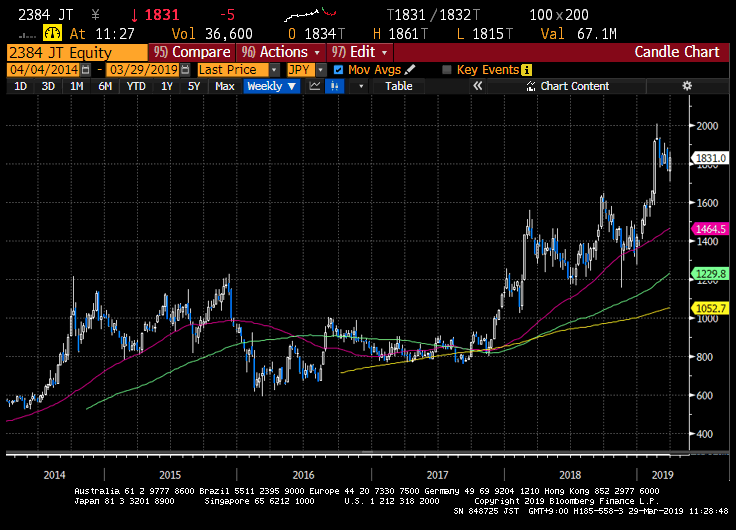
2384

It is seeing decent organic growth, led by a focus on third party logistics (3PL). This will carry on. The recently acquired Ricoh Logistics should eventually see margins improve as it is integrated into SBS. This year’s operating profit forecast of Y9bn (+10%) is conservative. An increase of Y1bn this year will come from Ricoh Logistics alone, and then we have organic growth. In our view operating profit will be at least Y10bn. There is the unrealised profit on land, which add some Y85bn to a company whose market cap is Y71bn. Despite the outperformance over the last 12 months, this remains a decent long-term domestic buy, and one in which foreigners still own only 12%. The shares trade on 13x 12/19 assuming an operating profit of Y10bn. 

2. Drill Results Confirm High-Grade Mineralisation (Flash Note)

Figures%203%20&%204

  • Significant thick, high-grade Zn/Pb intersections with substantial by-products
  • X-sections highlight ore thickness variability
  • On schedule for maiden Resource mid-June incorporating both S. Nights and Wagga Tank
  • Current drill programmes to be completed within a month
  • Employing VMS structural and geochemical specialists for future exploration vectoring
  • Maintain Speculative Buy Recommendation

3. Mexican Banks – Near Term Relief on Fees from the ABM Convention; Thoughts on January’s Bank Data

Fees%20%25%20ata

  • The Mexican president Andres Manuel Lopez Obrador (AMLO) announced at the annual Mexican bank association (ABM) convention on the 22nd March that there would be no cap or regulatory-enforced reduction in Mexican banking fee and commission charges
  • AMLO stated that he expects fees to decline going forward, as a result of increased competition between banks; in the ABM convention, it was also announced that banks will charge zero commissions on the planned platform for digital payments
  • This seems a better outcome on fees than the market expected – at least in the near term, as fees are still on the political agenda – and there was greater emphasis at the convention on how to achieve increased financial inclusion, via digital banking initiatives
  • Yet we still believe that bank fees could be a bone of contention over the medium term, and we show the FY 2018 ratio of fees to revenues and to assets for eight banks, in the charts below
  • The January 2019 Mexican banks data implies slower system loan growth going forward, yet credit quality remains healthy and credit spreads are holding steady
  • Despite the volatile global markets, in the short term banks like Grupo Financiero Banorte-O (GFNORTEO MM) could benefit from the “fee relief”; longer term, we would highlight Gentera SAB De CV (GENTERA* MM EQUITY) as an attractive fundamental pick in Mexican banks

4. Viva Biotech (维亚生物) IPO: Warning Signs from 2018 Numbers (Part 2)

Fvtpl%20movement%202018

Viva Biotechnology, a China-based drug discovery company, is seeking to raise USD 200m to list on the Hong Kong Stock Exchange. It has recently obtained approval for listing by the Hong Kong Stock Exchange. In our previous insight (link here), we discussed the company’s fundamentals, its unique business model, its shareholders, and our thoughts on its valuation.

In this insight, we look at its latest prospectus and review our valuation for Viva Biotech.

5. Koolearn (新东方在线) Trading Update – A Wobbly Start

Performance%20of%20ipos%20in%202019

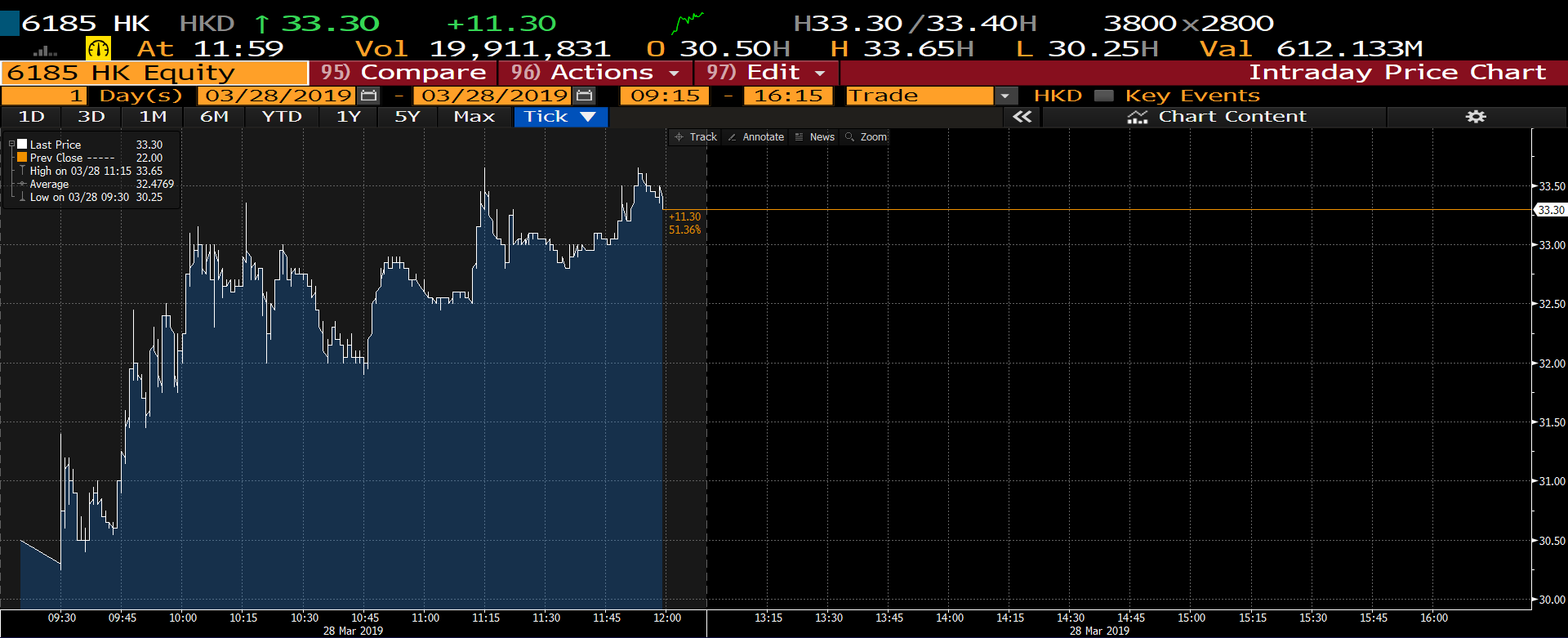
Koolearn (1797 HK) raised about US$214m at HK$10.20 per share, the mid-point of its IPO price range. We have previously covered the IPO in: 

In this insight, we will update on the deal dynamics, implied valuation, and include a valuation sensitivity table.

Get Straight to the Source on Smartkarma

Smartkarma supports the world’s leading investors with high-quality, timely, and actionable Insights. Subscribe now for unlimited access, or request a demo below.


Brief Growth Ideas: Yahoo Japan’s JV with OYO Could Be Big, If Tokyo Is Ready to “Co-Live” and more

By | Growth Ideas

In this briefing:

  1. Yahoo Japan’s JV with OYO Could Be Big, If Tokyo Is Ready to “Co-Live”
  2. PRM: Thai Largest Tanker Fleets Assured of Consistent Growth
  3. China Tobacco Intl (HK) IPO: Proxy For the Chinese Cigarette Consumption

1. Yahoo Japan’s JV with OYO Could Be Big, If Tokyo Is Ready to “Co-Live”

  • OYO, the largest budget hotel network in India, announced a JV with Yahoo Japan (4689 JP) to expand its co-living rental service, “OYO Living”, to Japan. OYO will own 66.1% while YJ will own the remainder of the JV, named “Oyo Technology & Hospitality Japan”. 
  • Rebranded as “OYO Life”, the service would be the first of its kind, in the virtually non-existent co-living market in Japan. In Japan, apartments are usually compact single-occupier units as opposed to shared spaces, which might pose a problem for OYO’s co-living model. 
  • Assuming the model is a success and OYO Life could ramp up its capacity to around 150,000 beds in Tokyo, which is around 5% of the total apartment stock in central Tokyo, this would contribute around ¥3bn (2% of net income in FY03/18) to Yahoo Japan’s net income. There is potential for further gains, however, this would depend on how ready Tokyo is to move into a “Co-Living” culture in masses.

2. PRM: Thai Largest Tanker Fleets Assured of Consistent Growth

Prm%20pic%204

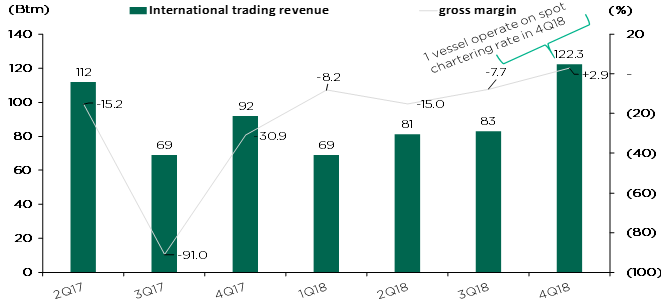
We initiate coverage of PRM with a BUY rating, based on a target price of Bt7.70, derived from a PEG ratio of 0.9x, which is the average for the Asia ex-japan transportation sector, implying 22.0x PE’19E.

The story:

  • Secured revenue from domestic trading business
  • IMO 2020 implementation to propel floating storage demand
  • Recovery in T/C rate should prompt international trading turnaround

Risks:  Lower-than-expected domestic oil consumption and trading activities in ASEAN, foreign currency and fuel cost fluctuations

3. China Tobacco Intl (HK) IPO: Proxy For the Chinese Cigarette Consumption

Tobacco%20export

China Tobacco International (Hong Kong), a subsidiary of the China Tobacco International, is seeking a listing in Hong Kong. Per media reports, the company plans to raise USD 100 million. In this insight, we will discuss the following topics: 

  • What does China Tobacco International do?
  • What is its relationship with China Tobacco?
  • How did its different segments perform?
  • The industrial backdrop

Get Straight to the Source on Smartkarma

Smartkarma supports the world’s leading investors with high-quality, timely, and actionable Insights. Subscribe now for unlimited access, or request a demo below.


Brief Growth Ideas: Yahoo Japan’s JV with OYO Could Be Big, If Tokyo Is Ready to “Co-Live” and more

By | Growth Ideas

In this briefing:

  1. Yahoo Japan’s JV with OYO Could Be Big, If Tokyo Is Ready to “Co-Live”
  2. PRM: Thai Largest Tanker Fleets Assured of Consistent Growth
  3. China Tobacco Intl (HK) IPO: Proxy For the Chinese Cigarette Consumption
  4. New Century Hotel (浙江開元酒店) IPO Review – Higher ADR and RevPAR than Peers but Margins Fall Short

1. Yahoo Japan’s JV with OYO Could Be Big, If Tokyo Is Ready to “Co-Live”

  • OYO, the largest budget hotel network in India, announced a JV with Yahoo Japan (4689 JP) to expand its co-living rental service, “OYO Living”, to Japan. OYO will own 66.1% while YJ will own the remainder of the JV, named “Oyo Technology & Hospitality Japan”. 
  • Rebranded as “OYO Life”, the service would be the first of its kind, in the virtually non-existent co-living market in Japan. In Japan, apartments are usually compact single-occupier units as opposed to shared spaces, which might pose a problem for OYO’s co-living model. 
  • Assuming the model is a success and OYO Life could ramp up its capacity to around 150,000 beds in Tokyo, which is around 5% of the total apartment stock in central Tokyo, this would contribute around ¥3bn (2% of net income in FY03/18) to Yahoo Japan’s net income. There is potential for further gains, however, this would depend on how ready Tokyo is to move into a “Co-Living” culture in masses.

2. PRM: Thai Largest Tanker Fleets Assured of Consistent Growth

Prm%20pic%204

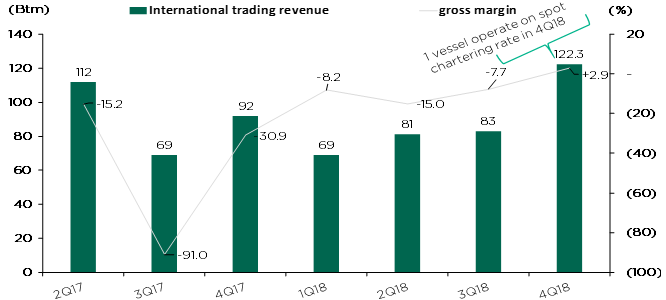
We initiate coverage of PRM with a BUY rating, based on a target price of Bt7.70, derived from a PEG ratio of 0.9x, which is the average for the Asia ex-japan transportation sector, implying 22.0x PE’19E.

The story:

  • Secured revenue from domestic trading business
  • IMO 2020 implementation to propel floating storage demand
  • Recovery in T/C rate should prompt international trading turnaround

Risks:  Lower-than-expected domestic oil consumption and trading activities in ASEAN, foreign currency and fuel cost fluctuations

3. China Tobacco Intl (HK) IPO: Proxy For the Chinese Cigarette Consumption

Tobacco%20export

China Tobacco International (Hong Kong), a subsidiary of the China Tobacco International, is seeking a listing in Hong Kong. Per media reports, the company plans to raise USD 100 million. In this insight, we will discuss the following topics: 

  • What does China Tobacco International do?
  • What is its relationship with China Tobacco?
  • How did its different segments perform?
  • The industrial backdrop

4. New Century Hotel (浙江開元酒店) IPO Review – Higher ADR and RevPAR than Peers but Margins Fall Short

Sell%20wine

Zhejiang New Century Hotel Management Group (1158 HK) (NCH) is looking to raise up to US$179m in its upcoming IPO.

NCH is riddled with related party transactions, from the sales of consumer goods, carpets and wine to having 24% of its hotel management revenue come from related parties. There had been a handful of small acquisitions and disposals but it all seemed to be just reshuffling of assets between NCH and the controlling shareholder with no clear strategy. 

Key metrics show that even though NCH is operating at higher ADR and RevPAR compared to peers, it ultimately falls short in terms of EBITDA and net margins. It also has the lowest occupancy rate.

In this insight, we will focus on corporate governance issues, peer metric comparison, and relative valuation with listed hotel operators. 

Get Straight to the Source on Smartkarma

Smartkarma supports the world’s leading investors with high-quality, timely, and actionable Insights. Subscribe now for unlimited access, or request a demo below.



Brief Growth Ideas: IPO Stalker: SISB’s Growth Plans and more

By | Growth Ideas

In this briefing:

  1. IPO Stalker: SISB’s Growth Plans

1. IPO Stalker: SISB’s Growth Plans

SISB has been one of the best investments in our portfolio, rising 26% since we jumped in shortly after the IPO. Founder Kelvin Koh reiterated the strengths in his prospectus (English-Chinese language, affordability, own brand) and backs it up with:

  • positive stats and trends. 7.8% CAGR in international students, growth in high net worth Thais (11.4% CAGR) and expat population (6.9% CAGR) all of which are supportive of the business.
  • expansion plans both abroad and domestic. A Bt70m investment in the Thonburi site as well as talks to potentially set up new campuses in China and/or CLMV region.
  • Financials. An almost sixfold jump in earnings from Bt18m in 2017 to Bt103.5m in 2018 primarily due to its high operating leverage and now debt-free status after the IPO.
  • favorable operating environment. High availability of Caucasian teachers in Thailand and growing Chinese expat community due to China’s increasing environment.

Get Straight to the Source on Smartkarma

Smartkarma supports the world’s leading investors with high-quality, timely, and actionable Insights. Subscribe now for unlimited access, or request a demo below.


Brief Growth Ideas: IPO Stalker: SISB’s Growth Plans and more

By | Growth Ideas

In this briefing:

  1. IPO Stalker: SISB’s Growth Plans
  2. Brazilian Payments Report: Cielo on the Defensive Against Disruptive Challengers

1. IPO Stalker: SISB’s Growth Plans

SISB has been one of the best investments in our portfolio, rising 26% since we jumped in shortly after the IPO. Founder Kelvin Koh reiterated the strengths in his prospectus (English-Chinese language, affordability, own brand) and backs it up with:

  • positive stats and trends. 7.8% CAGR in international students, growth in high net worth Thais (11.4% CAGR) and expat population (6.9% CAGR) all of which are supportive of the business.
  • expansion plans both abroad and domestic. A Bt70m investment in the Thonburi site as well as talks to potentially set up new campuses in China and/or CLMV region.
  • Financials. An almost sixfold jump in earnings from Bt18m in 2017 to Bt103.5m in 2018 primarily due to its high operating leverage and now debt-free status after the IPO.
  • favorable operating environment. High availability of Caucasian teachers in Thailand and growing Chinese expat community due to China’s increasing environment.

2. Brazilian Payments Report: Cielo on the Defensive Against Disruptive Challengers

Stone

  • The non-cash payments market continues to grow at a double-digit rate in Brazil, driven primarily by growing usage of credit and debit cards
  • De-regulation and new entrants have brought challenges for the incumbents, especially for the largest player Cielo SA (CIEL3 BZ), with the challengers taking market share, squeezing margins and promoting better service for SME merchants in particular
  • Competitive pressures continue in the Brazil payments market, reflected in the declining merchant discount rate (MDR), lower rental rates and sale prices for POS terminals, as well as pressure on the commissions for early payment of merchant receivables; the near-term prospects for Cielo remain challenging in our view
  • Due to the ongoing headwinds, we expect Cielo to show negative earnings growth to 2021; management has announced that Cielo will defend its market share against the challengers; we see further downside risk to consensus earnings and the real risk of a greater than consensus 2019 DPS cut
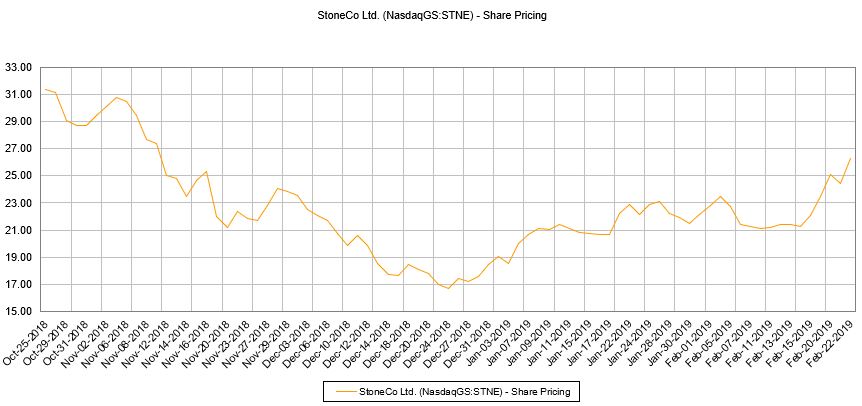
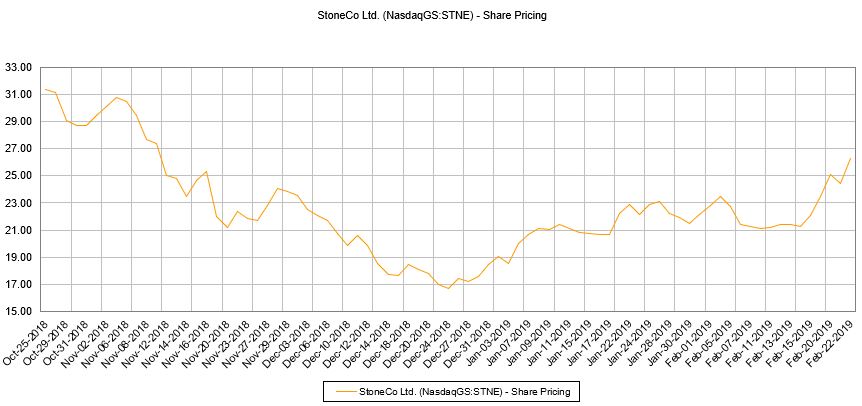
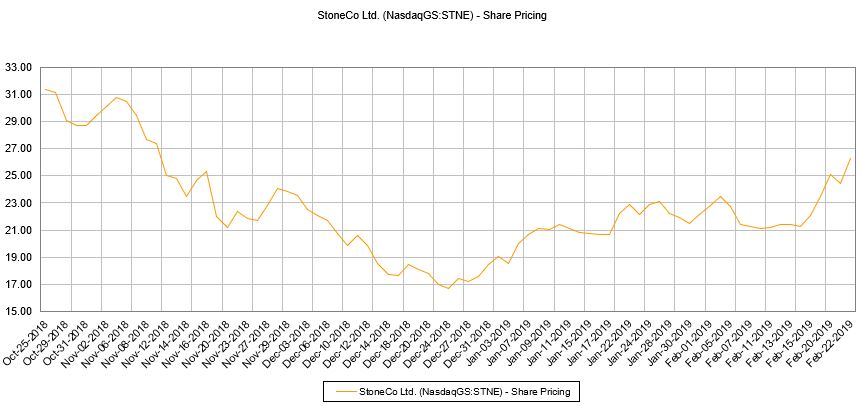
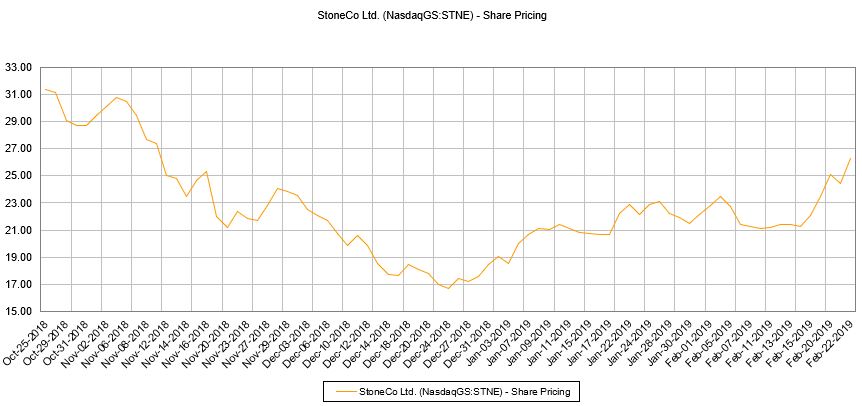
  • StoneCo Ltd (STNE US)and Pagseguro Digital Ltd (PAGS US) are two of the payment challengers in this de-regulated market, growing faster than the Brazilian non-cash transactions market and taking incumbents’ market share; we see StoneCo to be the preferred entity to PagSeguro, based on StoneCo’s higher revenue yielding SME segment of focus and on its more attractive PEG ratio valuation

Get Straight to the Source on Smartkarma

Smartkarma supports the world’s leading investors with high-quality, timely, and actionable Insights. Subscribe now for unlimited access, or request a demo below.


Brief Growth Ideas: Drill Results Confirm High-Grade Mineralisation (Flash Note) and more

By | Growth Ideas

In this briefing:

  1. Drill Results Confirm High-Grade Mineralisation (Flash Note)
  2. Mexican Banks – Near Term Relief on Fees from the ABM Convention; Thoughts on January’s Bank Data
  3. Viva Biotech (维亚生物) IPO: Warning Signs from 2018 Numbers (Part 2)
  4. Koolearn (新东方在线) Trading Update – A Wobbly Start
  5. Denso Continues to Strengthen Its Investment CASE with Acquisitions

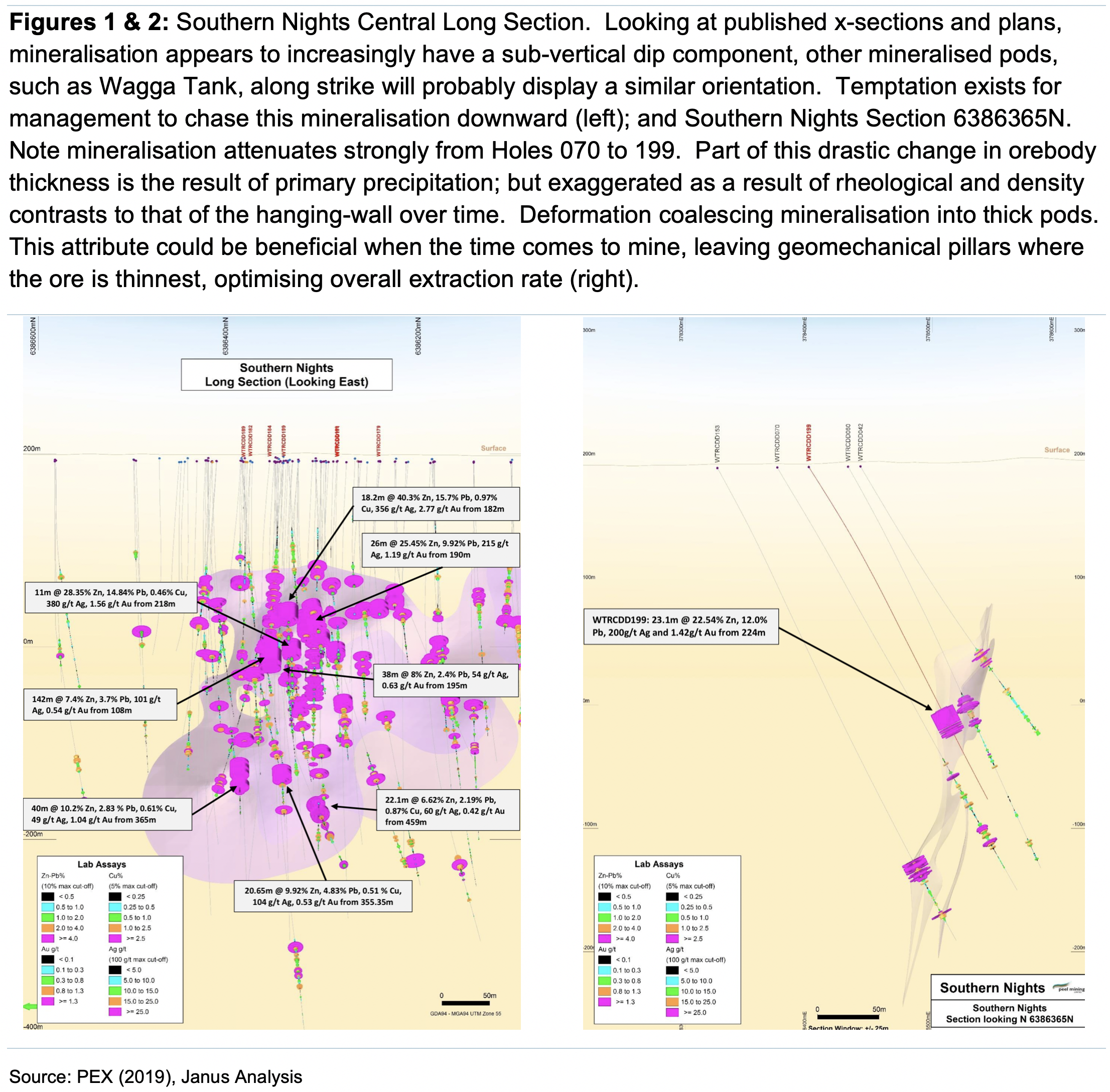
1. Drill Results Confirm High-Grade Mineralisation (Flash Note)

Figures%201%20&%202%20

  • Significant thick, high-grade Zn/Pb intersections with substantial by-products
  • X-sections highlight ore thickness variability
  • On schedule for maiden Resource mid-June incorporating both S. Nights and Wagga Tank
  • Current drill programmes to be completed within a month
  • Employing VMS structural and geochemical specialists for future exploration vectoring
  • Maintain Speculative Buy Recommendation

2. Mexican Banks – Near Term Relief on Fees from the ABM Convention; Thoughts on January’s Bank Data

Fees%20%25%20rev

  • The Mexican president Andres Manuel Lopez Obrador (AMLO) announced at the annual Mexican bank association (ABM) convention on the 22nd March that there would be no cap or regulatory-enforced reduction in Mexican banking fee and commission charges
  • AMLO stated that he expects fees to decline going forward, as a result of increased competition between banks; in the ABM convention, it was also announced that banks will charge zero commissions on the planned platform for digital payments
  • This seems a better outcome on fees than the market expected – at least in the near term, as fees are still on the political agenda – and there was greater emphasis at the convention on how to achieve increased financial inclusion, via digital banking initiatives
  • Yet we still believe that bank fees could be a bone of contention over the medium term, and we show the FY 2018 ratio of fees to revenues and to assets for eight banks, in the charts below
  • The January 2019 Mexican banks data implies slower system loan growth going forward, yet credit quality remains healthy and credit spreads are holding steady
  • Despite the volatile global markets, in the short term banks like Grupo Financiero Banorte-O (GFNORTEO MM) could benefit from the “fee relief”; longer term, we would highlight Gentera SAB De CV (GENTERA* MM EQUITY) as an attractive fundamental pick in Mexican banks

3. Viva Biotech (维亚生物) IPO: Warning Signs from 2018 Numbers (Part 2)

Cfo

Viva Biotechnology, a China-based drug discovery company, is seeking to raise USD 200m to list on the Hong Kong Stock Exchange. It has recently obtained approval for listing by the Hong Kong Stock Exchange. In our previous insight (link here), we discussed the company’s fundamentals, its unique business model, its shareholders, and our thoughts on its valuation.

In this insight, we look at its latest prospectus and review our valuation for Viva Biotech.

4. Koolearn (新东方在线) Trading Update – A Wobbly Start

Performance%20of%20ipos%20in%202019

Koolearn (1797 HK) raised about US$214m at HK$10.20 per share, the mid-point of its IPO price range. We have previously covered the IPO in: 

In this insight, we will update on the deal dynamics, implied valuation, and include a valuation sensitivity table.

5. Denso Continues to Strengthen Its Investment CASE with Acquisitions

Denso Corp (6902 JP) announced this month that it has invested in the Seattle-based connected vehicle services pioneer- Airbiquity Inc. Airbiquity is one of the leading companies in the connected vehicle services sector and has been one of the companies that has continuously developed automotive telematics technology. This investment made by Denso follows its investment made in Quadric.io this year ( Stake in Quadric.io Following Renesas; Denso Attempts to Keep Chip Makers Close to Achieve AD Aims). As we previously mentioned, Denso is in full swing in its development in the autonomous driving field and next-generation technologies development. Thus, it wouldn’t be a surprise to see Denso emerge as the first mover in next-generation technologies such as AD and connectivity solutions. According to Denso, its investment worth $5m in Airbiquity is expected to accelerate the development of over-the-air (OTA) systems for wirelessly updating automotive software from a remote location. OTA systems are methods of distributing new software, configuration settings, and providing updates to the electronic device in use, for instance, a car navigation system in a vehicle. These OTA systems which have been increasingly used to update the software of such multimedia products in a vehicle are now gaining more prominence given the emergence of next-generation technologies such as electrification, EV and connectivity. We also believe that Denso’s Stake in Airbiquity is likely to accelerate Denso’s transition in its business model to be a leading software solution provider. Thus, its series of investments such as in Tohoku Pioneer EG, JOLED, ThinCI, Quadric, and now Airbiquity are indicative of the decisiveness of its change in business model and moves towards achieving next-generation technology leadership.

Get Straight to the Source on Smartkarma

Smartkarma supports the world’s leading investors with high-quality, timely, and actionable Insights. Subscribe now for unlimited access, or request a demo below.


Brief Growth Ideas: CanSino Biologics (康希诺) IPO Trading Update – Time to Cash Out and more

By | Growth Ideas

In this briefing:

  1. CanSino Biologics (康希诺) IPO Trading Update – Time to Cash Out
  2. Nissan Governance Structure Report Out: Fog Dissipating Slowly. Sunny in Summer. Storms Next Winter?
  3. A Reality Check for Money Forward (3994 JP): Key Takeaways from Our Recent Visit
  4. Small Cap Diary: Rajthanee Hospital, CAZ
  5. New J Hutton – Exploration Report (Weeks Ending 22/03/19)

1. CanSino Biologics (康希诺) IPO Trading Update – Time to Cash Out

Gip%20v2

CanSino Biologics raised USD 148 million at HKD 22/share, at the high end of its guided price range. We have previously covered the IPO in the following note: 

In this insight, we will update on the deal dynamics, implied valuation, and include a valuation sensitivity table.

2. Nissan Governance Structure Report Out: Fog Dissipating Slowly. Sunny in Summer. Storms Next Winter?

Six weeks ago I wrote that Nissan’s governance outlook was “Foggy Now, Sunny Later.” I said “Governance changes are afoot, with a steady flow of developments likely coming in March, April, May, and June.”

The last couple of months have seen numerous media articles about the process of Nissan Motor (7201 JP) and Renault SA (RNO FP) rebuilding their relationship. There have been visits to Tokyo by Renault’s new chairman of the board of directors Jean-Dominique Senard, and visits to Paris and Amsterdam by the CEOs of Nissan and Mitsubishi Motors (7211 JP)

There have been many suggestions in French and European newspapers in the interim that Jean-Dominique Senard would be the obvious choice as a representative director of Nissan. There have been other articles out there in the Japanese press suggesting what conclusions the committee might come to as to what outcomes should result. The difference is notable. The French side still wants control. The Japanese/Nissan/committee side sees the need to fix governance.

Today there was a report in the FT suggesting that Renault “wants” to restart merger talks with Nissan and “aims to restart merger talks with Nissan within 12 months.” It should be noted that these two sentences are not exactly the same. It may still be that France wants Renault to do so, and therefore Renault aims to do so. The same article revealed past talks on Renault merging with FCA but France putting a stop to it and a current desire to acquire another automaker – perhaps FCA – after dealing with Nissan. 

Also today, the long-awaited Nissan Special Committee for Improving Governance (SCIG) report was released. It outlines some of the issues of governance which existed under Ghosn- both the ones which got him the boot, and the structural governance issues which were “discovered” after he got the boot. 

There are clear patches in the fog. Two things shine through immediately. 

  1. Governance weaknesses under Ghosn were inexcusably bad. Worse than previously reported.
  2. The recommendations to the board now are, on the whole, pretty decent. Some are sine qua non changes – formation of nomination and compensation committees, whistleblower reporting to the audit committee and not the CEO, and greater checks and balances. Some are stronger in terms of the independence of Nissan from Renault: the committee recommends a majority of independent board members, an independent chairman, and no representative directors from Renault, Mitsubishi, or principal shareholders.

There are, however, other issues which were not addressed, which for Nissan’s sake probably should be addressed. Yesterday was a first step on what will be a 3-month procession of news about the way Nissan will address the SCIG report’s recommendations, the process by which it will choose new directors when it does not have an official nomination committee, and the AGM in June to propose and confirm new directors. Then they will start their jobs in July. 

The fog looks to lift slowly. And one may anticipate some better weather beyond. But business concerns remain a threat, and while relations appear to be getting better after the departure of Carlos Ghosn and the arrival of Jean-Dominique Senard, it is not clear that a Franco-Japanese storm is not brewing in the distance.

More below.

3. A Reality Check for Money Forward (3994 JP): Key Takeaways from Our Recent Visit

Capture

In our previous note, Money Forward (3994 JP): Solid Mid-Term Prospects for the Fintech Pro, but Overvalued, published July last year (2018), we suggested that Money Forward (3994 JP) (MF) was overvalued despite its strong growth profile. MF’s share price, which was at an all-time high (close to JPY6,000) around this time, fell below its IPO price (JPY3,000) in December, reinforcing our bearish view.

Since then, Money Forward’s share price has picked up (closing at JPY4,400 on 26th March 2019), on the back of strong topline guidance for FY11/19E (+55%-65% YoY growth) and “aggressive” medium-term profit targets (positive EBITDA by FY11/21E).

However, following our recent conversation with MF’s IR team, we believe that the above guidance needs to be slightly toned down.

4. Small Cap Diary: Rajthanee Hospital, CAZ

We visited two small-cap companies from totally different industries today. These are the key highlights.

  • Rajthanee Hospital, a small hospital chain based in Ayuthya, achieved 15.7% revenue growth CAGR since 2016 on the back of its proximity to industrial estates.
  • CAZ has seen its backlog double to Bt2.5bn largely due to its good relations with major clients (PTT) and partners (Samsung and other Korean chaebol), which dole out projects in the oil & gas sector to it.
  • Internally, CAZ follows a sophisticated cost control method sporting bar codes and GPS to track materials and dedicated cost-control staff.

5. New J Hutton – Exploration Report (Weeks Ending 22/03/19)

Figure%208

Get Straight to the Source on Smartkarma

Smartkarma supports the world’s leading investors with high-quality, timely, and actionable Insights. Subscribe now for unlimited access, or request a demo below.


Brief Growth Ideas: IPO Stalker: SISB’s Growth Plans and more

By | Growth Ideas

In this briefing:

  1. IPO Stalker: SISB’s Growth Plans
  2. Brazilian Payments Report: Cielo on the Defensive Against Disruptive Challengers
  3. India’s Military Strikes on Pakistan: No War in the Offing from Either Side

1. IPO Stalker: SISB’s Growth Plans

SISB has been one of the best investments in our portfolio, rising 26% since we jumped in shortly after the IPO. Founder Kelvin Koh reiterated the strengths in his prospectus (English-Chinese language, affordability, own brand) and backs it up with:

  • positive stats and trends. 7.8% CAGR in international students, growth in high net worth Thais (11.4% CAGR) and expat population (6.9% CAGR) all of which are supportive of the business.
  • expansion plans both abroad and domestic. A Bt70m investment in the Thonburi site as well as talks to potentially set up new campuses in China and/or CLMV region.
  • Financials. An almost sixfold jump in earnings from Bt18m in 2017 to Bt103.5m in 2018 primarily due to its high operating leverage and now debt-free status after the IPO.
  • favorable operating environment. High availability of Caucasian teachers in Thailand and growing Chinese expat community due to China’s increasing environment.

2. Brazilian Payments Report: Cielo on the Defensive Against Disruptive Challengers

Stone

  • The non-cash payments market continues to grow at a double-digit rate in Brazil, driven primarily by growing usage of credit and debit cards
  • De-regulation and new entrants have brought challenges for the incumbents, especially for the largest player Cielo SA (CIEL3 BZ), with the challengers taking market share, squeezing margins and promoting better service for SME merchants in particular
  • Competitive pressures continue in the Brazil payments market, reflected in the declining merchant discount rate (MDR), lower rental rates and sale prices for POS terminals, as well as pressure on the commissions for early payment of merchant receivables; the near-term prospects for Cielo remain challenging in our view
  • Due to the ongoing headwinds, we expect Cielo to show negative earnings growth to 2021; management has announced that Cielo will defend its market share against the challengers; we see further downside risk to consensus earnings and the real risk of a greater than consensus 2019 DPS cut
  • StoneCo Ltd (STNE US)and Pagseguro Digital Ltd (PAGS US) are two of the payment challengers in this de-regulated market, growing faster than the Brazilian non-cash transactions market and taking incumbents’ market share; we see StoneCo to be the preferred entity to PagSeguro, based on StoneCo’s higher revenue yielding SME segment of focus and on its more attractive PEG ratio valuation

3. India’s Military Strikes on Pakistan: No War in the Offing from Either Side

Balakot%20bbc

The air strikes launched by the Indian Air Force on Jaba Top in Balakot, in the Khyber Pakhtunkhwa province of Pakistan, have raised the stakes in the escalation of conflict between the two nuclear-armed neighbours in South Asia.  The stock market reaction on the morning of February 26 was negative with the Nifty-50 down nearly 146 points (1.3%), but thereafter it recovered to close at 10,835, only 45 points down (0.4%) from the previous close.  The central issue for the Indian market remains whether this will result in another war or a military retaliation by Pakistan as India targeted a venue in Pakistan proper and outside Pakistan-administered Kashmir (PAK), unlike the earlier ‘surgical strike’ wherein Indian army units attacked a camp in PAK. A war will be prohibitively expensive for both countries, but more so for Pakistan. It would have a material impact on the fiscal deficits of both countries, and it is also unlikely that America would want an escalation of conflict in this heavily militarised region. Hence, while the Pakistani government may make appropriate noises to satisfy their public, their response may be non-military, through an escalation in low intensity conflict targeting the Indian military and para-military in Indian-administered Kashmir (IAK). Hence, while the casualties may rise, the possibility of another India-Pakistan war may be remote.

At the same time, there is an indirect fall-out of the present conflict. Since voters may perceive Prime Minister as a more credible war leader than his opponents, a war atmosphere may strengthen the prospects of the ruling party. If the market comes to this conclusion, the recent military strikes may in fact boost the market. However, that ‘war’ effect may wear off before the elections.

Get Straight to the Source on Smartkarma

Smartkarma supports the world’s leading investors with high-quality, timely, and actionable Insights. Subscribe now for unlimited access, or request a demo below.


Brief Growth Ideas: Brazilian Payments Report: Cielo on the Defensive Against Disruptive Challengers and more

By | Growth Ideas

In this briefing:

  1. Brazilian Payments Report: Cielo on the Defensive Against Disruptive Challengers
  2. India’s Military Strikes on Pakistan: No War in the Offing from Either Side

1. Brazilian Payments Report: Cielo on the Defensive Against Disruptive Challengers

Stone

  • The non-cash payments market continues to grow at a double-digit rate in Brazil, driven primarily by growing usage of credit and debit cards
  • De-regulation and new entrants have brought challenges for the incumbents, especially for the largest player Cielo SA (CIEL3 BZ), with the challengers taking market share, squeezing margins and promoting better service for SME merchants in particular
  • Competitive pressures continue in the Brazil payments market, reflected in the declining merchant discount rate (MDR), lower rental rates and sale prices for POS terminals, as well as pressure on the commissions for early payment of merchant receivables; the near-term prospects for Cielo remain challenging in our view
  • Due to the ongoing headwinds, we expect Cielo to show negative earnings growth to 2021; management has announced that Cielo will defend its market share against the challengers; we see further downside risk to consensus earnings and the real risk of a greater than consensus 2019 DPS cut
  • StoneCo Ltd (STNE US)and Pagseguro Digital Ltd (PAGS US) are two of the payment challengers in this de-regulated market, growing faster than the Brazilian non-cash transactions market and taking incumbents’ market share; we see StoneCo to be the preferred entity to PagSeguro, based on StoneCo’s higher revenue yielding SME segment of focus and on its more attractive PEG ratio valuation

2. India’s Military Strikes on Pakistan: No War in the Offing from Either Side

Balakot%20bbc

The air strikes launched by the Indian Air Force on Jaba Top in Balakot, in the Khyber Pakhtunkhwa province of Pakistan, have raised the stakes in the escalation of conflict between the two nuclear-armed neighbours in South Asia.  The stock market reaction on the morning of February 26 was negative with the Nifty-50 down nearly 146 points (1.3%), but thereafter it recovered to close at 10,835, only 45 points down (0.4%) from the previous close.  The central issue for the Indian market remains whether this will result in another war or a military retaliation by Pakistan as India targeted a venue in Pakistan proper and outside Pakistan-administered Kashmir (PAK), unlike the earlier ‘surgical strike’ wherein Indian army units attacked a camp in PAK. A war will be prohibitively expensive for both countries, but more so for Pakistan. It would have a material impact on the fiscal deficits of both countries, and it is also unlikely that America would want an escalation of conflict in this heavily militarised region. Hence, while the Pakistani government may make appropriate noises to satisfy their public, their response may be non-military, through an escalation in low intensity conflict targeting the Indian military and para-military in Indian-administered Kashmir (IAK). Hence, while the casualties may rise, the possibility of another India-Pakistan war may be remote.

At the same time, there is an indirect fall-out of the present conflict. Since voters may perceive Prime Minister as a more credible war leader than his opponents, a war atmosphere may strengthen the prospects of the ruling party. If the market comes to this conclusion, the recent military strikes may in fact boost the market. However, that ‘war’ effect may wear off before the elections.

Get Straight to the Source on Smartkarma

Smartkarma supports the world’s leading investors with high-quality, timely, and actionable Insights. Subscribe now for unlimited access, or request a demo below.


Brief Growth Ideas: Brazilian Payments Report: Cielo on the Defensive Against Disruptive Challengers and more

By | Growth Ideas

In this briefing:

  1. Brazilian Payments Report: Cielo on the Defensive Against Disruptive Challengers
  2. India’s Military Strikes on Pakistan: No War in the Offing from Either Side
  3. New J. Hutton Exploration Report (Week Ending 22/02/19)

1. Brazilian Payments Report: Cielo on the Defensive Against Disruptive Challengers

Stone

  • The non-cash payments market continues to grow at a double-digit rate in Brazil, driven primarily by growing usage of credit and debit cards
  • De-regulation and new entrants have brought challenges for the incumbents, especially for the largest player Cielo SA (CIEL3 BZ), with the challengers taking market share, squeezing margins and promoting better service for SME merchants in particular
  • Competitive pressures continue in the Brazil payments market, reflected in the declining merchant discount rate (MDR), lower rental rates and sale prices for POS terminals, as well as pressure on the commissions for early payment of merchant receivables; the near-term prospects for Cielo remain challenging in our view
  • Due to the ongoing headwinds, we expect Cielo to show negative earnings growth to 2021; management has announced that Cielo will defend its market share against the challengers; we see further downside risk to consensus earnings and the real risk of a greater than consensus 2019 DPS cut
  • StoneCo Ltd (STNE US)and Pagseguro Digital Ltd (PAGS US) are two of the payment challengers in this de-regulated market, growing faster than the Brazilian non-cash transactions market and taking incumbents’ market share; we see StoneCo to be the preferred entity to PagSeguro, based on StoneCo’s higher revenue yielding SME segment of focus and on its more attractive PEG ratio valuation

2. India’s Military Strikes on Pakistan: No War in the Offing from Either Side

Balakot%20bbc

The air strikes launched by the Indian Air Force on Jaba Top in Balakot, in the Khyber Pakhtunkhwa province of Pakistan, have raised the stakes in the escalation of conflict between the two nuclear-armed neighbours in South Asia.  The stock market reaction on the morning of February 26 was negative with the Nifty-50 down nearly 146 points (1.3%), but thereafter it recovered to close at 10,835, only 45 points down (0.4%) from the previous close.  The central issue for the Indian market remains whether this will result in another war or a military retaliation by Pakistan as India targeted a venue in Pakistan proper and outside Pakistan-administered Kashmir (PAK), unlike the earlier ‘surgical strike’ wherein Indian army units attacked a camp in PAK. A war will be prohibitively expensive for both countries, but more so for Pakistan. It would have a material impact on the fiscal deficits of both countries, and it is also unlikely that America would want an escalation of conflict in this heavily militarised region. Hence, while the Pakistani government may make appropriate noises to satisfy their public, their response may be non-military, through an escalation in low intensity conflict targeting the Indian military and para-military in Indian-administered Kashmir (IAK). Hence, while the casualties may rise, the possibility of another India-Pakistan war may be remote.

At the same time, there is an indirect fall-out of the present conflict. Since voters may perceive Prime Minister as a more credible war leader than his opponents, a war atmosphere may strengthen the prospects of the ruling party. If the market comes to this conclusion, the recent military strikes may in fact boost the market. However, that ‘war’ effect may wear off before the elections.

3. New J. Hutton Exploration Report (Week Ending 22/02/19)

Figure%202

Get Straight to the Source on Smartkarma

Smartkarma supports the world’s leading investors with high-quality, timely, and actionable Insights. Subscribe now for unlimited access, or request a demo below.