Category

Hong Kong

Daily Hong Kong: Ten Years On – Asia Outperforms Advanced Economies and more

By | Hong Kong

In this briefing:

  1. Ten Years On – Asia Outperforms Advanced Economies
  2. Asian Credit Monitor: 2019 Portfolio Strategy, US Rate Trajectory, China Reform Pause
  3. TRACKING TRAFFIC/Chinese Tourism: Visits to Macau & HK Surge

1. Ten Years On – Asia Outperforms Advanced Economies

Capture%201

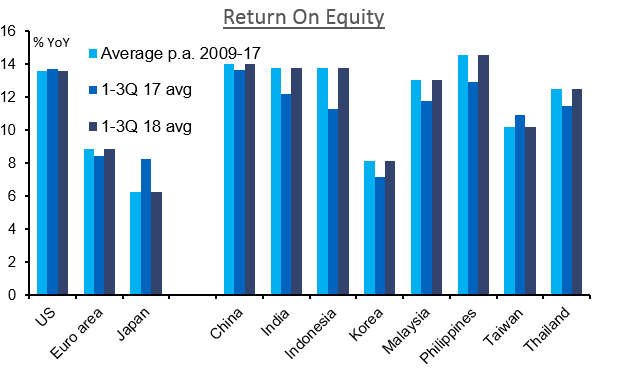
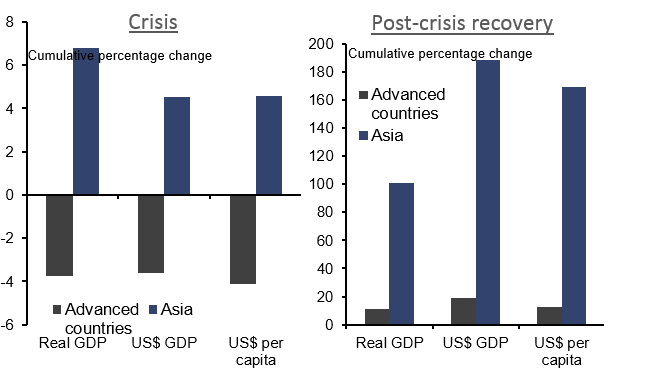
You might be surprised to learn that in the ten years to 2017 Asia has outperformed advanced economies. Despite extraordinary monetary and fiscal stimulus and the damaging dollar-demand deflationary policies of the ECB, BoJ and BoE, the region is 188% larger in US dollar terms compared with 2007 while US dollar GDP per capita income is 170% higher. The parallel numbers for the advanced countries – the US, euro-area and Japan combined- are 19% and 13%. Asian stock markets have underperformed since 2010 but we believe that investors are still to fully acknowledge Asia’s strong growth fundamentals. Combined with cheap valuations there is significant upside for Asian equity markets.

2. Asian Credit Monitor: 2019 Portfolio Strategy, US Rate Trajectory, China Reform Pause

G3%20cb

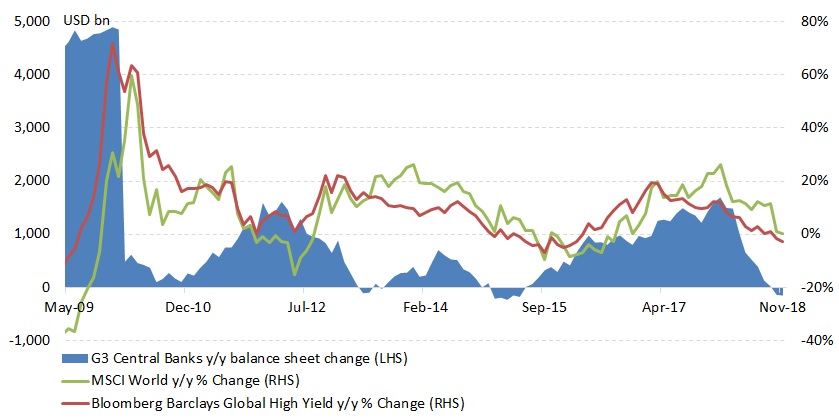
If we had to make a base observation for Asia credit markets over 2018, it was certainly caught “wrong-footed” like most of its other risky asset counterparts. The combination of a more hawkish Fed in 2018, global quantitative tightening, late-cycle economic conditions, volatility and a strong USD have all served to impact almost all the asset classes negatively. According to some asset allocators, the only asset class which returned positive in 2018 was cash, every other traditional asset class saw losses.

USD direction will further dictate the impact on overall Asian risk, in our view, with many undervalued Asian currencies following their sharp declines in 2018. One of our scenarios includes a range-bound USD in 1H19, followed by a possible reversal in 2H19 on any dovish Fed policy/US economic weakness. In this case, it has the potential to attract incremental portfolio inflows back into Asian risk. We expect a slightly tighter bias in monetary policy in most Asia ex-Japan nations which is supportive for their respective currencies.

In 2019, risk-reward dynamics have improved particularly for Asian investment grade (“IG”) where we see more limited MTM pressure. We expect a more defensive market at least in 1H19 which supports our heavier IG bias. We suspect larger investors would continue to reallocate depending on the outcomes of the China-US trade dispute and their view on US risk (arguably near its last late-cycle expansion legs). We continue to be extremely selective in Asian high yield (“HY”) which have been impacted by idiosyncratic situations including credit deterioration and rising defaults. Exogenous factors such as the potential for “fallen angel” risk (i.e. a migration from issuers on the cusp of IG, “BBB-”  into HY) as well as net portfolio outflows from HY, EM and leveraged loan funds are ongoing concerns. Despite cheaper valuations in Asian HY, we still see skewed risk-reward (with larger potential risks).

In the US, our base case expects the Fed to hike 1-2 times (quarter point each) for 2019, premised on still below-trend inflation and external factors. We think it is near the tail-end of its current tightening cycle, but we would continue to monitor the US supply-side (labour markets, employment gaps, prices) for further clues. A sustained upshot to the previous factors may have the potential to prolong the Fed’s tightening cycle.

On China’s side, we have seen a critical reversal in policy towards selective expansion/accommodation again as economic reforms instituted 3 years ago have been reprioritized. China’s difficult task to balance growth targets and restructure its economy is a perennial issue. We would also expect defaults to remain elevated domestically/internationally as a new paradigm of credit investing takes root in China.

Finally, we would like to wish our readers luck in investing and trading in the year ahead.

3. TRACKING TRAFFIC/Chinese Tourism: Visits to Macau & HK Surge

Dec18 ggr

A year ago we began publishing Tracking Traffic/Chinese Tourism as the hub for all of our research on China’s tourism sector. This monthly report features analysis of Chinese tourism data, notes from our conversations with industry participants, and links to recent company news and thematic pieces. Our aim is to highlight important trends in China’s tourism sector (and changes to those trends).

In this issue readers can find:

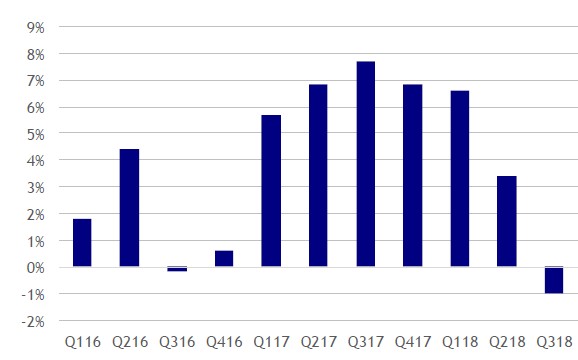
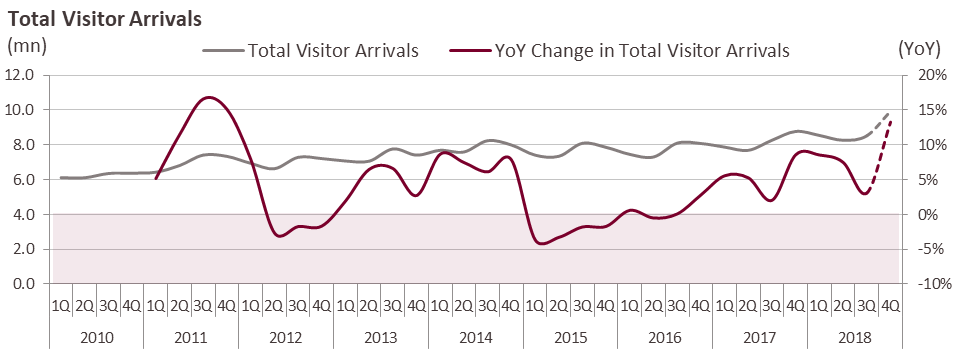
  1. A review of China’s outbound tourist traffic in November, which strengthened: Lifted by extraordinarily strong growth in visits to Hong Kong and, to a lesser extent, Macau, Chinese outbound travel demand rebounded strongly in the seven regional destinations we track. But the fact that November’s growth was led overwhelmingly by Hong Kong and Macau — destinations close enough for weekend or day trips from population centers in Southern China — suggests Chinese tourists’ purse strings are still tight.
  2. An analysis of November domestic Chinese travel activity, which turned weaker: November data from China’s three leading airlines and the Ministry of Transport show moderating domestic travel demand. For combined rail, highway, and air travel, November demand grew by less than 3% Y/Y. Along with the change in destination mix for outbound travel (that favors ‘nearby’ destinations), it now appears domestic demand has weakened, too. 
  3. Links to other recent news & research on Chinese tourism: Readers can check out our quick takes on Macau’s December GGR figure, preliminary GTV and revenue figures released by Ctrip.Com International (Adr) (CTRP US), declining US visa issuance to Chinese tourists, and Qatar Airways’ new investment in a leading Chinese airline.

Although we remain positive on the long-term growth of Chinese tourism, it’s clear that near-term demand has weakened substantially. We continue to take a negative view of travel intermediaries like Ctrip, which face intensifying competition from many sources. We are more positive on the prospects of actual owners of Chinese travel and tourism assets, like hotel chain Huazhu Group (HTHT US) and Air China Ltd (H) (753 HK)

Get Straight to the Source on Smartkarma

Smartkarma supports the world’s leading investors with high-quality, timely, and actionable Insights. Subscribe now for unlimited access, or request a demo below.


Daily Hong Kong: Screening the Silk Road: Q1-2019 Small-Mid Cap GARP (Zulu Warrior Screening) and more

By | Hong Kong

In this briefing:

  1. Screening the Silk Road: Q1-2019 Small-Mid Cap GARP (Zulu Warrior Screening)
  2. Chinese Telcos: 5G Launches in 2019. Buy the 5G Beneficiary (China Tower).
  3. Are Chip Oligopolies Real?
  4. Global Banks: Some New Year Pointers
  5. Extraordinary Fiscal and Monetary Policies Have Disrupted the Global Economy

1. Screening the Silk Road: Q1-2019 Small-Mid Cap GARP (Zulu Warrior Screening)

Chart%201

  • Value made a comeback, but growth remains core: In May 2018, we examined the divide between value and growth stocks, ( Notes from the Silk Road: Small-Mid Cap Screening for Zulu Warriors). As Q3 unfolded, this eventuated with a +7.5% reversal in favour of value stocks, only to see growth resume dominance in October and November.
  • The optimal value/growth style dynamic: We feel exposure to growth at a reasonable price (GARP) coupled with a healthy FCF yield (via our amended Zulu Screen) should provide some healthy medium to long term returns for investors.
  • The Screen’s Risk: The Zulu Screen relies on analyst estimates. When market sentiment is weak and forecasts are not amended in a timely manner, the screen is susceptible to mis-selection.
  • Q2 2018 screening list succumbed to volatile markets: This was seen in our May screen with our list posting on average a 30% decline in share price, relative to the broader Asia-Pacific Ex-Japan declining 13.6% and the Asia Pacific index by 11.8%.
  • Are there reasons for the underperformance? 10 of the 19 stocks in the May screen were from Hong Kong, which saw the Hang Seng Index (HIS) decline 16% over the same period. The decrease seems due to concern over trade wars and doubts about the China economy. Our key approach to stock selection is to take a medium-to-long-term view as well as focus on quality ranked stocks relative to their peers. This is highlighted via the average stock rank of the group declining only 15.8% from 89.6 to 75.5 points.
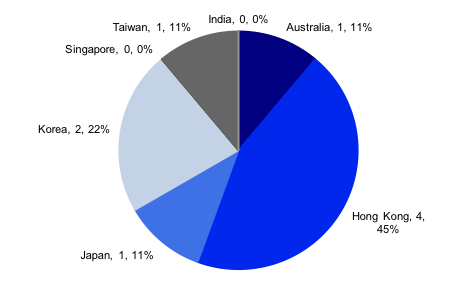
  • Our Q1 2019 screen selected only 9 stocks. Of the 9 stocks identified, the average PEG Ratio was 0.4x, the price to FCF yield was 11% and ROCE was 25%. Stocks were selected from Australia, New Zealand, India, Korea, Japan, Hong Kong, Taiwan and Singapore. Cowell Fashion Company from Korea was the only remaining stock from our May screening.

2. Chinese Telcos: 5G Launches in 2019. Buy the 5G Beneficiary (China Tower).

China%20target%20prices

We highlighted in a recent note Chris Hoare‘s positive outlook for China Tower (788 HK). Our view takes into account the 5G build-out commencing this year, improved capex efficiency from using “social resources”, the rapid growth in non-tower businesses that lie outside the Master Services Agreement (MSA), and the valuation benefit from what looks like surprisingly investor friendly management. 

This note focuses on four key issues facing the Chinese telcos in 2019:

  • 5G capex (March) (this is by far the most important),
  • Regulatory newsflow (February/ March),
  • Operating trend improvements (August), and
  • Emerging business opportunities driving future growth (August).

We remain positive on the telcos which trade at low multiples. China Unicom (762 HK) continues to trade at a discount, yet is most exposed to the positive story emerging at China Tower. We switch our top pick among the telcos from China Mobile (941 HK) back to China Unicom as a result. Alastair Jones thinks China Telecom’s (728 HK) premium multiple is at risk if management execution on the cost base doesn’t improve. It is our least preferred telco at this stage. Overall, we expect China Tower to outperform all telcos and it is our top pick.  The upgrade to China Tower flows through the telcos (valuation and costs) and our new target prices are as follows: China Unicom to HK$14.4, China Telecom to HK$5.4 and China Mobile to HK$96. 

3. Are Chip Oligopolies Real?

Slide50

In the semiconductor industry, particularly in the DRAM sector, there has been significant consolidation leading some to hypothesize that there’s now an oligopoly that will cause prices to normalize and thus end the business’ notorious revenue cycles.  Here we will take a critical look at this argument to explain its fallacy.

4. Global Banks: Some New Year Pointers

Here is a look at how regions fare regarding key indicators.

  • PH Score = value-quality (10 variables)
  • FV=Franchise Valuation
  • RSI
  • TRR= Dividend-adjusted PEG factor
  • ROE
  • EY=Earnings Yield

We have created a model that incorporates these components into a system that covers>1500 banks.

5. Extraordinary Fiscal and Monetary Policies Have Disrupted the Global Economy

In their public presentations, central banks seem to be contemplating the use of neutral interest rates (r*) in addition to unemployment/inflation theories. R* has the advantage of appearing to be subject to mathematical precision, yet it’s unobservable, and so unfalsifiable. Thus, it permits central banks to present any policy conclusion they want without fear of verifiable contradiction. R* is the policy rate that would equate the future supply of and demand for loans. It rises and falls as an economy strengthens and weakens. Long-term observation during the non-inflationary gold standard, period indicated that r* in an average economy was 2% plus, which would become 4% plus with today’s 2% inflation target. The Fed may soon end this tightening cycle with the fed funds rate at or near 2¾%, which would be r* if the rate of lending and borrowing in America remained stable thereafter. Rising (falling) lending would indicate a higher (lower) r*. 

Get Straight to the Source on Smartkarma

Smartkarma supports the world’s leading investors with high-quality, timely, and actionable Insights. Subscribe now for unlimited access, or request a demo below.


Daily Hong Kong: Asian Credit Monitor: 2019 Portfolio Strategy, US Rate Trajectory, China Reform Pause and more

By | Hong Kong

In this briefing:

  1. Asian Credit Monitor: 2019 Portfolio Strategy, US Rate Trajectory, China Reform Pause
  2. TRACKING TRAFFIC/Chinese Tourism: Visits to Macau & HK Surge
  3. Forecasting the Semiconductor Market

1. Asian Credit Monitor: 2019 Portfolio Strategy, US Rate Trajectory, China Reform Pause

G3%20cb

If we had to make a base observation for Asia credit markets over 2018, it was certainly caught “wrong-footed” like most of its other risky asset counterparts. The combination of a more hawkish Fed in 2018, global quantitative tightening, late-cycle economic conditions, volatility and a strong USD have all served to impact almost all the asset classes negatively. According to some asset allocators, the only asset class which returned positive in 2018 was cash, every other traditional asset class saw losses.

USD direction will further dictate the impact on overall Asian risk, in our view, with many undervalued Asian currencies following their sharp declines in 2018. One of our scenarios includes a range-bound USD in 1H19, followed by a possible reversal in 2H19 on any dovish Fed policy/US economic weakness. In this case, it has the potential to attract incremental portfolio inflows back into Asian risk. We expect a slightly tighter bias in monetary policy in most Asia ex-Japan nations which is supportive for their respective currencies.

In 2019, risk-reward dynamics have improved particularly for Asian investment grade (“IG”) where we see more limited MTM pressure. We expect a more defensive market at least in 1H19 which supports our heavier IG bias. We suspect larger investors would continue to reallocate depending on the outcomes of the China-US trade dispute and their view on US risk (arguably near its last late-cycle expansion legs). We continue to be extremely selective in Asian high yield (“HY”) which have been impacted by idiosyncratic situations including credit deterioration and rising defaults. Exogenous factors such as the potential for “fallen angel” risk (i.e. a migration from issuers on the cusp of IG, “BBB-”  into HY) as well as net portfolio outflows from HY, EM and leveraged loan funds are ongoing concerns. Despite cheaper valuations in Asian HY, we still see skewed risk-reward (with larger potential risks).

In the US, our base case expects the Fed to hike 1-2 times (quarter point each) for 2019, premised on still below-trend inflation and external factors. We think it is near the tail-end of its current tightening cycle, but we would continue to monitor the US supply-side (labour markets, employment gaps, prices) for further clues. A sustained upshot to the previous factors may have the potential to prolong the Fed’s tightening cycle.

On China’s side, we have seen a critical reversal in policy towards selective expansion/accommodation again as economic reforms instituted 3 years ago have been reprioritized. China’s difficult task to balance growth targets and restructure its economy is a perennial issue. We would also expect defaults to remain elevated domestically/internationally as a new paradigm of credit investing takes root in China.

Finally, we would like to wish our readers luck in investing and trading in the year ahead.

2. TRACKING TRAFFIC/Chinese Tourism: Visits to Macau & HK Surge

Dec18 ggr

A year ago we began publishing Tracking Traffic/Chinese Tourism as the hub for all of our research on China’s tourism sector. This monthly report features analysis of Chinese tourism data, notes from our conversations with industry participants, and links to recent company news and thematic pieces. Our aim is to highlight important trends in China’s tourism sector (and changes to those trends).

In this issue readers can find:

  1. A review of China’s outbound tourist traffic in November, which strengthened: Lifted by extraordinarily strong growth in visits to Hong Kong and, to a lesser extent, Macau, Chinese outbound travel demand rebounded strongly in the seven regional destinations we track. But the fact that November’s growth was led overwhelmingly by Hong Kong and Macau — destinations close enough for weekend or day trips from population centers in Southern China — suggests Chinese tourists’ purse strings are still tight.
  2. An analysis of November domestic Chinese travel activity, which turned weaker: November data from China’s three leading airlines and the Ministry of Transport show moderating domestic travel demand. For combined rail, highway, and air travel, November demand grew by less than 3% Y/Y. Along with the change in destination mix for outbound travel (that favors ‘nearby’ destinations), it now appears domestic demand has weakened, too. 
  3. Links to other recent news & research on Chinese tourism: Readers can check out our quick takes on Macau’s December GGR figure, preliminary GTV and revenue figures released by Ctrip.Com International (Adr) (CTRP US), declining US visa issuance to Chinese tourists, and Qatar Airways’ new investment in a leading Chinese airline.

Although we remain positive on the long-term growth of Chinese tourism, it’s clear that near-term demand has weakened substantially. We continue to take a negative view of travel intermediaries like Ctrip, which face intensifying competition from many sources. We are more positive on the prospects of actual owners of Chinese travel and tourism assets, like hotel chain Huazhu Group (HTHT US) and Air China Ltd (H) (753 HK)

3. Forecasting the Semiconductor Market

Slide77

This is the time of year that Objective Analysis releases its semiconductor forecast.  This post is based upon a video posted on the WeSRCH website that explains the Objective Analysis 2019 semiconductor forecast.

Although accurate semiconductor forecasts are straightforward to produce, the consistently-accurate methodology spelled out in this Insight is rarely used.

The forecast predicts that the downturn that the industry is currently entering will be longer than most, with profits eluding chip companies until 2022.

Get Straight to the Source on Smartkarma

Smartkarma supports the world’s leading investors with high-quality, timely, and actionable Insights. Subscribe now for unlimited access, or request a demo below.


Daily Hong Kong: China Tower: More Details on Non Telco Growth Suggest Further Upside to Share Price and more

By | Hong Kong

In this briefing:

  1. China Tower: More Details on Non Telco Growth Suggest Further Upside to Share Price
  2. ASIC Review of Allocation in Equity Raising – Some Truths, Some Half-Truths – No Improvements
  3. StubWorld: Time For A BGF Setup? An Unlikely Boost for Kingboard
  4. A Golden Future?
  5. Uranium – About to Enter Its Own Nuclear Winter

1. China Tower: More Details on Non Telco Growth Suggest Further Upside to Share Price

Ct%20financials

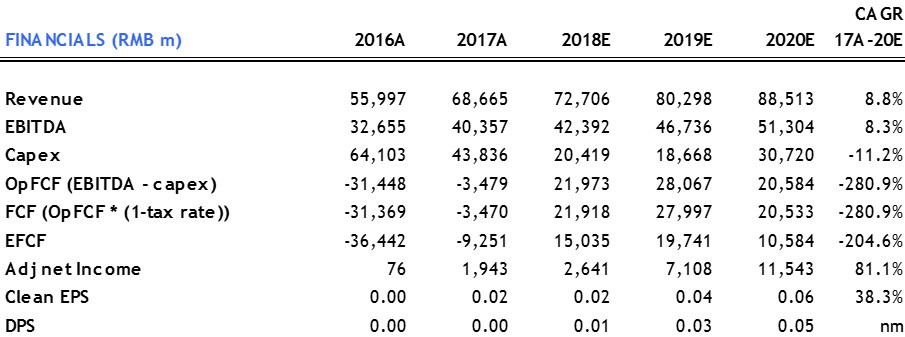
After initially being very skeptical of the China Tower (788 HK) IPO given it is essentially a price take to its three largest shareholders, we changed our view in early December to a more positive outlook. What changed our view has been series of calls and meetings with the company that suggested a more shareholder friendly approach than expected and a real opportunity to reduce capex substantially through the use of “social resources” (e.g. electricity grid, local government sites). These can be used to deliver co-locations without building towers and poles and imply much lower capital intensity at a time when revenue growth will be accelerating as 5G is rolled out.  Management has also given more detail on non-Tower business prospects which can generate higher returns (not under the Master Services Agreement). While small now (2% of revenue) they are growing rapidly. With lower capex than initially guided and a more shareholder friendly management (i.e. higher dividends are possible) we reduce the SOE discount and raise our forecasts (again). We remain at BUY with a new target price of HK$2.20

2. ASIC Review of Allocation in Equity Raising – Some Truths, Some Half-Truths – No Improvements

Size%20of%20the%20bid

Over 2017-18, the Australian Securities & Investments Commission (ASIC) undertook a review of allocation in equity raising transactions. The review involved large and mid-sized licensees (brokers), Issuers, International investors and other international regulators. The results of the review were published by ASIC in Dec 2018. This insight highlights some of the key findings.

It’s good to see that some of the standard practices of banks allocating more to existing clients and participants of earlier deals have at least been acknowledged. Even though some institutional investors have outright labelled the allocation process as a “black box”, ASIC doesn’t seem to want to do much about it.

The area where ASIC is more concerned is the messaging to investors which highlights the different definitions of “well-covered” across banks. Although, the banks seem to have mislead the regulator on interpretation of “real-demand” with ECM bankers saying that all orders are taken at face-value. That raises a whole new level of questions on the messaging around demand for the deal.

3. StubWorld: Time For A BGF Setup? An Unlikely Boost for Kingboard

Nav%20jan%202019

This week in StubWorld …

Preceding my comments on BGF and KBC are the weekly setup/unwind tables for Asia-Pacific Holdcos.

These relationships trade with a minimum liquidity threshold of US$1mn on a 90-day moving average, and a % market capitalisation threshold – the $ value of the holding/opco held, over the parent’s market capitalisation, expressed as a % – of at least 20%.

4. A Golden Future?

The ability to have stable prices has great value.

According to Edward Gibbon, the decaying Roman Empire exhibited five hallmarks: 1) concern with displaying affluence instead of building wealth; 2) obsession with sex; 3) freakish and sensationalistic art; 4) widening disparity between the rich and the poor; and 5) increased demand to live off the state. Most DMs and many EMs display similar symptoms today because fiscal and monetary policies, the foundation of both ancient and modern societies, are identical: increasing welfare outlays by artificially inflating the money supply. The Roman Empire took more than four centuries to destroy what the Republic had built in the previous five centuries because clipping and debasing coins inflated currency supplies slowly. Entering debits and credits in the books of commercial and central banks is much more efficient. 

5. Uranium – About to Enter Its Own Nuclear Winter

Figure%201

  • Quantifying nuclear statistics with substantial discrepancies
  • LT contracts & speculative hoarding driving recent 40% spot price increase
  • Primary/secondary Uranium supplies currently 112% of 2017 demand
  • Uranium supply deficits extremely unlikely before 2022
  • Global Uranium demand to fall 25-40% by 2050
  •  Primary Uranium sector LT SELL

We have independently audited global nuclear construction statistics in order to determine future Uranium demand.  Although near-term statistics match those in the public domain, long-term demand determined via construction pipeline illustrates substantial discrepancies.  Compiling planned plant construction, operational extensions, nameplate upgrades, versus decommissioning announcements/events, and in many cases, public policy inertia; has led us to believe that despite historical primary supply shortages, global nuclear demand peaked in 2006.

Since plateauing and despite strong Chinese growth, nuclear power generation has fallen <2% over the past two decades, a decline that is predicted to accelerate as a number of developed and developing nations pursue other energy options.

The macro-trend not replacing existing nuclear infrastructure means (dependent on assumptions), according to our calculations, global uranium demand will decrease between 20 to 40% by 2050.

As opposed to signifying a fundamental change in underlying demand, we believe that recent Uranium price increases are the result of producers closing primary operations, and substituting production with purchases on the spot market to meet long-term contract obligations.  In addition, hedge funds are buying physical uranium in order to realise profits on potential future commodity price increases.  Critically, we determine that primary and secondary supplies are more than sufficient to meet forecast demand over the next four to five years; before taking into account substantial existing global uranium stocks, some of which are able to re-enter the spot market at short notice.

Get Straight to the Source on Smartkarma

Smartkarma supports the world’s leading investors with high-quality, timely, and actionable Insights. Subscribe now for unlimited access, or request a demo below.


Daily Hong Kong: Chinese Telcos: 5G Launches in 2019. Buy the 5G Beneficiary (China Tower). and more

By | Hong Kong

In this briefing:

  1. Chinese Telcos: 5G Launches in 2019. Buy the 5G Beneficiary (China Tower).
  2. Are Chip Oligopolies Real?
  3. Global Banks: Some New Year Pointers
  4. Extraordinary Fiscal and Monetary Policies Have Disrupted the Global Economy
  5. China Tower: More Details on Non Telco Growth Suggest Further Upside to Share Price

1. Chinese Telcos: 5G Launches in 2019. Buy the 5G Beneficiary (China Tower).

China%20msr%20growth

We highlighted in a recent note Chris Hoare‘s positive outlook for China Tower (788 HK). Our view takes into account the 5G build-out commencing this year, improved capex efficiency from using “social resources”, the rapid growth in non-tower businesses that lie outside the Master Services Agreement (MSA), and the valuation benefit from what looks like surprisingly investor friendly management. 

This note focuses on four key issues facing the Chinese telcos in 2019:

  • 5G capex (March) (this is by far the most important),
  • Regulatory newsflow (February/ March),
  • Operating trend improvements (August), and
  • Emerging business opportunities driving future growth (August).

We remain positive on the telcos which trade at low multiples. China Unicom (762 HK) continues to trade at a discount, yet is most exposed to the positive story emerging at China Tower. We switch our top pick among the telcos from China Mobile (941 HK) back to China Unicom as a result. Alastair Jones thinks China Telecom’s (728 HK) premium multiple is at risk if management execution on the cost base doesn’t improve. It is our least preferred telco at this stage. Overall, we expect China Tower to outperform all telcos and it is our top pick.  The upgrade to China Tower flows through the telcos (valuation and costs) and our new target prices are as follows: China Unicom to HK$14.4, China Telecom to HK$5.4 and China Mobile to HK$96. 

2. Are Chip Oligopolies Real?

Slide50

In the semiconductor industry, particularly in the DRAM sector, there has been significant consolidation leading some to hypothesize that there’s now an oligopoly that will cause prices to normalize and thus end the business’ notorious revenue cycles.  Here we will take a critical look at this argument to explain its fallacy.

3. Global Banks: Some New Year Pointers

Here is a look at how regions fare regarding key indicators.

  • PH Score = value-quality (10 variables)
  • FV=Franchise Valuation
  • RSI
  • TRR= Dividend-adjusted PEG factor
  • ROE
  • EY=Earnings Yield

We have created a model that incorporates these components into a system that covers>1500 banks.

4. Extraordinary Fiscal and Monetary Policies Have Disrupted the Global Economy

In their public presentations, central banks seem to be contemplating the use of neutral interest rates (r*) in addition to unemployment/inflation theories. R* has the advantage of appearing to be subject to mathematical precision, yet it’s unobservable, and so unfalsifiable. Thus, it permits central banks to present any policy conclusion they want without fear of verifiable contradiction. R* is the policy rate that would equate the future supply of and demand for loans. It rises and falls as an economy strengthens and weakens. Long-term observation during the non-inflationary gold standard, period indicated that r* in an average economy was 2% plus, which would become 4% plus with today’s 2% inflation target. The Fed may soon end this tightening cycle with the fed funds rate at or near 2¾%, which would be r* if the rate of lending and borrowing in America remained stable thereafter. Rising (falling) lending would indicate a higher (lower) r*. 

5. China Tower: More Details on Non Telco Growth Suggest Further Upside to Share Price

China tower since ipo rallying as growth prospects become clearer last price volume m  chartbuilder

After initially being very skeptical of the China Tower (788 HK) IPO given it is essentially a price take to its three largest shareholders, we changed our view in early December to a more positive outlook. What changed our view has been series of calls and meetings with the company that suggested a more shareholder friendly approach than expected and a real opportunity to reduce capex substantially through the use of “social resources” (e.g. electricity grid, local government sites). These can be used to deliver co-locations without building towers and poles and imply much lower capital intensity at a time when revenue growth will be accelerating as 5G is rolled out.  Management has also given more detail on non-Tower business prospects which can generate higher returns (not under the Master Services Agreement). While small now (2% of revenue) they are growing rapidly. With lower capex than initially guided and a more shareholder friendly management (i.e. higher dividends are possible) we reduce the SOE discount and raise our forecasts (again). We remain at BUY with a new target price of HK$2.20

Get Straight to the Source on Smartkarma

Smartkarma supports the world’s leading investors with high-quality, timely, and actionable Insights. Subscribe now for unlimited access, or request a demo below.


Daily Hong Kong: This Week in Blockchain & Cryptos: A Bitcoin Reversal; More Red Flags for Bitmain and more

By | Hong Kong

In this briefing:

  1. This Week in Blockchain & Cryptos: A Bitcoin Reversal; More Red Flags for Bitmain
  2. HK Connect Discovery Weekly: CR Beer, Great Wall Motors, and Kingsoft (2019-01-07)
  3. Asia Gaming Preview 2019: Part Two Picks: Galaxy, MGM China and Nagacorp
  4. Ten Years On – Asia Outperforms Advanced Economies
  5. Asian Credit Monitor: 2019 Portfolio Strategy, US Rate Trajectory, China Reform Pause

1. This Week in Blockchain & Cryptos: A Bitcoin Reversal; More Red Flags for Bitmain

Gmo

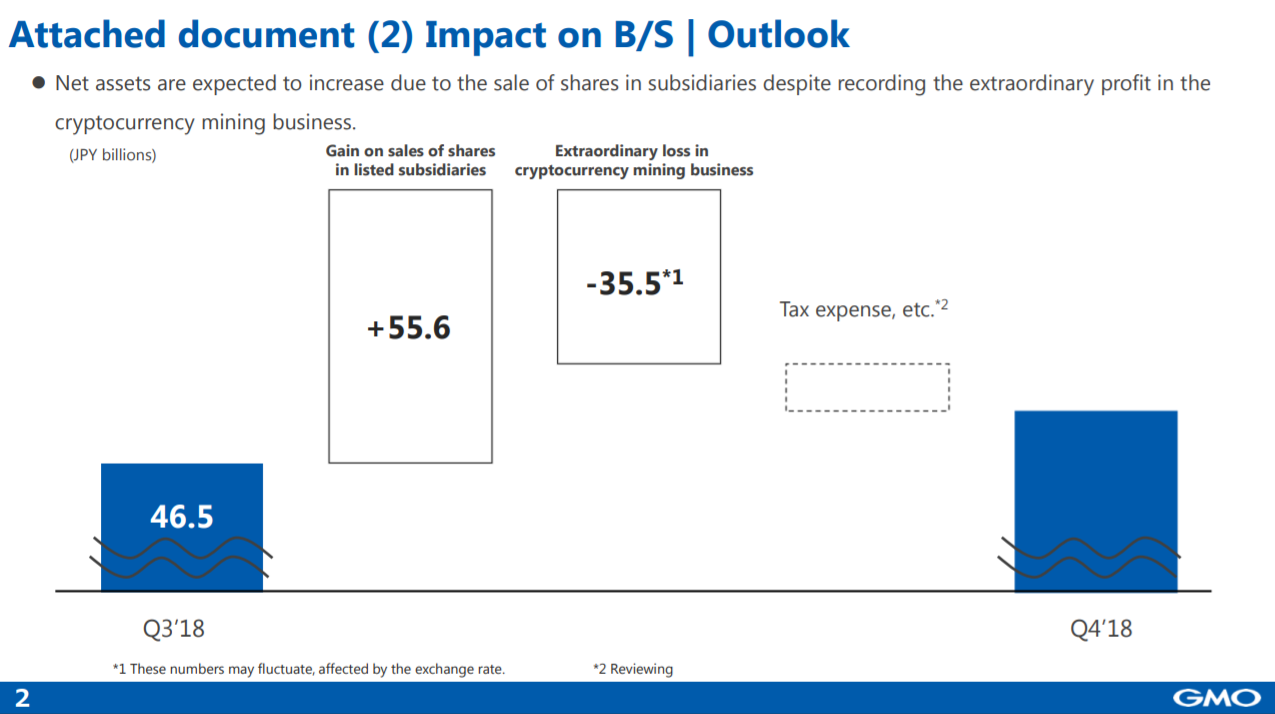
The year 2018 was not the brightest for cryptocurrencies; Bitcoin (XBTUSD CURNCY) fell around 70% during 2018 and top altcoins like Ethereum (ETH BGN CURNCY), Ripple and Bitcoin Cash were also down around 80%, 85% and 95% respectively during last year. While it is difficult to pinpoint a single reason for this, a number of factors including, rising security concerns, increased scrutiny, failed institutional support and Bitcoin Cash hash wars have collectively contributed to this bearish sentiment in the cryptocurrency markets last year.

In this note we take a look at several top cryptocurrency and blockchain developments from last year, to see how they would fare going into 2019.

This is a collaborative report between Douglas Kim and myself.

2. HK Connect Discovery Weekly: CR Beer, Great Wall Motors, and Kingsoft (2019-01-07)

Kingsoft

In our Discover HK Connect series, we aim to help our investors understand the flow of southbound trades via the Hong Kong Connect, as analyzed by our proprietary data engine. We will discuss the stocks that experienced the most inflow and outflow by mainlanders in the past seven days.

We split the stocks eligible for the Hong Kong Connect trade into three groups: those with a market capitalization of above USD 5 billion, those with a market capitalization between USD 1 billion and USD 5 billion, and those with a market capitalization between USD 500 million and USD 1 billion.

In the past week, there were only three and a half days trading on the Hong Kong Stock Exchange last week. Hence the flow numbers were not as significant as a typical 5 trading day week. Having said that, we find it interesting that the Chinese were buying China Resources Beer Holdin (291 HK), Great Wall Motor Company (H) (2333 HK). In addition, Yichang Hec Changjiang Pharm (1558 HK) is a rare health care stock that experienced inflow last week despite overall poor sector performance last week. 

3. Asia Gaming Preview 2019: Part Two Picks: Galaxy, MGM China and Nagacorp

11031766 web1 wynn boston sep02 18 082418kc 020

  • Global and Asia headwinds still rattle the gaming sector, but these three companies remain undervalued despite market sentiment.
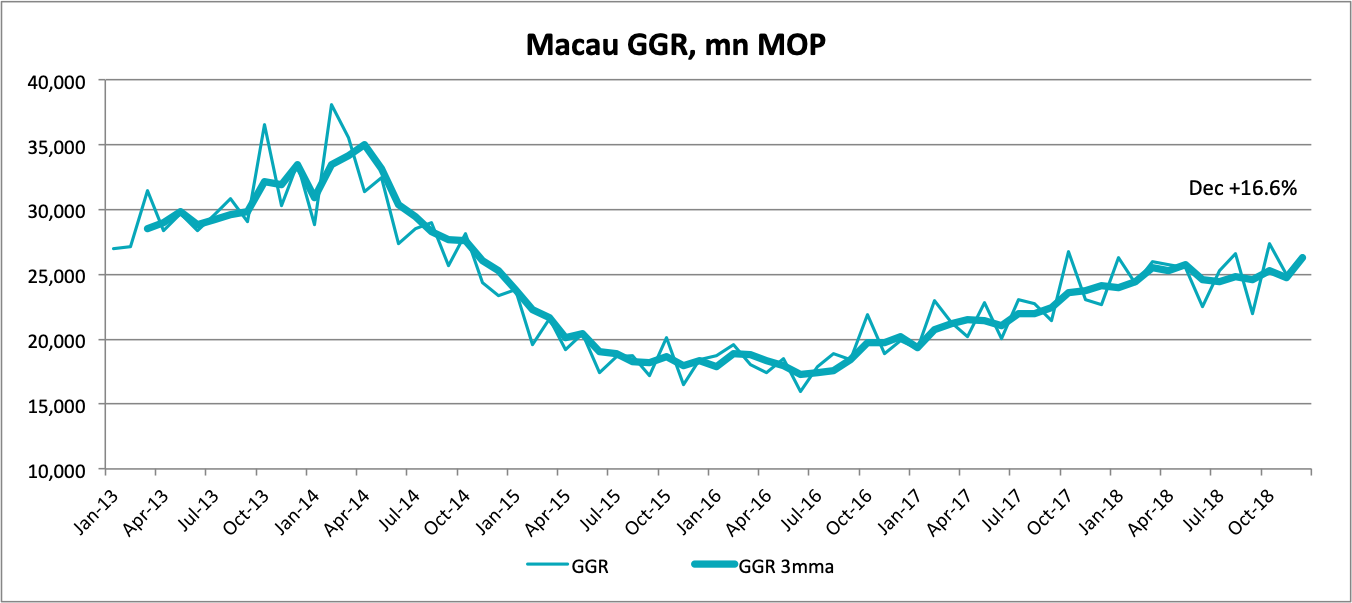
  • Macau’s solid year end performance continues to defy projections, producing a 14% y/y GGR increase.
  • Galaxy will benefit disproportionately from the HKMB bridge traffic growth, MGM’s single digit market share will ramp up to double digits and Nagacorp may be the single most siloed gaming operator in all of Asia.

4. Ten Years On – Asia Outperforms Advanced Economies

Capture%201

You might be surprised to learn that in the ten years to 2017 Asia has outperformed advanced economies. Despite extraordinary monetary and fiscal stimulus and the damaging dollar-demand deflationary policies of the ECB, BoJ and BoE, the region is 188% larger in US dollar terms compared with 2007 while US dollar GDP per capita income is 170% higher. The parallel numbers for the advanced countries – the US, euro-area and Japan combined- are 19% and 13%. Asian stock markets have underperformed since 2010 but we believe that investors are still to fully acknowledge Asia’s strong growth fundamentals. Combined with cheap valuations there is significant upside for Asian equity markets.

5. Asian Credit Monitor: 2019 Portfolio Strategy, US Rate Trajectory, China Reform Pause

G3%20cb

If we had to make a base observation for Asia credit markets over 2018, it was certainly caught “wrong-footed” like most of its other risky asset counterparts. The combination of a more hawkish Fed in 2018, global quantitative tightening, late-cycle economic conditions, volatility and a strong USD have all served to impact almost all the asset classes negatively. According to some asset allocators, the only asset class which returned positive in 2018 was cash, every other traditional asset class saw losses.

USD direction will further dictate the impact on overall Asian risk, in our view, with many undervalued Asian currencies following their sharp declines in 2018. One of our scenarios includes a range-bound USD in 1H19, followed by a possible reversal in 2H19 on any dovish Fed policy/US economic weakness. In this case, it has the potential to attract incremental portfolio inflows back into Asian risk. We expect a slightly tighter bias in monetary policy in most Asia ex-Japan nations which is supportive for their respective currencies.

In 2019, risk-reward dynamics have improved particularly for Asian investment grade (“IG”) where we see more limited MTM pressure. We expect a more defensive market at least in 1H19 which supports our heavier IG bias. We suspect larger investors would continue to reallocate depending on the outcomes of the China-US trade dispute and their view on US risk (arguably near its last late-cycle expansion legs). We continue to be extremely selective in Asian high yield (“HY”) which have been impacted by idiosyncratic situations including credit deterioration and rising defaults. Exogenous factors such as the potential for “fallen angel” risk (i.e. a migration from issuers on the cusp of IG, “BBB-”  into HY) as well as net portfolio outflows from HY, EM and leveraged loan funds are ongoing concerns. Despite cheaper valuations in Asian HY, we still see skewed risk-reward (with larger potential risks).

In the US, our base case expects the Fed to hike 1-2 times (quarter point each) for 2019, premised on still below-trend inflation and external factors. We think it is near the tail-end of its current tightening cycle, but we would continue to monitor the US supply-side (labour markets, employment gaps, prices) for further clues. A sustained upshot to the previous factors may have the potential to prolong the Fed’s tightening cycle.

On China’s side, we have seen a critical reversal in policy towards selective expansion/accommodation again as economic reforms instituted 3 years ago have been reprioritized. China’s difficult task to balance growth targets and restructure its economy is a perennial issue. We would also expect defaults to remain elevated domestically/internationally as a new paradigm of credit investing takes root in China.

Finally, we would like to wish our readers luck in investing and trading in the year ahead.

Get Straight to the Source on Smartkarma

Smartkarma supports the world’s leading investors with high-quality, timely, and actionable Insights. Subscribe now for unlimited access, or request a demo below.


Daily Hong Kong: ASIC Review of Allocation in Equity Raising – Some Truths, Some Half-Truths – No Improvements and more

By | Hong Kong

In this briefing:

  1. ASIC Review of Allocation in Equity Raising – Some Truths, Some Half-Truths – No Improvements
  2. StubWorld: Time For A BGF Setup? An Unlikely Boost for Kingboard
  3. A Golden Future?
  4. Uranium – About to Enter Its Own Nuclear Winter
  5. Futu Holdings Pre-IPO – Great Metrics but in a Commoditised Industry

1. ASIC Review of Allocation in Equity Raising – Some Truths, Some Half-Truths – No Improvements

Ranking%20of%20investors

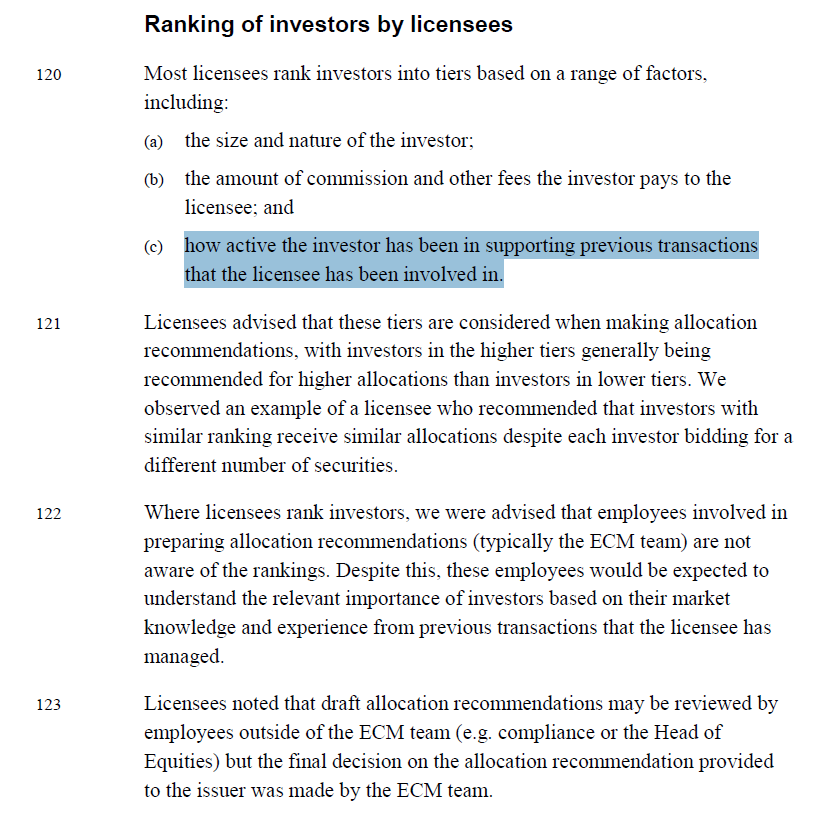
Over 2017-18, the Australian Securities & Investments Commission (ASIC) undertook a review of allocation in equity raising transactions. The review involved large and mid-sized licensees (brokers), Issuers, International investors and other international regulators. The results of the review were published by ASIC in Dec 2018. This insight highlights some of the key findings.

It’s good to see that some of the standard practices of banks allocating more to existing clients and participants of earlier deals have at least been acknowledged. Even though some institutional investors have outright labelled the allocation process as a “black box”, ASIC doesn’t seem to want to do much about it.

The area where ASIC is more concerned is the messaging to investors which highlights the different definitions of “well-covered” across banks. Although, the banks seem to have mislead the regulator on interpretation of “real-demand” with ECM bankers saying that all orders are taken at face-value. That raises a whole new level of questions on the messaging around demand for the deal.

2. StubWorld: Time For A BGF Setup? An Unlikely Boost for Kingboard

9%20jan%202019%20uw

This week in StubWorld …

Preceding my comments on BGF and KBC are the weekly setup/unwind tables for Asia-Pacific Holdcos.

These relationships trade with a minimum liquidity threshold of US$1mn on a 90-day moving average, and a % market capitalisation threshold – the $ value of the holding/opco held, over the parent’s market capitalisation, expressed as a % – of at least 20%.

3. A Golden Future?

The ability to have stable prices has great value.

According to Edward Gibbon, the decaying Roman Empire exhibited five hallmarks: 1) concern with displaying affluence instead of building wealth; 2) obsession with sex; 3) freakish and sensationalistic art; 4) widening disparity between the rich and the poor; and 5) increased demand to live off the state. Most DMs and many EMs display similar symptoms today because fiscal and monetary policies, the foundation of both ancient and modern societies, are identical: increasing welfare outlays by artificially inflating the money supply. The Roman Empire took more than four centuries to destroy what the Republic had built in the previous five centuries because clipping and debasing coins inflated currency supplies slowly. Entering debits and credits in the books of commercial and central banks is much more efficient. 

4. Uranium – About to Enter Its Own Nuclear Winter

Figure%201

  • Quantifying nuclear statistics with substantial discrepancies
  • LT contracts & speculative hoarding driving recent 40% spot price increase
  • Primary/secondary Uranium supplies currently 112% of 2017 demand
  • Uranium supply deficits extremely unlikely before 2022
  • Global Uranium demand to fall 25-40% by 2050
  •  Primary Uranium sector LT SELL

We have independently audited global nuclear construction statistics in order to determine future Uranium demand.  Although near-term statistics match those in the public domain, long-term demand determined via construction pipeline illustrates substantial discrepancies.  Compiling planned plant construction, operational extensions, nameplate upgrades, versus decommissioning announcements/events, and in many cases, public policy inertia; has led us to believe that despite historical primary supply shortages, global nuclear demand peaked in 2006.

Since plateauing and despite strong Chinese growth, nuclear power generation has fallen <2% over the past two decades, a decline that is predicted to accelerate as a number of developed and developing nations pursue other energy options.

The macro-trend not replacing existing nuclear infrastructure means (dependent on assumptions), according to our calculations, global uranium demand will decrease between 20 to 40% by 2050.

As opposed to signifying a fundamental change in underlying demand, we believe that recent Uranium price increases are the result of producers closing primary operations, and substituting production with purchases on the spot market to meet long-term contract obligations.  In addition, hedge funds are buying physical uranium in order to realise profits on potential future commodity price increases.  Critically, we determine that primary and secondary supplies are more than sufficient to meet forecast demand over the next four to five years; before taking into account substantial existing global uranium stocks, some of which are able to re-enter the spot market at short notice.

5. Futu Holdings Pre-IPO – Great Metrics but in a Commoditised Industry

Interactive%20brokers%20hk%20fees

Futu Holdings Ltd (FHL US) plans to raise around US$300m in its US IPO. The company is backed by Tencent Holdings (700 HK) , Matrix Partners and Sequoia, who together own over 45% of the company.

The founding team comes mostly from Tencent, which might explain Tencent’s large stake in the company. Growth for the company has been stupendous despite the jittery markets, with margin financing adding to the top-line growth. 

While its low costs will help it to steal clients from the more traditional brokers, other new low-cost brokers seem to be offering similar services at comparable rates. In addition, the company is not licensed or regulated by any entities in China, despite the majority of its client base being Chinese nationals. Furthermore, the company plans to expand into newer overseas market where it doesn’t seem to have much of a cost advantage.

Get Straight to the Source on Smartkarma

Smartkarma supports the world’s leading investors with high-quality, timely, and actionable Insights. Subscribe now for unlimited access, or request a demo below.


Daily Hong Kong: TRACKING TRAFFIC/Chinese Tourism: Visits to Macau & HK Surge and more

By | Hong Kong

In this briefing:

  1. TRACKING TRAFFIC/Chinese Tourism: Visits to Macau & HK Surge
  2. Forecasting the Semiconductor Market
  3. Chengdu Expressway (成都高速) IPO Review – Well-Managed but Unexciting
  4. Weimob IPO Valuation: Optically Cheap
  5. Weimob IPO Quick Take – Less SaaS, More Ads -> Lower Valuation

1. TRACKING TRAFFIC/Chinese Tourism: Visits to Macau & HK Surge

Dec18 ggr

A year ago we began publishing Tracking Traffic/Chinese Tourism as the hub for all of our research on China’s tourism sector. This monthly report features analysis of Chinese tourism data, notes from our conversations with industry participants, and links to recent company news and thematic pieces. Our aim is to highlight important trends in China’s tourism sector (and changes to those trends).

In this issue readers can find:

  1. A review of China’s outbound tourist traffic in November, which strengthened: Lifted by extraordinarily strong growth in visits to Hong Kong and, to a lesser extent, Macau, Chinese outbound travel demand rebounded strongly in the seven regional destinations we track. But the fact that November’s growth was led overwhelmingly by Hong Kong and Macau — destinations close enough for weekend or day trips from population centers in Southern China — suggests Chinese tourists’ purse strings are still tight.
  2. An analysis of November domestic Chinese travel activity, which turned weaker: November data from China’s three leading airlines and the Ministry of Transport show moderating domestic travel demand. For combined rail, highway, and air travel, November demand grew by less than 3% Y/Y. Along with the change in destination mix for outbound travel (that favors ‘nearby’ destinations), it now appears domestic demand has weakened, too. 
  3. Links to other recent news & research on Chinese tourism: Readers can check out our quick takes on Macau’s December GGR figure, preliminary GTV and revenue figures released by Ctrip.Com International (Adr) (CTRP US), declining US visa issuance to Chinese tourists, and Qatar Airways’ new investment in a leading Chinese airline.

Although we remain positive on the long-term growth of Chinese tourism, it’s clear that near-term demand has weakened substantially. We continue to take a negative view of travel intermediaries like Ctrip, which face intensifying competition from many sources. We are more positive on the prospects of actual owners of Chinese travel and tourism assets, like hotel chain Huazhu Group (HTHT US) and Air China Ltd (H) (753 HK)

2. Forecasting the Semiconductor Market

Slide77

This is the time of year that Objective Analysis releases its semiconductor forecast.  This post is based upon a video posted on the WeSRCH website that explains the Objective Analysis 2019 semiconductor forecast.

Although accurate semiconductor forecasts are straightforward to produce, the consistently-accurate methodology spelled out in this Insight is rarely used.

The forecast predicts that the downturn that the industry is currently entering will be longer than most, with profits eluding chip companies until 2022.

3. Chengdu Expressway (成都高速) IPO Review – Well-Managed but Unexciting

Map

Chengdu Expressway Company Limited (1785 HK) is looking to raise US$112m in its upcoming IPO. 

The expressways that CEC operate are integral in Chengdu’s transport network. The expressways have been upgraded and expanded consistently over the past three years which has led to an increase in traffic and toll revenue. However, in terms of valuation, CEC will likely trade at a valuation closer to small expressway peers which implies a 10% downside.

In this insight, we will look at the company’s financial and operational performance, toll payment model, and compare its valuation to Hong Kong-listed expressway peers. We will also run the deal through our IPO framework.

4. Weimob IPO Valuation: Optically Cheap

Weimob.com (1260480D CH) is a combination of a SaaS software and an adtech (targeted marketing) business which has started book building to raise gross proceeds of $108-135 million. According to press reports, Weimob is being viewed favourably by investors as it is being offered at a “cheap” valuation of 18-23x 2019 P/E.

However, the valuation of 18-23x 2019 P/E is optically cheap. Our analysis suggests that including capitalised R&D, Weimob is being offered at a material premium to a peer group of major Chinese internet companies. Notably, our forecasts do not adjust for the capitalised contract acquisition costs which would further increase Weimob’s P/E multiple. Consequently, we believe that the proposed IPO price range is unattractive and would sit out this IPO.

5. Weimob IPO Quick Take – Less SaaS, More Ads -> Lower Valuation

Beyond%20science

Weimob.com (1260480D CH),  a Tencent Holdings (700 HK) and GIC investee company, plans to raise up to US$135m in its Hong Kong IPO.

I’ve covered most aspects of the deal in my earlier insight, Weimob Pre-IPO – Can Be Steamrolled by Tencent, Anytime, where I spoke about the over-reliance on Tencent, high attrition rates and acquisition costs for SMBs, and the increasing contribution of its ads business.

In this insight, I’ll provide an update from the latest filings, comment on valuations and run the deal through our IPO framework.

Get Straight to the Source on Smartkarma

Smartkarma supports the world’s leading investors with high-quality, timely, and actionable Insights. Subscribe now for unlimited access, or request a demo below.


Daily Hong Kong: FutureBright (703 HK): Typhoon Dampens 3Q Results and more

By | Hong Kong

In this briefing:

  1. FutureBright (703 HK): Typhoon Dampens 3Q Results

1. FutureBright (703 HK): Typhoon Dampens 3Q Results

3

We recently met with management to discuss the company’s 3Q results and outlook for the coming year.

There was clear disappointment that goals for 2018 had not been achieved: rising opex dampened the recovery in EBITDA, despite solid SSSg, the Hengqin Land sale is racked with yet further delays, and the key rental property is still untenanted. That said, we feel much of the frustration is due to positive outcomes on all front being just around the corner.

This note aims to give a brief update on the key pillars forming our thesis.

Get Straight to the Source on Smartkarma

Smartkarma supports the world’s leading investors with high-quality, timely, and actionable Insights. Subscribe now for unlimited access, or request a demo below.


Daily Hong Kong: Ten Years On – Asia Outperforms Advanced Economies and more

By | Hong Kong

In this briefing:

  1. Ten Years On – Asia Outperforms Advanced Economies
  2. Asian Credit Monitor: 2019 Portfolio Strategy, US Rate Trajectory, China Reform Pause
  3. TRACKING TRAFFIC/Chinese Tourism: Visits to Macau & HK Surge
  4. Forecasting the Semiconductor Market
  5. Chengdu Expressway (成都高速) IPO Review – Well-Managed but Unexciting

1. Ten Years On – Asia Outperforms Advanced Economies

Capture%203

You might be surprised to learn that in the ten years to 2017 Asia has outperformed advanced economies. Despite extraordinary monetary and fiscal stimulus and the damaging dollar-demand deflationary policies of the ECB, BoJ and BoE, the region is 188% larger in US dollar terms compared with 2007 while US dollar GDP per capita income is 170% higher. The parallel numbers for the advanced countries – the US, euro-area and Japan combined- are 19% and 13%. Asian stock markets have underperformed since 2010 but we believe that investors are still to fully acknowledge Asia’s strong growth fundamentals. Combined with cheap valuations there is significant upside for Asian equity markets.

2. Asian Credit Monitor: 2019 Portfolio Strategy, US Rate Trajectory, China Reform Pause

Cbo

If we had to make a base observation for Asia credit markets over 2018, it was certainly caught “wrong-footed” like most of its other risky asset counterparts. The combination of a more hawkish Fed in 2018, global quantitative tightening, late-cycle economic conditions, volatility and a strong USD have all served to impact almost all the asset classes negatively. According to some asset allocators, the only asset class which returned positive in 2018 was cash, every other traditional asset class saw losses.

USD direction will further dictate the impact on overall Asian risk, in our view, with many undervalued Asian currencies following their sharp declines in 2018. One of our scenarios includes a range-bound USD in 1H19, followed by a possible reversal in 2H19 on any dovish Fed policy/US economic weakness. In this case, it has the potential to attract incremental portfolio inflows back into Asian risk. We expect a slightly tighter bias in monetary policy in most Asia ex-Japan nations which is supportive for their respective currencies.

In 2019, risk-reward dynamics have improved particularly for Asian investment grade (“IG”) where we see more limited MTM pressure. We expect a more defensive market at least in 1H19 which supports our heavier IG bias. We suspect larger investors would continue to reallocate depending on the outcomes of the China-US trade dispute and their view on US risk (arguably near its last late-cycle expansion legs). We continue to be extremely selective in Asian high yield (“HY”) which have been impacted by idiosyncratic situations including credit deterioration and rising defaults. Exogenous factors such as the potential for “fallen angel” risk (i.e. a migration from issuers on the cusp of IG, “BBB-”  into HY) as well as net portfolio outflows from HY, EM and leveraged loan funds are ongoing concerns. Despite cheaper valuations in Asian HY, we still see skewed risk-reward (with larger potential risks).

In the US, our base case expects the Fed to hike 1-2 times (quarter point each) for 2019, premised on still below-trend inflation and external factors. We think it is near the tail-end of its current tightening cycle, but we would continue to monitor the US supply-side (labour markets, employment gaps, prices) for further clues. A sustained upshot to the previous factors may have the potential to prolong the Fed’s tightening cycle.

On China’s side, we have seen a critical reversal in policy towards selective expansion/accommodation again as economic reforms instituted 3 years ago have been reprioritized. China’s difficult task to balance growth targets and restructure its economy is a perennial issue. We would also expect defaults to remain elevated domestically/internationally as a new paradigm of credit investing takes root in China.

Finally, we would like to wish our readers luck in investing and trading in the year ahead.

3. TRACKING TRAFFIC/Chinese Tourism: Visits to Macau & HK Surge

Dec18 ggr

A year ago we began publishing Tracking Traffic/Chinese Tourism as the hub for all of our research on China’s tourism sector. This monthly report features analysis of Chinese tourism data, notes from our conversations with industry participants, and links to recent company news and thematic pieces. Our aim is to highlight important trends in China’s tourism sector (and changes to those trends).

In this issue readers can find:

  1. A review of China’s outbound tourist traffic in November, which strengthened: Lifted by extraordinarily strong growth in visits to Hong Kong and, to a lesser extent, Macau, Chinese outbound travel demand rebounded strongly in the seven regional destinations we track. But the fact that November’s growth was led overwhelmingly by Hong Kong and Macau — destinations close enough for weekend or day trips from population centers in Southern China — suggests Chinese tourists’ purse strings are still tight.
  2. An analysis of November domestic Chinese travel activity, which turned weaker: November data from China’s three leading airlines and the Ministry of Transport show moderating domestic travel demand. For combined rail, highway, and air travel, November demand grew by less than 3% Y/Y. Along with the change in destination mix for outbound travel (that favors ‘nearby’ destinations), it now appears domestic demand has weakened, too. 
  3. Links to other recent news & research on Chinese tourism: Readers can check out our quick takes on Macau’s December GGR figure, preliminary GTV and revenue figures released by Ctrip.Com International (Adr) (CTRP US), declining US visa issuance to Chinese tourists, and Qatar Airways’ new investment in a leading Chinese airline.

Although we remain positive on the long-term growth of Chinese tourism, it’s clear that near-term demand has weakened substantially. We continue to take a negative view of travel intermediaries like Ctrip, which face intensifying competition from many sources. We are more positive on the prospects of actual owners of Chinese travel and tourism assets, like hotel chain Huazhu Group (HTHT US) and Air China Ltd (H) (753 HK)

4. Forecasting the Semiconductor Market

Slide77

This is the time of year that Objective Analysis releases its semiconductor forecast.  This post is based upon a video posted on the WeSRCH website that explains the Objective Analysis 2019 semiconductor forecast.

Although accurate semiconductor forecasts are straightforward to produce, the consistently-accurate methodology spelled out in this Insight is rarely used.

The forecast predicts that the downturn that the industry is currently entering will be longer than most, with profits eluding chip companies until 2022.

5. Chengdu Expressway (成都高速) IPO Review – Well-Managed but Unexciting

Map

Chengdu Expressway Company Limited (1785 HK) is looking to raise US$112m in its upcoming IPO. 

The expressways that CEC operate are integral in Chengdu’s transport network. The expressways have been upgraded and expanded consistently over the past three years which has led to an increase in traffic and toll revenue. However, in terms of valuation, CEC will likely trade at a valuation closer to small expressway peers which implies a 10% downside.

In this insight, we will look at the company’s financial and operational performance, toll payment model, and compare its valuation to Hong Kong-listed expressway peers. We will also run the deal through our IPO framework.

Get Straight to the Source on Smartkarma

Smartkarma supports the world’s leading investors with high-quality, timely, and actionable Insights. Subscribe now for unlimited access, or request a demo below.