Category

Hong Kong

Daily Hong Kong: Time-Out Not Time up for Trade War and more

By | Hong Kong

In this briefing:

  1. Time-Out Not Time up for Trade War
  2. Semiconductor WFE Outlook. Things Just Got Really Ugly
  3. AsiaInfo Tech (亚信科技) IPO: What You Need to Know Before the Trading Debut
  4. Harbin Electric Expected To Be Privatised

1. Time-Out Not Time up for Trade War

Sk1

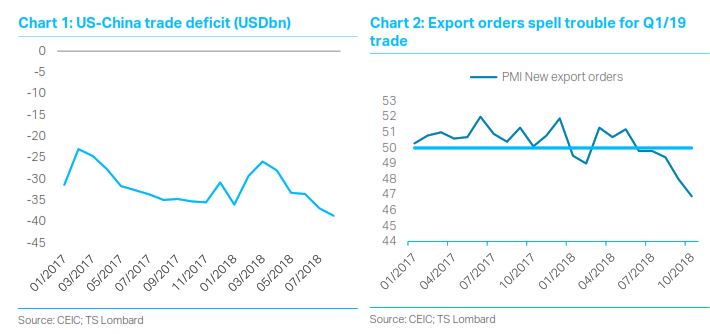
  • Xi and Trump walk away from Buenos Aires with something to sell at home
  • But trade negotiations will be dominated by fraught disagreements
  • After 90-day negotiations, further delays to tariff escalation are likely 

2. Semiconductor WFE Outlook. Things Just Got Really Ugly

Screen%20shot%202018 12 19%20at%208.59.03%20am

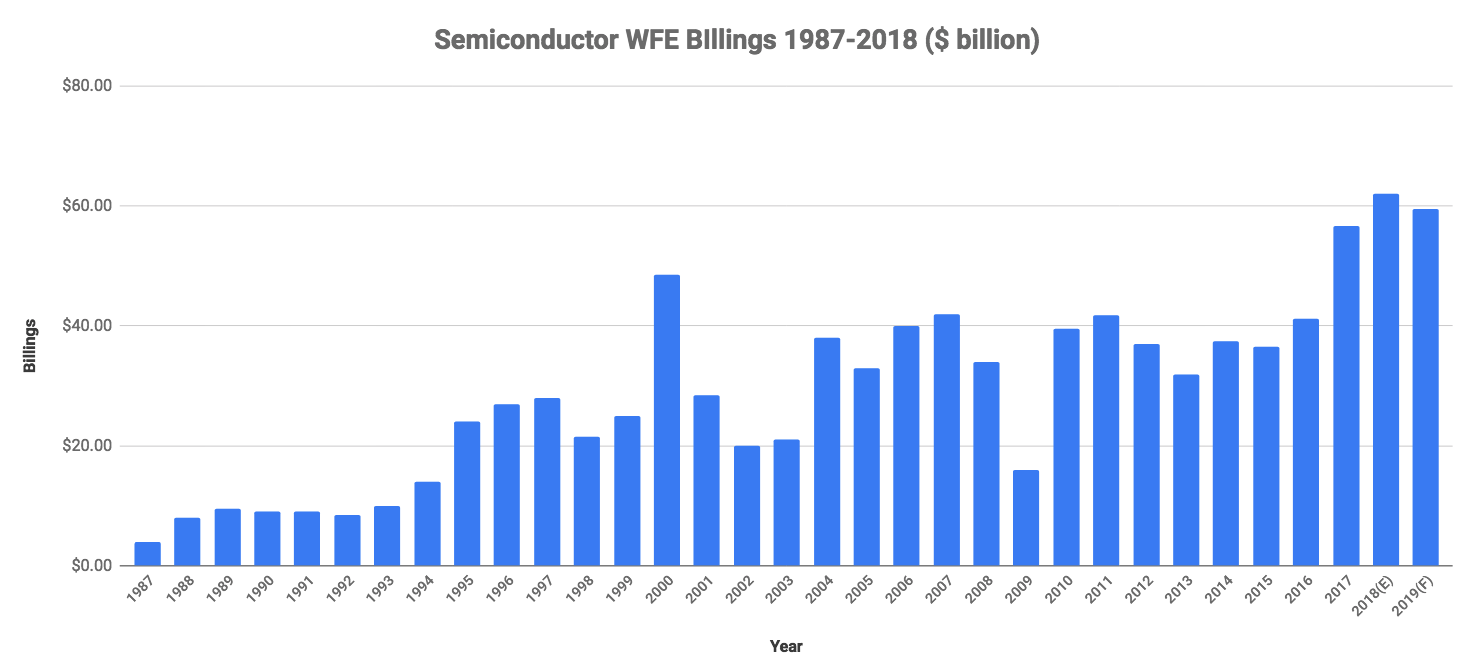
SEMI, the global industry association serving the manufacturing supply chain for the electronics industry, published three different forecasts for wafer fab equipment (WFE) sales in the past week. While the forecasts differ in approach and detail, they all agree on one thing, WFE revenues are continuing to fall and the outlook for 2019 is sharply down on previous estimates.

Specifically, Q4 2018 WFE revenues are set to decline 20.8% or $3.3 billion QoQ and the forecast which had just six months ago predicted 7% growth in 2019 is now calling for an 8% decline next year. 

These latest forecasts cast a dark shadow over the predictions of the leading WFE manufacturers that H1 2019 would be stronger than H2 2018 and we anticipate a strong downward revision of forward guidance in the upcoming earnings season. 

There may be a glimmer of hope on the horizon however as SEMI forecasts a strong rebound in the second half of 2019 leading to a return to growth of ~20% in 2020. Let’s see.  

3. AsiaInfo Tech (亚信科技) IPO: What You Need to Know Before the Trading Debut

Valuation%20dec%2018thpng

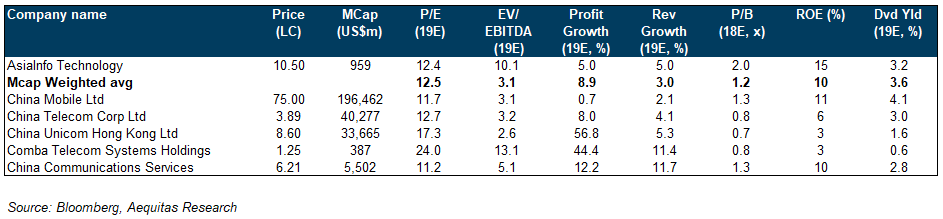
AsiaInfo Tech priced its IPO at HKD 10.50/share and will start trading today. Prior to the trading debut, in this short note, we summarize the latest information with updates on our valuation. 


Our Previous Insight on AsiaInfo Tech:

4. Harbin Electric Expected To Be Privatised

Chart

Power generation equipment manufacturer Harbin Electric Co Ltd H (1133 HK) is currently suspended pursuant to Hong Kong’s Codes on Takeovers and Mergers and Share Buy-backs, suggesting a privatisation offer from parent Harbin Electric Corporation (“HEC”) is pending.

HE is PRC incorporated, therefore a privatisation by way of a merger by absorption may be proposed, similar to Advanced Semiconductor Mfg Corp Ltd. (3355 HK) as discussed in ASMC’s Merger By Absorption. 

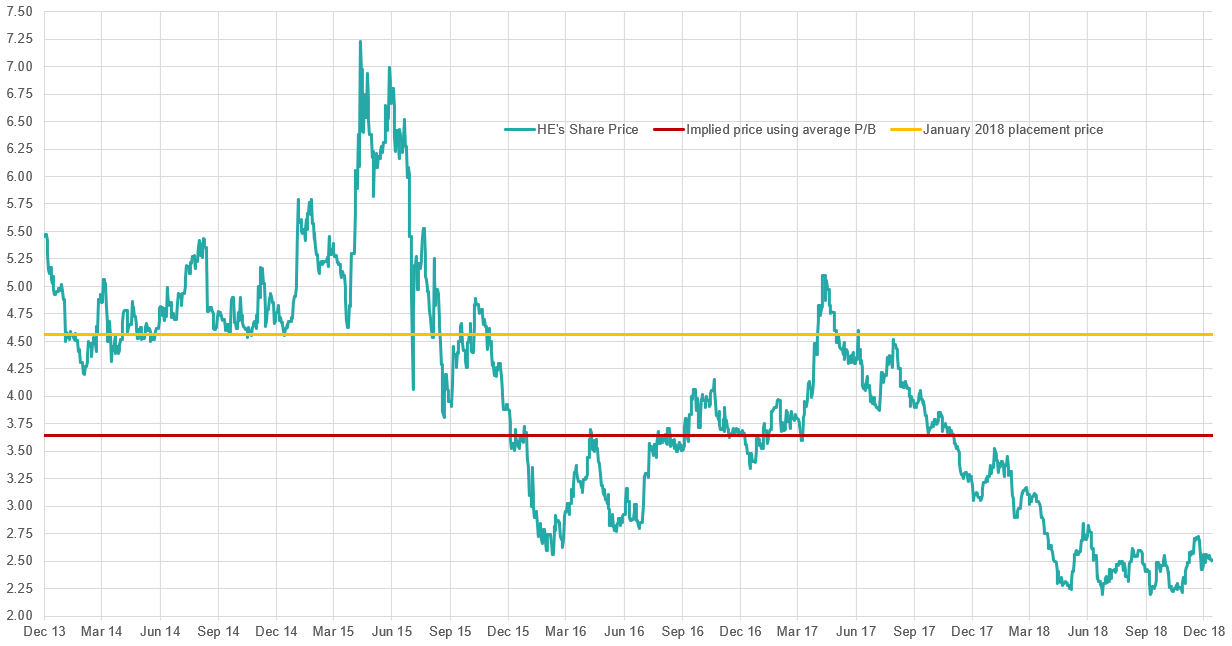
HE has perennially traded at discount to net cash. As at its last traded price, the discount to net cash (using the 2018 interim figure of HK$12.4bn or HK$7.27/share) was 65%.

HE issued 329mn domestic shares (~47.16% of the existing issued domestic shares and ~24.02% of the existing total issued shares) to its parent in January this year, at HK$4.56/share or a 60.9% discount to the June 2017 book value.  A similar discount to the June 2018 book value backs out HK$4.15/share, or ~67% upside from the undisturbed price, in line with the premium to ASMC’s Offer. 

A privatisation would require a scheme-like vote for the H-shares. HEC holds no H shares. There are 675mn H shares and no single shareholder controls a 10% (or more) blocking stake.

Dissension rights are available according to HE’s articles of association, although what constitutes a “fair price” under those rights, and the timing of the settlement under such rights, are not evident. 

There are likely to be the customary PRC regulatory approvals required, however as HEC is already the controlling shareholder and an SOE, these conditions are not in doubt.

Should an offer emerge, expect completion in ~6 months from the initial announcement.
Daily Hong Kong: Micron’s Guidance Bombshell Signals Troubled Times Ahead For Beleaguered Semiconductor Segment and more

By | Hong Kong

In this briefing:

  1. Micron’s Guidance Bombshell Signals Troubled Times Ahead For Beleaguered Semiconductor Segment
  2. TRACKING TRAFFIC/Chinese Express & Logistics: Parcel Pricing Weak, Again
  3. Overview of My Winners and Losers in 2018…and 5 High Conviction Ideas Going into 2019
  4. Universal, SegaSammy & Dynam Sit Best Positioned Among Japan Companies in Race for IR Partnerships
  5. Manias, Booms & Bears: BDI & Shipping Vs Bitcoin… Lessons for Stock Markets

1. Micron’s Guidance Bombshell Signals Troubled Times Ahead For Beleaguered Semiconductor Segment

Screen%20shot%202018 12 20%20at%2011.20.25%20am

After months of skirting around inventory build-up and a weakening demand outlook, Micron used their latest earnings report to call closing time on a revenue and profitability party that began in Q4 2016 and just got better and better with each passing quarter. 

Micron reported Q1 FY2019 results on December 18’th and while revenues were largely in line with recently lowered guidance from the company, their outlook for both Q2 and 2019 as a whole was worse than even the most bearish of expectations. 

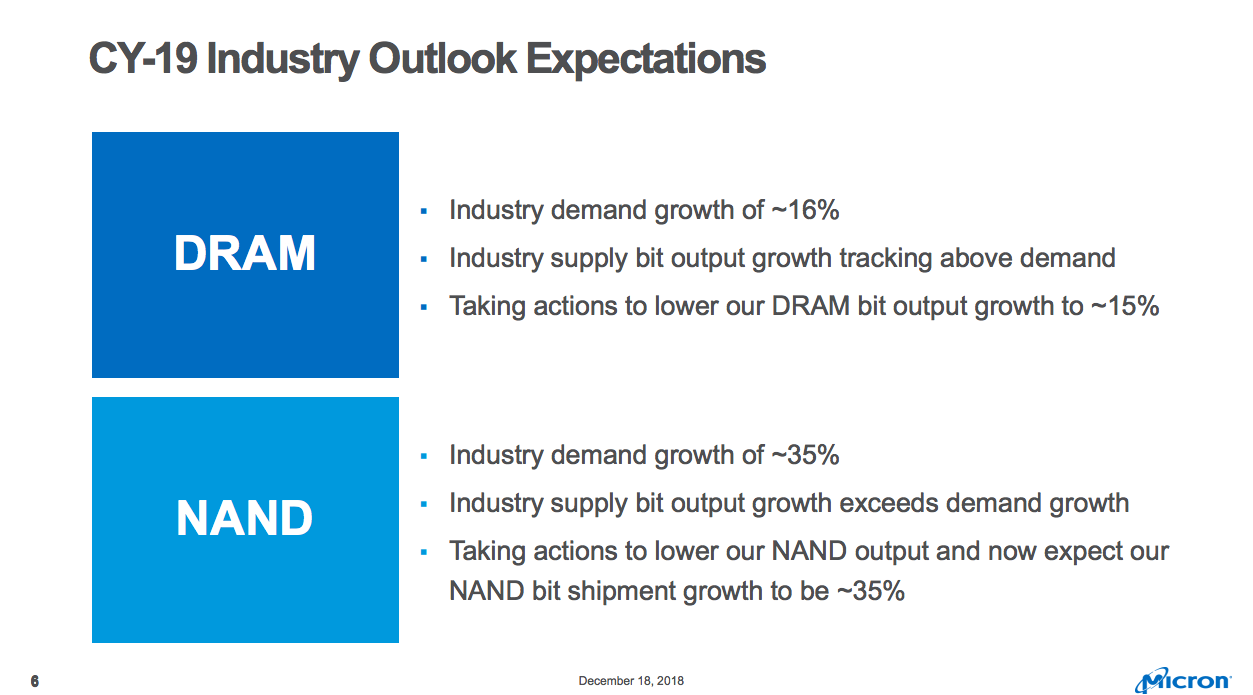
Citing high inventory levels at key customers, Micron guided Q2 FY2019 revenues for $6 billion at the midpoint, down a staggering $1.9 billion, 24% QoQ and 18% YoY. At the same time, Micron revised down their CY2019 bit demand growth forecast for both DRAM (from 20% to 16%) and NAND (35%, the bottom of the previously forecasted range). The company plans to adjust both CapEx and bit supply output downwards to match.

In the wake of their guidance bombshell, Micron’s share price closed down almost 8% the following day to end the session at $31.41, a level last seen in August 2017. Micron is unique in reporting out of sync with its industry peers, making it the proverbial canary in a coal mine. The company’s gloomy outlook and clarion call for further CapEx reductions in a bid to rebalance supply and demand spells troubled times ahead for an already beleaguered semiconductor segment ahead of the upcoming earnings season. 

2. TRACKING TRAFFIC/Chinese Express & Logistics: Parcel Pricing Weak, Again

Nov main exp

Tracking Traffic/Chinese Express & Logistics is the hub for our research on China’s express parcels and logistics sectors. Tracking Traffic/Chinese Express & Logistics features analysis of monthly Chinese express and logistics data, notes from our conversations with industry players, and links to company and thematic notes. 

This month’s issue covers the following topics:

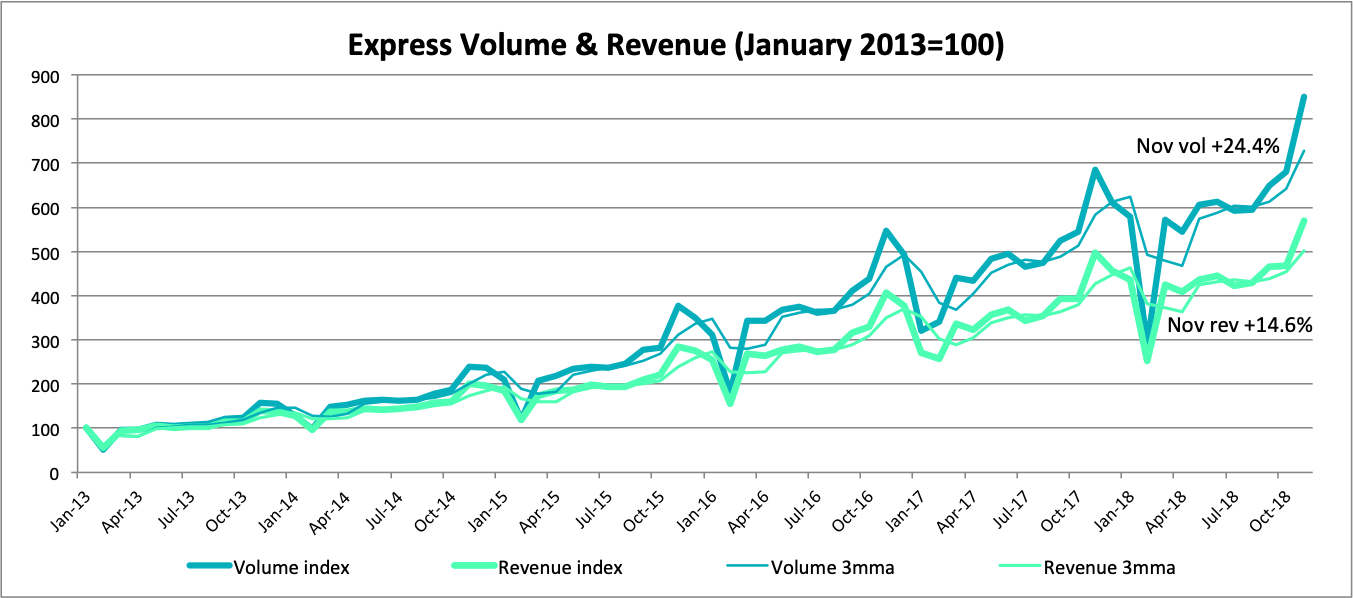
  1. November express parcel pricing remained weak. Average pricing per express parcel fell by 7.8% Y/Y to just 11.06 RMB per piece. November’s average price represents a new all-time low for the industry, and November’s Y/Y decline was the steepest monthly decline in over two years (excluding Lunar New Year months, which tend to be distorted by the timing of the holiday).
  2. Express parcel revenue growth dipped below 15% last month. Weak per-parcel pricing pulled express sector Y/Y revenue growth down to just 14.6% in November, the worst on record (again excluding distorted Lunar New Year comparisons). Chinese e-commerce demand has slowed and we suspect ‘O2O’ initiatives, under which online purchases are fulfilled via local stores, are also undermining express demand growth. 
  3. Intra-city pricing (ie, local delivery) remains firm relative to inter-city. Relative to weak inter-city express pricing (where ZTO Express (ZTO US) and the other listed express companies compete), pricing for local, intra-city express deliveries remained firm. In the first 11 months of 2018, express pricing rose 1.7% Y/Y versus a -2.9% decline in inter-city shipments (international pricing fell sharply, -14.5% Y/Y). Relatively firm pricing on local shipments may make it hard for local food delivery companies like Meituan Dianping (3690 HK) and Alibaba Group Holding (BABA US) ‘s ele.me to beat down unit operating costs. 
  4. Underlying domestic transport demand held up well again in November. Although demand for speedy, relatively expensive express service (and air freight) appears to be moderating, demand for rail and highway freight transport has held up well. The relative strength of rail and water transport (slow, cheap, industry-facing) versus express and air freight (fast, expensive, consumer-oriented) suggests a couple of things: a) upstream industrial activity is stronger than downstream retail activity and b) the people in charge of paying freight are shifting to cheaper modes of transport when possible.

We retain a negative view of China’s express industry’s fundamentals: demand growth is slowing and pricing appears to be falling faster than costs can be cut. Overall domestic transportation demand, however, remains solid and shows no signs of slowing. 

3. Overview of My Winners and Losers in 2018…and 5 High Conviction Ideas Going into 2019

In a follow up to my note from last year Overview of My Winners and Losers in 2017…and 5 High Conviction Ideas Going into 2018 I again look at my stock ideas that have worked out in 2018, those that have not and those where the verdict is still pending.

Last year I provided 5 high conviction ideas and here is their performance in a brutal year for Asian Stock Markets:

Company
Share Price 27 Dec 2017
Share Price 20 December 2018
Dividends
% Total Return
0.70 HKD
0.88 HKD
0.01 HKD
+27%
0.20 SGD
0.27 SGD
0.0 SGD
+35%
2.39 HKD
2.82 HKD
0.147 HKD
+24%
0.84 SGD
0.85 SGD
0.02 SGD
+3.5%
1.44 MYR
0.32 MYR
0.0 MYR
-79%
source: Refinitiv

4 out of 5 had a positive performance.

Below I will make a new attempt to provide five high conviction ideas going into 2019.

4. Universal, SegaSammy & Dynam Sit Best Positioned Among Japan Companies in Race for IR Partnerships

P.php

  • We’ve reviewed 10 companies in the sector. Of those, three are the consensus favorites of our Tokyo based panel of industry, financial and economics observers of the IR initiative over many years.
  • Based on pachinko alone, the stocks of these companies are fully valued. Based on potential tailwind from a license award within 6 months, they could be vastly undervalued.
  • Each of the three noted here brings strength to a bid less based on financials than corporate focus, outlook and experience in the field.

5. Manias, Booms & Bears: BDI & Shipping Vs Bitcoin… Lessons for Stock Markets

Bitcoin%202%20bdi

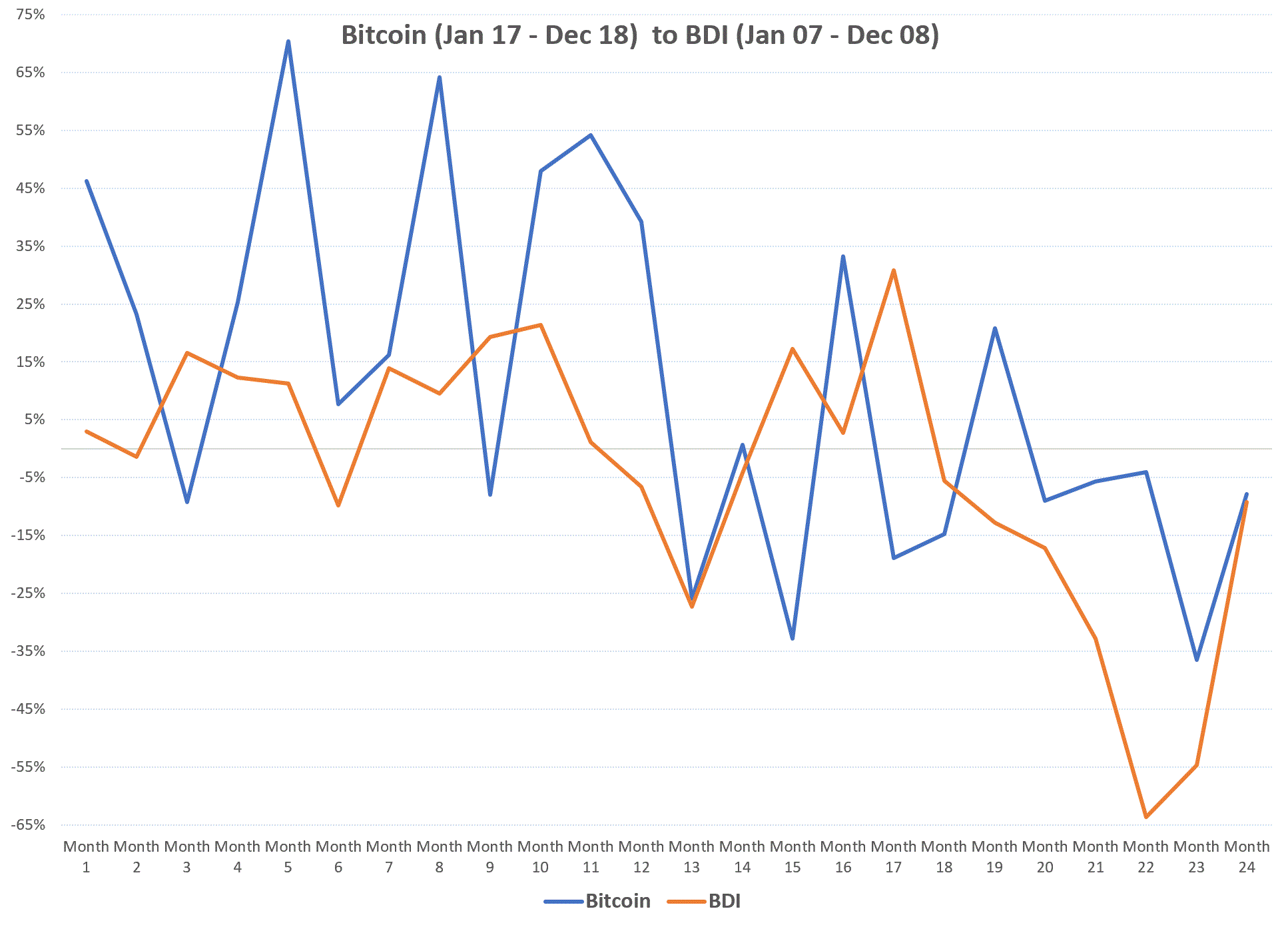
Most of us are following the relatively deep correction in stocks, which has been sparked by a change in psychology reacting to small rises in interest rates coupled to the US – China Trade War, some economic data rolling over, and some growing concerns over Trump thrown in for good measure. The market overall should be able to learn some lessons from the 10+ year bear market in shipping (our contention has always been to expect only a slow rebound in shipping, but the recent risk off has brought these names right back down along with many deep cyclical stocks).

First, we consider the current trajectory of stock market corrections, learning from some behavioral excesses in shipping in the run up to 2008 – and what made the correction so deep for so long.

Second, we look back at the 2006-07 Baltic (BDI) Shipping Index Boom and 2008 crash and contrast a few parallels and differences we see with the Bitcoin Madness of 2017. Maybe we should consider adding a quick comparison of Marijuana stocks, but we don’t yet have the same distance.

In all cases, including Marijuana stocks recent rallies, the big boom came as supply was squeezed as demand went beyond physical, and developed a life of their own. With small market caps gaining a world audience, the game is easy to play initially, with those having the greatest foolhardiness or courage possibly getting to time exits or partial exits toward tops. Analytically, we usually see the madness way ahead, and the first tricks are to make up stories on why we should continue to buy. And then comes the brick wall.

Daily Hong Kong: 2019 Asia Selected Gaming Stock Outlook: Headwinds, Tailwinds and Our Top Picks for Entry Levels Now and more

By | Hong Kong

In this briefing:

  1. 2019 Asia Selected Gaming Stock Outlook: Headwinds, Tailwinds and Our Top Picks for Entry Levels Now
  2. Are US Stocks Still Expensive?
  3. Business Happenings in the Americas that May Be “Below the Radar” – Week Ending December 22, 2018
  4. Singapore REIT – Preferred Picks 2019
  5. Micron’s Guidance Bombshell Signals Troubled Times Ahead For Beleaguered Semiconductor Segment

1. 2019 Asia Selected Gaming Stock Outlook: Headwinds, Tailwinds and Our Top Picks for Entry Levels Now

Dma 095378 l

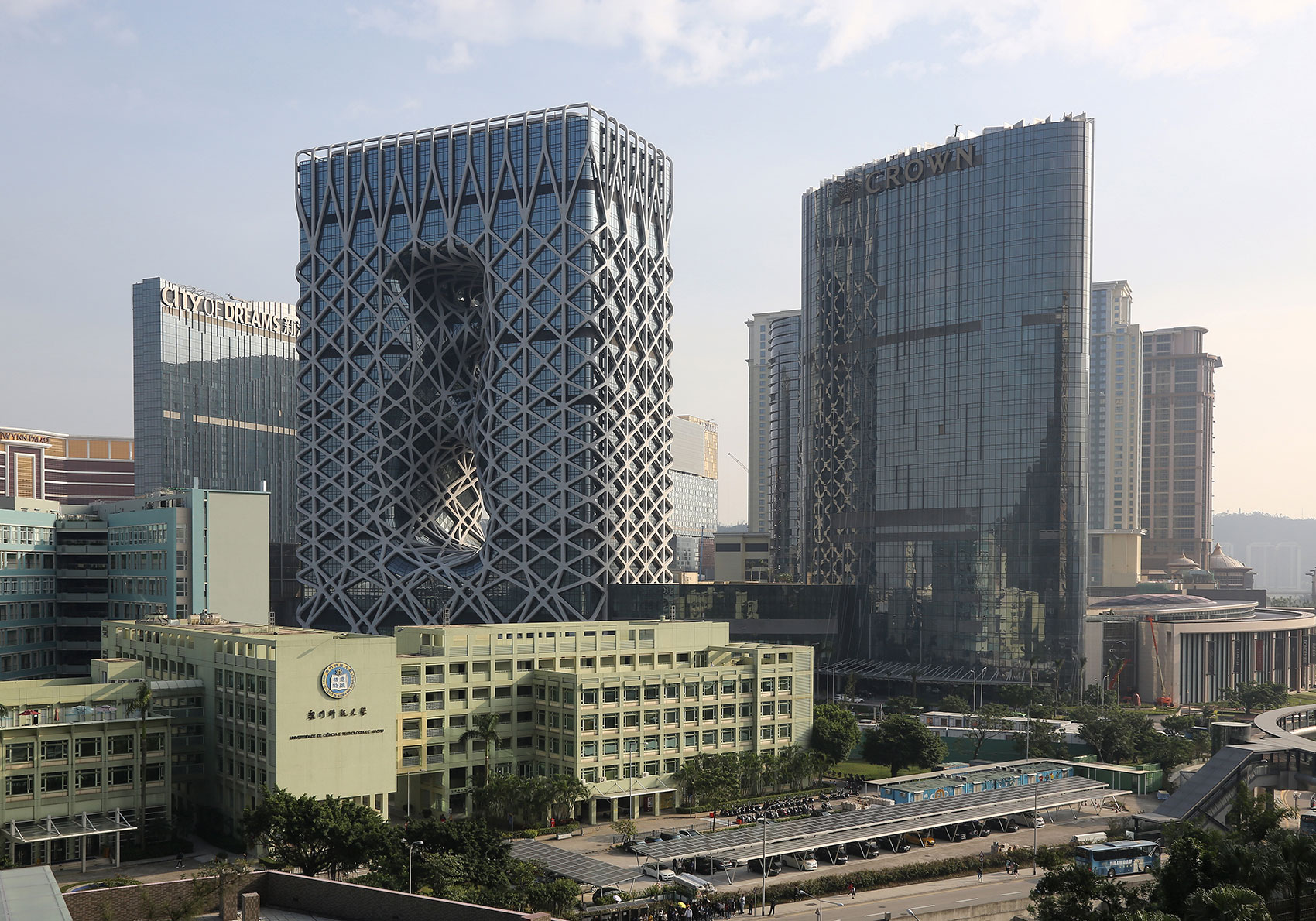
Our review of ten Asian gaming companies forward prospects for 2019 yielded our top five picks. Two of those comprise this insight. Three more will follow in Part Two. There is, in our opinion, some disconnect between continuing macro headwinds in both the VIP and mass sectors and a more bullish tone based on a recent upside trend in Macau, strong results in the Philippines and Cambodia. Given the battering of the market in general, the already 8 month old bearish tone to the sector and the current pricing of the two stocks noted here, we see significant upside opportunity as we near the beginning of 2019.

2. Are US Stocks Still Expensive?

Picture1

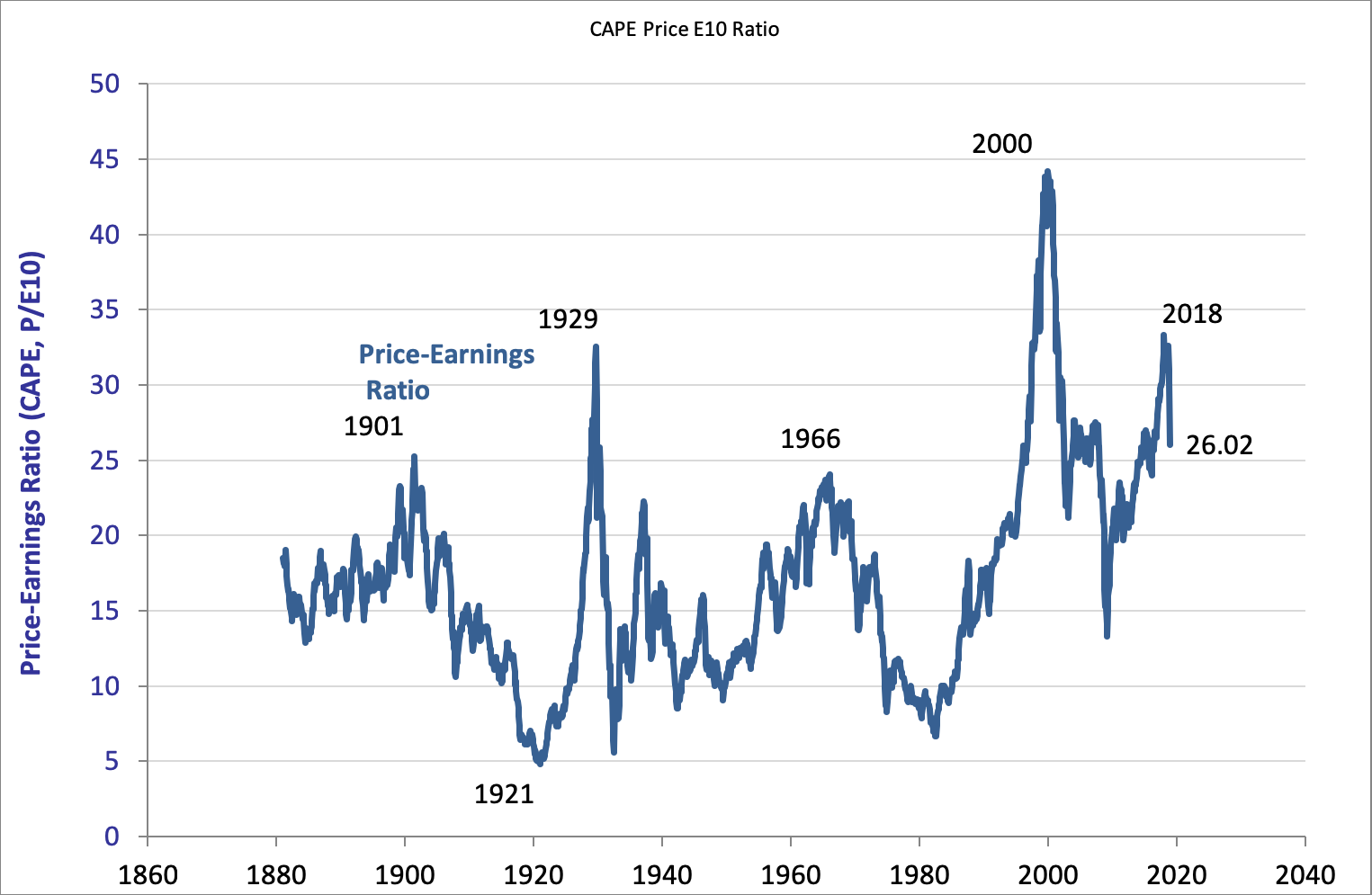
There are striking parallels between 1929 and 2018.  

The 1929 crash put a halt to a nine-year bull run on the market.

Up until October 1929, same as this year, market consensus was that asset prices could only go up from their current level.

As we mentioned in When the Tide Goes Out, Dominoes Fall, a decade of building up excesses meant a painful burst, back 79 years ago: between October of 1929 and September of 1932, eighty-nine percent of the value of stocks was erased and the market didn’t recover to its former peak until 25 years later.

Are we in a similar situation right now? 

3. Business Happenings in the Americas that May Be “Below the Radar” – Week Ending December 22, 2018

Sesame%20credit%20report

Highlights of significant recent happenings include:

  1. Feeding the Dragon – Sumitomo Corp (8053 JP) buying into massive Chile copper project; Mitsui & Co Ltd (8031 JP) and Tokyo Gas (9531 JP) announced plans to be long-term buyers of Mexican LNG.
  2.  Local News on Global Companies Huawei Technology (40978Z CH)‘s to do “whatever is required” to meet Canada’s 5G security standards; Ant Financial (1051260D CH)’s Sesame Credit be used to apply for Canadian visas;  Facebook Inc A (FB US) offered data to  Netflix Inc (NFLX US) and Royal Bank Of Canada (RY CN)BlackBerry Ltd (BB CN)‘s high-security reputation increasingly valuable; Fedex Corp (FDX US) and  United Parcel Service Cl B (UPS US) deny negative impact from  Amazon.com Inc (AMZN US)‘s Amazon Air operations; and Anheuser Busch Inbev Sa (Adr) (BUD US) and Tilray Inc (TLRY US) are doing “joint” product development.
  3. Trade Deals & No Deals – Bosideng Intl Hldgs (3998 HK) got an unexpected boost, while Canada Goose Holdings (GOOS CN) took an unexpected hit as a consequence of the U.S.A. Government’s problems with Huawei Technology (40978Z CH)
  4. Outliers – Another “silver lining” to global warming?  The Warming Arctic Opens the Northwest Passage as a Potential Maritime Superhighway

4. Singapore REIT – Preferred Picks 2019

With the FTSE ST REIT index’s decline of 9.3% year-to-date, value has emerged for some of the bellwether names in the Singapore REITs sector. The forward yield spread between these REITs and the Singapore government 10-year bond yield (2.13%) currently stand at least 390 basis points. In view of the increasing concerns over global economic growth, rising interest rates and the ongoing trade tension between the US and China, I present three quality REITs with fortified portfolios that are well-positioned to weather the near-term market uncertainties. They possess growth potential from acquisitions, positive rental reversions and deliver resilient forward distribution yield of more than 6%. Some of the bellwether names in the more resilient retail REIT sector, while offering lower yield of around 5.0% – 5.7%, are also in my buy list. 

5. Micron’s Guidance Bombshell Signals Troubled Times Ahead For Beleaguered Semiconductor Segment

Screen%20shot%202018 12 20%20at%2011.20.25%20am

After months of skirting around inventory build-up and a weakening demand outlook, Micron used their latest earnings report to call closing time on a revenue and profitability party that began in Q4 2016 and just got better and better with each passing quarter. 

Micron reported Q1 FY2019 results on December 18’th and while revenues were largely in line with recently lowered guidance from the company, their outlook for both Q2 and 2019 as a whole was worse than even the most bearish of expectations. 

Citing high inventory levels at key customers, Micron guided Q2 FY2019 revenues for $6 billion at the midpoint, down a staggering $1.9 billion, 24% QoQ and 18% YoY. At the same time, Micron revised down their CY2019 bit demand growth forecast for both DRAM (from 20% to 16%) and NAND (35%, the bottom of the previously forecasted range). The company plans to adjust both CapEx and bit supply output downwards to match.

In the wake of their guidance bombshell, Micron’s share price closed down almost 8% the following day to end the session at $31.41, a level last seen in August 2017. Micron is unique in reporting out of sync with its industry peers, making it the proverbial canary in a coal mine. The company’s gloomy outlook and clarion call for further CapEx reductions in a bid to rebalance supply and demand spells troubled times ahead for an already beleaguered semiconductor segment ahead of the upcoming earnings season. 

Daily Hong Kong: TRACKING TRAFFIC/Chinese Express & Logistics: Parcel Pricing Weak, Again and more

By | Hong Kong

In this briefing:

  1. TRACKING TRAFFIC/Chinese Express & Logistics: Parcel Pricing Weak, Again
  2. Overview of My Winners and Losers in 2018…and 5 High Conviction Ideas Going into 2019
  3. Universal, SegaSammy & Dynam Sit Best Positioned Among Japan Companies in Race for IR Partnerships
  4. Manias, Booms & Bears: BDI & Shipping Vs Bitcoin… Lessons for Stock Markets
  5. Time-Out Not Time up for Trade War

1. TRACKING TRAFFIC/Chinese Express & Logistics: Parcel Pricing Weak, Again

Nov main exp

Tracking Traffic/Chinese Express & Logistics is the hub for our research on China’s express parcels and logistics sectors. Tracking Traffic/Chinese Express & Logistics features analysis of monthly Chinese express and logistics data, notes from our conversations with industry players, and links to company and thematic notes. 

This month’s issue covers the following topics:

  1. November express parcel pricing remained weak. Average pricing per express parcel fell by 7.8% Y/Y to just 11.06 RMB per piece. November’s average price represents a new all-time low for the industry, and November’s Y/Y decline was the steepest monthly decline in over two years (excluding Lunar New Year months, which tend to be distorted by the timing of the holiday).
  2. Express parcel revenue growth dipped below 15% last month. Weak per-parcel pricing pulled express sector Y/Y revenue growth down to just 14.6% in November, the worst on record (again excluding distorted Lunar New Year comparisons). Chinese e-commerce demand has slowed and we suspect ‘O2O’ initiatives, under which online purchases are fulfilled via local stores, are also undermining express demand growth. 
  3. Intra-city pricing (ie, local delivery) remains firm relative to inter-city. Relative to weak inter-city express pricing (where ZTO Express (ZTO US) and the other listed express companies compete), pricing for local, intra-city express deliveries remained firm. In the first 11 months of 2018, express pricing rose 1.7% Y/Y versus a -2.9% decline in inter-city shipments (international pricing fell sharply, -14.5% Y/Y). Relatively firm pricing on local shipments may make it hard for local food delivery companies like Meituan Dianping (3690 HK) and Alibaba Group Holding (BABA US) ‘s ele.me to beat down unit operating costs. 
  4. Underlying domestic transport demand held up well again in November. Although demand for speedy, relatively expensive express service (and air freight) appears to be moderating, demand for rail and highway freight transport has held up well. The relative strength of rail and water transport (slow, cheap, industry-facing) versus express and air freight (fast, expensive, consumer-oriented) suggests a couple of things: a) upstream industrial activity is stronger than downstream retail activity and b) the people in charge of paying freight are shifting to cheaper modes of transport when possible.

We retain a negative view of China’s express industry’s fundamentals: demand growth is slowing and pricing appears to be falling faster than costs can be cut. Overall domestic transportation demand, however, remains solid and shows no signs of slowing. 

2. Overview of My Winners and Losers in 2018…and 5 High Conviction Ideas Going into 2019

In a follow up to my note from last year Overview of My Winners and Losers in 2017…and 5 High Conviction Ideas Going into 2018 I again look at my stock ideas that have worked out in 2018, those that have not and those where the verdict is still pending.

Last year I provided 5 high conviction ideas and here is their performance in a brutal year for Asian Stock Markets:

Company
Share Price 27 Dec 2017
Share Price 20 December 2018
Dividends
% Total Return
0.70 HKD
0.88 HKD
0.01 HKD
+27%
0.20 SGD
0.27 SGD
0.0 SGD
+35%
2.39 HKD
2.82 HKD
0.147 HKD
+24%
0.84 SGD
0.85 SGD
0.02 SGD
+3.5%
1.44 MYR
0.32 MYR
0.0 MYR
-79%
source: Refinitiv

4 out of 5 had a positive performance.

Below I will make a new attempt to provide five high conviction ideas going into 2019.

3. Universal, SegaSammy & Dynam Sit Best Positioned Among Japan Companies in Race for IR Partnerships

P.php

  • We’ve reviewed 10 companies in the sector. Of those, three are the consensus favorites of our Tokyo based panel of industry, financial and economics observers of the IR initiative over many years.
  • Based on pachinko alone, the stocks of these companies are fully valued. Based on potential tailwind from a license award within 6 months, they could be vastly undervalued.
  • Each of the three noted here brings strength to a bid less based on financials than corporate focus, outlook and experience in the field.

4. Manias, Booms & Bears: BDI & Shipping Vs Bitcoin… Lessons for Stock Markets

Bitcoin%202%20bdi

Most of us are following the relatively deep correction in stocks, which has been sparked by a change in psychology reacting to small rises in interest rates coupled to the US – China Trade War, some economic data rolling over, and some growing concerns over Trump thrown in for good measure. The market overall should be able to learn some lessons from the 10+ year bear market in shipping (our contention has always been to expect only a slow rebound in shipping, but the recent risk off has brought these names right back down along with many deep cyclical stocks).

First, we consider the current trajectory of stock market corrections, learning from some behavioral excesses in shipping in the run up to 2008 – and what made the correction so deep for so long.

Second, we look back at the 2006-07 Baltic (BDI) Shipping Index Boom and 2008 crash and contrast a few parallels and differences we see with the Bitcoin Madness of 2017. Maybe we should consider adding a quick comparison of Marijuana stocks, but we don’t yet have the same distance.

In all cases, including Marijuana stocks recent rallies, the big boom came as supply was squeezed as demand went beyond physical, and developed a life of their own. With small market caps gaining a world audience, the game is easy to play initially, with those having the greatest foolhardiness or courage possibly getting to time exits or partial exits toward tops. Analytically, we usually see the madness way ahead, and the first tricks are to make up stories on why we should continue to buy. And then comes the brick wall.

5. Time-Out Not Time up for Trade War

Sk1

  • Xi and Trump walk away from Buenos Aires with something to sell at home
  • But trade negotiations will be dominated by fraught disagreements
  • After 90-day negotiations, further delays to tariff escalation are likely 

Daily Hong Kong: Semiconductor WFE Outlook. Things Just Got Really Ugly and more

By | Hong Kong

In this briefing:

  1. Semiconductor WFE Outlook. Things Just Got Really Ugly
  2. AsiaInfo Tech (亚信科技) IPO: What You Need to Know Before the Trading Debut
  3. Harbin Electric Expected To Be Privatised

1. Semiconductor WFE Outlook. Things Just Got Really Ugly

Screen%20shot%202018 12 19%20at%208.59.03%20am

SEMI, the global industry association serving the manufacturing supply chain for the electronics industry, published three different forecasts for wafer fab equipment (WFE) sales in the past week. While the forecasts differ in approach and detail, they all agree on one thing, WFE revenues are continuing to fall and the outlook for 2019 is sharply down on previous estimates.

Specifically, Q4 2018 WFE revenues are set to decline 20.8% or $3.3 billion QoQ and the forecast which had just six months ago predicted 7% growth in 2019 is now calling for an 8% decline next year. 

These latest forecasts cast a dark shadow over the predictions of the leading WFE manufacturers that H1 2019 would be stronger than H2 2018 and we anticipate a strong downward revision of forward guidance in the upcoming earnings season. 

There may be a glimmer of hope on the horizon however as SEMI forecasts a strong rebound in the second half of 2019 leading to a return to growth of ~20% in 2020. Let’s see.  

2. AsiaInfo Tech (亚信科技) IPO: What You Need to Know Before the Trading Debut

Valuation%20dec%2018thpng

AsiaInfo Tech priced its IPO at HKD 10.50/share and will start trading today. Prior to the trading debut, in this short note, we summarize the latest information with updates on our valuation. 


Our Previous Insight on AsiaInfo Tech:

3. Harbin Electric Expected To Be Privatised

Chart

Power generation equipment manufacturer Harbin Electric Co Ltd H (1133 HK) is currently suspended pursuant to Hong Kong’s Codes on Takeovers and Mergers and Share Buy-backs, suggesting a privatisation offer from parent Harbin Electric Corporation (“HEC”) is pending.

HE is PRC incorporated, therefore a privatisation by way of a merger by absorption may be proposed, similar to Advanced Semiconductor Mfg Corp Ltd. (3355 HK) as discussed in ASMC’s Merger By Absorption. 

HE has perennially traded at discount to net cash. As at its last traded price, the discount to net cash (using the 2018 interim figure of HK$12.4bn or HK$7.27/share) was 65%.

HE issued 329mn domestic shares (~47.16% of the existing issued domestic shares and ~24.02% of the existing total issued shares) to its parent in January this year, at HK$4.56/share or a 60.9% discount to the June 2017 book value.  A similar discount to the June 2018 book value backs out HK$4.15/share, or ~67% upside from the undisturbed price, in line with the premium to ASMC’s Offer. 

A privatisation would require a scheme-like vote for the H-shares. HEC holds no H shares. There are 675mn H shares and no single shareholder controls a 10% (or more) blocking stake.

Dissension rights are available according to HE’s articles of association, although what constitutes a “fair price” under those rights, and the timing of the settlement under such rights, are not evident. 

There are likely to be the customary PRC regulatory approvals required, however as HEC is already the controlling shareholder and an SOE, these conditions are not in doubt.

Should an offer emerge, expect completion in ~6 months from the initial announcement.

Daily Hong Kong: Are US Stocks Still Expensive? and more

By | Hong Kong

In this briefing:

  1. Are US Stocks Still Expensive?
  2. Business Happenings in the Americas that May Be “Below the Radar” – Week Ending December 22, 2018
  3. Singapore REIT – Preferred Picks 2019
  4. Micron’s Guidance Bombshell Signals Troubled Times Ahead For Beleaguered Semiconductor Segment
  5. TRACKING TRAFFIC/Chinese Express & Logistics: Parcel Pricing Weak, Again

1. Are US Stocks Still Expensive?

Picture1

There are striking parallels between 1929 and 2018.  

The 1929 crash put a halt to a nine-year bull run on the market.

Up until October 1929, same as this year, market consensus was that asset prices could only go up from their current level.

As we mentioned in When the Tide Goes Out, Dominoes Fall, a decade of building up excesses meant a painful burst, back 79 years ago: between October of 1929 and September of 1932, eighty-nine percent of the value of stocks was erased and the market didn’t recover to its former peak until 25 years later.

Are we in a similar situation right now? 

2. Business Happenings in the Americas that May Be “Below the Radar” – Week Ending December 22, 2018

Costa%20mexico%20lng%20project

Highlights of significant recent happenings include:

  1. Feeding the Dragon – Sumitomo Corp (8053 JP) buying into massive Chile copper project; Mitsui & Co Ltd (8031 JP) and Tokyo Gas (9531 JP) announced plans to be long-term buyers of Mexican LNG.
  2.  Local News on Global Companies Huawei Technology (40978Z CH)‘s to do “whatever is required” to meet Canada’s 5G security standards; Ant Financial (1051260D CH)’s Sesame Credit be used to apply for Canadian visas;  Facebook Inc A (FB US) offered data to  Netflix Inc (NFLX US) and Royal Bank Of Canada (RY CN)BlackBerry Ltd (BB CN)‘s high-security reputation increasingly valuable; Fedex Corp (FDX US) and  United Parcel Service Cl B (UPS US) deny negative impact from  Amazon.com Inc (AMZN US)‘s Amazon Air operations; and Anheuser Busch Inbev Sa (Adr) (BUD US) and Tilray Inc (TLRY US) are doing “joint” product development.
  3. Trade Deals & No Deals – Bosideng Intl Hldgs (3998 HK) got an unexpected boost, while Canada Goose Holdings (GOOS CN) took an unexpected hit as a consequence of the U.S.A. Government’s problems with Huawei Technology (40978Z CH)
  4. Outliers – Another “silver lining” to global warming?  The Warming Arctic Opens the Northwest Passage as a Potential Maritime Superhighway

3. Singapore REIT – Preferred Picks 2019

With the FTSE ST REIT index’s decline of 9.3% year-to-date, value has emerged for some of the bellwether names in the Singapore REITs sector. The forward yield spread between these REITs and the Singapore government 10-year bond yield (2.13%) currently stand at least 390 basis points. In view of the increasing concerns over global economic growth, rising interest rates and the ongoing trade tension between the US and China, I present three quality REITs with fortified portfolios that are well-positioned to weather the near-term market uncertainties. They possess growth potential from acquisitions, positive rental reversions and deliver resilient forward distribution yield of more than 6%. Some of the bellwether names in the more resilient retail REIT sector, while offering lower yield of around 5.0% – 5.7%, are also in my buy list. 

4. Micron’s Guidance Bombshell Signals Troubled Times Ahead For Beleaguered Semiconductor Segment

Screen%20shot%202018 12 20%20at%2011.20.25%20am

After months of skirting around inventory build-up and a weakening demand outlook, Micron used their latest earnings report to call closing time on a revenue and profitability party that began in Q4 2016 and just got better and better with each passing quarter. 

Micron reported Q1 FY2019 results on December 18’th and while revenues were largely in line with recently lowered guidance from the company, their outlook for both Q2 and 2019 as a whole was worse than even the most bearish of expectations. 

Citing high inventory levels at key customers, Micron guided Q2 FY2019 revenues for $6 billion at the midpoint, down a staggering $1.9 billion, 24% QoQ and 18% YoY. At the same time, Micron revised down their CY2019 bit demand growth forecast for both DRAM (from 20% to 16%) and NAND (35%, the bottom of the previously forecasted range). The company plans to adjust both CapEx and bit supply output downwards to match.

In the wake of their guidance bombshell, Micron’s share price closed down almost 8% the following day to end the session at $31.41, a level last seen in August 2017. Micron is unique in reporting out of sync with its industry peers, making it the proverbial canary in a coal mine. The company’s gloomy outlook and clarion call for further CapEx reductions in a bid to rebalance supply and demand spells troubled times ahead for an already beleaguered semiconductor segment ahead of the upcoming earnings season. 

5. TRACKING TRAFFIC/Chinese Express & Logistics: Parcel Pricing Weak, Again

Nov main exp

Tracking Traffic/Chinese Express & Logistics is the hub for our research on China’s express parcels and logistics sectors. Tracking Traffic/Chinese Express & Logistics features analysis of monthly Chinese express and logistics data, notes from our conversations with industry players, and links to company and thematic notes. 

This month’s issue covers the following topics:

  1. November express parcel pricing remained weak. Average pricing per express parcel fell by 7.8% Y/Y to just 11.06 RMB per piece. November’s average price represents a new all-time low for the industry, and November’s Y/Y decline was the steepest monthly decline in over two years (excluding Lunar New Year months, which tend to be distorted by the timing of the holiday).
  2. Express parcel revenue growth dipped below 15% last month. Weak per-parcel pricing pulled express sector Y/Y revenue growth down to just 14.6% in November, the worst on record (again excluding distorted Lunar New Year comparisons). Chinese e-commerce demand has slowed and we suspect ‘O2O’ initiatives, under which online purchases are fulfilled via local stores, are also undermining express demand growth. 
  3. Intra-city pricing (ie, local delivery) remains firm relative to inter-city. Relative to weak inter-city express pricing (where ZTO Express (ZTO US) and the other listed express companies compete), pricing for local, intra-city express deliveries remained firm. In the first 11 months of 2018, express pricing rose 1.7% Y/Y versus a -2.9% decline in inter-city shipments (international pricing fell sharply, -14.5% Y/Y). Relatively firm pricing on local shipments may make it hard for local food delivery companies like Meituan Dianping (3690 HK) and Alibaba Group Holding (BABA US) ‘s ele.me to beat down unit operating costs. 
  4. Underlying domestic transport demand held up well again in November. Although demand for speedy, relatively expensive express service (and air freight) appears to be moderating, demand for rail and highway freight transport has held up well. The relative strength of rail and water transport (slow, cheap, industry-facing) versus express and air freight (fast, expensive, consumer-oriented) suggests a couple of things: a) upstream industrial activity is stronger than downstream retail activity and b) the people in charge of paying freight are shifting to cheaper modes of transport when possible.

We retain a negative view of China’s express industry’s fundamentals: demand growth is slowing and pricing appears to be falling faster than costs can be cut. Overall domestic transportation demand, however, remains solid and shows no signs of slowing. 

Daily Hong Kong: AsiaInfo Tech (亚信科技) IPO: What You Need to Know Before the Trading Debut and more

By | Hong Kong

In this briefing:

  1. AsiaInfo Tech (亚信科技) IPO: What You Need to Know Before the Trading Debut
  2. Harbin Electric Expected To Be Privatised
  3. Discover HK Connect: Mainlanders Are Buying Shandong Gold, and Pharmaceuticals (2018-12-17)
  4. Last Week’s GER IPO Research: Tencent Music, IPO Trading Strategy Deep Dive, WuXi, Junshi & Xinyi

1. AsiaInfo Tech (亚信科技) IPO: What You Need to Know Before the Trading Debut

Valuation%20dec%2018thpng

AsiaInfo Tech priced its IPO at HKD 10.50/share and will start trading today. Prior to the trading debut, in this short note, we summarize the latest information with updates on our valuation. 


Our Previous Insight on AsiaInfo Tech:

2. Harbin Electric Expected To Be Privatised

Chart

Power generation equipment manufacturer Harbin Electric Co Ltd H (1133 HK) is currently suspended pursuant to Hong Kong’s Codes on Takeovers and Mergers and Share Buy-backs, suggesting a privatisation offer from parent Harbin Electric Corporation (“HEC”) is pending.

HE is PRC incorporated, therefore a privatisation by way of a merger by absorption may be proposed, similar to Advanced Semiconductor Mfg Corp Ltd. (3355 HK) as discussed in ASMC’s Merger By Absorption. 

HE has perennially traded at discount to net cash. As at its last traded price, the discount to net cash (using the 2018 interim figure of HK$12.4bn or HK$7.27/share) was 65%.

HE issued 329mn domestic shares (~47.16% of the existing issued domestic shares and ~24.02% of the existing total issued shares) to its parent in January this year, at HK$4.56/share or a 60.9% discount to the June 2017 book value.  A similar discount to the June 2018 book value backs out HK$4.15/share, or ~67% upside from the undisturbed price, in line with the premium to ASMC’s Offer. 

A privatisation would require a scheme-like vote for the H-shares. HEC holds no H shares. There are 675mn H shares and no single shareholder controls a 10% (or more) blocking stake.

Dissension rights are available according to HE’s articles of association, although what constitutes a “fair price” under those rights, and the timing of the settlement under such rights, are not evident. 

There are likely to be the customary PRC regulatory approvals required, however as HEC is already the controlling shareholder and an SOE, these conditions are not in doubt.

Should an offer emerge, expect completion in ~6 months from the initial announcement.

3. Discover HK Connect: Mainlanders Are Buying Shandong Gold, and Pharmaceuticals (2018-12-17)

Mid%20cap%20by%20outflow

In our Discover HK Connect series, we aim to help our investors understand the flow of southbound trades via the Hong Kong Connect, as analyzed by our proprietary data engine. We will discuss the stocks that experienced the most inflow and outflow by mainlanders in the past seven days.

We split the stocks eligible for the Hong Kong Connect trade into three groups: those with a market capitalization of above USD 5 billion, those with a market capitalization between USD 1 billion and USD 5 billion, and those with a market capitalization between USD 500 million and USD 1 billion.

4. Last Week’s GER IPO Research: Tencent Music, IPO Trading Strategy Deep Dive, WuXi, Junshi & Xinyi

Another busy week for IPO research from the GER team. This week, we recap the Tencent Music Entertainment (TME US) IPO which we noted is more fairly valued post its day one rally. Secondly, we dig into Chinese domiciled IPOs that are listed in the States and find some interesting trends on maximizing the ‘pop’, knowing when to get out and an assessment of longer-term performance. Arun nails his DCF valuation on WuXi AppTec Co. Ltd. (2359 HK) which closed at his base-case valuation while he recommends getting involved at the low-end for Shanghai Junshi Bioscience Co. Ltd. (1387344D CH) . Finally, Xinyi Energy Holdings Ltd (1671746D HK) spares further wrath as it postpones its IPO – Venkat digs into the reasons why he is cautious on the company. 

Quote of the week: 

Please note the post-apocalyptical fiction section has been moved to current affairs

– Sign in front of a UK bookstore

Video of the week: Santas hit the slopes in Maine

This is our last wrap of 2018 – we wish you a safe and happy festive period – and we will back in 2019!

Best wishes – Rickin, Venkat and Arun

Daily Hong Kong: Business Happenings in the Americas that May Be “Below the Radar” – Week Ending December 22, 2018 and more

By | Hong Kong

In this briefing:

  1. Business Happenings in the Americas that May Be “Below the Radar” – Week Ending December 22, 2018
  2. Singapore REIT – Preferred Picks 2019
  3. Micron’s Guidance Bombshell Signals Troubled Times Ahead For Beleaguered Semiconductor Segment
  4. TRACKING TRAFFIC/Chinese Express & Logistics: Parcel Pricing Weak, Again
  5. Overview of My Winners and Losers in 2018…and 5 High Conviction Ideas Going into 2019

1. Business Happenings in the Americas that May Be “Below the Radar” – Week Ending December 22, 2018

Northwest passage%20route

Highlights of significant recent happenings include:

  1. Feeding the Dragon – Sumitomo Corp (8053 JP) buying into massive Chile copper project; Mitsui & Co Ltd (8031 JP) and Tokyo Gas (9531 JP) announced plans to be long-term buyers of Mexican LNG.
  2.  Local News on Global Companies Huawei Technology (40978Z CH)‘s to do “whatever is required” to meet Canada’s 5G security standards; Ant Financial (1051260D CH)’s Sesame Credit be used to apply for Canadian visas;  Facebook Inc A (FB US) offered data to  Netflix Inc (NFLX US) and Royal Bank Of Canada (RY CN)BlackBerry Ltd (BB CN)‘s high-security reputation increasingly valuable; Fedex Corp (FDX US) and  United Parcel Service Cl B (UPS US) deny negative impact from  Amazon.com Inc (AMZN US)‘s Amazon Air operations; and Anheuser Busch Inbev Sa (Adr) (BUD US) and Tilray Inc (TLRY US) are doing “joint” product development.
  3. Trade Deals & No Deals – Bosideng Intl Hldgs (3998 HK) got an unexpected boost, while Canada Goose Holdings (GOOS CN) took an unexpected hit as a consequence of the U.S.A. Government’s problems with Huawei Technology (40978Z CH)
  4. Outliers – Another “silver lining” to global warming?  The Warming Arctic Opens the Northwest Passage as a Potential Maritime Superhighway

2. Singapore REIT – Preferred Picks 2019

With the FTSE ST REIT index’s decline of 9.3% year-to-date, value has emerged for some of the bellwether names in the Singapore REITs sector. The forward yield spread between these REITs and the Singapore government 10-year bond yield (2.13%) currently stand at least 390 basis points. In view of the increasing concerns over global economic growth, rising interest rates and the ongoing trade tension between the US and China, I present three quality REITs with fortified portfolios that are well-positioned to weather the near-term market uncertainties. They possess growth potential from acquisitions, positive rental reversions and deliver resilient forward distribution yield of more than 6%. Some of the bellwether names in the more resilient retail REIT sector, while offering lower yield of around 5.0% – 5.7%, are also in my buy list. 

3. Micron’s Guidance Bombshell Signals Troubled Times Ahead For Beleaguered Semiconductor Segment

Screen%20shot%202018 12 20%20at%2011.18.03%20am

After months of skirting around inventory build-up and a weakening demand outlook, Micron used their latest earnings report to call closing time on a revenue and profitability party that began in Q4 2016 and just got better and better with each passing quarter. 

Micron reported Q1 FY2019 results on December 18’th and while revenues were largely in line with recently lowered guidance from the company, their outlook for both Q2 and 2019 as a whole was worse than even the most bearish of expectations. 

Citing high inventory levels at key customers, Micron guided Q2 FY2019 revenues for $6 billion at the midpoint, down a staggering $1.9 billion, 24% QoQ and 18% YoY. At the same time, Micron revised down their CY2019 bit demand growth forecast for both DRAM (from 20% to 16%) and NAND (35%, the bottom of the previously forecasted range). The company plans to adjust both CapEx and bit supply output downwards to match.

In the wake of their guidance bombshell, Micron’s share price closed down almost 8% the following day to end the session at $31.41, a level last seen in August 2017. Micron is unique in reporting out of sync with its industry peers, making it the proverbial canary in a coal mine. The company’s gloomy outlook and clarion call for further CapEx reductions in a bid to rebalance supply and demand spells troubled times ahead for an already beleaguered semiconductor segment ahead of the upcoming earnings season. 

4. TRACKING TRAFFIC/Chinese Express & Logistics: Parcel Pricing Weak, Again

Nov main exp

Tracking Traffic/Chinese Express & Logistics is the hub for our research on China’s express parcels and logistics sectors. Tracking Traffic/Chinese Express & Logistics features analysis of monthly Chinese express and logistics data, notes from our conversations with industry players, and links to company and thematic notes. 

This month’s issue covers the following topics:

  1. November express parcel pricing remained weak. Average pricing per express parcel fell by 7.8% Y/Y to just 11.06 RMB per piece. November’s average price represents a new all-time low for the industry, and November’s Y/Y decline was the steepest monthly decline in over two years (excluding Lunar New Year months, which tend to be distorted by the timing of the holiday).
  2. Express parcel revenue growth dipped below 15% last month. Weak per-parcel pricing pulled express sector Y/Y revenue growth down to just 14.6% in November, the worst on record (again excluding distorted Lunar New Year comparisons). Chinese e-commerce demand has slowed and we suspect ‘O2O’ initiatives, under which online purchases are fulfilled via local stores, are also undermining express demand growth. 
  3. Intra-city pricing (ie, local delivery) remains firm relative to inter-city. Relative to weak inter-city express pricing (where ZTO Express (ZTO US) and the other listed express companies compete), pricing for local, intra-city express deliveries remained firm. In the first 11 months of 2018, express pricing rose 1.7% Y/Y versus a -2.9% decline in inter-city shipments (international pricing fell sharply, -14.5% Y/Y). Relatively firm pricing on local shipments may make it hard for local food delivery companies like Meituan Dianping (3690 HK) and Alibaba Group Holding (BABA US) ‘s ele.me to beat down unit operating costs. 
  4. Underlying domestic transport demand held up well again in November. Although demand for speedy, relatively expensive express service (and air freight) appears to be moderating, demand for rail and highway freight transport has held up well. The relative strength of rail and water transport (slow, cheap, industry-facing) versus express and air freight (fast, expensive, consumer-oriented) suggests a couple of things: a) upstream industrial activity is stronger than downstream retail activity and b) the people in charge of paying freight are shifting to cheaper modes of transport when possible.

We retain a negative view of China’s express industry’s fundamentals: demand growth is slowing and pricing appears to be falling faster than costs can be cut. Overall domestic transportation demand, however, remains solid and shows no signs of slowing. 

5. Overview of My Winners and Losers in 2018…and 5 High Conviction Ideas Going into 2019

In a follow up to my note from last year Overview of My Winners and Losers in 2017…and 5 High Conviction Ideas Going into 2018 I again look at my stock ideas that have worked out in 2018, those that have not and those where the verdict is still pending.

Last year I provided 5 high conviction ideas and here is their performance in a brutal year for Asian Stock Markets:

Company
Share Price 27 Dec 2017
Share Price 20 December 2018
Dividends
% Total Return
0.70 HKD
0.88 HKD
0.01 HKD
+27%
0.20 SGD
0.27 SGD
0.0 SGD
+35%
2.39 HKD
2.82 HKD
0.147 HKD
+24%
0.84 SGD
0.85 SGD
0.02 SGD
+3.5%
1.44 MYR
0.32 MYR
0.0 MYR
-79%
source: Refinitiv

4 out of 5 had a positive performance.

Below I will make a new attempt to provide five high conviction ideas going into 2019.

Daily Hong Kong: Universal, SegaSammy & Dynam Sit Best Positioned Among Japan Companies in Race for IR Partnerships and more

By | Hong Kong

In this briefing:

  1. Universal, SegaSammy & Dynam Sit Best Positioned Among Japan Companies in Race for IR Partnerships
  2. Manias, Booms & Bears: BDI & Shipping Vs Bitcoin… Lessons for Stock Markets
  3. Time-Out Not Time up for Trade War
  4. Semiconductor WFE Outlook. Things Just Got Really Ugly
  5. AsiaInfo Tech (亚信科技) IPO: What You Need to Know Before the Trading Debut

1. Universal, SegaSammy & Dynam Sit Best Positioned Among Japan Companies in Race for IR Partnerships

P.php

  • We’ve reviewed 10 companies in the sector. Of those, three are the consensus favorites of our Tokyo based panel of industry, financial and economics observers of the IR initiative over many years.
  • Based on pachinko alone, the stocks of these companies are fully valued. Based on potential tailwind from a license award within 6 months, they could be vastly undervalued.
  • Each of the three noted here brings strength to a bid less based on financials than corporate focus, outlook and experience in the field.

2. Manias, Booms & Bears: BDI & Shipping Vs Bitcoin… Lessons for Stock Markets

Bitcoin%202%20bdi

Most of us are following the relatively deep correction in stocks, which has been sparked by a change in psychology reacting to small rises in interest rates coupled to the US – China Trade War, some economic data rolling over, and some growing concerns over Trump thrown in for good measure. The market overall should be able to learn some lessons from the 10+ year bear market in shipping (our contention has always been to expect only a slow rebound in shipping, but the recent risk off has brought these names right back down along with many deep cyclical stocks).

First, we consider the current trajectory of stock market corrections, learning from some behavioral excesses in shipping in the run up to 2008 – and what made the correction so deep for so long.

Second, we look back at the 2006-07 Baltic (BDI) Shipping Index Boom and 2008 crash and contrast a few parallels and differences we see with the Bitcoin Madness of 2017. Maybe we should consider adding a quick comparison of Marijuana stocks, but we don’t yet have the same distance.

In all cases, including Marijuana stocks recent rallies, the big boom came as supply was squeezed as demand went beyond physical, and developed a life of their own. With small market caps gaining a world audience, the game is easy to play initially, with those having the greatest foolhardiness or courage possibly getting to time exits or partial exits toward tops. Analytically, we usually see the madness way ahead, and the first tricks are to make up stories on why we should continue to buy. And then comes the brick wall.

3. Time-Out Not Time up for Trade War

Sk1

  • Xi and Trump walk away from Buenos Aires with something to sell at home
  • But trade negotiations will be dominated by fraught disagreements
  • After 90-day negotiations, further delays to tariff escalation are likely 

4. Semiconductor WFE Outlook. Things Just Got Really Ugly

Screen%20shot%202018 12 19%20at%208.59.03%20am

SEMI, the global industry association serving the manufacturing supply chain for the electronics industry, published three different forecasts for wafer fab equipment (WFE) sales in the past week. While the forecasts differ in approach and detail, they all agree on one thing, WFE revenues are continuing to fall and the outlook for 2019 is sharply down on previous estimates.

Specifically, Q4 2018 WFE revenues are set to decline 20.8% or $3.3 billion QoQ and the forecast which had just six months ago predicted 7% growth in 2019 is now calling for an 8% decline next year. 

These latest forecasts cast a dark shadow over the predictions of the leading WFE manufacturers that H1 2019 would be stronger than H2 2018 and we anticipate a strong downward revision of forward guidance in the upcoming earnings season. 

There may be a glimmer of hope on the horizon however as SEMI forecasts a strong rebound in the second half of 2019 leading to a return to growth of ~20% in 2020. Let’s see.  

5. AsiaInfo Tech (亚信科技) IPO: What You Need to Know Before the Trading Debut

Valuation%20dec%2018thpng

AsiaInfo Tech priced its IPO at HKD 10.50/share and will start trading today. Prior to the trading debut, in this short note, we summarize the latest information with updates on our valuation. 


Our Previous Insight on AsiaInfo Tech:

Daily Hong Kong: Harbin Electric Expected To Be Privatised and more

By | Hong Kong

In this briefing:

  1. Harbin Electric Expected To Be Privatised
  2. Discover HK Connect: Mainlanders Are Buying Shandong Gold, and Pharmaceuticals (2018-12-17)
  3. Last Week’s GER IPO Research: Tencent Music, IPO Trading Strategy Deep Dive, WuXi, Junshi & Xinyi

1. Harbin Electric Expected To Be Privatised

Chart

Power generation equipment manufacturer Harbin Electric Co Ltd H (1133 HK) is currently suspended pursuant to Hong Kong’s Codes on Takeovers and Mergers and Share Buy-backs, suggesting a privatisation offer from parent Harbin Electric Corporation (“HEC”) is pending.

HE is PRC incorporated, therefore a privatisation by way of a merger by absorption may be proposed, similar to Advanced Semiconductor Mfg Corp Ltd. (3355 HK) as discussed in ASMC’s Merger By Absorption. 

HE has perennially traded at discount to net cash. As at its last traded price, the discount to net cash (using the 2018 interim figure of HK$12.4bn or HK$7.27/share) was 65%.

HE issued 329mn domestic shares (~47.16% of the existing issued domestic shares and ~24.02% of the existing total issued shares) to its parent in January this year, at HK$4.56/share or a 60.9% discount to the June 2017 book value.  A similar discount to the June 2018 book value backs out HK$4.15/share, or ~67% upside from the undisturbed price, in line with the premium to ASMC’s Offer. 

A privatisation would require a scheme-like vote for the H-shares. HEC holds no H shares. There are 675mn H shares and no single shareholder controls a 10% (or more) blocking stake.

Dissension rights are available according to HE’s articles of association, although what constitutes a “fair price” under those rights, and the timing of the settlement under such rights, are not evident. 

There are likely to be the customary PRC regulatory approvals required, however as HEC is already the controlling shareholder and an SOE, these conditions are not in doubt.

Should an offer emerge, expect completion in ~6 months from the initial announcement.

2. Discover HK Connect: Mainlanders Are Buying Shandong Gold, and Pharmaceuticals (2018-12-17)

Mid%20cap%20by%20outflow

In our Discover HK Connect series, we aim to help our investors understand the flow of southbound trades via the Hong Kong Connect, as analyzed by our proprietary data engine. We will discuss the stocks that experienced the most inflow and outflow by mainlanders in the past seven days.

We split the stocks eligible for the Hong Kong Connect trade into three groups: those with a market capitalization of above USD 5 billion, those with a market capitalization between USD 1 billion and USD 5 billion, and those with a market capitalization between USD 500 million and USD 1 billion.

3. Last Week’s GER IPO Research: Tencent Music, IPO Trading Strategy Deep Dive, WuXi, Junshi & Xinyi

Another busy week for IPO research from the GER team. This week, we recap the Tencent Music Entertainment (TME US) IPO which we noted is more fairly valued post its day one rally. Secondly, we dig into Chinese domiciled IPOs that are listed in the States and find some interesting trends on maximizing the ‘pop’, knowing when to get out and an assessment of longer-term performance. Arun nails his DCF valuation on WuXi AppTec Co. Ltd. (2359 HK) which closed at his base-case valuation while he recommends getting involved at the low-end for Shanghai Junshi Bioscience Co. Ltd. (1387344D CH) . Finally, Xinyi Energy Holdings Ltd (1671746D HK) spares further wrath as it postpones its IPO – Venkat digs into the reasons why he is cautious on the company. 

Quote of the week: 

Please note the post-apocalyptical fiction section has been moved to current affairs

– Sign in front of a UK bookstore

Video of the week: Santas hit the slopes in Maine

This is our last wrap of 2018 – we wish you a safe and happy festive period – and we will back in 2019!

Best wishes – Rickin, Venkat and Arun