In-depth interviews with two full-time drivers reveal that Lyft Inc (0812823D US) has disrupted the incumbent Yellow Cab in NY City due to better take-home income economics for drivers.
Bargaining and pricing power favor LYFT (vs. drivers) as LYFT could provide the volume (sufficient number of rides per day) for drivers.
LYFT’s path to profitability depends on 1) the further scale-up of network effect 2) diversification of transportation-related business and 3) progress in autonomous cars’ unit cost economics.
Given its track record as a disruptive force, investors could be willing to pay up (over 5.0x P/S multiple) for LYFT, making the IPO a hot deal.
Wisetech Global (WTC AU) plans to raise US$177m/AUD250m in order to shore-up its balancesheet for future acquistiions.
The company has done exceedingly well since listing and even its past fund raising delivered good returns. However, the deal scores a mixed score on our framework as valuations appear strecthed with the stock trading above analysts target price. Thus, the deal might warrant a large discount.
Subscription rate is 797 to 1. Offer price was fixed at ₩48,000, substantially higher than the upper end. Deal size is now ₩168.5bil. Company value is put at slightly higher than ₩1tril. Demands are spread out pretty well between long-term funds and hot money and local and foreign investors as well. All of the orders are universally placed at 75% of upper end or higher.
Local street is betting on Autoever/Glovis merger not long after this IPO. That is, HMG is still wanting the initial Glovis/Mobis merger plan. To better manage to win shareholder support, they must be thinking that bigger Glovis can be an answer. This means HMG should do whatever it takes to make Autoever bigger in the immediate future.
This is what local street is betting on and why they went really aggressive on this IPO. As witnessed in the bookbuilding results, this street mentalitywon’t be changed any time soon. We should expect even stronger prices after new shares are listed on Mar 28.
In this report, we provide a trading strategy for Hyundai Autoever Corp (0978519D KS) IPO, which is expected to start trading on March 28th. The IPO price has been finalized at 48,000 won, which is 9% higher than the high-end of the original IPOprice of 44,000 won. The institutional investors’ demand for the Hyundai Autoever IPO was very strong at 797 to 1.
Given the very strong institutional demand for this IPO, it appears that our base case valuation (59,454 won), which is 24% higher than the IPO price, may be too conservative. A more likely scenario now is that the stock reaches about 60,000 won to 65,000 won in the first few hours of trading on the first day, overshooting its intrinsic value and sells off a bit for a few days/weeks, enters a consolidation phase and then resumes its higher share price again.
Of the 913 institutional investors that participated in the Hyundai Autoever IPO survey, 89% of them thought that the intrinsic value of the company should be more than the high end of the IPO price range (44,400 won), which provides a strong vote of confidence that this IPO should do well once it starts trading.
CanSino Biologics started its book building today to raise up to USD 160 million to list in Hong Kong. In our previous insights (links provided below), we provided a detailed analysis of the company’s core drug candidates, its shareholders and our thoughts on valuation. In this insight, we will cover the following topics:
Smartkarma supports the world’s leading investors with high-quality, timely, and actionable Insights. Subscribe now for unlimited access, or request a demo below.
Jinxin Fertility, a leading privately owned assisted reproductive service provider in China and the US, refiled to list in Hong Kong. Per news reports, the company planned to raise up to USD 500 million. In this insight, we will cover the following topics:
Yunji Inc. (YJ US) is looking to raise about US$200m in its upcoming IPO.
YJ is a membership-based social e-commerce platform. Growth from FY2016 to FY2018 has been stupendous. Revenue has grown at a 218% CAGR while gross profit grew at 175% CAGR. Losses have been shrinking as a percentage of revenue and the company seems to be close to break even.
However, the disclosure of data is poor. There is no clear explanation how the company has achieved such strong growth in FY2018 without having to provide a proportionately larger incentive in the same period.
ESR Cayman (ESR HK) aims to raise up to US$1.5bn in its planned Hong Kong listing, as per media reports. The company is backed by Warburg Pincus and counts APG, the Netherlands’ largest pension provider, as one of its main investors.
Yunji Inc. (YJ US) is a leading membership-based social e-commerce platform in China which primarily sells merchandise through its Yunji app. Yunji is also referred to as a multi-level revenue sharing platform as the business model is based on providing incentives to members to promote products and invite new members through their social networks. Yunji is seeking to raise $200 million through a Nasdaq IPO.
Our analysis of the balance sheet points to waning member engagement which does not bode well for Yunji’s long-term sustainable growth in a highly competitive market.
Get Straight to the Source on Smartkarma
Smartkarma supports the world’s leading investors with high-quality, timely, and actionable Insights. Subscribe now for unlimited access, or request a demo below.
ZLH is a fast-growing real estate developer in China. Its completed projects are mostly in the Zhejiang Province but its projects under development are spread across the country.
It was highly leveraged in FY2016 as it ramped up its expansion efforts but had been able to reduce it significantly to about 260% net debt to equity levels while effective interest rates on debt has been falling every year.
In this insight, we will look at the company’s operations and financials, identify key corporate governance issues, and share our thoughts on peer valuation.
CIMC Vehicle, the largest manufacturer of semi-trailers in the world and a subsidiary of CIMC, will start to pre-market its USD300-500 million IPO in Hong Kong, as per media reports. In this insight, we will cover the following topics:
Aequitas Research puts out a weekly update on the deals that have been covered by Smartkarma Insight Providers recently, along with updates for upcoming IPOs.
CanSino Biologics Inc (6185 HK)‘s debut in Hong Kong this week was spectacular. It closed almost 60% above its IPO price on the first day. In Ke Yan, CFA, FRM‘s trading update note, he pointed out that valuation is trading close to fair value and that the near term driver will be the progress of the NMPA review and commercialization of MCV2. On the other hand, Koolearn (1797 HK)‘s IPO was not as fortunate. The company got listed on the same day but struggled to hold onto its IPO price even though it was oversubscribed.
For upcoming IPOs, Dongzheng Automotive Finance (2718 HK) will finally be listing next week on the 3rd of April after re-launching its IPO at a much lower fixed price of HK$3.06 per share. Sun Car Insurance(1879 HK), however, pulled its IPO even though reports mentioned that books were covered. We are also hearing that Shenwan Hongyuan Hk (218 HK) will be pre-marketing its IPO next week while CIMC Vehicle will be seeking approval soon.
Meanwhile, in the U.S, Ruhnn Holding Ltd (RUHN US) launched its IPO to raise about US$125m and we heard that books have already been covered. Lyft Inc (LYFT US)‘s strong debut even after it priced above its original IPO price range should bode well would likely mean that there will be more tech unicorns looking to list in the coming few months.
In Malaysia, we also heard that Leong Hup International (LEHUP MK) will be pre-marketing next week while in Indonesia, Map Actif will open its books for US$200 – 400m IPO next week as well.
Accuracy Rate:
Our overall accuracy rate is 72.4% for IPOs and 63.9% for Placements
(Performance measurement criteria is explained at the end of the note)
New IPO filings
Haitong UniTrust International Leasing (Hong Kong, re-filed)
Below is a snippet of our IPO tool showing upcoming events for the next week. The IPO tool is designed to provide readers with timely information on all IPO related events (Book open/closing, listing, initiation, lock-up expiry, etc) for all the deals that we have worked on. You can access the tool here or through the tools menu.
We like Metropolis Health Services Limited (MHL IN) ’ track record of growing revenue/patient despite competition, premium pricing and strong margin defence. Margins have however, come under some pressure in 9MFY19. Its patient growth lags that of Dr Lal Pathlabs (DLPL IN)’s despite rapid network expansion. It is also at the highest risk from any government instituted pricing cap on pathology tests owing to (1) high share of institutional business and (2) premium pricing. Also, 51.6% of promoter stake will be pledged with lenders after the IPO. At the upper end of its price band, Metropolis is valued at 20.9x FY20F EV/EBITDA and 33.3x FY20F PE- at ~15% discount to Dr Lal. We see EPS compounding at 12% Cagr over FY18-21, lower than the 16% EPS Cagr of Dr Lal’s. We feel valuation leaves limited upside.
Metropolis Health Services Limited (MHL IN) (MHL) plans to raise around US$175m in its Indian IPO via a sell down of shares by the promoter and private equity owners. MHL is one of the largest diagnostic chains in the country.
In this insight, I’ll run the deal through our IPO framework and comment on valuation.
Get Straight to the Source on Smartkarma
Smartkarma supports the world’s leading investors with high-quality, timely, and actionable Insights. Subscribe now for unlimited access, or request a demo below.
Xinyi Energy Holdings Ltd (1671746D HK) has filed IPO prospectus once again to list its solar generation business that was spun-off from its parent company Xinyi Solar Holding Ltd. Xinyi Energy has 9 operational solar farms with a total capacity of ~950MW.
The company is set to acquire additional solar farms of 540MW capacity from its parent company in a separate transaction post IPO.
Xinyi Energy has not indicated the size and pricing of its offer, however, according to various media reports the company is expected to raise nearly HK$570M (around 12% of the previous offering of HK$4.5B). A significant portion of IPO proceeds is expected to be utilised towards upfront payment of 50% for acquiring solar farms from its parent company and the remainder for working capital and debt repayment. Although we have a positive view of the solar energy sector, the IPO pricing will determine our overall view of the company.
Leong Hup International (LEHUP MK) (LHI) plans to raise up to US$400m in its Malaysian IPO. LHI is one of the largest integrated poultry producer in Southeast Asia.
LHI was listed on Bursa Malaysia from 1990 to 2012. Since delisting, it has consolidated its Southeast Asia operations under a single entity and is now looking to relist the larger entity.
While revenue has been growing steadily, margins have been volatile. In addition, its difficult to pinpoint which products are performing well in which geographies. The feedmills business seems to be a more consistent performer as compared to the livestock business. It’s also a larger revenue contributor in the faster growing regions.
Dongzheng Automotive Finance (2718 HK) (DAF) re-launched its IPO at a lower fixed price of HK$3.06 per share, expecting to raise about US$208m. We have covered the fundamentals and valuation of the company in:
Pinterest Inc (PINS US), a leading digital media platform in the US, is getting ready for an IPO in the next several weeks. In our view, this is one of the most exciting global tech IPOs since the Elastic NV (ESTC US) IPO in October 2018. Pinterest has one of those rare combinations of strong sales growth, leading website brand awareness, loyal users network effect, and a clear path to profitability. Pinterest was most recently valued at $12.3 billion in private market valuation when it raised $150 million in 2017.
One of the attractive features about Pinterest is the fact that it has a very loyal user base among moms in the US. According to the company, about two thirds of its total user base are female, mostly in the US. Nearly 8 out of 10 moms (who are often the decision makers for purchasing household goods) and about half of the millennials in the US regularly use Pinterest.
The company has a very attractive income statement. Its revenue increased 59% CAGR from 2016 to 2018 and its operating losses have been declining nicely. Operating loss as a percentage of sales declined from 62.9% in 2016 to 9.9% in 2018.
Ruhnn Holding Ltd (RUHN US) is an e-commerce platform which drives sales through KOLs (key opinion leaders), backed by Alibaba Group Holding (BABA US) which an 8.6% shareholder. It announced its IPO price range of $11.50-13.50 per ADS. At the mid-point of the IPO price range, Ruhnn will raise net proceeds of $113 million, resulting in a fully diluted market cap of $1 billion.
We had previously expressed our concerns about Ruhnn’s fundamentals. Overall, we believe that the proposed IPO price range in unattractive and would stay clear of the deal.
Get Straight to the Source on Smartkarma
Smartkarma supports the world’s leading investors with high-quality, timely, and actionable Insights. Subscribe now for unlimited access, or request a demo below.
Viva Biotechnology, a China-based drug discovery company, is seeking to raise USD 200m to list on the Hong Kong Stock Exchange. It has recently obtained approval for listing by the Hong Kong Stock Exchange. In our previous insight (link here), we discussed the company’s fundamentals, its unique business model, its shareholders, and our thoughts on its valuation.
In this insight, we look at its latest prospectus and review our valuation for Viva Biotech.
Lyft Inc (LYFT US) announced an increase in its IPO price range from $62-68 to $70-72 after previous reports had indicated that the IPO became oversubscribed very early.
There has been significant coverage of the name on Smartkarma but a disappointing lack of obvious puns:
We would highlight Johannes’ interview piece as being well worth a read to understand the driver perspective, as well as Sumeet’s piece and the comments sections for discussions of business model strengths and weaknesses.
Ultimately, this issue isn’t going to be bought for its cheapness and we would guess that it will be successful (initially) due to pent up demand and relatively strong broad stock market performance over the last few months. Below, however, we examine NY transportation data to point out what we feel are misconceptions about the overall value proposition of the ride sharing industry.
CanSino Biologics raised USD 148 million at HKD 22/share, at the high end of its guided price range. We have previously covered the IPO in the following note:
SNK Corp (950180 KS), a Japanese game company founded in 1978, is trying to complete its IPO in the Korean stock market (KOSDAQ) in April. SNK is well known its The King of Fighters game. The IPO price range is between 30,800 won and 40,400 won. The IPO base deal size ranges from $114 million to $150 million.
This is the second time that SNK Corp is trying to complete the IPO after a failed attempt in late 2018. The company has reduced the average IPO price range by 12% this time compared to the first try in late 2018.
The bankers used four comparable companies including Webzen, NCsoft, Pearl Abyss, and Netmarble Games to value SNK Corp. Using P/B valuation method, the bankers derived an average P/B multiple of 4.1x. The bankers then took the applied equity (controlling interest) of the company and applied the P/B multiple of 4.1x to derive an implied value of the company. After applying additional 8.57% to 32.99% IPO discount, the bankers derived an IPO price range of 34,300 – 46,800 won.
Get Straight to the Source on Smartkarma
Smartkarma supports the world’s leading investors with high-quality, timely, and actionable Insights. Subscribe now for unlimited access, or request a demo below.
In my previous insights I’ve covered the company background, its projected growth, compared it to its main listed peer and other yield assets in India:
On Friday, Qutoutiao Inc (QTT US) unveiled plans to raise around $11 million (based on the closing price of $11.45 per ADS) through a public offering of 1.1 million ADS. Also, certain selling shareholders will offer 7.5 ADS in the offering. The public offering comes hot on the heels of the announcement of a $171.1 million convertible loan from Alibaba Group Holding (BABA US) on 28 March.
We remain cautious on Qutoutiao as it faces an inescapable catch-22 as it cannot attract users without increasing its user acquisition spend and it cannot reach breakeven without lowering its user acquisition costs. Overall, we would not participate in the public offering.
Pnb Metlife (PNBM IN) plans to raise around US$350m in its IPO via a secondary sale. All the owners plan to sell a part of their stake in the IPO. The deal will likely be launched in 2H19.
While operations have been on the right track in terms of growth and product mix, the company still lags its larger peers on most key parameters. Thus, despite its large distribution network the company has failed to gain market share over the past few years.
In this insight, I’ll do a quick comparison of PNB Metlife versus its listed peers. You can find my prior IPO coverage for the sector at these links:
Qutoutiao Inc (QTT US) announced a USD 100 million share sales by the company and its shareholders, slightly more than two weeks after the lock-up expiration on March 13th. In this insight, we will provide our quick thought on the deal.
Get Straight to the Source on Smartkarma
Smartkarma supports the world’s leading investors with high-quality, timely, and actionable Insights. Subscribe now for unlimited access, or request a demo below.
Polycab India (POLY IN) plans to raise around US$190m in its IPO through a mix of selling primary and secondary shares. It is the largest manufacturer of wires and cables in India with a 12% market share, as per CRISIL research. The company also recently entered the consumer electrical segments.
On Monday, Bilibili Inc (BILI US) unveiled plans to raise around $192 million (based on the closing price of $18.95 per ADS) through a public offering of 10.6 million ADS and a concurrent offering of $300 million convertible senior notes. Also, certain selling shareholders will offer 6.5 ADS in the offering.
We believe bilibili’s fundamentals are mixed as rapid monthly active users (MAUs) and non-mobile games growth is offset by a declining margin and higher cash burn. Overall, the proposed offering is unnecessary and highly opportunistic, and we would not participate in the offering.
Bilibili announced a USD 300 million share placement and a USD 300 million convertible note placement after market close on Monday. This is the first major placement since Bilibili’s IPO in March 2018. In this insight, we will provide our thoughts on the deal and score the deal in our ECM Framework.
CVC is looking to raise about US$353m through the sale of about 648m Map Aktif Adiperkasa PT (MAPA IJ) shares in the follow-on offering.
Map Aktif (MAPA) is a sports, leisure, and kids retailer in Indonesia. It is a subsidiary of Mitra Adiperkasa (MAPI IJ). The selldown might not be totally unexpected as CVC planned to exit its investment by 2020. However, post this selldown it will still have 192m share left.
Get Straight to the Source on Smartkarma
Smartkarma supports the world’s leading investors with high-quality, timely, and actionable Insights. Subscribe now for unlimited access, or request a demo below.
Almost 150 years ago in 1871, a modern postal service was established in Japan by the new Meiji government. The following year, a government-sponsored nationwide network of postal services was launched. Postal money orders started in 1875 and other money and payment services started in the following two decades. In the first decade of the 20th century, domestic money transfers and pension payment receipt were launched. In 1916 postal life insurance sales began. Life annuity sales began a decade later. The Japanese postal system of teigaku deposits started in 1941. In 1949, postal operations were established as the Ministry of Posts alongside the Ministry of Electric Communications (Telecommunications), and eventually both were subsumed into the Ministry of Posts & Telecommunications. In 2001, the business of the Japanese postal system was separated into the Japan Postal Agency, a short-lived entity set up under “central government restructuring” which took place that year. In 2003, the postal system was set up as the Japan Post Corporation under a law which established it as a statutory public corporation (in England, the Bank of England, the BBC, and the Civil Aviation Authority are such companies).
The issue of privatisation – i.e. making it responsible for its own accounts, which would take things one step further rather than being a government budget item – had long been mooted but constantly rejected because it might cost jobs and reduce services. Finally after several Lower House LDP politicians voted against Koizumi’s proposal to split the Japan Post Corporation into four parts in summer 2005 and the Upper House knocked it down, Koizumi dissolved both houses of the Diet and called a snap election saying that it was a referendum on postal privatization. He won easily and the bill was passed a month later. Things were iffy as a privatized company for a few years until after the 2011 Tohoku Earthquake, after which the government needed to find sources of extra funds to finance reconstruction. In 2012, the government announced it would sell shares to the public within three years.
Three years ago and change, the government of Japan launched the promised public offering for Japan Post Holdings (6178 JP) (“JPH”), which acted as a holding company for Japan Post Bank (7182 JP) (“JPB”), and affiliated insurance arm Japan Post Insurance (7181 JP) (“JPI”). At the time, the triple-IPO at ¥1.4 trillion was the largest one-day offering in almost two decades, and the situation created some significant and interesting short-term trading opportunities.
In the end, there was always going to be “overhang” because the explicit goal of the privatization policy was to get JPH’s ownership of JPB and JPI below 50%. In doing so, the bank and insurance operations could then go out and compete with other banks and insurers; currently they are to a large extent restricted from offering new products and entering new markets.
Japan Post Insurance announced on April 4th after the close that JPH would offer 168.1mm shares of Japan Post Insurance to the public, with another 16.9mm shares offered in an over-allotment. This is big news as it is almost 31% of the shares outstanding of Japan Post Insurance and will dramatically increase its float.
One can say it is a big deal – ¥450bn (~US$4bn) of stock and at announcement it was equivalent to the last 477 days of traded volume. More importantly, this ALMOST like an IPO in that the placement is almost 3x the original IPO size (66mm shares) and will get a lot of foreign investor attention.
In addition, JPI announced it would conduct a buyback for up to 50 million shares (with a spending limit of ¥100 billion) on the ToSTNeT-3 off-hours auction-like trading system on days between April 8th and April 12th.
JPH announced in its “Intention To Sell shares” announcement (end of section 1 on p2) that if it sold shares in the ToSTNeT-3 trade, it would likely reduce the number of shares it offered.
The stock rallied very sharply Friday, rising 3% at the open and ending the morning session up 3% but rising much further in the afternoon to end up 9.9%.
After the close Friday, the company announced it would spend ¥100bn to buy up to 37.411mm shares pre-open on ToSTNeT-3 on Monday morning. That was 6.2% of shares outstanding.
The dynamics of this ToSTNeT-3 buyback were discussed in Japan Post Insurance – The ToSTNeT-3 Buyback. The ToSTNeT-3 buyback was, at its basest, an interesting garbitrage trade for a limited number of traders but the resulting dynamics are important. They influence the supply in the Offering, the dynamics of demand, and may influence trading patterns into pricing.
There are several things going on here. There is a huge offering, a buyback, earnings accretion, a float change, substantial sale to foreigners this time, and index changes. Sooner and later, it will mean a substantial move towards getting closer to 50%, and the fact that this is now investable for lots of institutional investors.
It is worth looking at these aspects independently to better understand demand for the offering as a whole.
I’ve covered some of the background and index weightage impact in my earlier insight: Japan Post Insurance Placement – 3x the IPO Size – Basics and Index Impact. For people interested in reading more about the history and background, I’ve covered the IPO and JPH sell down in the below series of insights:
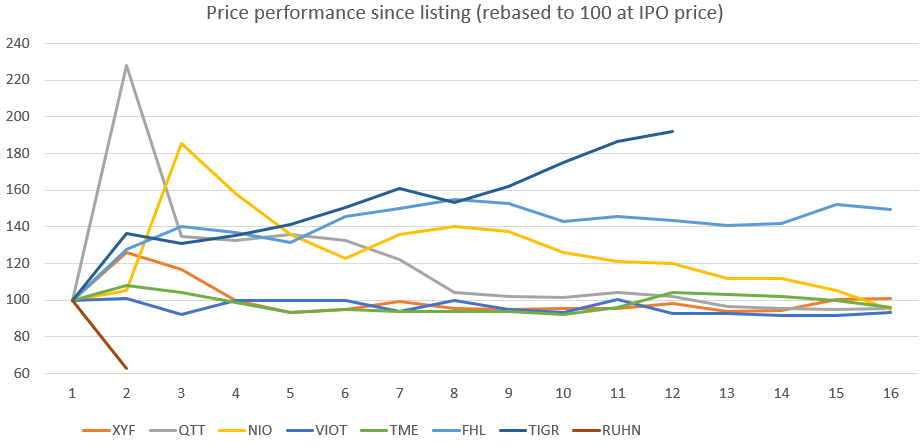
Below is a recap of the key IPO/placement research produced by the Global Equity Research team. This week, we update on the bevvy of placements offered by various companies. After placements by Pinduoduo (PDD US) and Sea Ltd (SE US) , we saw more offerings from HUYA Inc (HUYA US) , Bilibili Inc (BILI US) and Qutoutiao Inc (QTT US). We update on these three offerings and perhaps big picture, this could reflect a signalling inflection point in these shares. More details below
In addition, we have provided an updated calendar of upcoming catalysts for EVENT driven names below.
Best of luck for the new week – Arun, Venkat and Rickin
Aequitas Research puts out a weekly update on the deals that have been covered by Smartkarma Insight Providers recently, along with updates for upcoming IPOs.
Placements activity picked up momentum this week as evidenced by the number of follow-on offerings launched by a handful of US-listed Chinese tech companies. It all started with Qutoutiao Inc (QTT US) ‘s follow-on offering, then followed by Bilibili Inc (BILI US)‘s equity + convertible note placement, and ending the week with HUYA Inc (HUYA US)‘s follow-on offering and Baozun Inc. (BZUN US)‘s convertible bond and placement.
On the other hand, Ruhnn Holding Ltd (RUHN US)‘s debut this week had been a total disaster. It closed 37% below its IPO price on the first day. This is the worst first-day performance among Chinese ADRs (deal size >US$100m) in the past six months.
Back in Hong Kong, Dongzheng Automotive Finance (2718 HK) also broke its IPO price on the first day after relaunching at a much lower price. As per our trading update note, considering that there will be greenshoe support, we thought that the risk to reward could be favorable for a trade (from its first day mid-day price of HK$2.57).
As for placements, Ronshine China Holdings (3301 HK) seems to have made its equity raise a yearly affair. The company is back to tap the equity market through a top-up placement and it has done the same in 2017 and 2018. The initial deal size was small, US$122m, but was upsized later on. The share price traded well post-placement, closing 9.5% above its deal price of HK$10.95 on Thursday.
Map Aktif Adiperkasa PT (MAPA IJ) will be closing its bookbuild for its follow-on offering next Tuesday (pricing on Wednesday). We heard that books are already covered as of Thursday.
Accuracy Rate:
Our overall accuracy rate is 72.4% for IPOs and 63.5% for Placements
(Performance measurement criteria is explained at the end of the note)
New IPO filings
Changliao AKA 派派(Hong Kong, ~US$100m)
Below is a snippet of our IPO tool showing upcoming events for the next week. The IPO tool is designed to provide readers with timely information on all IPO related events (Book open/closing, listing, initiation, lock-up expiry, etc) for all the deals that we have worked on. You can access the tool here or through the tools menu.
Yesterday, post-market close, Japan Post Holdings (6178 JP)(JPH) announced that it will sell 185m shares (including over-allotment) or 30.8% of Japan Post Insurance (7181 JP)(JPI) amounting to US$4bn. JPI plans to buy back up to 50m shares out of these, leaving around US$3.1bn worth of stock to be placed. Out of these 185m shares, 30% will be placed with foreigners.
The selldown is part of the government’s plan for privatization under which JPH is supposed to reduce its stake in JPI and Japan Post Bank (7182 JP)(JPB) to around 50%. This was highlighted in the IPO of the three entities in 2015. Thus, the deal is not totally unexpected but the timing of it was never certain. For people interested in more about the history and background, we’ve covered the IPO and JPH sell down in the below series of insights:
In this insight, I’ll comment on some of the deal dynamics and index weighting impact.
Get Straight to the Source on Smartkarma
Smartkarma supports the world’s leading investors with high-quality, timely, and actionable Insights. Subscribe now for unlimited access, or request a demo below.
Follow-on offerings by Chinese ADRs are the flavour of the day. Hot on the heels of Qutoutiao Inc (QTT US) and Bilibili Inc (BILI US), HUYA Inc (HUYA US) filed for a potential $550 million public offering without presenting any details on the new ADS being offered. Also, certain selling shareholders will offer shares in the offering.
Huya is one of the few recent Chinese “new-economy” IPOs which has lived up to the hype by delivering a creditable post-IPO financial performance. While Huya has proven to be a good IPO, we believe this follow-on offering is highly opportunistic and would be tempted to participate only at a large discount.
Huya, a leading live streaming player in China, announced share placement of USD 550 million after market close on April 3rd. In this insight, we will look at recent developments of Huya and score the deal in our ECM Framework.
Naspers (NPN SJ) recently announced another attempt to reduce the holdco discount which has remained stubbornly high despite previous attempts by management to reduce it. Since the announcement there has been movement, so perhaps this time it really is different!
So what is being done? Naspers will spin off its international internet assets, which account for >99% of its value, into a newco. They will then list 25% of newco on the Euronext in Amsterdam by issuing these shares to Naspers’ shareholders. The intention is to create a vehicle which can attract increased foreign and tech investors without the complication of a South African listing. The company believes this has been a key factor behind the wide holdco discount. The move also reduces Naspers weighting in South African indices which is another contributing factor.
Alastair Jones sees the announcement as a positive, although there are still issues with the main listing being in South Africa. He still believes a buyback would be the most effective way to reduce the discount, but Naspers is also keen to keep investing.
The deal scores marginally positive on our framework owing to its decent track record, and price and earnings momentum.
Its past deals have done well in the long run. Even though it did not perform well over the one-month period, its first week returns have tend to hold up above the deal price.
Get Straight to the Source on Smartkarma
Smartkarma supports the world’s leading investors with high-quality, timely, and actionable Insights. Subscribe now for unlimited access, or request a demo below.
Guotai Junan Securities (H) (2611 HK) plans to raise around US$350m via placing new H-Shares. We had earlier covered the IPO, you can find our coverage below:
Studio City, a spin-off by MLCO US, was listed on October 18th, 2018 and its lock-up will expire next week on April 16th. The company raised USD 359 million in its IPO with the majority of the shares taken up by its shareholders.
In this insight, we will review the company’s operation, shares subject to lock-up expiry and its valuation vs peers.
Changliao Inc (CL HK) is looking to raise about US$100m in its upcoming IPO. The company just filed its draft prospectus with the HKEX last week.
Changliao is a fast-growing social networking entertainment platform. The business model of engaging and monetizing users through interactive games is interesting.
However, the need for an IPO is questionable since the company has a healthy net cash balance sheet and it had paid out dividends in the past two years. It can easily finance its growth through debt or operating cash flow.
Tencent is an investor in the firm, however, it had only invested RMB9m in the company in FY2016. There are no other notable investors despite several rounds of financing.
In this insight, we will look at the company’s business model, analyze its financial performance and operating metrics.
The company has been reporting flattish earnings for the past few years and remains well positioned in its main segments. HOLI is net cash, it has ample cash for that matter, and it has been generating operating cash flow consistently. It hasn’t provided any specific reasons for the capital raise. Which makes one wonder if this is just an opportunistic raise.
In my view, either the company needs to clearly disclose the intended use of capital or it needs to offer the deal at a very wide discount to where the shares are currently trading.
AGC Inc (5201 JP) plans to raise US$215m (including over allotment) via a secondary offering of share, this represents 2.9% of the outstanding shares.
The deal scores a mixed score on our framework, aided by its cheaper valuation while it scoring is hampered by its under performance versus it regional peers. However, the shares have been correcting since the deal was announced and the deal represents just a few days of ADV.
Get Straight to the Source on Smartkarma
Smartkarma supports the world’s leading investors with high-quality, timely, and actionable Insights. Subscribe now for unlimited access, or request a demo below.