
In this briefing:
- Farm Loan WaiversTo Dampen Credit Growth Cycle
- Korea Stock Market Monthly Recap #31 (December 2018)
- Monthly Geopolitical Comment: Redrafting of Global Map of Political Alliances to Continue in 2019
- Direct Income Transfers Likely Soon; Universal Basic Income Possible By 2024 Funded by RBI Reserves
- Changing Lanes
1. Farm Loan WaiversTo Dampen Credit Growth Cycle

The NPA growth cycle affects credit growth cycle negatively. The recent farm waivers announced by many state governments and the speculations of a nationwide farm loan waiver by the Central government do not augur well for the banks’ credit space in India.
2. Korea Stock Market Monthly Recap #31 (December 2018)
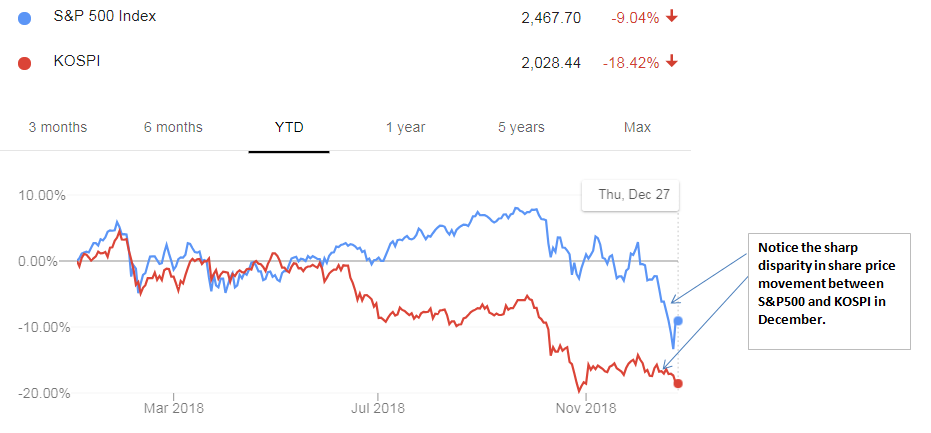
Korean stock market declined again in December. KOSPI was down 2.7% in December and completed 2018 with a decline of 18% this year. Investors remained cautious preferring to increase their capital allocation to defensive sectors such as utilities. However, December was a bit unusual in that KOSPI declined much less than the US market (S&P 500 was down 9% in December). In the past few months, there has been a noticeable outperformance of numerous emerging markets stocks relative to the US stock market.
Fool me once, fool me twice, fool me three times? It has been 10 years since the last Great Repression. Unlike in 2008, when the US Fed Fund rate plummeted from 4.1% in the beginning of the year to 0.09% at the end of the year, the US Fed Fund rate kept climbing throughout the year. The share price declines in global equity markets around the world this year are probably reflecting the concerns about a potential recession in the next two years.

Our model portfolio was down 2.0% in December (cash is 30% of model portfolio), outperforming KOSPI which was down 2.8% in December. Starting January 2019, we are increasing the cash portion to 35% of the model portfolio, to become more defensive in capital allocation.
The top 10 events impacting the Korean stock market, economy, & politics in December were as follows:
- Global markets volatility
- Growing concerns about the declining memory prices on the semiconductor sector
- Investors trying to find next HanjinKal
- Hyundai Motor Group and Korean Government’s Big Push into Hydrogen Fuel Cell Vehicles
- Jim Rogers & Ananti
- The EU agrees to cut carbon emissions from cars by 37.5% by 2030
- Amorepacific’s strong rebound
- Korean prefs vs. common
- Samsung Biologics trades again
- Naver’s surprising stock option plan
The top three reports we wrote in December related to the Korean market were as follows (in terms of views & appreciates):
- Review of Our IPO Research in 2018 & Change in Our IPO Research Process for 2019
- Top Seven Korean Stocks for Corporate Activists in 2019
- Korean Stock Market Sectors 2018 Review & 2019 Outlook
3. Monthly Geopolitical Comment: Redrafting of Global Map of Political Alliances to Continue in 2019
The year 2018 has proven tumultuous for global markets. Rapidly changing geopolitical priorities of the US, an erstwhile hegemon, have played a role no less significant than the withdrawal of liquidity by leading central banks or US monetary policy tightening. The US has openly declared that it is in a state of “cold war” with China. Despite the recent truce, signs are abundant that the confrontation between the two global superpowers will continue into 2019 and beyond. In 2019, we expect more countries to find themselves in a position where they must choose who they want to side with, the US or China. There are other tectonic shifts, too, which are causing re-alignment of global geopolitical alliances.
4. Direct Income Transfers Likely Soon; Universal Basic Income Possible By 2024 Funded by RBI Reserves
Direct income transfers to farmers are likely to become reality as competitive loan waivers are fast becoming a norm than an exception and every party is offering a larger waiver.
Direct income transfers have been quite successful in the South Indian state of Telangana with KCR promising one at the national level if the Federal front (that he is proposing) is voted to power in the general elections.
Cost of each of the measures (from loan waivers to universal basic income for all Indians) is between 0.7% to 2.7% of GDP with Universal Basic Income (Rs 7620/individual for 75% of Indians) costing the highest.
Even as initial fiscal costs are alarming, a gradual scale up (like in the Rural Employment Guarantee Scheme) and transfer of reserves from RBI in tranches could mitigate some fiscal impact. We expect the expert committee of the govt and the RBI to identify transferable reserves between Rs 1.0trn – 3.0trn.
Overall, the freebies to Rural India will certainly power the consumption story strongly in 2019 with products sold in rural areas like FMCG, tractors and motorcycles expected to gain.
5. Changing Lanes
The hyper-competitive Indian payments industry is changing. New regulations are increasing the cost operations, NPCI (National Payments Corporation of India) & Reserve Bank of India (RBI) are breaking all barriers to entry enabling a level playing field that ensures no competitive moats exist. Although there are volumes, profitability remains a distant dream and likely to remain so making Indian payments a bad business to be invested in.

