
In this briefing:
- How To Spot The Bear Market Bottom
- India: Notes from Hindi Heartland, There Are Issues but People Don’t See a Better Choice than Modi
- Japan: 2018 Market Review – Bear Market Rally Ahead
- Farm Loan WaiversTo Dampen Credit Growth Cycle
- Korea Stock Market Monthly Recap #31 (December 2018)
1. How To Spot The Bear Market Bottom
The outsized daily swings in the major U.S. equity averages tell the classic story of a bear market. Normal bull markets simply do not experience consecutive multiple daily moves of 2% or more.
The market’s panicked price action is highly reminiscent of past panics in 1962, 2002 and 2015. In those cases, the market bounced, and made a lower low several months later. In all cases, stock prices were higher a year later. Our base case scenario calls for an initial low, rally, followed by choppy price action, and a final low in 6-8 months.
Our analysis finds that the technical price action of the market is consistent with a bear market. We offered a checklist of events that occur at market bottoms, but we do not know where the market may bottom out. Much depends on the fundamental drivers of the bear market, policy risks from the White House and the Federal Reserve, and how they are ultimately resolved.
2. India: Notes from Hindi Heartland, There Are Issues but People Don’t See a Better Choice than Modi
We have spent more than ten days in Uttar Pradesh in the second half of December 2018 and tried to assess the chances for BJP and how it could perform in 2019 Lok Sabha elections. Of course the number of seats which each party could win depends more on coalitions, the vote share will remain important nonetheless. We were trying to understand the voting preference of people and the political choices they will be making next year.
First, the good news for BJP is that Prime Minister continues to enjoy almost similar level of popularity as 2014 (the previous Lok Sabha elections) and 2017 (previous Assembly elections in the state). There is also perception that BJP Governments are in general much less corrupt than administration provided by other political parties including Congress. BJP is by far the No. 1 political entity in the state because of Modi’s leadership.
But there is also important bad news, a) the level of satisfaction with state Govt is much lower, b) issues such as cow protection have become nuisance for many people, farmers for example, c) there is a perception that BJP’s simple majority at the Centre and 3/4th majority in state made accountability more difficult and that was the reason governance also suffered in a big way, and, d) people also think that BJP’s elected representatives are not qualitatively different vs. other parties.
3. Japan: 2018 Market Review – Bear Market Rally Ahead

2018 MARKET REVIEW – In this Insight, we shall review the performance of the Japanese stock market, during 2018 and look forward to the coming year. We shall look back at the year from a Sectors, Peer Group and Company perspective in separate Insights to follow next week.

BEAR MARKET RALLY AHEAD – From the January 23rd peak to the December 25th low, the All Market Composite declined 24.5% in Yen terms and 24.9% in US$ terms placing Japan in a bear market for the seventh time since the bursting of the 1989 stock market ‘bubble’. The average stock is now 35% below its one-year high compared with just 10% below at the beginning of the year. Total Market Value is still ¥123t above the low of 12th February 2016, and the question remains – are we replaying March 2008 or February 2016? In both cases, there were bear market rallies (25% and 17%) before the final downward leg – which entailed further declines of 50% and 13%, respectively. In our recent Insight on 21st December – Ticking the Bear Market Boxes – we commented that it was too early for contrarians to start ‘nibbling’. The 1,000 point Nikkei 225 (NKY INDEX) decline the next trading day, and the rebound into the year-end suggests that a case can now be made for, at least, a short-term rally. In the charts in the DETAIL below, we shall explore the case for (✓) and against (✕), and attempt to answer the question of the 2008 or 2016 reprise.
4. Farm Loan WaiversTo Dampen Credit Growth Cycle

The NPA growth cycle affects credit growth cycle negatively. The recent farm waivers announced by many state governments and the speculations of a nationwide farm loan waiver by the Central government do not augur well for the banks’ credit space in India.
5. Korea Stock Market Monthly Recap #31 (December 2018)
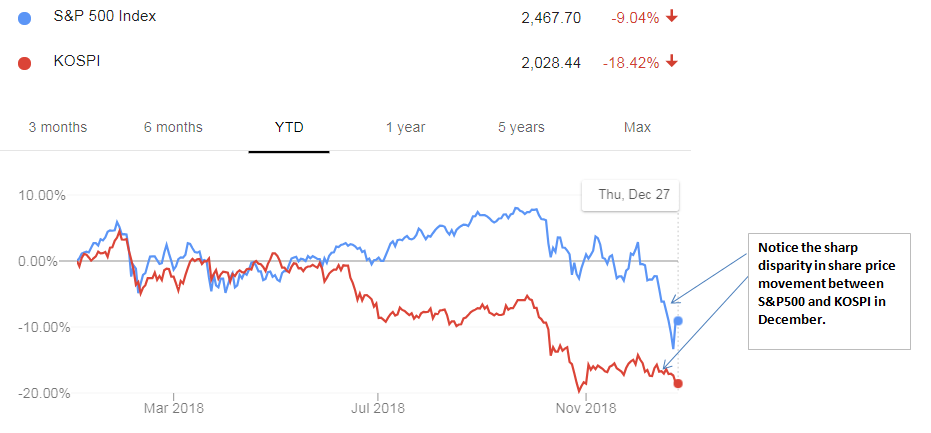
Korean stock market declined again in December. KOSPI was down 2.7% in December and completed 2018 with a decline of 18% this year. Investors remained cautious preferring to increase their capital allocation to defensive sectors such as utilities. However, December was a bit unusual in that KOSPI declined much less than the US market (S&P 500 was down 9% in December). In the past few months, there has been a noticeable outperformance of numerous emerging markets stocks relative to the US stock market.
Fool me once, fool me twice, fool me three times? It has been 10 years since the last Great Repression. Unlike in 2008, when the US Fed Fund rate plummeted from 4.1% in the beginning of the year to 0.09% at the end of the year, the US Fed Fund rate kept climbing throughout the year. The share price declines in global equity markets around the world this year are probably reflecting the concerns about a potential recession in the next two years.

Our model portfolio was down 2.0% in December (cash is 30% of model portfolio), outperforming KOSPI which was down 2.8% in December. Starting January 2019, we are increasing the cash portion to 35% of the model portfolio, to become more defensive in capital allocation.
The top 10 events impacting the Korean stock market, economy, & politics in December were as follows:
- Global markets volatility
- Growing concerns about the declining memory prices on the semiconductor sector
- Investors trying to find next HanjinKal
- Hyundai Motor Group and Korean Government’s Big Push into Hydrogen Fuel Cell Vehicles
- Jim Rogers & Ananti
- The EU agrees to cut carbon emissions from cars by 37.5% by 2030
- Amorepacific’s strong rebound
- Korean prefs vs. common
- Samsung Biologics trades again
- Naver’s surprising stock option plan
The top three reports we wrote in December related to the Korean market were as follows (in terms of views & appreciates):

