This weekly newsletter pulls together summaries of the top ten most-read Insights across Macro and Cross Asset Strategy on Smartkarma.
Receive this weekly newsletter keeping 45k+ investors in the loop
1. UK: Inflation Intensities Re-Weighted
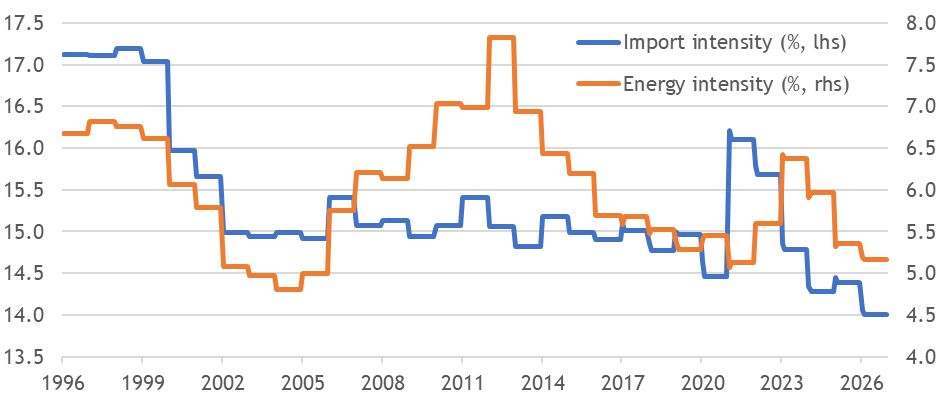
- The near-term inflation outlook is swinging with the fundamental news about supply disruption in the Middle East, but there is a statistical element to how that hits the CPI.
- Updated weights for 2026 have derated gas to record lows, conveniently trimming that passthrough, but the CPI’s indirect energy intensity has held steady at 1.65%.
- A deflated gas weight is easily captured, but core passthrough may prove surprisingly strong again, especially if excessive inflation expectations power second-round effects.
2. BoE: Hawkish Wind Blows Doves Away
- The MPC found rare unanimity in its on-hold decision for March after the energy shock blew the doves away from votes that they signalled would otherwise have survived.
- At least five members are explicitly standing ready to act if necessary. The persistence of the war’s hit to energy supply and prices will be clearer at the April meeting.
- Evidence of second-round effects would take longer to accumulate. If the shock is ongoing in July, contrary to our call, a rate hike is likely to be needed and delivered.
3. EA: HICP Exploding Out Of 2026 Trough
- EA inflation’s surprise rise to 1.9% in February was confirmed in Eurostat’s final print, with the underlying monthly impulses broadly aligned at the 2% target.
- Energy prices have exploded higher since the US attacked Iran, driving a massive shock that the consensus currently misses. Surprises usually correlate with energy prices.
- The ECB should stay hawkishly vigilant, enjoying the good starting place, without actively tightening unless high energy prices persist or second-round effects emerge.
4. UK: Pre-War Employment Steadies
- Underlying cohort responses corroborated a surprisingly bullish start to 2026 for employment, while a return to payroll growth signals the tax shock has passed.
- Vacancies remain worryingly stagnant, but half of the redundancy shock has already faded. Private sector pay remains an outlying, gloomy signal that doves can cling to.
- The inflationary energy price shock should keep the BoE on hold, but accommodating it will probably secure excessive pressures beyond inflation’s unavoidable direct hump.
5. HEW: Escalating Hawkish Pressures
- Attacks on energy infrastructure are raising the risk that the supply shock persists even if the conflict ends swiftly, stoking hawkish pressures for action at the BoE and ECB.
- Our inflation forecasts are accumulating a substantial hump, now breaching 4% on UK CPI. Second-round effects are central to calibrating the global monetary response.
- Next week is calmer for policy, with only Norway, Chile and Mexico announcing. We will be watching UK inflation, flash PMIs, and developments in the Middle East most closely.
6. Asian Equities: Risks Not Adequately Factored in Asian Markets, IERP Tells Us
- We study Implied Equity Risk Premium (IERP) of Asian markets over the past 20 years to assess whether the markets are adequately factoring in the present risks or not.
- In most markets, risk perceptions were much higher during the COVID pandemic or during the Russia-Ukraine conflict. It seems Asia is hoping for a quick resolution to the Middle-East conflict.
- In particular, we think investors are complacent, reflected in low IERP, in Taiwan and Singapore. IERP’s in these markets are near their lowest ever.
7. Korean Regulators to Create a Two-Tier KOSDAQ Market
- On 18 March, the Korean financial regulators announced that they are seeking to create a two-tier KOSDAQ market.
- KOSDAQ will be divided into two tier system, including the premium market for large companies and the standard market for promising companies.
- The introduction of a two-tier KOSDAQ system would have significant implications for valuation dynamics, raising valuations of companies included in the premium market and lowering valuations in standard market.
8. Fed Holds: Higher for Longer?
- Fed holds at 3.5–3.75% as expected. The SEP shows stronger growth and higher inflation, reinforcing a cautious, higher‑for‑longer rate stance.
- Median dots still pencil in only gradual cuts to 3.4% end‑2026, with a higher 3.1% long‑run rate signalling a structural limit to loosening.
- Oil‑driven inflation and a softening labour market will determine the timing of another possible cut, with risks skewed to later, not faster, easing.
9. The Complexity of the Oil Trade
- USO, an oil ETF, has experienced volatility and resurgence, prompting discussion on alternative energy investments and complexities in the oil trade
This content is sourced through publicly available sources and has been machine generated. Information displayed is for general informational purposes only.
10. From the River to the Reservoir to the Lake: China’s De-Dollarisation Story
- PBOC’s declining holdings of US Treasuries is often equated with the de-dollarisation of the Chinese economy. Less known is that USD assets remain substantial and systemically embedded in Chinese banks
- Chinese data shows their domestic banks are increasingly net long USD, with positions expanding alongside weaker domestic opportunities—especially from the property downturn—reinforcing demand for dollar assets
- A forward-adjusted FX proxy shows RMB pressures remain driven by dollar flows, suggesting de-dollarisation narratives are overstated and China’s system still responds primarily to USD liquidity conditions