This weekly newsletter pulls together summaries of the top ten most-read Insights across Macro and Cross Asset Strategy on Smartkarma.
Receive this weekly newsletter keeping 45k+ investors in the loop
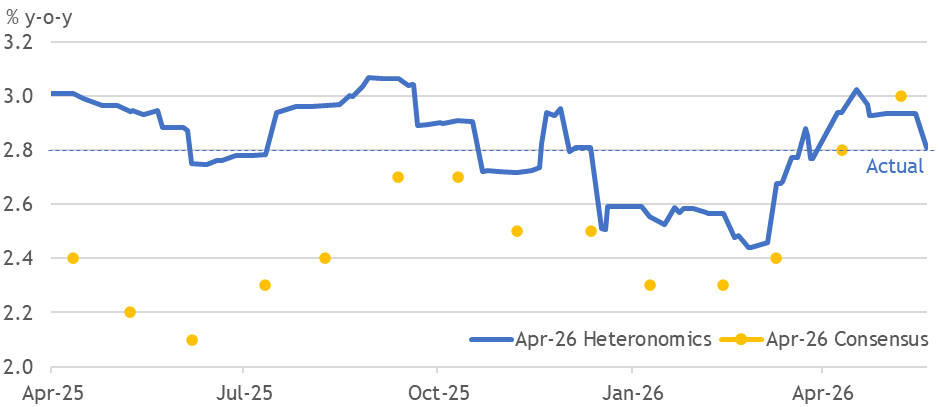
1. UK: Flying Less High In April
- Inflation slowed further in April than the latest over-inflated consensus, but exceeded all profiles before April. It also undershot our view by 13-15bp on the CPI and RPI.
- A rare airfares decline drove this and a shocking 0.6pp RPI consensus miss, but it was not much weaker than usual given the timing of Easter relative to index dates.
- Underlying inflation pressures are stuck ~3%, and passthrough of the latest shock is coming. The BoE has another excuse to hold in June, but we still expect a July hike.
2. UK: ONS Upscales Unemployment
- Unemployment partly reversed its shock drop with a rise to 5% in March, as the labour force recovered as we forecast. There was still a slight underlying improvement in Q1.
- March’s weakness arose from the ONS’s statistical adjustments, not raw responses, and seems to have been narrowly triggered by a student failing to find flexible work.
- Pay data were mixed, with weakness in private pay, ex-bonuses, providing an excuse to hold rates in June. But other measures are 4-5% and rising, encouraging a July rate hike.
3. HEW: Dampening Hawkish Urges
- There was broad weakness in European news over the past week, with broadly dismal PMI surveys outside the US, plus lower inflation and higher unemployment in the UK.
- Policymakers are prepared to lean against second-round effects, but are likely to be cautious. We still see single rate hikes from the ECB in June and the BoE in July.
- It’s a quiet, bank holiday-shortened week ahead in the UK and US, plus it’s Eid in the Muslim world. With little data scheduled, the RBNZ and BOK become unusual highlights.
4. The Oil Shock of 2026 : Why It Is Not a Repeat of the 1970s
- Today’s oil shock is serious, but inventories, shale production, and lower energy dependence make the global economy far more resilient than in the 1970s
- If today’s oil shock were truly worse than the 1970s, prices should be far higher. Oil quadrupled then, implying crude could approach $260/barrel by July if history repeated
- For the US economy specifically, fears that higher oil prices will derail the AI capex boom appears overstated. Data centres run on electricity and not crude oil
5. Services Scrape Post-Pandemic Lows
- Weakness in the services sector deepened and broadened in the flash PMIs for May. The EA is still underperforming, but the UK caught up with a crash amid political turmoil.
- Australia and Japan remain less exposed, while the US is shrugging off the shock, and India keeps booming. The demand hit is broadly worse than last year’s tariff shock.
- The average flash balance matches the 2022-23 lows, but France is worryingly closer to its Great Recession lows. The ECB should be cautious about hiking much beyond June.
6. EA: Inflating To a Hike
- EA inflation was confirmed at 3% in April, with housing and transport driving the 48bps increase amid ongoing passthrough of the energy supply shock from the Middle East.
- The monthly impulse in underlying inflation pressures is otherwise mostly marginally above the target, except in France. The UK still suffers the worst inflationary trend.
- Another rise is likely in May, despite government efforts to limit the shock. We still see upside risks to our forecast. A June ECB rate hike helps with second-round effects.
7. Global Economics: Bill From Hormuz Crisis Is Already Due and May Grow Larger
- The Hormuz closure has lasted long enough that a significant share of the economic damage is already locked in, regardless of when a diplomatic resolution enables a reopening.
- Structural obstacles, namely Washington’s credibility deficit after dismantling the JCPOA and sunk-cost logic, inhibit previous and current efforts to reach a negotiated settlement.
- The crisis is transmitting across multiple channels simultaneously—energy supply scarring, agricultural input shortages, disruptions in global trade, and tighter financial conditions.
8. BI’s Hawkish Hike To 5.25%
- BI’s surprise 50bp hike to 5.25% exceeds the consensus, demonstrating a shift to a hawkish bias focused on Rupiah and risk premia.
- Future rate moves hinge on FX stability, imported inflation from higher oil and administered prices, and resilience of portfolio inflows.
- An eventual return to cuts is contingent on calmer global conditions, a firmer Rupiah and contained inflation; macroprudential easing offsets growth risks.
9. BoJ Himino: A Blunt Critique of US Digital Finance Strategy
- No monetary policy signal. Himino’s speech was entirely focused on digital finance and payment system architecture. This reduces the probability of a June rate hike, in my view.
- He described Scott Bessent’s stablecoin vision as designed to “induce people around the world to finance the US fiscal deficit”, taking a mild jab at the credibility of US dollar.
- Japan will not follow the US toward lighter-touch crypto regulation. Himino’s explicit reference to anonymity of crypto use as a “problematic motive” signals his weariness about crypto.
10. Ominous Core Inflation Developments in the Fed’s Preferred Measure
- The Fed’s preferred core inflation gauge has accelerated since November in contrast to the equivalent consumer price index (CPI) measure based on three-month annualised and twelve-month core changes.
- Accelerating price increases for information processing equipment and software related to the AI infrastructure buildout is partly responsible for the core PCE deflator acceleration versus the CPI.
- Elevated readings for the core PCE deflator make Fed policy rate reductions difficult to justify in the current environment. Any rate reduction would probably require demand destruction and higher unemployment.