This weekly newsletter pulls together summaries of the top ten most-read Insights across Macro and Cross Asset Strategy on Smartkarma.
Receive this weekly newsletter keeping 45k+ investors in the loop
1. UK: Good Relief
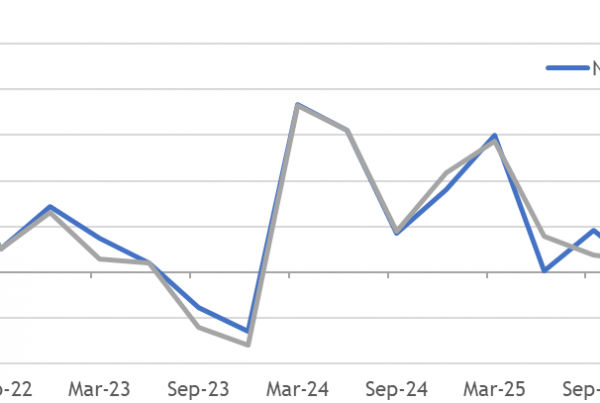
- A second downside inflation surprise narrowly kept the UK CPI at 2.8% (2.848%). Services were resurgent, but goods provided relief, despite their high energy content.
- Fertiliser shortages made us see upside risks to food. The stability of small changes and soft PPIs suggests it will stay like that, as UK margins take the strain again.
- High labour costs pushing up domestic service prices remain the problem. 3%+ inflation has become normal, but not acceptable, despite the BoE’s bias to assume it away.
2. Fed Dots Defy Market Doves
- The Fed holds rates at 3.5–3.75%, but the dots now flag at least one 2026 hike, in contrast to the firm consensus for an unchanged median path.
- SEP lifts 2026–28 inflation and funds‑rate medians, signalling higher‑for‑longer policy as strong growth and investment sustain demand.
- This outcome broadly validates our “fundamentals over politics” view and argues for a more cautious stance on US rates and risk assets.
3. UK: Tightening Labour Market Trends
- Another bullish surprise in the labour market report lowered the unemployment rate to 4.9% and signalled a trend improvement since December worth ~0.1pp quarterly.
- Weakness remains concentrated among those banned from competing for work on price, compounding the hawkish pressure of the implied labour market tightening.
- Pay growth also beat expectations. Private pay remains a flimsy dovish straw for doves, while measures less sensitive to bias are broadly 4-5%, inconsistent with the target.
4. US EQUITY OVERSUPPLY: When the Public Buyers Become the Greater Fools
- The US market is undergoing a rapid and significant shift from “de-equitization” to “re-equitization”. Firms are quickly foregoing buybacks and instead increasing debt issuance, convertible issuance, and secondary equity offerings.
- AI capex is driving the change and potentially crowding out capital with technology sector mega-IPOs and secondary offerings projected to offload trillions of dollars of equity in the coming years.
- The rush to issue equity comes at a time when retail investor buying has resurfaced as a significant source of market support, accounting for 20% of overall volume.
5. Iran: A Dream of Spring
- The Iran-US MOU is a welcome step that reduces escalation risk and may reopen the Strait of Hormuz for outbound traffic soon, but vessels won’t return without a real deal.
- Production can’t normalise until ships return in months. Benchmark prices for physical oil products have only fallen to 2022 levels, despite the move in financial markets.
- Our inflation forecast peak is ~0.3pp lower, but at 3.8% on UK CPI, and the target elusive, hawkish pressure persists, even with the BoE’s bias to be too stimulative.
6. BoE: Poised For Finely Balanced Votes
- Megan Greene joined Huw Pill’s hawkish dissent, but Catherine Mann waited, despite seeing hawkish activism needed in either scenario. She seems set to support a July hike.
- The MPC’s centre has hardly moved since April, but dovish belief in a softening labour market, while excess inflation persists, makes a hike likely in September instead.
- Votes seem set to become increasingly finely balanced again as the MPC grudgingly grinds towards a hike. Unfortunately, an ongoing inflation overshoot is not a close call.
7. HEW: Odd One Out
- The BoE became the odd one out in resisting rate hikes, despite the UK suffering a worse inflation problem than peers who are broadly either hiking or warning they will.
- UK labour market data beat expectations again, but the biased BoE always focuses on the worst points. Stable inflation amid temporarily soft food prices also eased pressure.
- Next week’s calendar is much thinner, with the flash PMIs providing the main highlight. Potential moves to oust the UK’s PM after Burnham’s by-election will also be watched.
8. BoJ Hike After FX Squeeze
- After April’s no‑hike misstep and costly yen intervention, a June move to 1% became effectively unavoidable for the BoJ.
- Guidance points to further gradual hikes if core inflation and wages stay firm, with bond buying used to cap curve volatility.
- Future rates hinge on core inflation, wage‑price dynamics and FX stability, making the path beyond 1% highly data‑dependent.
9. Iran Deal Imminent: The Trade That Most Portfolios Are Completely Unprepared For
- Prediction markets price US–Iran deal at 75–80% probability; draft MoU exchanged 12 June. Signing expected within weeks. Base case: treat it as done and position accordingly.
- Iran’s return adds 1.5–2.5mb/d to global supply within 18 months. Brent’s structural ceiling collapses to US$60–75/bbl. Energy importers win; OPEC+ pricing discipline is broken permanently.
- China captures the reconstruction dividend — not the West. Surgical longs: SLB, TotalEnergies, Airbus, Standard Chartered. Avoid binary oil shorts; the nuance is in the value chain.
10. EA: Fading Follow-Up ECB Hike
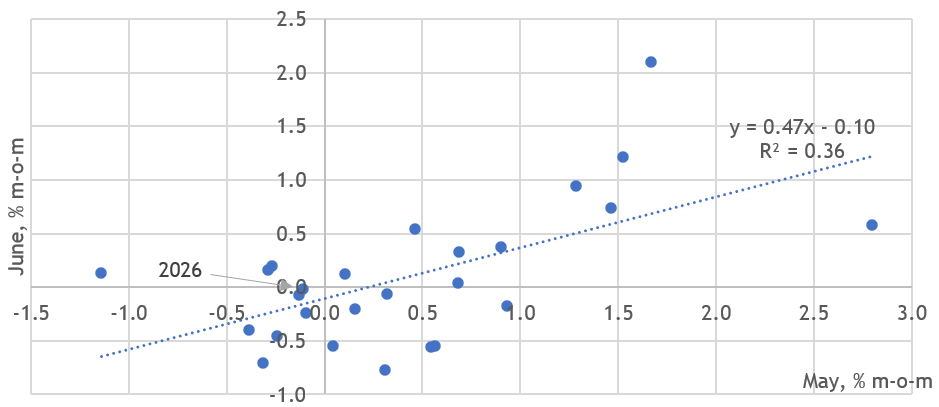
- A slight downward revision to May inflation coincides with an abrupt reversal of pressures. Second-round effects have not yet shown signs of emerging in the EA.
- Food prices have shrugged off the cost shock so far, and underlying inflation measures have slowed recently rather than rising to levels that might threaten the target.
- May is likely the peak, with a drop back below 3% imminent and 2% looking achievable in 2027 without hikes. So, we still see June’s hike as the only one.