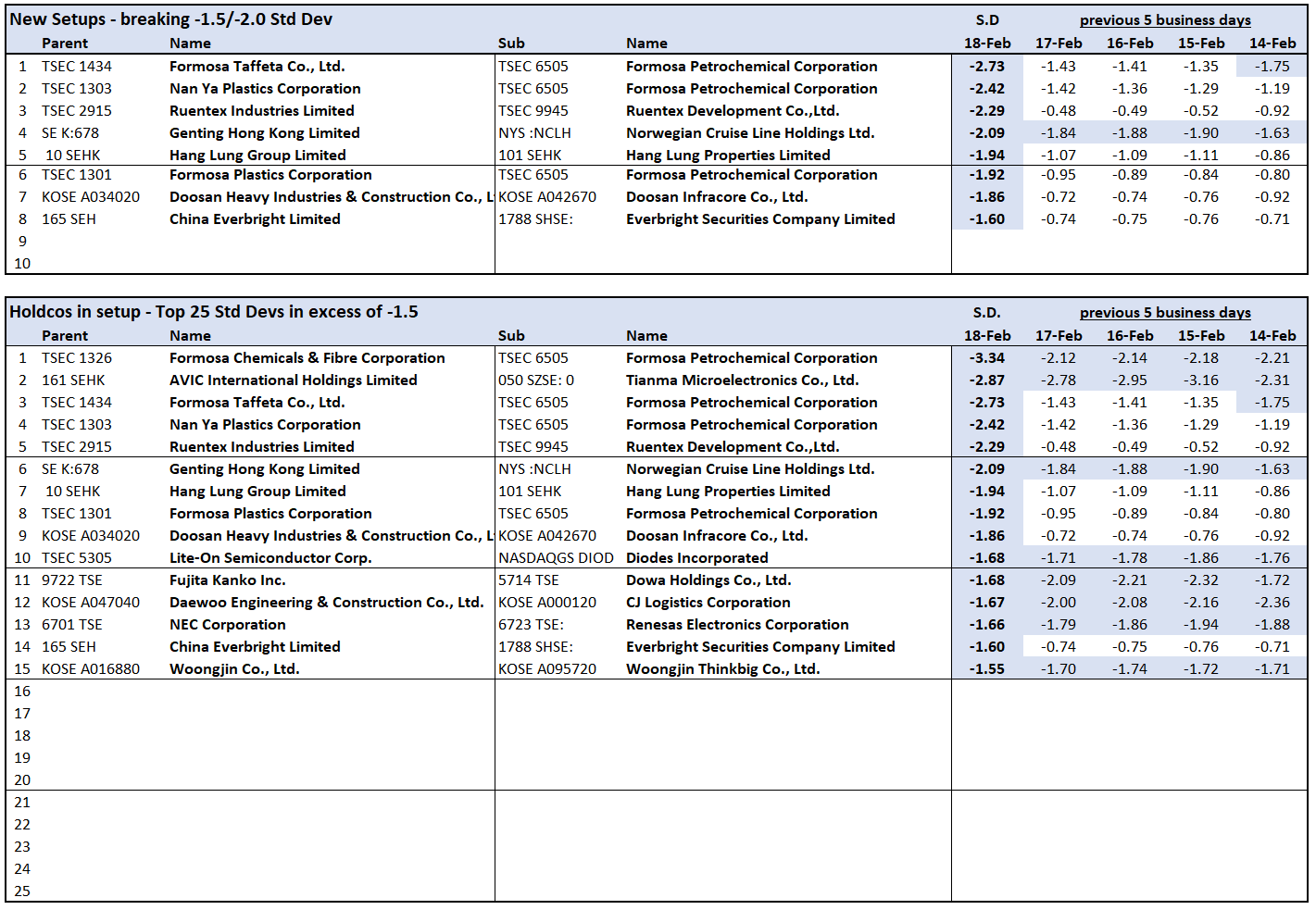
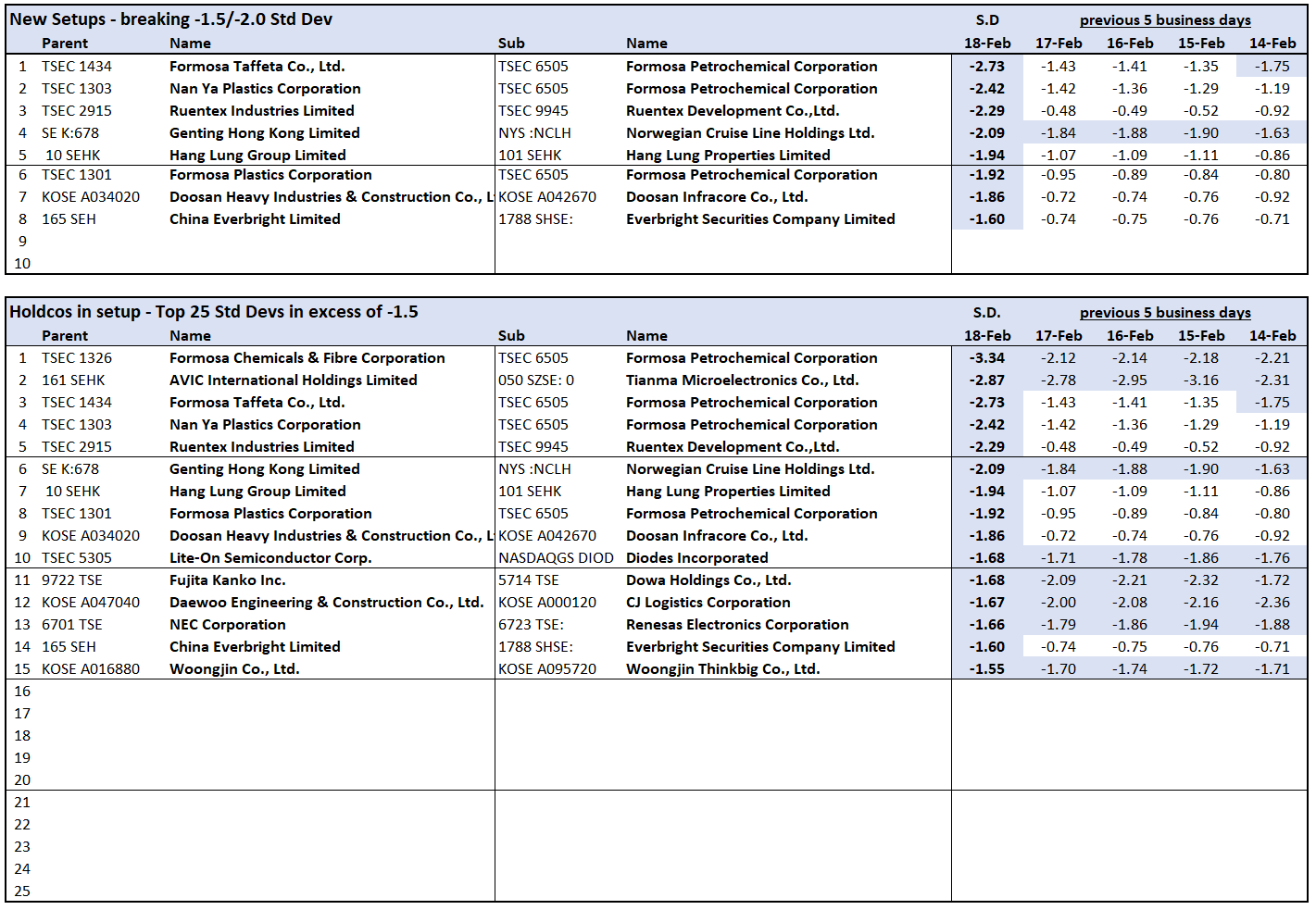
Preceding my comments on Can One/Kian Joo, Mahindra and other stubs are the weekly setup/unwind tables for Asia-Pacific Holdcos.
These relationships trade with a minimum liquidity threshold of US$1mn on a 90-day moving average, and a % market capitalisation threshold – the $ value of the holding/opco held, over the parent’s market capitalisation, expressed in percent – of at least 20%.
Get Straight to the Source on Smartkarma
Smartkarma supports the world’s leading investors with high-quality, timely, and actionable Insights. Subscribe now for unlimited access, or request a demo below.
Preceding my comments on Can One/Kian Joo, Mahindra and other stubs are the weekly setup/unwind tables for Asia-Pacific Holdcos.
These relationships trade with a minimum liquidity threshold of US$1mn on a 90-day moving average, and a % market capitalisation threshold – the $ value of the holding/opco held, over the parent’s market capitalisation, expressed in percent – of at least 20%.
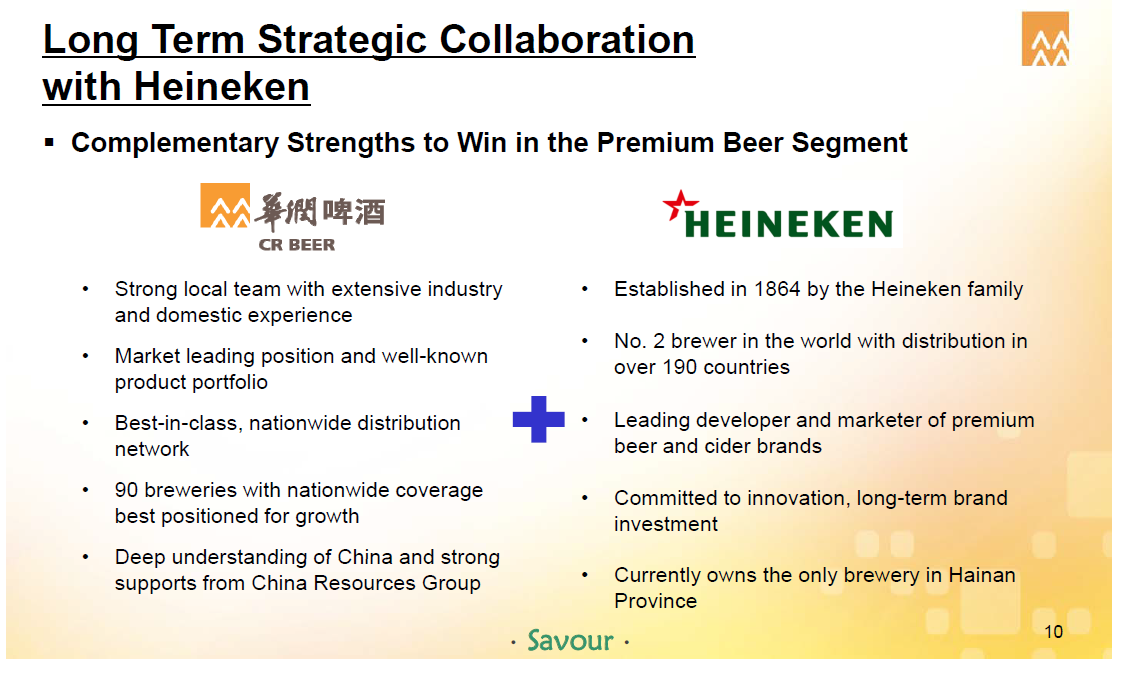
Anheuser Busch Inbev Sa/Nv (ABI BB) is looking to list its Asian operations in order to lighten its debt burden. The listing will probably be in Hong Kong and the company could raise around US$5bn at a valuation of around US$70bn.
Smartkarma supports the world’s leading investors with high-quality, timely, and actionable Insights. Subscribe now for unlimited access, or request a demo below.
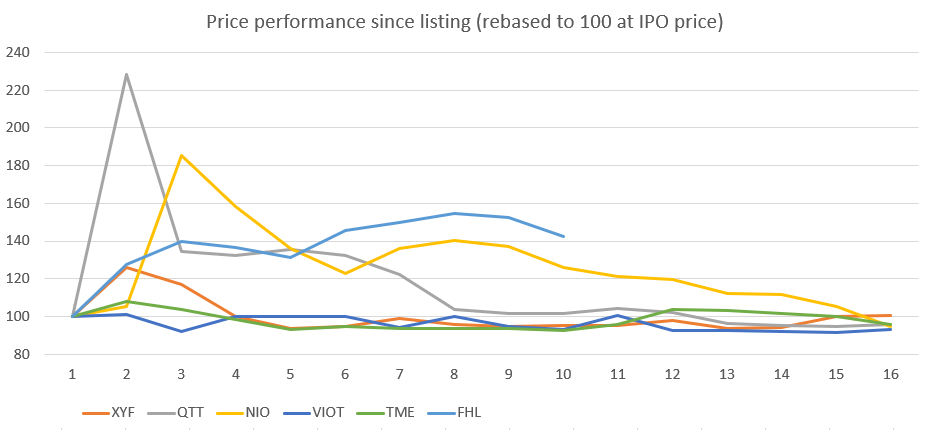
In my earlier insights, I looked at the company’s background, past financial performance, scored the deal on our IPO framework and compared it to Futu Holdings Ltd (FHL US):
Biologics holdings is looking to raise upto US$517m by selling a 4.2% stake in Wuxi Biologics (Cayman) Inc (2269 HK). This will be fourth placement by the company since it listed less than two years ago. Below is a link to our coverage of the listing and the earlier placement:
Each of the past placement has been of a similar size and has generally done well. The company recently reported results which were ahead of street estimates. The deal scores a marginal positive score on our framework but there is still a lot more selling left once the 90-day lock-up expires.
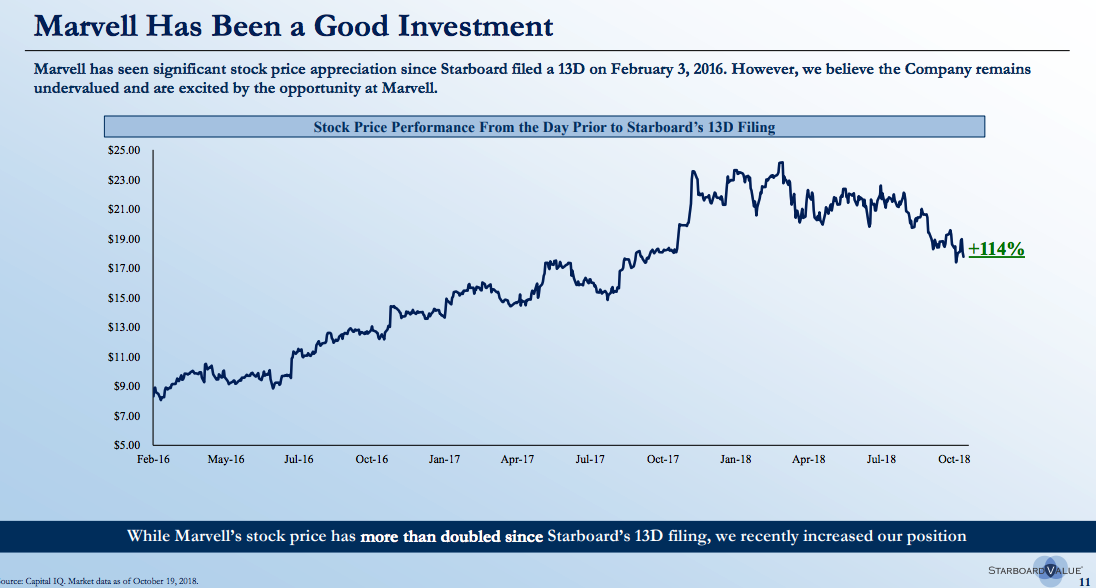
New York based activist investor firm Starboard Value has been intricately involved in shaping the fortunes and futures of two high profile technology companies in recent years, Marvell and Mellanox. The firm first to prominence some five years ago when they were the first among their peers to accomplish the extraordinary feat of replacing the CEO and entire board of Fortune 500 restaurant group Darden, while holding less than 10% of the company’s shares.
In the wake of their Darden coup, the firm has gone from strength to strength. To date the firm has taken positions in a total of 105 publicly listed companies, replacing or adding some 211 directors on over 60 corporate boards.
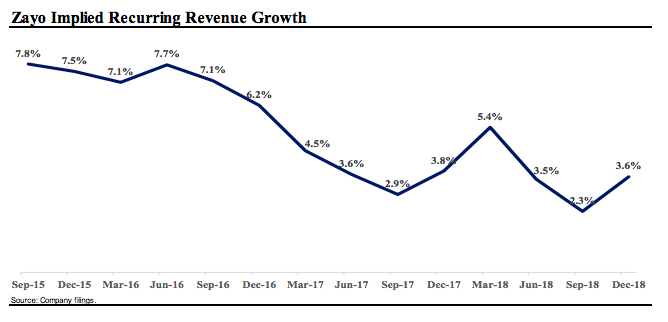
On March 7’th 2019, Starboard Value announced the acquisition of a 4% stake in US comms infrastructure firm Zayo. In the intervening period, Zayo’s share price has risen by 14% as canny investors scramble to partake in the goodness that will surely be extracted by the activist firm that simply doesn’t take no for an answer.
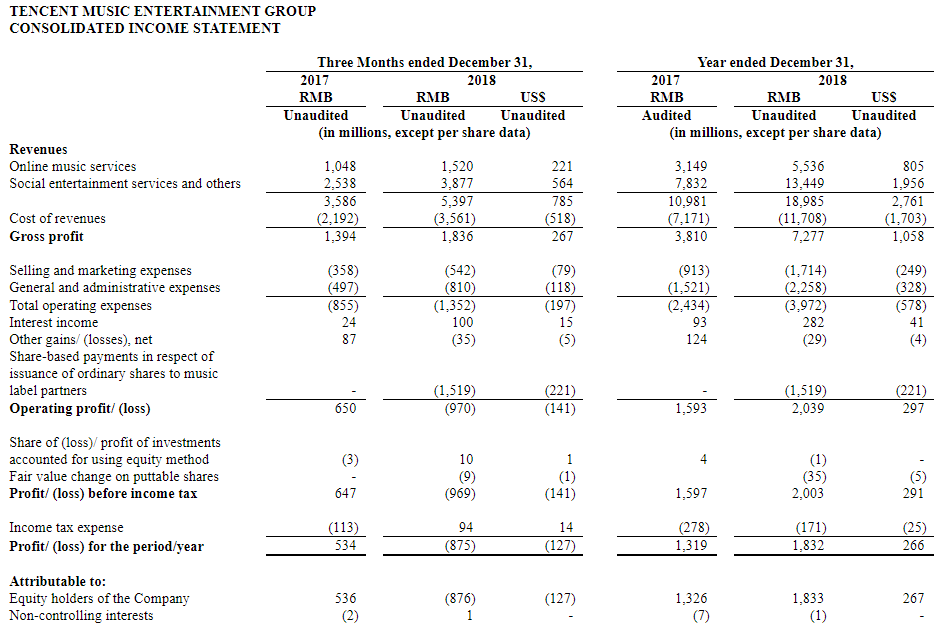
Tencent Music Entertainment (TME US) reported its full year results today, post US market close. Revenue growth was slightly ahead of estimates as paying ratio continue to improve for both online music (subscription revenue) and social entertainment (live streaming). Growth for the latter continued to be driven more by ARPU rather than user growth.
The concerning bit in the results was the decline in gross margins as the company continues to invest in more content.
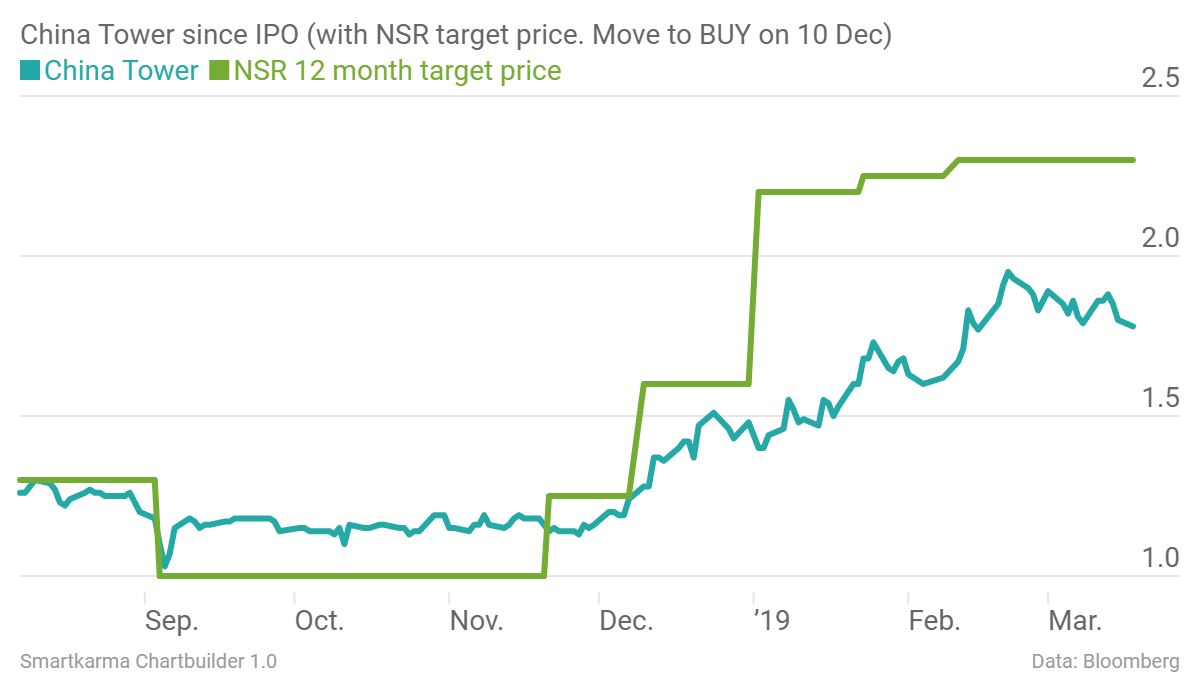
China Tower (788 HK) has rallied strongly in recent months and the question raised repeatedly in recent client meetings was “how much further is China Tower likely to rally?”. Chris Hoare sees China Tower’s position as unusual as the price moves are not driven by earnings upgrades or changed 5G expectations. Rather is is a sustained move post the IPO when the information in the market was incomplete and expectations were much lower. We were negative at the time of the IPO but changed our views as more information became available. We remain positive on the scope for revaluation in China Tower given its rapid revenue growth and low valuations vs EM peers. While the recent results were somewhat disappointing, we see good upside as the market factors is lower capex and higher returns.
Get Straight to the Source on Smartkarma
Smartkarma supports the world’s leading investors with high-quality, timely, and actionable Insights. Subscribe now for unlimited access, or request a demo below.
Anheuser Busch Inbev Sa/Nv (ABI BB) is looking to list its Asian operations in order to lighten its debt burden. The listing will probably be in Hong Kong and the company could raise around US$5bn at a valuation of around US$70bn.
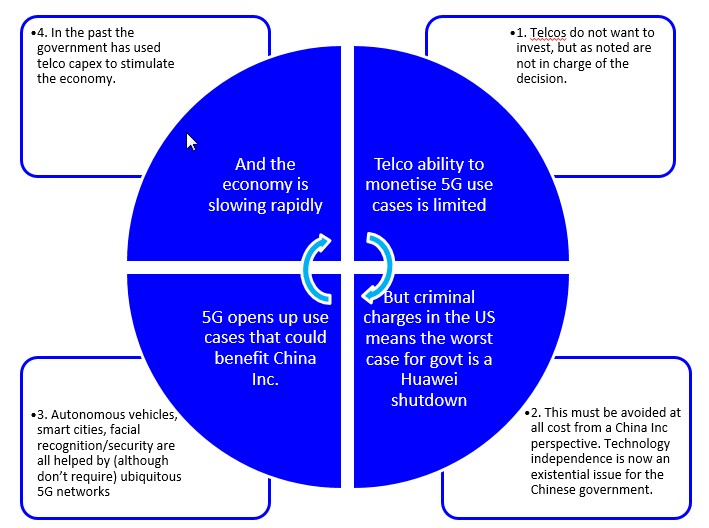
We recently downgraded the Chinese telcos on rising concerns that the telcos will be required to do “national service” to support China’s technological leadership in 5G. The closure of many overseas markets to Chinese equipment suppliers (esp Huawei, but also Zte Corp H (763 HK)) means the risk of a more aggressive 5G roll-out has increased. Markets have started to take notice but the initial reaction has been positive on excitement over the 5G opportunity. Given the lack of a strong business case for 5G currently, we don think additional capex is a positive. We model what an extreme roll-out could look like and the impact on the telcos. Along with a weakening macro outlook, we have further downgraded target prices for all three operators and cut China Mobile (941 HK) and China Telecom (728 HK) to Reduce and China Unicom (762 HK) to Neutral.
Get Straight to the Source on Smartkarma
Smartkarma supports the world’s leading investors with high-quality, timely, and actionable Insights. Subscribe now for unlimited access, or request a demo below.
Biologics holdings is looking to raise upto US$517m by selling a 4.2% stake in Wuxi Biologics (Cayman) Inc (2269 HK). This will be fourth placement by the company since it listed less than two years ago. Below is a link to our coverage of the listing and the earlier placement:
Each of the past placement has been of a similar size and has generally done well. The company recently reported results which were ahead of street estimates. The deal scores a marginal positive score on our framework but there is still a lot more selling left once the 90-day lock-up expires.
New York based activist investor firm Starboard Value has been intricately involved in shaping the fortunes and futures of two high profile technology companies in recent years, Marvell and Mellanox. The firm first to prominence some five years ago when they were the first among their peers to accomplish the extraordinary feat of replacing the CEO and entire board of Fortune 500 restaurant group Darden, while holding less than 10% of the company’s shares.
In the wake of their Darden coup, the firm has gone from strength to strength. To date the firm has taken positions in a total of 105 publicly listed companies, replacing or adding some 211 directors on over 60 corporate boards.
On March 7’th 2019, Starboard Value announced the acquisition of a 4% stake in US comms infrastructure firm Zayo. In the intervening period, Zayo’s share price has risen by 14% as canny investors scramble to partake in the goodness that will surely be extracted by the activist firm that simply doesn’t take no for an answer.
Tencent Music Entertainment (TME US) reported its full year results today, post US market close. Revenue growth was slightly ahead of estimates as paying ratio continue to improve for both online music (subscription revenue) and social entertainment (live streaming). Growth for the latter continued to be driven more by ARPU rather than user growth.
The concerning bit in the results was the decline in gross margins as the company continues to invest in more content.
China Tower (788 HK) has rallied strongly in recent months and the question raised repeatedly in recent client meetings was “how much further is China Tower likely to rally?”. Chris Hoare sees China Tower’s position as unusual as the price moves are not driven by earnings upgrades or changed 5G expectations. Rather is is a sustained move post the IPO when the information in the market was incomplete and expectations were much lower. We were negative at the time of the IPO but changed our views as more information became available. We remain positive on the scope for revaluation in China Tower given its rapid revenue growth and low valuations vs EM peers. While the recent results were somewhat disappointing, we see good upside as the market factors is lower capex and higher returns.
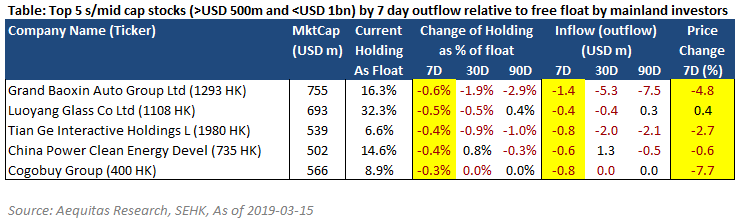
In our Discover HK Connect series, we aim to help our investors understand the flow of southbound trades via the Hong Kong Connect, as analyzed by our proprietary data engine. We will discuss the stocks that experienced the most inflow and outflow by mainland investors in the past seven days.
We split the stocks eligible for the Hong Kong Connect trade into three groups: component stocks in the HSCEI index, stocks with a market capitalization between USD 1 billion and USD 5 billion, and stocks with a market capitalization between USD 500 million and USD 1 billion.
In this insight, we will provide an analysis of the performance of selected stocks that just joined the Stock Connect last week.
Get Straight to the Source on Smartkarma
Smartkarma supports the world’s leading investors with high-quality, timely, and actionable Insights. Subscribe now for unlimited access, or request a demo below.
We recently downgraded the Chinese telcos on rising concerns that the telcos will be required to do “national service” to support China’s technological leadership in 5G. The closure of many overseas markets to Chinese equipment suppliers (esp Huawei, but also Zte Corp H (763 HK)) means the risk of a more aggressive 5G roll-out has increased. Markets have started to take notice but the initial reaction has been positive on excitement over the 5G opportunity. Given the lack of a strong business case for 5G currently, we don think additional capex is a positive. We model what an extreme roll-out could look like and the impact on the telcos. Along with a weakening macro outlook, we have further downgraded target prices for all three operators and cut China Mobile (941 HK) and China Telecom (728 HK) to Reduce and China Unicom (762 HK) to Neutral.
Get Straight to the Source on Smartkarma
Smartkarma supports the world’s leading investors with high-quality, timely, and actionable Insights. Subscribe now for unlimited access, or request a demo below.
New York based activist investor firm Starboard Value has been intricately involved in shaping the fortunes and futures of two high profile technology companies in recent years, Marvell and Mellanox. The firm first to prominence some five years ago when they were the first among their peers to accomplish the extraordinary feat of replacing the CEO and entire board of Fortune 500 restaurant group Darden, while holding less than 10% of the company’s shares.
In the wake of their Darden coup, the firm has gone from strength to strength. To date the firm has taken positions in a total of 105 publicly listed companies, replacing or adding some 211 directors on over 60 corporate boards.
On March 7’th 2019, Starboard Value announced the acquisition of a 4% stake in US comms infrastructure firm Zayo. In the intervening period, Zayo’s share price has risen by 14% as canny investors scramble to partake in the goodness that will surely be extracted by the activist firm that simply doesn’t take no for an answer.
Tencent Music Entertainment (TME US) reported its full year results today, post US market close. Revenue growth was slightly ahead of estimates as paying ratio continue to improve for both online music (subscription revenue) and social entertainment (live streaming). Growth for the latter continued to be driven more by ARPU rather than user growth.
The concerning bit in the results was the decline in gross margins as the company continues to invest in more content.
China Tower (788 HK) has rallied strongly in recent months and the question raised repeatedly in recent client meetings was “how much further is China Tower likely to rally?”. Chris Hoare sees China Tower’s position as unusual as the price moves are not driven by earnings upgrades or changed 5G expectations. Rather is is a sustained move post the IPO when the information in the market was incomplete and expectations were much lower. We were negative at the time of the IPO but changed our views as more information became available. We remain positive on the scope for revaluation in China Tower given its rapid revenue growth and low valuations vs EM peers. While the recent results were somewhat disappointing, we see good upside as the market factors is lower capex and higher returns.
In our Discover HK Connect series, we aim to help our investors understand the flow of southbound trades via the Hong Kong Connect, as analyzed by our proprietary data engine. We will discuss the stocks that experienced the most inflow and outflow by mainland investors in the past seven days.
We split the stocks eligible for the Hong Kong Connect trade into three groups: component stocks in the HSCEI index, stocks with a market capitalization between USD 1 billion and USD 5 billion, and stocks with a market capitalization between USD 500 million and USD 1 billion.
In this insight, we will provide an analysis of the performance of selected stocks that just joined the Stock Connect last week.
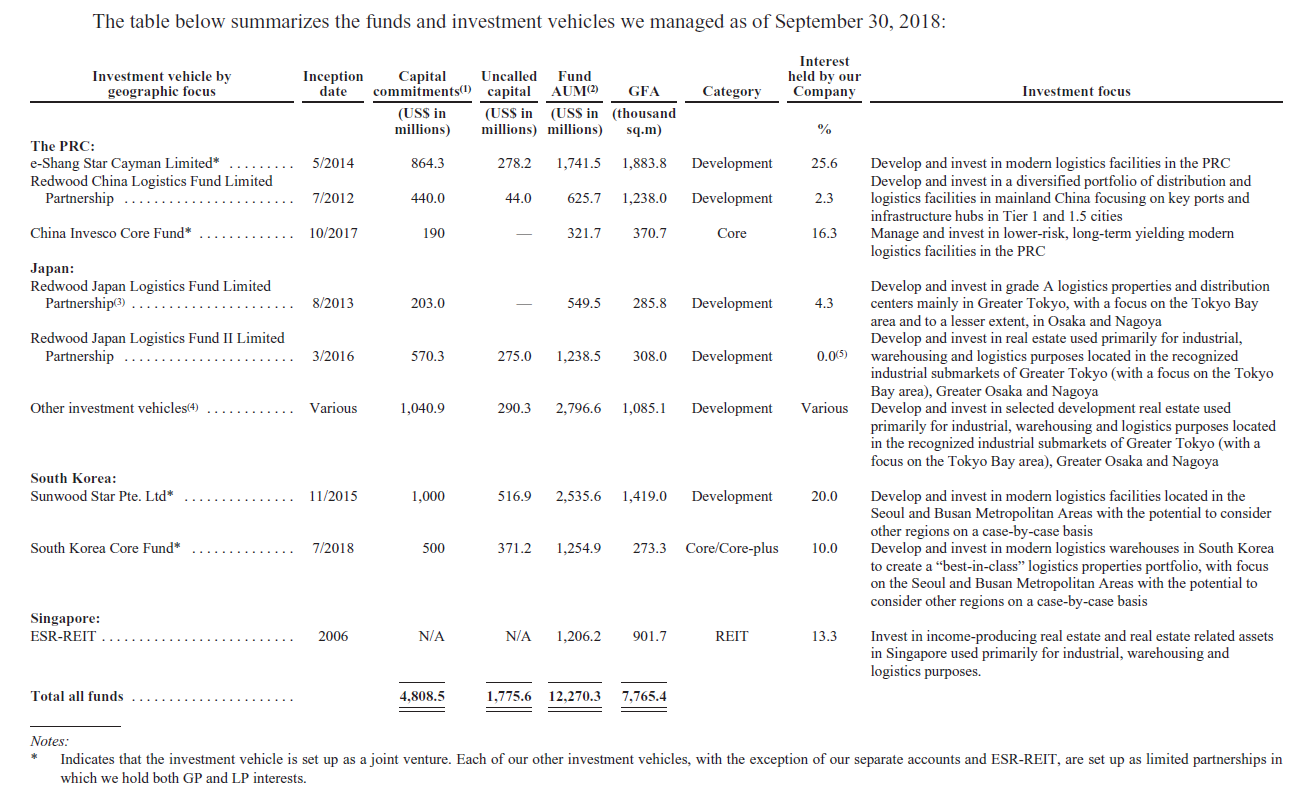
ESR Cayman (ESR HK) aims to raise up to US$1.5bn in its planned Hong Kong listing, as per media reports. The company is backed by Warburg Pincus and counts APG, the Netherlands’ largest pension provider, as one of its main investors.
In this insight, I’ll talk more about the financials and the drivers for each of the three segments.
Get Straight to the Source on Smartkarma
Smartkarma supports the world’s leading investors with high-quality, timely, and actionable Insights. Subscribe now for unlimited access, or request a demo below.
Shanghai composite breakout above 2,650 is a bullish catalyst for HK and pushing into secondary resistance. Typically, a re test of the breakout zone is often seen.
Shanghai A50 futures face a formidable barrier that has capped rally attempts for the last 7 months.
H share and the HSI are both exhibiting signs of distribution into strength. Choppy rising patterns warn that the rise is getting extended with breadth starting to struggle.
Tencent is exhibiting upside momentum deterioration amid divergence.
We question just how much trade deal euphoria is now priced into the HK market (and for that matter global cycle) and must take into account odds of a deadline extension deflating the current rally as the reality sets in that major trade issues remain unsettled.
Any trade deal would give us an exhaustive spike higher while an extension would knock us back to re cycle supports.
Get Straight to the Source on Smartkarma
Smartkarma supports the world’s leading investors with high-quality, timely, and actionable Insights. Subscribe now for unlimited access, or request a demo below.
Tencent Music Entertainment (TME US) reported its full year results today, post US market close. Revenue growth was slightly ahead of estimates as paying ratio continue to improve for both online music (subscription revenue) and social entertainment (live streaming). Growth for the latter continued to be driven more by ARPU rather than user growth.
The concerning bit in the results was the decline in gross margins as the company continues to invest in more content.
China Tower (788 HK) has rallied strongly in recent months and the question raised repeatedly in recent client meetings was “how much further is China Tower likely to rally?”. Chris Hoare sees China Tower’s position as unusual as the price moves are not driven by earnings upgrades or changed 5G expectations. Rather is is a sustained move post the IPO when the information in the market was incomplete and expectations were much lower. We were negative at the time of the IPO but changed our views as more information became available. We remain positive on the scope for revaluation in China Tower given its rapid revenue growth and low valuations vs EM peers. While the recent results were somewhat disappointing, we see good upside as the market factors is lower capex and higher returns.
In our Discover HK Connect series, we aim to help our investors understand the flow of southbound trades via the Hong Kong Connect, as analyzed by our proprietary data engine. We will discuss the stocks that experienced the most inflow and outflow by mainland investors in the past seven days.
We split the stocks eligible for the Hong Kong Connect trade into three groups: component stocks in the HSCEI index, stocks with a market capitalization between USD 1 billion and USD 5 billion, and stocks with a market capitalization between USD 500 million and USD 1 billion.
In this insight, we will provide an analysis of the performance of selected stocks that just joined the Stock Connect last week.
ESR Cayman (ESR HK) aims to raise up to US$1.5bn in its planned Hong Kong listing, as per media reports. The company is backed by Warburg Pincus and counts APG, the Netherlands’ largest pension provider, as one of its main investors.
Smartkarma supports the world’s leading investors with high-quality, timely, and actionable Insights. Subscribe now for unlimited access, or request a demo below.
China Tower (788 HK) has rallied strongly in recent months and the question raised repeatedly in recent client meetings was “how much further is China Tower likely to rally?”. Chris Hoare sees China Tower’s position as unusual as the price moves are not driven by earnings upgrades or changed 5G expectations. Rather is is a sustained move post the IPO when the information in the market was incomplete and expectations were much lower. We were negative at the time of the IPO but changed our views as more information became available. We remain positive on the scope for revaluation in China Tower given its rapid revenue growth and low valuations vs EM peers. While the recent results were somewhat disappointing, we see good upside as the market factors is lower capex and higher returns.
In our Discover HK Connect series, we aim to help our investors understand the flow of southbound trades via the Hong Kong Connect, as analyzed by our proprietary data engine. We will discuss the stocks that experienced the most inflow and outflow by mainland investors in the past seven days.
We split the stocks eligible for the Hong Kong Connect trade into three groups: component stocks in the HSCEI index, stocks with a market capitalization between USD 1 billion and USD 5 billion, and stocks with a market capitalization between USD 500 million and USD 1 billion.
In this insight, we will provide an analysis of the performance of selected stocks that just joined the Stock Connect last week.
ESR Cayman (ESR HK) aims to raise up to US$1.5bn in its planned Hong Kong listing, as per media reports. The company is backed by Warburg Pincus and counts APG, the Netherlands’ largest pension provider, as one of its main investors.
Since early November, when Chiyoda incurred substantial losses, scant details regarding the structure of the likely capital raise have emerged, except that the components would include additional loans and equity from industrial partners and most likely, main shareholder Mitsubishi Corp (8058 JP).
LightStream Research‘s conversations with the company suggest a high likelihood a deal would not be in place by the end of Mar, though in a one-on-one meeting they said they were in the final stages of discussions. Lightstream believes a deal is almost certain to be in place by the time of the company’s fiscal year earnings announcement which should be in mid May.
Getting injections of debt capital from banks (likely Mitsubishi Ufj Financial (8306 JP)) and equity capital from Mitsubishi are unlikely to be stumbling blocks. It is plausible that Mitsubishi would be keen to retain its current 33.39% stake in the company, so if the capital is in the form of prefs, Lightstream would expect them to be convertible.
As for the industrial partner, Chiyoda noted that there was significant interest due to their long track record as the leading LNG EPC player in the world, and that it was not so much a matter of being able to secure the financing, as it was a matter of finding a partner where there would be mutual benefits without constraining Chiyoda in terms of its business operations. But that implies the stake would be so large as to imply a controlling or heavily influential stake.
In terms of numbers, Lightstream speculates about ¥30bn in debt from banks with MUFG a likely lead candidate given the keiretsu ties. Perhaps ¥75bn in equity (prefs and common) split between Mitsubishi and an industrial partner. More likely, if Mitsubishi opted for pref shares, the industrial partner would end up with a stake of around 20% in Chiyoda, which could mean a ¥25bn injection, with Mitsubishi buying ¥50bn in prefs.
Shin Etsu announced a share buyback program to buy up to 14mn shares for up to ¥100bn. If it were to have bought all 14mn shares, that would be 3.3% of shares outstanding. Simultaneously, it announced a ToSTNeT-3 buyback of 11,001,100 shares at today’s closing price of ¥9,090/share which if all bought would complete the buyback program.
There was some speculation across the Street there would be a buyback because of slowing earnings expectations and a surfeit of capital, which was itself important because of the company’s lack of recent history of buybacks (the last and only time the company has bought back shares (to date) was a repurchase of 3 million shares for ¥13.6 billion in late October 2008 when things were hairy (and cheap))
It was a decent-sized buyback. That by itself is worthwhile. But it is not enormous. And with ¥1tn in net cash, buying back ¥100bn is not huge enough. It reduces the dividend out a little, and lifts EPS a little. But…
The BIG trade here is to identify the seller as quickly as possible – if it is a corporate seller. If it is Hachijuni Bank, buy Hachijuni Bank. If it is another small listed financial for whom the position is meaningful portion of market cap, Travis Lundy would be inclined to buy that one.
As a follow-up…
the result of the ToSTNeT-3 transaction was that the company bought back 9.84mm shares using 89.5% of the funds. The remaining ¥10.5bn to buy will likely be bought on market. It represents less than one day of volume.
Travis notes that there have been no announcements on TDNET which indicate who the seller might have been. If it had been a life insurer, it would not have made the news because it was portfolio gains, not corporate gains. It is also possible that corporate or bank holders in question would have other sales to offset the gains. We may not know until the yuho.
The previous Friday, the Nikkei announced that because the third party share sale of Pioneer Corp (6773 JP) had been completed, it would be deleted from the Nikkei 225 Average (and the Nikkei 500 Index). Omron will replace Pioneer in the Nikkei 225, with a deemed par value of ¥50 per share. The date for this index deletion and inclusion event was the 15th of March.
The Pioneer exclusion has been known/certain since the deal was approved. The Omron inclusion was less well-flagged. There is a lot of Pioneer stock to come out this week. Because it is so much, and because many people will not want to hold more than 5% of the company, Travis expects there is room for several people to increase their stake for an OK size.
Because of the path of Omron over the past year, Travis expected there would be many foreign holders unwilling to sell their shares at the current price. And they would be ill-prepared to sell large quantities in the market on Friday just because there was a Nikkei 225 inclusion. Travis expected the shares to squeeze. It is not easy to dislodge 25% of the float.
THE HINDSIGHT: As Travis notes in a discussion point appended to his piece, it appears every single buyer post-announcement was down-money by the inclusion, which happened at the lowest price of any traded post-announcement. This indicates substantially more pre-positioning than he thought, and the low volume on the print itself suggests substantially more shorting than might be healthy.
The Daewoo Shipbuilding & Marine Engineering (042660 KS) deal between HHI and KDB is now officially finalised, and it will take the following four-step process: the HHI (to be renamed Korea Shipbuilding & Offshore Engineering, or KSOE) spin-off of the opco (HHI opco); the KDB PIK into HHI; the KSOE rights issue; followed by the DSME rights issue. These details were further elaborated upon in Sanghyun Park‘s prior insight: Hyundai Heavy/DSME Event – Comprehensive Summary.
HHI declined 4% when the deal was finalized while DSME stayed flat. Apparently HHI and Korea Eximbank agreed that the ₩2.3tril CBs wouldn’t be converted into DSME shares and disposed any time soon. Plus, there will be a downward interest adjustment to help ease DSME’s financial burden.
This sparked a speculation that HHI must have pledged Korea Eximbank with some sort of DSME expected valuation. Sanghyun would close the current HHI long/DSME short position. Short-term, he expects DSME will outperform HHI. Longer term, he’d rather stay away from both.
The revision – the divestment on the SPP1 co-generation plant – was a remedial requirement by the ERC regulator. The sale of SPP1 to B Grimm Power (BGRIM TB) for Bt3.3bn was announced on the 22 February and was completed mid-week.
Subsequent to the SPP1 sale, the purchase price under the SPA was adjusted to Bt91.9906/share, a ~3% decline from the initial Bt94.892/share price under the original SPA.
My discussions with GLOW indicate that the 247-4 Tender Offer form may be submitted to the SEC & SEC by GPSC as early as next week, with the Offer open to acceptances shortly after. The ERC signed off on the SPA the previous Friday. Assuming mid-May payment, this is currently trading at a gross/annualised spread of 1.6%/10.8%.
HKICIM announced HNA Finance had entered into a SPA in which Times Holdings, a Blackstone-controlled vehicle, had conditionally agreed to buy 69.54% of HKICIM’s issued shares for HK$3/share in an HK$7bn transaction. Should the SPA complete, Times will make a mandatory unconditional offer – also at $3.00/share (14.5% premium to last close) – for the remaining 30.46% of shares out. This proposal arrives nearly three years after HNA bought a 66% in Tysan Holdings – as HKICIM was previously known – from Blackstone for HK$4.53 per share, triggering an MGO.
After a rapid-fire acquisition spree – at record prices, oddly motivated to “snatch land and pricing power from the city’s real estate cartel” – and similar disposal pace of Kai Tak properties, HNA is presumably recycling these sales proceeds to offset its debt obligations.
This will continue to trade tight to, if not through terms, with an anticipated completion late April. There will be no bump to the Offer. Times does not intend to avail itself to compulsory acquisition and intends to maintain HKICIM’s listing; while both Times and HKICIM will take appropriate steps to maintain a sufficient public float after the close of the Offer.
Iph Ltd (IPH AU) has gate crashed Xenith/Qantm Intellectual Property (QIP AU)‘s marriage of equals, submitting a proposal (by way of a Scheme) for Xenith comprising cash (A$1.28) and IPH shares (0.1056 IPH shares) or A$1.97/share, 23.3% above the implied QANTM all-scrip merger consideration, based on QANTM’s 26 Nov 2016 closing price.
On the same day as the Xenith/QANTM announcement, IPH lobbed a non-binding cash & scrip proposal to acquire QANTM at $1.80/share (including a A$0.05 dividend) by way of a scheme, or a 42% premium to last close. QANTM’s board rejected the proposal due to its highly conditional nature, significant execution risk, and that the offer undervalued the company. So, IPH bought a 19.9% stake in Xenith at $1.85/share (or ~A$33mn) from institutional investors, and further added that is does not support QANTM’s merger and intends to vote against it at the forthcoming scheme meeting on the 3 April.
The key risk to IPH’s proposal is ACCC’s consent – the provisional clearance date for the QANTM/Xenith merger is the 21 March; while IPH/Xenith‘s is the 2 May. IPH, QANTM and Xenith are the only three ASX-listed intellectual property companies, and IPH is the largest (in terms of revenue). However privately owned companies collectively hold a larger market share – and growing – compared to the three listcos. It is not apparent a merger between either of these two listcos would lessen IP service competition in Australia.
With a 19.9% blocking stake, the QANTM/Xenith scheme is toast. 19.9% of institutional investors have already cashed out at $1.85/share. Xenith should engage with IPH.
In the past six months, Hyosung Corp is up 62% while Hyosung TNC is down 12%. Corp’s share price has surged in the past six months on account of excellent dividends, strong financial results and the timing of the increased insider ownerships/completion of tender offers. Douglas Kim believes the market has already factored into Corp’s share price many of these positive factors.
Both TNC and Corp have underperformed the market. However, TNC appears to be a turnaround story driven by a decline in raw material prices, aggressive spandex investment in India, the stabilization of spandex prices in 2H19 and the consolidation of the global spandex industry
Douglas would be long TNC and short Corp on a dollar-for-dollar basis. His base case strategy is to achieve gains of 7-9% on this pair trade. Plugging in Douglas’s numbers results in the discount to NAV at extreme levels. One pushback is that TNC accounts for just 16% of Corps’ NAV. Five other listco holdings total 40% of NAV.
Curtis Lehnert flags this simple holdco structure wherein the bifurcation between the two counters is in excess of 2 STDs. I also touched on this pair last month (StubWorld: Hang Lung’s Implied Stub At Extreme Levels) and this unreasonably wide discount which is made more than unreasonable by the fact that there is very little to distinguish between the two stocks.
Curtis proposes one avenue for narrowing the discount – by HLG divesting its stake in HLP. Maybe. Over a decade ago, HLG’s stake dipped below 50% in HLP, but it still consolidated the accounts.
However the last few years has seen HLG gradually increasing its stake in HLP; and in one instance selling property to HLP (at book), then buying shares in HLP at 0.6x P/B. HLG is cheap, but a catalyst for narrowing the discount remains elusive.
Inputting the latest of Wheelock’s, Wharf’s and WREIC’s FY18’s numbers backs out a discount to NAV of 37.5%, bang in line with its 12-month average. Wheelock is coming up “expensive” vs. Wharf, but Wharf accounts for only 25% and 22% of NAV & GAV respectively.
Wharf’s net profit decreased by 11% in FY18. While the company said cooling measures in China have had minimal impact on demand, it added “the timing of sales launch continued to be dictated by local government approval to sell at full or close to full market price“.
Chairman & MD Stephen Ng said it will sell/reduce its mainland property investments, ruling out any possibility of returning. This suggests the momentum is with non-PRC asset portfolio companies under the Wheelock group, favouring both Wheelock and WREIC.
First Pacific Co (142 HK)exits from the Goodman Fielder JV for US$300mn. First Pac will incur a US$280mn non-cash loss on the sale. Not an ideal return on a five-year investment. Shares closed marginally up suggesting this announcement was largely expected.
MYOB Group Ltd (MYO AU)‘s scheme doc is out. The Scheme meeting is scheduled for 17 April, with an expected implementation date of the 8 May. The independent expert, Grant Samuels, considers the Scheme consideration to be fair & reasonable, with an assessed value range of $3.19-$3.69 vs KKR’s Offer of $3.40.
Trade Me (TME NZ)‘s scheme book is out. The vote will take place on the 3 April. The Independent Adviser concluded that the Scheme consideration of NZ$6.45 is above its valuation range for the shares of NZ$5.93 – NZ$6.39. OIO consent has also been received.
The IFA believesDelta Electronics Thai (DELTA TB)shareholders should accept the Tender Offer of Bt71/share as it is above its fair value range of Bt62.33-Bt67.80/share.
Mastercard’s offer has now lapsed, leaving Visa as the sole bidder for Earthport plc (EPO LN). Visa’s 37 pence offer has been extended for two weeks until the 25 March.
The IFA (UOB) considers the $3.10/share Offer for Kian Joo Can Factory (KJC MK) is “not fair” but “reasonable”. (Best to open the link in Chrome not Edge). UOB considers the Offer price represents a 25 sen or 7.46% discount to the estimated fair value of RM3.35/share. The Offer will be open for acceptances until the 22 March – unless extended.
Australian property developer, Villa World Ltd (VLW AU)announced that it had received an unsolicited proposal from AVID Property Group Australia to acquire all of the company’s shares for A$231/share (a 12% premium to last close) by way of a scheme of arrangement.
CCASS
My ongoing series flags large moves (~10%) in CCASS holdings over the past week or so, moves which are often outside normal market transactions. These may be indicative of share pledges. Or potential takeovers. Or simply help understand volume swings.
Often these moves can easily be explained – the placement of new shares, rights issue, movements subsequent to a takeover, amongst others. For those mentioned below, I could not find an obvious reason for the CCASS move.
Closing date of Subsequent Offer for remaining shares
C
Norway
Oslo Børs VPS
Off Mkt
29-Mar
Acceptance Period Ends
C
Switzerland
Panalpina
Off Mkt
5-Apr
EGM
C
US
Red Hat, Inc.
Scheme
March/April
Deal lodged for approval with EU Regulators
C
Source: Company announcements. E = my estimates; C =confirmed
Get Straight to the Source on Smartkarma
Smartkarma supports the world’s leading investors with high-quality, timely, and actionable Insights. Subscribe now for unlimited access, or request a demo below.