Category

TMT/Internet

Brief TMT & Internet: Ruhnn (如涵) Trading Update – Worst First-Day Performance Out of Recent US ADR Listings and more

By | TMT/Internet

In this briefing:

  1. Ruhnn (如涵) Trading Update – Worst First-Day Performance Out of Recent US ADR Listings
  2. Naspers: Addressing the Discount (Again). New Moves to Realize Value Are Having an Impact
  3. Alibaba (BABA): Weakest Business Line Transfers Risk to Suppliers and Cuts Headcount, 38% Upside
  4. Summit Ascent’s Slippery Slope
  5. Manikay Caves and Accepts KKR’s Reduced (And Now Final) Offer

1. Ruhnn (如涵) Trading Update – Worst First-Day Performance Out of Recent US ADR Listings
Price%20performance

Ruhnn Holding Ltd (RUHN US) raised US$125m at US$12.50 per share, the mid-point of the price range. We have previously analyzed the IPO in:

In this insight, we will update on the deal dynamics, implied valuation, and include a valuation sensitivity table.

2. Naspers: Addressing the Discount (Again). New Moves to Realize Value Are Having an Impact

Npn%20transaction

Naspers (NPN SJ) recently announced another attempt to reduce the holdco discount which has remained stubbornly high despite previous attempts by management to reduce it. Since the announcement there has been movement, so perhaps this time it really is different!

So what is being done? Naspers will spin off its international internet assets, which account for >99% of its value, into a newco. They will then list 25% of newco on the Euronext in Amsterdam by issuing these shares to Naspers’ shareholders. The intention is to create a vehicle which can attract increased foreign and tech investors without the complication of a South African listing. The company believes this has been a key factor behind the wide holdco discount. The move also reduces Naspers weighting in South African indices which is another contributing factor.

Alastair Jones sees the announcement as a positive, although there are still issues with the main listing being in South Africa. He still believes a buyback would be the most effective way to reduce the discount, but Naspers is also keen to keep investing. 

3. Alibaba (BABA): Weakest Business Line Transfers Risk to Suppliers and Cuts Headcount, 38% Upside

Pic%203

* Youku, the online TV subsidiary of BABA, is transforming its risk of loss to content providers.

* Youku is dismissing employees.

* We believe both of Youku’s decisions are positive for cost control and the operating margin will recover in FY2020.

* The P/E band suggests a price target HKD250, which is 38% upside above the market price.

4. Summit Ascent’s Slippery Slope

Capture

Back in September 2017, Lawrence Ho, Summit Ascent Holdings (102 HK)‘s major shareholder, reduced his stake to 18.75% from 27.06% (at between $1.13-$1.60/share, but mainly at the low end of this range), according to Hong Kong Exchange disclosure of interest filings. The share price of this Russian integrated gaming play declined 34% to $1.06/share in the following five trading days. Who bought those shares was not disclosed – CCASS shows these shares moving out of VC Brokerage into at least 10 different brokerage accounts.

Shortly after, Howard Klein quoted one insider in his insight Melco Resorts: A Gem Hiding in Plain Sight Offers an Entry Point After a Recent Dip that the sell-down wasn’t likely a sign “Ho has lost confidence in the area.

On the 15 December, Ho announced a complete exit from Summit, selling 17.37% of shares out. Concurrently Ho resigned from his NED and chairman positions. Those shares moved from VC Brokerage to Sun Hung Kai Investments on the 20 December 2017. Shares traded unchanged on the news. 

At the same time, First Steamship (2601 TT) disclosed it held 12.67% on the 18 December 2017. Concurrently, Kuo Jen Hao was appointed as NED and Chairman of the Board, with effect from 28 December 2017.  Kuo is also the chairman and the general manager of First Steamship. First Steamship gradually increased its stake to 19.11% as at 24 October 2018.

The New News

Yesterday, Summit Ascent announced it has been informed that First Steamship and Kuo are in talks to sell their entire shareholdings. No numbers were disclosed. This stake sale would not trigger an MGO and there was no reference to the release of an announcement pursuant to the Codes on Takeovers and Mergers and Share Buy-Backs in Hong Kong. Shares are up 24%.

With increased liquidity surrounding the news, this looks like a great opportunity to exit.

5. Manikay Caves and Accepts KKR’s Reduced (And Now Final) Offer

Screenshot%202019 04 03%20at%204.29.57%20pm

Originally I had thought KKR’s offer could go higher. Instead, it came in lower at A$3.40 and KKR gave MYOB Group Ltd (MYO AU) management all of a couple of days to think about it.

The title to my subsequent piece was MYOB Caves And Agrees To KKR’s Reduced Offer.

Manikay Partners started buying up shares and by early March had reached a position of 11%. They made noise. The Scheme Booklet came out on the 14th of March. Four days later Manikay announced their position was now 13.61% and the following day Mawer announced re-upped its stake from the mid 8s to high 9% level.

The 20th saw a Scheme Update from MYO announcing receipt of a letter from KKR saying that the A$3.40 price was their “best and final offer”, making it clear under Truth in Takeovers language that Manikay was not going to get a higher price out of them.

Manikay continued to buy shares on the 20th and the 21st, getting to 16.16% of the company as filed on the 22nd.

On Monday 1 April, MYOB announced a supplemental disclosure to the Scheme documents noting KKR’s final intention, and that the directors continued to unanimously recommend the Scheme.

Today we have new news.

Manikay Caves and Agrees to KKR’s Reduced (Now Final) Offer

Earlier today a Reuters story about Manikay accepting the offer popped up and MYOB shares popped from A$3.34 to A$3.38-39 area where they closed. Partway through the day MYOB released a document on the ASX feed saying that Manikay had sent a letter saying…

In order avoid speculation regarding our voting intentions in respect of the Scheme, we are writing to inform you that we, Manikay Partners, intend to vote all the MYOB shares that we own or control FOR the upcoming Scheme, subject to there being no proposal that we consider to be superior prior to the vote.

We remain very disappointed that, despite our repeated efforts to convince you otherwise, you failed to change your recommendation in light of the material improvement in market conditions since announcement of the Scheme, among other factors. We are also disappointed that the disclosures to MYOB shareholders did not fully explain the impact of such improved market conditions on the value of MYOB.
excerpt of the letter.

Get Straight to the Source on Smartkarma

Smartkarma supports the world’s leading investors with high-quality, timely, and actionable Insights. Subscribe now for unlimited access, or request a demo below.


Brief TMT & Internet: Naver Faces Macro Downside Pressure and more

By | TMT/Internet

In this briefing:

  1. Naver Faces Macro Downside Pressure
  2. Malaysian Telcos: Look for Improvements to Continue in 2019.
  3. HK Connect Discovery – March Snapshot (WH Group, Air China)
  4. Dongzheng Auto Finance (东正汽车金融) Trading Update – Could Be Worth Setting up a Trade
  5. U.S. Equity Strategy: Be Long & Carry On

1. Naver Faces Macro Downside Pressure

Naver Corp (035420 KS) is nearing tactical support for a trading buy but continues to face macro bear pressure stemming from key resistances note in the weekly RSI and MACD postures. This bear pressure is due to resume after a bounce sequence.

Naver has broken down out of triangulation after completing a corrective bounce cycle outlined in our recent update. Naver Bull Wedge to Trade Higher . We are now resuming the macro down cycle and view tactical rallies as selling opportunities as the major trend remains down.

A Kospi 200 rise above 290 will play a role in lifting Naver in the outlined tactical bounce cycle.

2. Malaysian Telcos: Look for Improvements to Continue in 2019.

Axiata%20fcast

The 4Q18 numbers released by the Malaysia wireless operators, showed stable trends vs 3Q. Market service revenue growth of -1.1% YoY was stable, with Maxis (MAXIS MK) the only operator able to slightly increase its market share (again). While 2H18 marked a small break in the Malaysian wireless sector recovery, guidance for 2019 looks broadly encouraging.

  • Axiata (AXIATA MK) expects a “promising 2019” with revenue and profit growth momentum (across the board),
  • Maxis guides for a slight improvement of revenues, albeit with EBITDA declining due to new business opportunities, and
  • DIGI (DIGI MK) which is a bit more cautious, expects flat revenues.

Data usage is already very high in Malaysia, but we expect growth to continue (at a slower pace) supported by youthful demographics (younger people use more video on mobile). The Malaysian operators have done a reasonable job at monetizing data growth so far. 

Chris Hoare turned more positive on Malaysian telcos in early 2019 as affordability has improved and there is a new profitable growth opportunity in fibre wholesale (with Telekom Malaysia (T MK) being forced to offer at low prices). Operating trends have also improved and we expect this to continue. In January, we upgraded Axiata to Buy and both Maxis and Digi to Neutral. None of them are “cheap” with Maxis (MAXIS MK) and DIGI (DIGI MK) on 11-13x EV:EBITDA, and Axiata on a more reasonable 6.5x.

3. HK Connect Discovery – March Snapshot (WH Group, Air China)

Smid%20cap%20outflow%2003 29

This is a monthly version of our HK Connect Weekly note, in which I highlight Hong Kong-listed companies leading the southbound flow weekly. Over the past month, we have seen the flow turned from outflow in February to inflow in March. Chinese investors were also buying Consumer Staples and Consumer Discretionary stocks.

Our March Coverage of Hong Kong Connect southbound flow

4. Dongzheng Auto Finance (东正汽车金融) Trading Update – Could Be Worth Setting up a Trade

Price%20performabnce

Dongzheng Automotive Finance (2718 HK) raised US$208m at a fixed price of HK$3.06 per share. We have covered the IPO extensively in:

In this insight, we will update on the deal dynamics, implied valuation, and include a valuation sensitivity table.

5. U.S. Equity Strategy: Be Long & Carry On

Untitled

Both the cap- and equal-weighted S&P 500 are trading at highs not seen since early October 2018 – a positive indication in itself. Additionally, key risk-on areas we highlighted in last week’s Compass (small-caps, Financials/Banks, and Transports) have outperformed off the recent lows – a welcomed sight for risk sentiment, and confirms out positive outlook. In today’s report we highlight attractive bottom-fishing opportunities within the Financials Sector, and attractive Groups and stocks within Large- and Small-Cap Railroads, and Internet Software

Get Straight to the Source on Smartkarma

Smartkarma supports the world’s leading investors with high-quality, timely, and actionable Insights. Subscribe now for unlimited access, or request a demo below.


Brief TMT & Internet: Japan Post Insurance Offering – Now It Gets Real and more

By | TMT/Internet

In this briefing:

  1. Japan Post Insurance Offering – Now It Gets Real
  2. OUE Commercial REIT & Hospitality Trust Merger Proposed
  3. HK Connect Discovery Weekly: Air China and Great Wall Motor (2019-04-04)
  4. Indonesia Property-In Search of the End of the Rainbow- Part 7 – Kawasan Industri Jababeka (KIJA IJ)
  5. Last Week in GER Research: Huya, Bilibili and Qutoutiao

1. Japan Post Insurance Offering – Now It Gets Real

Screenshot%202019 04 09%20at%202.52.38%20am

The Background

Almost 150 years ago in 1871, a modern postal service was established in Japan by the new Meiji government. The following year, a government-sponsored nationwide network of postal services was launched. Postal money orders started in 1875 and other money and payment services started in the following two decades. In the first decade of the 20th century, domestic money transfers and pension payment receipt were launched. In 1916 postal life insurance sales began. Life annuity sales began a decade later. The Japanese postal system of teigaku deposits started in 1941. In 1949, postal operations were established as the Ministry of Posts alongside the Ministry of Electric Communications (Telecommunications), and eventually both were subsumed into the Ministry of Posts & Telecommunications. In 2001, the business of the Japanese postal system was separated into the Japan Postal Agency, a short-lived entity set up under “central government restructuring” which took place that year. In 2003, the postal system was set up as the Japan Post Corporation under a law which established it as a statutory public corporation (in England, the Bank of England, the BBC, and the Civil Aviation Authority are such companies). 

The issue of privatisation – i.e. making it responsible for its own accounts, which would take things one step further rather than being a government budget item – had long been mooted but constantly rejected because it might cost jobs and reduce services. Finally after several Lower House LDP politicians voted against Koizumi’s proposal to split the Japan Post Corporation into four parts in summer 2005 and the Upper House knocked it down, Koizumi dissolved both houses of the Diet and called a snap election saying that it was a referendum on postal privatization. He won easily and the bill was passed a month later. Things were iffy as a privatized company for a few years until after the 2011 Tohoku Earthquake, after which the government needed to find sources of extra funds to finance reconstruction. In 2012, the government announced it would sell shares to the public within three years.  

Three years ago and change, the government of Japan launched the promised public offering for Japan Post Holdings (6178 JP) (“JPH”), which acted as a holding company for Japan Post Bank (7182 JP) (“JPB”), and affiliated insurance arm Japan Post Insurance (7181 JP) (“JPI”). At the time, the triple-IPO at ¥1.4 trillion was the largest one-day offering in almost two decades, and the situation created some significant and interesting short-term trading opportunities. 

In the end, there was always going to be “overhang” because the explicit goal of the privatization policy was to get JPH’s ownership of JPB and JPI below 50%. In doing so, the bank and insurance operations could then go out and compete with other banks and insurers; currently they are to a large extent restricted from offering new products and entering new markets.

Japan Post Insurance announced on April 4th after the close that JPH would offer 168.1mm shares of Japan Post Insurance to the public, with another 16.9mm shares offered in an over-allotment. This is big news as it is almost 31% of the shares outstanding of Japan Post Insurance and will dramatically increase its float. 

One can say it is a big deal – ¥450bn (~US$4bn) of stock and at announcement it was equivalent to the last 477 days of traded volume. More importantly, this ALMOST like an IPO in that the placement is almost 3x the original IPO size (66mm shares) and will get a lot of foreign investor attention. 

In addition, JPI announced it would conduct a buyback for up to 50 million shares (with a spending limit of ¥100 billion) on the ToSTNeT-3 off-hours auction-like trading system on days between April 8th and April 12th. 

JPH announced in its “Intention To Sell shares” announcement (end of section 1 on p2) that if it sold shares in the ToSTNeT-3 trade, it would likely reduce the number of shares it offered. 

The stock rallied very sharply Friday, rising 3% at the open and ending the morning session up 3% but rising much further in the afternoon to end up 9.9%. 

After the close Friday, the company announced it would spend ¥100bn to buy up to 37.411mm shares pre-open on ToSTNeT-3 on Monday morning. That was 6.2% of shares outstanding. 

The dynamics of this ToSTNeT-3 buyback were discussed in Japan Post Insurance – The ToSTNeT-3 Buyback. The ToSTNeT-3 buyback was, at its basest, an interesting garbitrage trade for a limited number of traders but the resulting dynamics are important. They influence the supply in the Offering, the dynamics of demand, and may influence trading patterns into pricing. 

There are several things going on here. There is a huge offering, a buyback, earnings accretion, a float change, substantial sale to foreigners this time, and index changes. Sooner and later, it will mean a substantial move towards getting closer to 50%, and the fact that this is now investable for lots of institutional investors.

It is worth looking at these aspects independently to better understand demand for the offering as a whole. 

Read on for more.

2. OUE Commercial REIT & Hospitality Trust Merger Proposed

Screenshot%202019 04 08%20at%202.59.25%20pm

After a WSJ article on Sunday suggesting as much, Monday morning 8 April 2018 saw the announcement of a Proposed Merger between OUE Commercial Real Estate Investment Tr (OUECT SP) and OUE Hospitality Trust (OUEHT SP) whereby OUEHT unitholders would receive a combination of cash and OUECT shares (S$0.04075 + 1.3853 shares of OUECT) for every share of OUEHT held. Investors in each would receive any “permitted distributions” (dividends, etc) declared by the respective managers in respect of the period from 1 Jan 2019 up to the day immediately before the date on which Trust Scheme becomes effective.

This would create a REIT with S$6.8bn of assets, a pro-forma market cap of ~S$2.9bn, and a free-float of S$1.1bn (up by 57%). OUE Group would continue to own 48.3% of the total. 

The benefits to investors would be increased scale (2.2mm square feet of commercial net lettable area, + 1,640 hotel rooms), more borrowing capacity, increased diversification as asset concentration would be lowered, and because the scope of NewREIT would be broader, it would allow REIT managers more flexibility. The above-mentioned points are advertised as being the fodder for a re-rating. The idea of possible index inclusion is mooted as well. 

The OUECT presentation says that the merger is “DPU accretive to unitholders” (+2.1% on a 2018 pro-forma basis) while the OUEHT presentation says that the merger is “value accretive to stapled securityholders” (+18.7% NAV uplift per stapled security). 

Details of how this all works below.


Separately, two other Singapore deals announced at the end of last week include:

3. HK Connect Discovery Weekly: Air China and Great Wall Motor (2019-04-04)

Great wall motor holding by mainland investors holding chartbuilder

In our Discover HK Connect series, we aim to help our investors understand the flow of southbound trades via the Hong Kong Connect, as analyzed by our proprietary data engine. We will discuss the stocks that experienced the most inflow and outflow by mainland investors in the past seven days.

We split the stocks eligible for the Hong Kong Connect trade into three groups: component stocks in the HSCEI index, stocks with a market capitalization between USD 1 billion and USD 5 billion, and stocks with a market capitalization between USD 500 million and USD 1 billion.

In this insight, we will highlight Air China and Great Wall Motor. 

4. Indonesia Property-In Search of the End of the Rainbow- Part 7 – Kawasan Industri Jababeka (KIJA IJ)

Screenshot%202019 03 19%20at%204.54.09%20pm

In this series under Smartkarma Originals, CrossASEAN insight providers AngusMackintosh and Jessica Irene seek to determine whether or not we are close to the end of the rainbow and to a period of outperformance for the property sector. Our end conclusions will be based on a series of company visits to the major listed property companies in Indonesia, conversations with local banks, property agents, and other relevant channel checks. 

In the seventh company in ongoing Smartkarma Originals series on the property space in Indonesia, we now look at Indonesia’s oldest Industrial Estate developer and operator Kawasan Industri Jababeka (KIJA IJ). The company’s largest and the original estate is in Cikarang to the East of Jakarta and comprises 1,239 hectares of industrial land bank and a masterplan of 5,600 ha. 

It has a blue chip customer base both local and foreign at Cikarang including Unilever Indonesia (UNVR IJ), Samsung Electronics (005930 KS), as well as a number of Japanese automakers and their related suppliers.

The company has also expanded its presence to Kendal, close to Semarang in Central Java, where it has a joint venture with Singapore listed company Sembcorp Industries (SCI SP). This estate covers a total area of 2,700 ha to be developed in three phases over a period of 25 years and is focused on manufacturing in industries.

The company also has successfully installed a 140 MW gas-fired power station at its Cikarang, providing a recurrent stream utility-type earnings, which cushion against the volatility in its industrial estate and property earnings. After some issues with one of its boilers (non-recurrent) and issues early last year with PLN, this asset now looks set to provide a stable earnings stream for the company.

KIJA has also built a dry-port at Cikarang estate which has been increasing throughput by around +25% every year, providing its customers with the facility for customs clearance at a faster pace of that at the Tanjong Priok port, as well as logistics support. 

After two difficult years where the company has been hit by a combination of problems at its power plant, foreign exchange write-downs, and slower demand for industrial plots, the company now looks set to see a strong recovery in earnings in 2019 and beyond.

The company has seen coverage from equity analysts dwindle, which means there are no consensus estimates but it looks attractive from both a PBV and an NAV basis trading on 0.85x FY19E PBV and at a 73% discount to NAV. If the company were to trade back to its historical mean from a PBV and PER point of view, this would imply an upside of 33% to IDR325, using a blend of the two measures. An absence of one-off charges in 2019 and a pick up in industrial sales should mean a significant recovery in earnings, putting the company on an FY19E PER multiple of 9.7x, which is by no means expensive given its strategic positioning and given that this is a recovery story. 

5. Last Week in GER Research: Huya, Bilibili and Qutoutiao

Below is a recap of the key IPO/placement research produced by the Global Equity Research team. This week, we update on the bevvy of placements offered by various companies. After placements by Pinduoduo (PDD US) and Sea Ltd (SE US) , we saw more offerings from HUYA Inc (HUYA US) , Bilibili Inc (BILI US) and Qutoutiao Inc (QTT US). We update on these three offerings and perhaps big picture, this could reflect a signalling inflection point in these shares. More details below 

In addition, we have provided an updated calendar of upcoming catalysts for EVENT driven names below. 

Best of luck for the new week – Arun, Venkat and Rickin

Get Straight to the Source on Smartkarma

Smartkarma supports the world’s leading investors with high-quality, timely, and actionable Insights. Subscribe now for unlimited access, or request a demo below.


Brief TMT & Internet: Nexon Sale: Key Questions at This Point & Most Realistic Answers and more

By | TMT/Internet

In this briefing:

  1. Nexon Sale: Key Questions at This Point & Most Realistic Answers
  2. Huya Offering: Everyone Else Was Doing It Excuse
  3. ALTABA UNWINDING – Not Much Juice, and Considerably Different Skew
  4. StubWorld: Naspers’ Restructuring Update
  5. Huya Placement: Best Performing Live Streaming Stock but Beware Douyu Is Catching Up

1. Nexon Sale: Key Questions at This Point & Most Realistic Answers

1

This post discusses the key questions on Nexon sale at this point. It then provides the most realistic answers to these questions from various circumstantial aspects. This post is based on the recent news reports and also various local sources.

2. Huya Offering: Everyone Else Was Doing It Excuse

Gross%20margin

Follow-on offerings by Chinese ADRs are the flavour of the day. Hot on the heels of Qutoutiao Inc (QTT US) and Bilibili Inc (BILI US), HUYA Inc (HUYA US) filed for a potential $550 million public offering without presenting any details on the new ADS being offered. Also, certain selling shareholders will offer shares in the offering.

Huya is one of the few recent Chinese “new-economy” IPOs which has lived up to the hype by delivering a creditable post-IPO financial performance. While Huya has proven to be a good IPO, we believe this follow-on offering is highly opportunistic and would be tempted to participate only at a large discount.

3. ALTABA UNWINDING – Not Much Juice, and Considerably Different Skew

Screenshot%202019 04 04%20at%208.59.54%20pm

On February 27th of this year, Altaba Inc (AABA US) held a “Strategic and Financial Update Conference Call.” In that call the company led by CEO Thomas McInerney said that effectively it was going to deal with its two major remaining assets (2.03bn shares of Yahoo Japan Corp (4689 JP) and 383.56mm shares of Alibaba Group Holding Ltd (BABA US)) in two stages, saying at the time they were “moving to an active monetization mode on [our] Yahoo Japan stake.”

That Yahoo Japan stake took longer, but the company worked to sell $20+bn of Alibaba last summer through a tender offer and selldown to generate cash for corporate liabilities and taxes, and then the company sold its Yahoo Japan stake in early September. 

Since then, there has been a period of watchful waiting. Some have been expecting a period with an acceptable amount of carry and then possible significant upside. I haven’t seen the upside but agree there has been some baseline carry. And if you can get lots of leverage on this and ride the volatility, it could produce an OK return from A to Z if you ignore the indignities and volatility of passing through stops B to Y.

The New News

Yesterday, Altaba and CEO McInerney held a conference call after filing a PRE 14A preliminary proxy statement related to the selldown/unwinding of its entire Alibaba stake and the proposed windup/dissolution of Altaba as an entity. 

Set of Relevant Documents and Filings

DocumentHTMLPDF
Press Release

👹

PRE 14 A Preliminary Proxy Filing

👹

🤖

DEFA14A Additional Info

👹

🤖

DEFA14A Additional Info  – Call Transcript

👹

🤖

The Webcast

🤖

Home Page with Basic Details

👹

Annual Report from Year to 31 December 2018

🤖

The company will sell or distribute, in stages, its remaining net assets to shareholders, with a “pre-dissolution liquidating distribution to stockholders (in cash, Alibaba ADSs or a combination thereof), which the Fund currently expects will be made in the fourth quarter of 2019 and estimates will be in an amount between $52.12 and $59.63 per Share in cash and/or Alibaba ADSs (which estimates assume, among other things, an Alibaba Share price realized on sale and, if applicable, an Alibaba Share value at the time of distribution, of $177.00 per Alibaba Share).”

As p55 of the preliminary proxy makes clear (and as discussed in the transcript linked above, which is short and worth reading), based on the same US$177/share assumption of value realized or distributed per Alibaba share held, the total distributed would be in a range of $76.72 and $79.72 based on some other assumptions. A larger portion of the remaining amount could take 12 months to arrive, and there could be other residual portions which will take longer (years), as discussed in the proxy and call transcript.

The figure of $76.72 – $79.72 represents a 5.44-9.56% premium to yesterday’s close of $72.76/share and represents the total of the Pre-Dissolution Liquidating Distribution in Q4 2019, a second distribution in Q4 2020, then residuals thereafter after the court-mandated holdback in the dissolution process pays its claims.

Fair value calculations, parameters, and risk discussion below.

Elaborate fair value calculations using different assumptions of appropriate discount rates for each payment, and exactly how much is in the last bit (and how long it takes to pay out) suggest a group of ranges of fair value, from about 3-4% below the last-traded price, to about 4-5% above. However, for a hedge fund to earn a 10% net return for investors from owning the trade at the close of yesterday, getting there requires a fair bit of leverage and the resulting information ratio may be lower than desirable.

Assuming the approximate time to payment as described in the proxy statement, and amount of payment in the first distribution as described, and a multi-year residual of US$5/share, current borrow rates and an assumption of slightly higher discount rate required for the portion of time the stock is unlisted and even higher when one is receiving residual claims, the current fair value of the stock ranges from about 2% below current price and 4% higher. If you assume a higher Holdback Amount, the range of outcomes shifts lower.

4. StubWorld: Naspers’ Restructuring Update

Nav%204%20apr

This week in StubWorld …

Preceding my comments on Naspers are the weekly setup/unwind tables for Asia-Pacific Holdcos.

These relationships trade with a minimum liquidity threshold of US$1mn on a 90-day moving average, and a % market capitalisation threshold – the $ value of the holding/opco held, over the parent’s market capitalisation, expressed in percent – of at least 20%.

5. Huya Placement: Best Performing Live Streaming Stock but Beware Douyu Is Catching Up

Quarterly%20financials

Huya, a leading live streaming player in China, announced share placement of USD 550 million after market close on April 3rd. In this insight, we will look at recent developments of Huya and score the deal in our ECM Framework.

Get Straight to the Source on Smartkarma

Smartkarma supports the world’s leading investors with high-quality, timely, and actionable Insights. Subscribe now for unlimited access, or request a demo below.


Brief TMT & Internet: StubWorld: Amorepacific Is “Cheap”, Again; Kingboard Cleans House and more

By | TMT/Internet

In this briefing:

  1. StubWorld: Amorepacific Is “Cheap”, Again; Kingboard Cleans House
  2. NTT DoCoMo: Sale of HTHK Mobile Stake Is the End of an Era (Thankfully)
  3. Changliao (畅聊) AKA Paipai (派派) Pre-IPO Review – Self-Sufficient
  4. Hollysys Auto Tech Placement – Has Ample Cash, Reasons for the Raising Remain Unclear
  5. Hoya: Future Prospects Remain Positive with More Room for Share Price Growth

1. StubWorld: Amorepacific Is “Cheap”, Again; Kingboard Cleans House

Nav%20apr%202019

This week in StubWorld …

Preceding my comments on Amorepacific, Kingboard and other stubs, are the weekly setup/unwind tables for Asia-Pacific Holdcos.

These relationships trade with a minimum liquidity threshold of US$1mn on a 90-day moving average, and a % market capitalisation threshold – the $ value of the holding/opco held, over the parent’s market capitalisation, expressed in percent – of at least 20%.

2. NTT DoCoMo: Sale of HTHK Mobile Stake Is the End of an Era (Thankfully)

Dcm%20hutch

NTT Docomo Inc (9437 JP) recently announced it would sell its 25% stake in Hutchinson Telecom Hong Kong’s ( Hutchison Telecommunications Hk Hld (215 HK)  mobile unit for US$60mn with closing expected at the end of May. This ends a 20-year association with Hutchinson forged in the initial excitement over 3G in 1999 but it hasn’t been a good ride for DoCoMo which lost close to 90% on its Hutchison investments and its other international forays were not much better.  On a related note, the HK mobile sale follows soon after DoCoMo’s exit from its credit card joint venture with Sumitomo Mitsui but we would not read anything into this beyond a rationalization of its non-core investments.

3. Changliao (畅聊) AKA Paipai (派派) Pre-IPO Review – Self-Sufficient

Operating cash flow after working capital rmbm cfo after wc chartbuilder

Changliao Inc (CL HK) is looking to raise about US$100m in its upcoming IPO. The company just filed its draft prospectus with the HKEX last week.

Changliao is a fast-growing social networking entertainment platform. The business model of engaging and monetizing users through interactive games is interesting.

However, the need for an IPO is questionable since the company has a healthy net cash balance sheet and it had paid out dividends in the past two years. It can easily finance its growth through debt or operating cash flow. 

Tencent is an investor in the firm, however, it had only invested RMB9m in the company in FY2016. There are no other notable investors despite several rounds of financing.

In this insight, we will look at the company’s business model, analyze its financial performance and operating metrics.

4. Hollysys Auto Tech Placement – Has Ample Cash, Reasons for the Raising Remain Unclear

Recent%20results

Hollysys Automation Technolo (HOLI US) plans to raise around US$170m in its follow-on offering.

The company has been reporting flattish earnings for the past few years and remains well positioned in its main segments. HOLI is net cash, it has ample cash for that matter, and it has been generating operating cash flow consistently. It hasn’t provided any specific reasons for the capital raise. Which makes one wonder if this is just an opportunistic raise. 

In my view, either the company needs to clearly disclose the intended use of capital or it needs to offer the deal at a very wide discount to where the shares are currently trading.

5. Hoya: Future Prospects Remain Positive with More Room for Share Price Growth

Hoya%20visit%201

This insight mainly focuses on the key takeaways from our recent visit to Hoya Corporation (7741 JP):

  • Hoya will continue to refresh its lineup of endoscopes this year as the company introduces new models once in every five to six years and we believe the company’s existing endoscope systems are nearing the end of their life cycles. We believe, this should result in growth in revenues for the company.
  • Hoya was the first company to introduce its Disposable Injector Development system which is one of the fastest growing businesses for Hoya. The global intraocular market is forecasted to grow at a CAGR of 5.4% until 2024 resulting in growth in top-line for Hoya which has been gradually taking share in this market.
  • The Luxottica/Essilor merger could pose a significant long-term threat to Hoya and will have a knock-on effect on the rest of the spectacle and eyewear manufacturers due to their market domination. That being said, we forecast the eyeglass and contact lenses to continue to witness growth due to Hoya’s strong presence in the markets in which it operates and a tailwind in the short-term as customers switch to Hoya for diversification reasons. The company’s acquisition of the eyewear business of 3M will also add to the revenue growth.
  • Hoya holds a monopoly in the glass HDD substrates market and the market is currently underpenetrated. The superior features of glass substrates compared to aluminum should shift the demand towards glass, which is sold at twice the price of aluminum.
  • Hoya Corporation is currently trading at a 1-year forward EV/EBIT multiple of 16.75x, which is close to its 52-week high of 16.79x. When compared with 5 year forward EBIT multiples there is still room for some multiple expansion in the short-term leading to price appreciation.

Get Straight to the Source on Smartkarma

Smartkarma supports the world’s leading investors with high-quality, timely, and actionable Insights. Subscribe now for unlimited access, or request a demo below.


Brief TMT & Internet: Futu Holdings IPO Trading Update – Might Be Trading a Little Too High and more

By | TMT/Internet

In this briefing:

  1. Futu Holdings IPO Trading Update – Might Be Trading a Little Too High

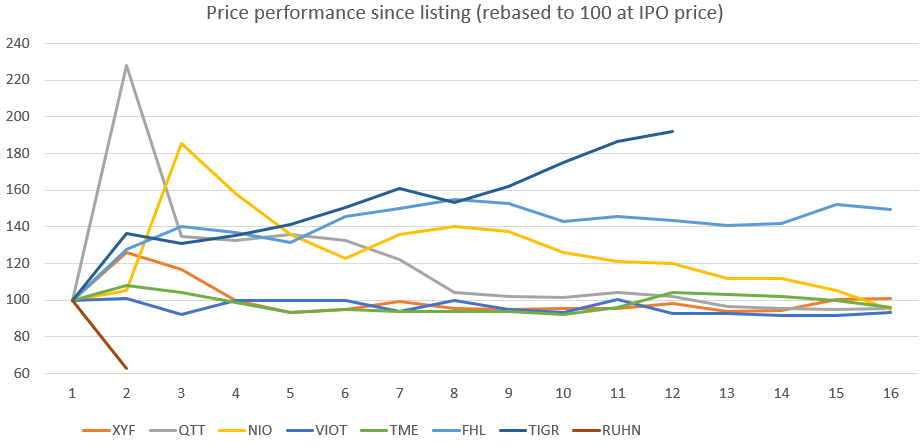
1. Futu Holdings IPO Trading Update – Might Be Trading a Little Too High

Recent%20us%20listing

Futu Holdings Ltd (FHL US)‘s IPO was priced at the top-end at US$12/ADS raising a total of US$160m, including the US$70m raised from General Atlantic via a concurrent private placement.

In my earlier insights, I looked at the company’s background,  past financial performance, scored the deal on our IPO framework and compared it to Tiger Brokers: 

In this insight, I will re-visit some of the deal dynamics, comment on share price drivers and provide a table with implied valuations.

Get Straight to the Source on Smartkarma

Smartkarma supports the world’s leading investors with high-quality, timely, and actionable Insights. Subscribe now for unlimited access, or request a demo below.


Brief TMT & Internet: Futu Holdings IPO Trading Update – Might Be Trading a Little Too High and more

By | TMT/Internet

In this briefing:

  1. Futu Holdings IPO Trading Update – Might Be Trading a Little Too High
  2. Hitachi High Tech’s Ace in the Hole

1. Futu Holdings IPO Trading Update – Might Be Trading a Little Too High

Recent%20us%20listing

Futu Holdings Ltd (FHL US)‘s IPO was priced at the top-end at US$12/ADS raising a total of US$160m, including the US$70m raised from General Atlantic via a concurrent private placement.

In my earlier insights, I looked at the company’s background,  past financial performance, scored the deal on our IPO framework and compared it to Tiger Brokers: 

In this insight, I will re-visit some of the deal dynamics, comment on share price drivers and provide a table with implied valuations.

2. Hitachi High Tech’s Ace in the Hole

Hht.profit.break.2

Last Friday, Hitachi (6501) was reported to be considering selling Hitachi Chemical (4217), according to media sources over the weekend. This has sent Hitachi Chemical and its parent into a frenzy with Hitachi Chemical ADR up 13% last Friday. We believe this news is relevant for Hitachi High Tech because both subsidiaries are 51-52% consolidated by the parent Hitachi, and both have arguably businesses with little synergy with the parent. We believe that Hitachi High Tech is also rumored to be on the block for sale or spin-off.  Media sources say that Hitachi is considering a sale of Hitachi Chemical and would reap Y300bn.  The current value of their 51% ownership in Hitachi Chemical is Y211bn, and thus there is 42% implied upside if the Y300bn figure is achieved.

To recap Q3 results for Hitachi High Tech from January 31, 2019, the numbers were decent with earnings above consensus forecasts by 33% for Q3 (Y15.8bn OP versus Y13.8bn forecast). The profit rise was due to improved margins in medical and continued strength in process semiconductor equipment. The shares are up 20% year-to-date, outperforming the Nikkei by 15%. Some of the fears of a sharp slowdown in semiconductor have been nullified by the continued strength in logic chip investments as well as the improved profitability in medical clinical analyzers. Medical profits soared 46% YoY in Q3 to Y7.6bn on a 13% YoY increase in revenues. OP margin improved from 12.3% to 15.8% YoY.

Get Straight to the Source on Smartkarma

Smartkarma supports the world’s leading investors with high-quality, timely, and actionable Insights. Subscribe now for unlimited access, or request a demo below.


Brief TMT & Internet: Futu Holdings IPO Trading Update – Might Be Trading a Little Too High and more

By | TMT/Internet

In this briefing:

  1. Futu Holdings IPO Trading Update – Might Be Trading a Little Too High
  2. Hitachi High Tech’s Ace in the Hole
  3. Tesla’s Plan B 2.0; Y Not

1. Futu Holdings IPO Trading Update – Might Be Trading a Little Too High

Recent%20us%20listing

Futu Holdings Ltd (FHL US)‘s IPO was priced at the top-end at US$12/ADS raising a total of US$160m, including the US$70m raised from General Atlantic via a concurrent private placement.

In my earlier insights, I looked at the company’s background,  past financial performance, scored the deal on our IPO framework and compared it to Tiger Brokers: 

In this insight, I will re-visit some of the deal dynamics, comment on share price drivers and provide a table with implied valuations.

2. Hitachi High Tech’s Ace in the Hole

Hht.profit.break.2

Last Friday, Hitachi (6501) was reported to be considering selling Hitachi Chemical (4217), according to media sources over the weekend. This has sent Hitachi Chemical and its parent into a frenzy with Hitachi Chemical ADR up 13% last Friday. We believe this news is relevant for Hitachi High Tech because both subsidiaries are 51-52% consolidated by the parent Hitachi, and both have arguably businesses with little synergy with the parent. We believe that Hitachi High Tech is also rumored to be on the block for sale or spin-off.  Media sources say that Hitachi is considering a sale of Hitachi Chemical and would reap Y300bn.  The current value of their 51% ownership in Hitachi Chemical is Y211bn, and thus there is 42% implied upside if the Y300bn figure is achieved.

To recap Q3 results for Hitachi High Tech from January 31, 2019, the numbers were decent with earnings above consensus forecasts by 33% for Q3 (Y15.8bn OP versus Y13.8bn forecast). The profit rise was due to improved margins in medical and continued strength in process semiconductor equipment. The shares are up 20% year-to-date, outperforming the Nikkei by 15%. Some of the fears of a sharp slowdown in semiconductor have been nullified by the continued strength in logic chip investments as well as the improved profitability in medical clinical analyzers. Medical profits soared 46% YoY in Q3 to Y7.6bn on a 13% YoY increase in revenues. OP margin improved from 12.3% to 15.8% YoY.

3. Tesla’s Plan B 2.0; Y Not

Tesla%20has%20horrible%20safety%20record

Tesla Motors (TSLA US) has changed its mind, again, and now reportedly is putting on hold plans to close hundreds of its mostly newly opened stores and lay off thousands more employees–at least until the end of the month.

Employees, customers, suppliers, and investors still are reeling over Tesla’s startling decision, announced February 28th, to move immediately to online-only sales, a dramatic reversal of strategy still in place as of the 2018 10-K filing on February 19th in which the company had touted growth via recent store expansions and substantial additions planned globally going forward

Tesla explained that even with now three substantial price cuts on all its cars and now three significant layoffs since last summer, it must slash costs even more to support the launch of its long overdue $35,000 base version of the flagship Model 3 (see my report Tesla’s New Plan: Buy Before You Try).

I warned clients that Tesla’s stunning strategy reversal seemed driven more by alarming cash consumption plus much weaker than expected sales and profit margins already apparent in what is shaping up to be a disastrous first quarter–troubling trends that may continue. However, as I noted, it also costs money to close stores, get out of leases (good luck with that), fire employees and redistribute remaining staff, and sell off fairly new equipment at steep losses.

Not to mention that shiny new Tesla stores suddenly going dark may appear ominously similar to retail stores going out of business seen increasingly all over the country–a bad look for Tesla, especially given customers already are spooked by its escalating quality, reliability, and service problems (see “Musk and Weird Q3 Developments Are Driving Investors to Telsa’s Rivals” and “Tesla – Dave’s Not Here, and Musk Won’t Leave” and “Tesla: Down to the Wire” and Tesla – Truth and Consequences).

Tesla probably hasn’t seen the light–it’s just received as of March 1st a desperately needed cash infusion by finally securing overdue funding for Tesla Shanghai Gigafactory 3 which has been under construction since January (see Tesla – Shanghai Surprise). Unfortunately, the four banks in Tesla’s new “China Loan Agreement,” which the company announced on Thursday with a rare 8-K filing, committed only to fund a one-year limited purpose loan for up to 3.5 billion yuan ($521 million). This is barely enough time or cash to get the Shanghai assembly plant up and running–much less also stave off the current cash crunch.

But Tesla must keep up appearances as well as bolster its liquidity through at least the end of the quarter as it gets ready to reveal Thursday evening the long-awaited Model Y–though I suspect this won’t result in a massive burst of cash from new reservations as Tesla hopes.

Years of robbing Peter to pay Paul hasn’t produced a sustainable growth model for Tesla, mostly because its business strategy still is better described as, “Wow, we didn’t see that coming.”

Continue reading for Bond Angle analysis.

Get Straight to the Source on Smartkarma

Smartkarma supports the world’s leading investors with high-quality, timely, and actionable Insights. Subscribe now for unlimited access, or request a demo below.


Brief TMT & Internet: Futu Holdings IPO Trading Update – Might Be Trading a Little Too High and more

By | TMT/Internet

In this briefing:

  1. Futu Holdings IPO Trading Update – Might Be Trading a Little Too High
  2. Hitachi High Tech’s Ace in the Hole
  3. Tesla’s Plan B 2.0; Y Not
  4. Last Week in GER Event-Driven Research: Myob, Rakuten, Delta, Graincorp and Hopewell Holding

1. Futu Holdings IPO Trading Update – Might Be Trading a Little Too High

Recent%20us%20listing

Futu Holdings Ltd (FHL US)‘s IPO was priced at the top-end at US$12/ADS raising a total of US$160m, including the US$70m raised from General Atlantic via a concurrent private placement.

In my earlier insights, I looked at the company’s background,  past financial performance, scored the deal on our IPO framework and compared it to Tiger Brokers: 

In this insight, I will re-visit some of the deal dynamics, comment on share price drivers and provide a table with implied valuations.

2. Hitachi High Tech’s Ace in the Hole

Hht.profit.break.2

Last Friday, Hitachi (6501) was reported to be considering selling Hitachi Chemical (4217), according to media sources over the weekend. This has sent Hitachi Chemical and its parent into a frenzy with Hitachi Chemical ADR up 13% last Friday. We believe this news is relevant for Hitachi High Tech because both subsidiaries are 51-52% consolidated by the parent Hitachi, and both have arguably businesses with little synergy with the parent. We believe that Hitachi High Tech is also rumored to be on the block for sale or spin-off.  Media sources say that Hitachi is considering a sale of Hitachi Chemical and would reap Y300bn.  The current value of their 51% ownership in Hitachi Chemical is Y211bn, and thus there is 42% implied upside if the Y300bn figure is achieved.

To recap Q3 results for Hitachi High Tech from January 31, 2019, the numbers were decent with earnings above consensus forecasts by 33% for Q3 (Y15.8bn OP versus Y13.8bn forecast). The profit rise was due to improved margins in medical and continued strength in process semiconductor equipment. The shares are up 20% year-to-date, outperforming the Nikkei by 15%. Some of the fears of a sharp slowdown in semiconductor have been nullified by the continued strength in logic chip investments as well as the improved profitability in medical clinical analyzers. Medical profits soared 46% YoY in Q3 to Y7.6bn on a 13% YoY increase in revenues. OP margin improved from 12.3% to 15.8% YoY.

3. Tesla’s Plan B 2.0; Y Not

Tesla%20has%20horrible%20safety%20record

Tesla Motors (TSLA US) has changed its mind, again, and now reportedly is putting on hold plans to close hundreds of its mostly newly opened stores and lay off thousands more employees–at least until the end of the month.

Employees, customers, suppliers, and investors still are reeling over Tesla’s startling decision, announced February 28th, to move immediately to online-only sales, a dramatic reversal of strategy still in place as of the 2018 10-K filing on February 19th in which the company had touted growth via recent store expansions and substantial additions planned globally going forward

Tesla explained that even with now three substantial price cuts on all its cars and now three significant layoffs since last summer, it must slash costs even more to support the launch of its long overdue $35,000 base version of the flagship Model 3 (see my report Tesla’s New Plan: Buy Before You Try).

I warned clients that Tesla’s stunning strategy reversal seemed driven more by alarming cash consumption plus much weaker than expected sales and profit margins already apparent in what is shaping up to be a disastrous first quarter–troubling trends that may continue. However, as I noted, it also costs money to close stores, get out of leases (good luck with that), fire employees and redistribute remaining staff, and sell off fairly new equipment at steep losses.

Not to mention that shiny new Tesla stores suddenly going dark may appear ominously similar to retail stores going out of business seen increasingly all over the country–a bad look for Tesla, especially given customers already are spooked by its escalating quality, reliability, and service problems (see “Musk and Weird Q3 Developments Are Driving Investors to Telsa’s Rivals” and “Tesla – Dave’s Not Here, and Musk Won’t Leave” and “Tesla: Down to the Wire” and Tesla – Truth and Consequences).

Tesla probably hasn’t seen the light–it’s just received as of March 1st a desperately needed cash infusion by finally securing overdue funding for Tesla Shanghai Gigafactory 3 which has been under construction since January (see Tesla – Shanghai Surprise). Unfortunately, the four banks in Tesla’s new “China Loan Agreement,” which the company announced on Thursday with a rare 8-K filing, committed only to fund a one-year limited purpose loan for up to 3.5 billion yuan ($521 million). This is barely enough time or cash to get the Shanghai assembly plant up and running–much less also stave off the current cash crunch.

But Tesla must keep up appearances as well as bolster its liquidity through at least the end of the quarter as it gets ready to reveal Thursday evening the long-awaited Model Y–though I suspect this won’t result in a massive burst of cash from new reservations as Tesla hopes.

Years of robbing Peter to pay Paul hasn’t produced a sustainable growth model for Tesla, mostly because its business strategy still is better described as, “Wow, we didn’t see that coming.”

Continue reading for Bond Angle analysis.

4. Last Week in GER Event-Driven Research: Myob, Rakuten, Delta, Graincorp and Hopewell Holding

In this version of the GER weekly EVENTS research wrap, we contend that investors should cash out on the MYOB Group Ltd (MYO AU) deal and assess the NAV discount potential for Rakuten Inc (4755 JP) post the IPO launch of Lyft Inc (0812823D US) – of which Rakuten has a 13% stake. Moreover, we dig into the deals for Delta Electronics Thai (DELTA TB) , Graincorp Ltd A (GNC AU) and Hopewell Holdings (54 HK)

More details can be found below. 

Best of luck for the new week – Rickin, Venkat and Arun

Get Straight to the Source on Smartkarma

Smartkarma supports the world’s leading investors with high-quality, timely, and actionable Insights. Subscribe now for unlimited access, or request a demo below.


Brief TMT & Internet: HHI – DSME Acquisition: Current Situation & Trade Approach and more

By | TMT/Internet

In this briefing:

  1. HHI – DSME Acquisition: Current Situation & Trade Approach

1. HHI – DSME Acquisition: Current Situation & Trade Approach

Comp%201 comp%202%20120d%20relative%20price%20chart%20%28source %20krx%29

  • The DSME deal between HHI and KDB was officially finalized last Friday. We will then have the following four step process. Schedule detail is yet to come out. HHI intermediate holdco is named Korea Shipbuilding & Offshore Engineering, or KSOE.
  • HHI went south by nearly 4% last Friday when the deal was finalized. DSME stayed flat. Why did this happen? There was another story we heard last Friday. HHI and Korea Eximbank agreed that the ₩2.3tril CBs wouldn’t be converted into DSME shares and disposed any time soon. Not only that, there will be a downwardly interest adjustment to help ease DSME’s financial burden.
  • This agreement immediately sparked a speculation that HHI must have pledged Korea Eximbank some sort of DSME valuation pushings. This is like a value transfer rather from HHI to DSME. I’d wrap the current HHI long/DSEM short position at this point. Short-term, I expect DSME outperforming HHI. Longer term, I still doubt what value transfer from who to who. I’d rather stay away from both.

Get Straight to the Source on Smartkarma

Smartkarma supports the world’s leading investors with high-quality, timely, and actionable Insights. Subscribe now for unlimited access, or request a demo below.