
In this briefing:
- Nexon Controlling Stake Sale: Names Included in Short List
- HDC Holdco Trade: Holdco Re-Rating Should Be Transferred to Sub, Time to Long Sub/Short Holdco
- Nexon Valuation Analysis
- Monthly Geopolitical Comment: Waiting for Trump and Xi to Clinch a Deal
- Global EM Special: Andean Condors Vs Asian Elephants – Where Is the Growth in EM?
1. Nexon Controlling Stake Sale: Names Included in Short List

- Korea’s local news house Hankyung reported the names that should be included in the short list. They are Kakao, MBK Partners (with NetMarble), Tencent, Bain Capital and another foreign PE whose name isn’t disclosed. Apparently, Amazon, Comcast and EA, didn’t make the short list. Those in the short list now get a chance to do due diligence. They will then participate in the main bidding round that is scheduled for early April.
- It is being reported that only Kakao and NetMarble (with MBK Partners) are truly interested in taking over Nexon’s management right. Tencent is expected to join either Kakao or NetMarble-led consortium in the end. Bain is looking into possible investment opportunities that may be created if this sale leads to a mandatory tender offer to Nexon minority shareholders. It seems safe to say that this comes down to a two-horse race: either Kakao or NetMarble.
2. HDC Holdco Trade: Holdco Re-Rating Should Be Transferred to Sub, Time to Long Sub/Short Holdco

- HDC Holdco and its major Sub HDC-OP are now at 247% of σ on a 20D MA for the first time since mid Nov last year. On a 120D, their current price ratio is substantially higher than the mean. Holdco discount is now 40% to NAV. This is nearly a 10%p drop since early Jan.
- My previous stub trade on the HDC duo again paid off very nicely. I went long Holdco and short Sub on Jan 11. This trade is now delivering a 15% return. During this period, Holdco climbed 23%. Sub went up 8%. They created a 15%p gap in price performance. Holdco’s 23% running was mainly attributable to re-rating of some of its major unlisted holdings.
- Sub also has several key assets that could equally be re-rated. Much of Holdco’s assets that have presumably undergone re-ratings lately are business wise closely correlated with Sub. A 15%p price yield gap should be too harsh on Sub. I expect their price ratio will be challenged downwardly at this level on a short term time horizon.
- I’d close my previous position. I’d initiate a new trade. I’d go long Sub and short Holdco. I’d close this trade at < 50% of σ. Given the fluctuation level of this duo, this’d give nearly a 8% yield.
3. Nexon Valuation Analysis
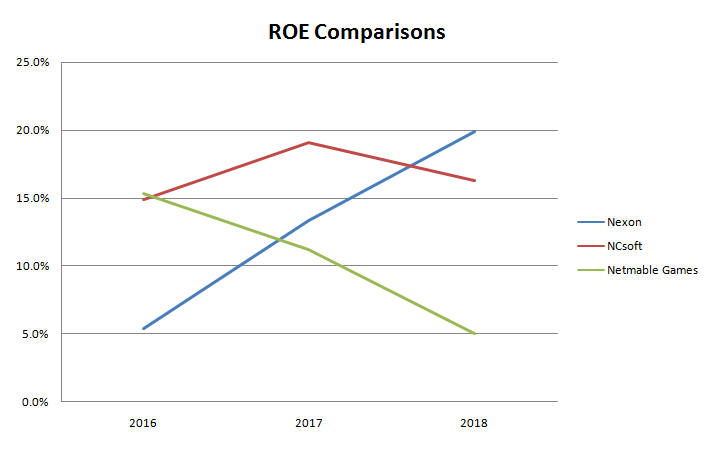
In this report, we provide a valuation analysis of Nexon Co Ltd (3659 JP). A key question is “How much are investors willing to pay for Nexon which would drive higher EV/EBIT multiples and inversely reduce the earnings yield (measured by EBIT/EV)?”
In our view, we believe that investors would be comfortable with earnings yield (measured by EBIT/EV) of about 7-9% given the risks of operating a global game franchise such as Nexon. This would suggest EV/EBIT of about 11x to 14x, using 2019 estimates. Our sensitivity analysis suggests that at the top end of the EV/EBIT valuation range of 14x, this would imply market cap of 1,905 billion yen, which would be 21% higher than current market cap. As such, despite Nexon’s share price rising 25% YTD, we think there could be further upside in the months ahead.
Having digested plethora of public information on this deal (but not privy to all the bankers’ discussions) in the past several days, we believe that the US based companies including Amazon and Comcast are better positioned to acquire NXC Corp/Nexon, rather than the consortium led by Tencent.
We believe there is an intense Chinese government pressure on Tencent to not do this deal. (This is just our guess based on public information). The game industry is not strategically important to China, unlike other industries such as semiconductors, energy, or financial. Depending on how much controlling stake Tencent wants to take, it is likely to involve several billions of dollars ($4 billion to $7 billion for Tencent, for example). This is a lot of money. Plus, China Inc’s balance sheet is not as strong as pre-GFC of 2008. Forking over $4 to $7 billion out of China into Japan/Korea would be meaningful. In short, although Tencent would like to do this deal, we think that behind the scenes, the Chinese government appears to be putting intense pressure on Tencent to not do this deal.
4. Monthly Geopolitical Comment: Waiting for Trump and Xi to Clinch a Deal
In the past month, positive announcements from both sides stoked hopes for a trade deal between the US and China. Meanwhile, global security deteriorated, with two more regions finding themselves on a brink of war. A major terrorist act in Kashmir provoked a sharp increase in tensions between India and Pakistan. Venezuela’s opposition leader has called for foreign powers to intervene after deadly clashes on the Colombian border. On the other hand, investors should be relieved by the relatively calm situation in Nigeria where incumbent president Buhari won the election last weekend. In Brazil, newly elected president Bolsonaro hopes to push through radical pension reform.
5. Global EM Special: Andean Condors Vs Asian Elephants – Where Is the Growth in EM?
Global growth is expected to slow over the coming quarters, possibly years – and emerging market economies are certainly not immune from this. Nevertheless, within this diverse universe, the pace of deceleration will be uneven. Whilst some “open” EM economies are generally synchronized with growth dynamics in the rest of the world, others will be shielded by a combination of idiosyncratic forces – including renewed accommodative (monetary and fiscal) policies, cyclical recovery or upswing in domestic growth drivers and – for some – positive political developments and reform progress. Still, other EMs are less fortunate and a growth deceleration is likely to deepen in the near-term – held back by less policy flexibility, political uncertainty and various domestic or external shocks.
With 4Q18 GDP growth reports underway, we sifted through – and synthesized – various growth indicators to introduce a “Growth-Profile Framework” (GPF) to systematically evaluate – and rank – growth profiles in a data-driven, automated and standardized manner. The “GPF” not only takes into account GDP for the most recently-reported four quarters but also forward-looking forecasts and the latest economist revisions, which often take into account the latest data surprises and other material developments.
The observation universe is the “Emerging Markets-25” (EM-25) of large, investable EM countries most often found in benchmark indices such as MSCI EM and JPMorgan (GBI-EM and EMBI) indices. This opportunity set offers a breadth of diversity spanning across Asia, EMEA and LatAm and different stages of development.

Highlights:
- Introducing the “EM-25” Growth Profile Framework: This data-driven, automated and standardized model generates a ranking of the “EM-25” economies based on a composite of factors reflecting: 1/ The most recent GDP growth data (in relation to three look-back periods), 2/ Forward-looking consensus growth forecasts (in relation to the most recent four quarters of GDP) and 3/ Upgrades and downgrades to those forecasts.
- Andean condors soar while Asian elephants amble along: LatAm – specifically the Andean economies (plus Brazil) – currently stand out as having the most attractive growth profiles among the EM-25. They are helped by a combination of – largely idiosyncratic – factors ranging from newfound reform optimism (Brazil), improving domestic confidence (Colombia), pent-up domestic demand (Peru) and stabilizing appetite for key commodities (Chile). This contrasts with export-oriented Asian manufacturers that dominate the bottom rankings. Elsewhere, the legacy of past macroeconomic policy choices – both painfully orthodox (Argentina) and otherwise (Turkey, Venezuela, Pakistan) – are taking their unique toll on certain other economies.
- Does growth matter for investment strategy? Yes…: Simplistically speaking, economies with exemplary growth profiles are viable candidates for long or overweight positions in equity markets and external debt. Strong growth is often associated with stronger corporate earnings potential as well as lower debt-to-GDP levels, respectively. Growth implications for FX and local debt are more ambiguous, but to the extent that a robust growth outlook guides central banks to tighten policy or lifts the government’s fiscal revenues over time, then this may also be positive for currencies and rates, respectively.
…But it’s complicated: However, strong growth can detract asset performance if it is the result of unsustainable policies (e.g. overly loose fiscal or monetary actions) or if it leads to overheating conditions (e.g. runaway inflation or a wider current account deficit). An attractive growth profile, as with all data sets, needs to be judged against its context. Although high and improving growth is an end-goal for many policymakers, the road to strong – and sustainable – growth is far more important for its longevity (and for risk assets over the medium-term). For instance: Are growth prospects improving due to rising productivity (as it might from structural reform)? Or rather from overly-stimulative policies that risk fanning inflation or widening the current account deficit? To what extent do officials have the policy flexibility to stoke growth, smoothen downside growth risks or stave off a recession? We touch upon these questions in the individual country sections below.
While the narrative is almost always more important than the number itself, this GPF framework nevertheless offers a valuable screening tool that systematically evaluates growth profiles – on a stand-alone and relative basis – across the “EM-25” universe.
Growth Profile Framework (GPF) Rankings: Snapshot and Historical Movement


Get Straight to the Source on Smartkarma
Smartkarma supports the world’s leading investors with high-quality, timely, and actionable Insights. Subscribe now for unlimited access, or request a demo below.

