This weekly newsletter pulls together summaries of the top ten most-read Insights across Macro and Cross Asset Strategy on Smartkarma.
Receive this weekly newsletter keeping 45k+ investors in the loop
1. The US Supports the Yen and Gold Rallies: CONNECTING THE DOTS
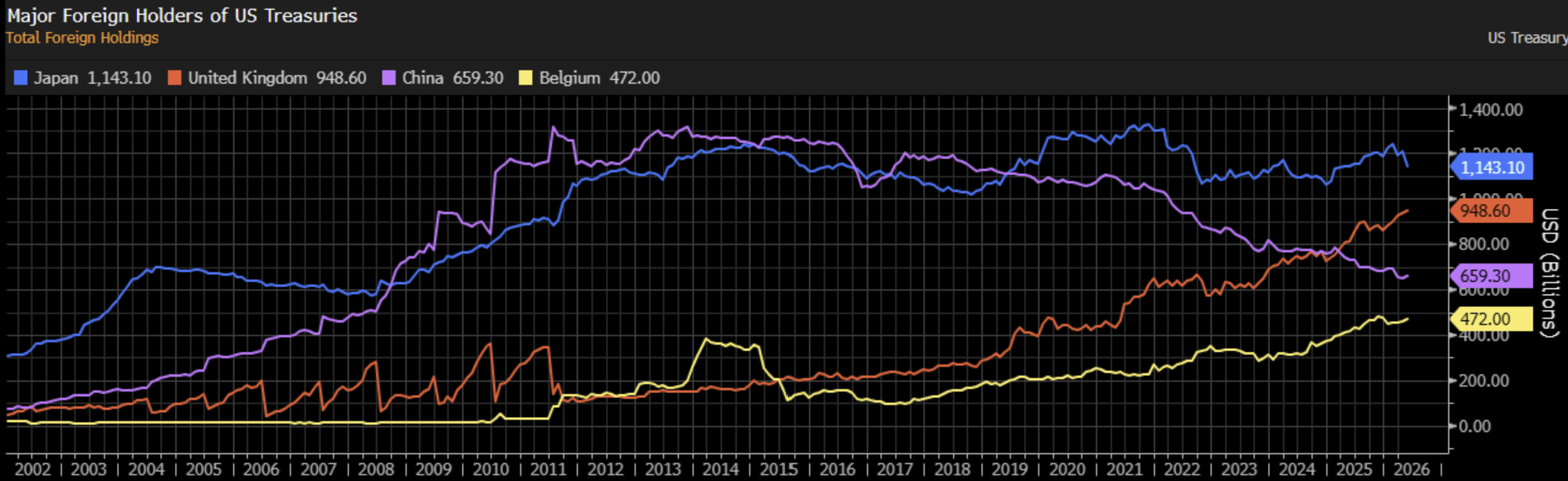
- The US Treasury Department has actively intervened in the F/X market to support the JPY for the first time since 2011 amid intensifying fears of weakness in US Treasury bonds.
- Treasury Secretary Bessent has suggested expanding the FIMA facility to allow Japan to borrow against its Treasury holdings rather than outright sales to support the JPY.
- The use of FIMA further expands the global US dollar monetary base, which provides a structural bid for gold as the primary non-sovereign store of value.
2. Sentiment Matters: Buy Side Sentiment Tracker
- The Buy Side Sentiment Tracker aggregates published asset-allocation views from 50+ asset managers across more than 70 assets.
- Grinding more bullish: Risk appetite rose for a third month, but buy-side positioning remains less bullish than before the Iran war and still shows meaningful caution.
- Consensus extremes: Infrastructure, Equities and Tech are most popular; CHF, Cash and Consumer Discretionary least popular. The US-over-Europe preference is unusually broad across asset classes.
3. The Fed Is Buying Treasuries Again—but This Is Not Another Round of Money Printing
- The Fed is buying Treasuries again—but this is not QE: purchases are mainly short-term bills designed to maintain banking-system liquidity, not stimulate the economy
- Rising Fed assets is not always “money printing”: reserves remain near US$3 trillion as the liquidity created has been largely offset by Treasury operations, currency demand and other Fed liabilities
- This helps explain the US dollar’s resilience: bill purchases barely suppress long-term yields, unlike conventional QE, so the direct downward pressure on the dollar is limited
4. UK: H1 Signals Stimulative Setting
- A surprisingly strong end to Q2 for GDP yields 1.1% growth so far in 2026. A 33bp unemployment rate fall and a 6-8% credit growth trend make activity cyclically strong.
- Residual seasonality does not explain all of GDP’s strength, which goes beyond the norm of recent years. The non-seasonally adjusted data also signal unusual strength.
- The signal seen through multiple lenses across H1 is of activity growth beyond potential, implying loose policy. The BoE assumes policy is tight and seems set to repeat mistakes.
5. Asian Equities: A Stupendous Earnings Quarter; Asia Matching US in Upgrades
- As the April-June quarter earnings season winds down, positive surprises outnumber disappointments. Consensus earnings estimates keep getting upgraded in Asia and the US. Asian EPS upgrade has lately outpaced US’s.
- Over the last month, consensus 2026 EPS estimate of Asia-ex-Japan has been upgraded 4.4%, driven by Korea (12.8%), Taiwan (5.8%), Thailand (5.5%). 105 of 162 market-sectors have seen EPS upgrades.
- The encouraging signs are: breadth across a wide range of sectors and not driven by AI capex only. Sectors not directly linked to AI exuberance are among top earnings gainers.
6. JAPAN & US YEN SUPPORT: Speak Loudly and Carry a Small Stick
- The historic Japan/US intervention to support the JPY at the end of July is already being tested as the yen falls back to the 160 level.
- Intervention methods are limited in scope, and jawboning threats carry limited weight. Each successive intervention since the BOJ began to normalize rates has required greater firepower.
- Hedge funds, traders, and even Japanese investors have already begun rebuilding short yen positions, taking advantage of the stronger yen to reposition.
7. Asian Equities: A Close Look at India – Identifying Opportunities in a Well-Diversified Market
- India’s recent outperformance coincided with AI capex anxiety. Simultaneously, macro-economic data points like bank loan growth and GFCF growth are improving. Valuations are higher than averages but not egregiously so.
- On growth-adjusted PE, basic materials, financials, consumer durables, transportation, industrial services, telecommunication stand out as cheaper than the market. Consensus EPS estimates of several sectors are beginning to get upgraded.
- On strong growth forecasts, reasonable valuations, healthy balance sheets and EPS upgrades over last 6 months, we screen 20 stocks – from financials, industrials, basic materials, utilities, healthcare and hardware.
8. The Solidigm Stub: SK Hynix’s US$35bn AI-Storage Asset Priced at Zero
- Korea Economic Daily reports Solidigm — SK Hynix’s AI-storage arm — pursuing a KRW5-10T pre-IPO raise at ~US$35bn; SK Hynix’s Form 6-K denies a decision but commits to 4 Sep.
- SK Hynix’s US$738bn market cap assigns near-zero value to Solidigm — a QLC eSSD franchise tripling revenue QoQ — creating a base-case +3-4% stub re-rating catalyst.
- Reiterate BULLISH; Fair Value KRW3,500,000 (KRX)/US$236 (ADR), based on our DRAM/HBM earnings model; Solidigm pre-IPO crystallisation is additive optionality — 4 Sep the trigger.
9. Korea Sector ETFs Weekly #1 [Week Ending 14 August 2026]
- This is our first inaugural issue of Korea Sector ETFs Weekly. There are two main purposes of this weekly insight.
- This weekly report tracks share price performance for Korea’s 23 major sector ETFs. It helps investors identify market trends by revealing exactly which sectors are outperforming or underperforming.
- Second, tracking sector ETF performance reveals early clues about specific catalysts driving higher stock prices for the companies within those ETFs.
10. US: Data Deferring Action
- US payrolls and CPI should determine whether the Fed hikes in September, but neither release for July signalled an immediate need, so action should be deferred.
- The latest inflation impulse is around a target-consistent level, although the sticky-price rate is 3.5% saar. We doubt the problem is solved, but it seems uncompelling.
- A high evidential hurdle needs clearing to break dovish assumptions. We doubt the Fed will clear it, even as the ECB prepares its second and the BoE belatedly goes once.