This weekly newsletter pulls together summaries of the top ten most-read Insights across Macro and Cross Asset Strategy on Smartkarma.
Receive this weekly newsletter keeping 45k+ investors in the loop
1. UK: Ascending Inflation’s Twin Peak
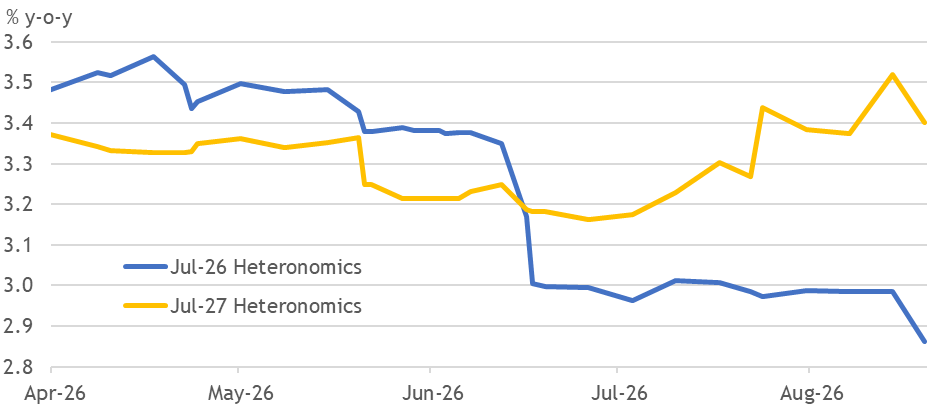
- Inflation began to ascend to its twin peak in July, despite failing to attain the target in between. Energy utility prices belatedly increased, but only add ~8bps to the y-o-y.
- The gas futures curve is back around its peak. Premature hope for the supply shock’s end helps contain October’s rise, postponing the peak pressure to January.
- Delayed pass-through of energy costs, food prices, and airfares should drive this peak much higher than most economists assume, pushing the BoE to hike once begrudgingly.
2. UK: Forgotten Excesses
- Q2’s flat end for the labour market might be exaggerated by imputation after the ONS forgot to appoint anyone to pick up the phone for the labour force survey.
- Underemployment’s decline corroborates the labour market’s trend of tightening so far in 2026, despite low vacancies, as both supply and demand are structurally struggling.
- Divergent pay growth measures have slowed by about 0.5pp on the year but remain excessive, near 4%. We still expect the BoE to hike once, failing to break the problem.
3. EA: Bouncing Back To Hike
- EA inflation bounced back from the brief relief in June as energy price pressures intensified again through July, but it wasn’t quite enough to round up from 2.94%.
- Food prices remain incredibly benign, and underlying inflation measures are contained, despite a bounce back from levels that had been too low in May and June.
- A further rise is likely in August, and the ECB isn’t taking any chances. It seems set to hike again in September, reinforcing the target, unlike its dovish peers.
4. US/CHINA AI WAR: State of Play & AI Sovereignty Decisions
- President Trump is pressuring nations to sign a Loyalty Pledge to the US for their AI future. The pledge aims to counter the rapid growth of open-weight Chinese AI models.
- Nations that agree to the AI Pledge risk compromising their digital sovereignty. This concern was underscored recently when the United States restricted foreign nationals’ access to Anthropic’s latest AI models.
- If the US can convince countries to join its US-controlled AI ecosystem, it would pose a powerful mechanism to co-opt them into future conflicts driven by US geopolitical interests.
5. ID: Rupiah First, Rates on Hold
- Bank Indonesia holds its policy rate at 5.75%, in line with consensus, prioritising Rupiah stability and a high real rate over near-term easing.
- Expanded FX hedging incentives and macroprudential liquidity tools aim to absorb shocks before rate moves, signalling a preference to hold rates at a high level.
- Future rate shifts hinge on Fed tightening, Rupiah resilience and inflation staying near the centre of the target despite global commodity and FX risks.
6. China & HK: The Long Road Back
- China & HK positioning is turning. Relative positioning is strengthening, flows have turned positive and more managers are moving overweight.
- Buying is highly selective. Managers are rotating towards AI infrastructure, semiconductor equipment and advanced technology, while reducing exposure to recent consumer and platform winners.
- The EM Big 4 has been reshaped. China now carries similar weight to Taiwan and South Korea, but offers a far more diversified range of underlying exposures.
7. HEW: Bored Debasement
- With market themes also on holiday recently, the USD debasement trade returned, fed by crumbs of poor policy that we doubt carry enough energy to let the theme run far.
- Flash PMIs were broadly solid, especially in the US. UK unemployment data were imputed flat while inflation’s rise was confirmed, including in the EA’s final print.
- Next week has more energy news in Ofgem’s price cap announcement. EA lending, ECB meeting accounts, and annual benchmark revisions for US payrolls are dull highlights.
8. US Treasuries: Panic Creeps In as Bessent Starts Dancing!!
- On August 19th, Secretary Bessent implemented the most significant intervention in the US long-end bond market in decades by doubling off-schedule buybacks in 10-to-30-year sector to at least $4 billion.
- This approach compresses long-end yields by reducing duration supply rather than relying on outright Federal Reserve purchases. However, as Japan’s experience shows, it also entails significant long-term consequences.
- The United States faces a trilemma: it cannot simultaneously suppress long-end yields, maintain dollar credibility, and control inflation. The current administration is prioritizing yield management over the other objectives.
9. Mergers in Korea to Be Completed Based on Fair Valuation Method Rather Than Average Market Prices
- An amendment to Capital Markets Act (mergers in Korea to be completed on fair valuation basis rather than average market prices) was passed at the National Assembly’s plenary session.
- It is likely that this amendment will be made into law by the end of this year.
- This is clearly a step in the right direction and takes Korea another step closer to reducing corporate governance problems that have persistently impacted lower relative valuations versus global peers.
10. Mandatory Tender Offer for All Remaining Shares in Korea – Lawmakers Trying to Make This Into Law
- I believe the mandatory tender offer for all remaining shares is likely to be passed into law sometime in 2H 2026/1H 2027.
- If this is finally made into law, it will have a positive impact on the entire Korean stock market (reduced corporate governance concerns related to M&A tender offers).
- Democratic Party lawmaker Park Hong-bae has proposed a Capital Markets Act amendment requiring a mandatory tender offer for all remaining shares.