This weekly newsletter pulls together summaries of the top ten most-read Insights across Macro and Cross Asset Strategy on Smartkarma.
Receive this weekly newsletter keeping 45k+ investors in the loop
1. How to Position for Greenland and Other 2026 TACOs
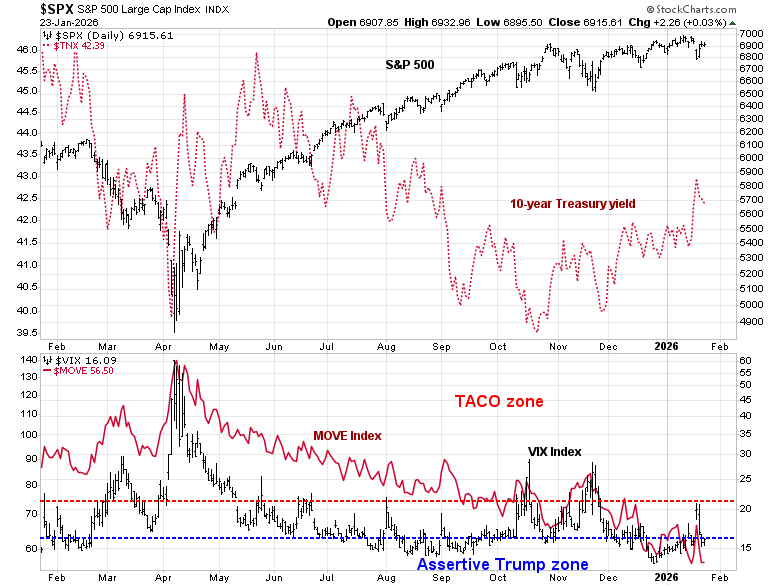
- Regardless of the apparent chaos and volatility of Trump’s initiatives, his actions are constrained by market spikes in volatility, which can crater stock prices and spike Treasury yields.
- The Trump Administration and Republicans are highly sensitive to the electoral popularity of specific issues. Recently, the extreme unpopularity of a Greenland purchase and military intervention forced a face-saving retreat.
- Investors are advised to buy sudden risk-off downdrafts between now and the November election as ways to position to potentially profit from a probable TACO response.
2. UK Politics: The Beginning of the End?
- A post-local election Labour Party leadership challenge remains high, despite Andy Burnham being blocked from standing for parliament in a forthcoming by-election.
- In this event, whoever prevailed would likely still be beholden to the left within the Parliamentary Labour Party, which markets would not welcome.
- However, investors might find some solace in a new leader’s likely willingness to move more quickly on closer economic and defence ties with Europe.
3. UK Shelter Costs Coasting
- The unusual stability of UK house prices is unlikely to last, while rent inflation is set to slow further. We expect the price-to-rent ratio to stabilise here at pre-pandemic levels.
- Rapid wage increases in the UK’s unbroken regime of excess inflation have eroded the price-to-earnings ratio to its lowest in over a decade, and will probably extend further.
- Banks have more regulatory space to lend while lower rates feed the affordability of leveraging up, so there are upside inflationary risks to this benign coasting narrative.
4. HEW: Markets Making Opinions
- The falling USD and surging precious metals prices don’t fit the fundamental narratives of lazy strategists seeking to extrapolate moves into spurious trends.
- Macro developments have been relatively benign, with resilient real activity shown in euro area GDP and surveys. Looser conditions pose upside risks to UK shelter prices.
- Next week’s ECB and BoE decisions are set for no change rate outcomes, and we expect that will also broadly apply to guidance. We still expect no more cuts from either bank.
5. KOSDAQ’s 7% Rise Today – A Fake Reversal or Sustainable by a Potential 17 Trillion Won Inflow?
- The KOSDAQ index rose by 7.1% today to 1,064.4 today which was one of the largest single day returns for KOSDAQ in the past three decades.
- Will this 7% upside move be a fake reversal or the start of a strong, sustainable momentum trade driven by a potential 17 trillion won inflow into the KOSDAQ companies?
- The Korean government is trying to encourage the injection of nearly 17 trillion won into KOSDAQ listed companies through venture capital (raised through integrated market assets (IMAs) and commercial papers).
6. JAPAN: Plaza Accord II Is a Pipe Dream!
- The JPY has gained since rumors of a coordinated effort between the U.S. and Japan to intervene in the currency market.
- Talk of a new Plaza Accord is motivating an unwind of JPY shorts, however, a sustained intervention to strengthen the JPY versus the USD is unrealistic.
- The risk to U.S. inflation, treasury yields, and the equity market will provide guardrails against any meaningful currency intervention by the U.S. Treasury Department.
7. CHARTING COURSE: Yuan’s Internationalization, Japan’s Bond & Currency Woes
- China continues to attract foreign capital through its yuan internationalization efforts as de-dollarization accelerates.
- Foreign Exchange repatriation in China hit a record in December as exporters and investors continue to favor a strengthening yuan.
- Japan may not get the help it needs to support the JPY as the dollar takes a leg down and breaks support.
8. KOSDAQ in on Fire! Korean Government Encourages Investment in KOSDAQ Companies by Pension Funds
- KOSDAQ has been on fire in the past week. KOSDAQ is up 20% in the past one week, outperforming KOSPI which is up 5.4% in the same period.
- One of the key reasons why KOSDAQ has been on fire is mainly due to expectation of the Korean government encouraging capital inflow into the KOSDAQ listed companies.
- Korean government will encourage investment in the KOSDAQ by incorporating the KOSDAQ index into the evaluation criteria for the management of pension funds’ assets, which amount to 1,400 trillion won.
9. US Policy: SACRIFICING THE DOLLAR ON THE ALTAR OF TREASURIES
- The U.S. dollar will face further pressure as the Administration tries to support the Treasury market and keep interest rates in check at the expense of a weaker dollar.
- Continued dollar debasement will fuel higher inflation expectations. The weaker dollar policy underpins the rally in precious metals, other commodities, and emerging-market currencies.
- The dollar has broken technical support, with the next target level for the DXY index at 90 (-6.25%). A coordinated effort to support the yen vs. the dollar is unlikely.
10. EM Active Investors’ Stock Positioning Guide
- TSMC, Tencent and Samsung remain dominant holdings, but are increasingly held as structural underweights as managers sell into strength to manage benchmark risk.
- 2025 saw sharp ownership increases in emerging leaders such as Xiaomi, CATL and Accton, while former consensus names like Meituan and Indonesian banks were heavily exited.
- Across regions, new stock leadership is forming in MENA, LATAM and ASEAN as capital rotates away from long-standing EM favourites into a broader set of positions.