This weekly newsletter pulls together summaries of the top ten most-read Insights across Macro and Cross Asset Strategy on Smartkarma.
Receive this weekly newsletter keeping 45k+ investors in the loop
1. UK: Stickier CPI Than BoE Assumes
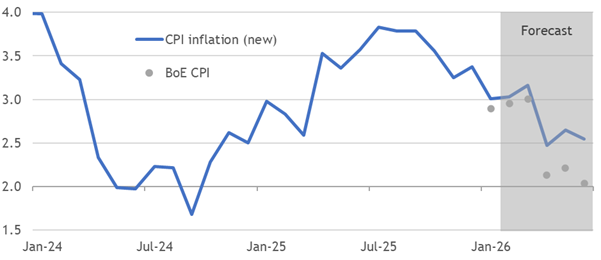
- UK inflation’s base effect-driven slide was stickier than the BoE expected in January, only reaching 3%. Core and services inflation hawkishly drove the resilience.
- Underlying inflation measures broadly remain stuck above levels consistent with the BoE’s 2% target, although it assumes the problem away with a dovish bias.
- We still expect the BoE to wait until 30 April before cutting again. It won’t see another inflation print until after the 19 March meeting, and there is good reason for caution.
2. BoE Failure is Institutionally Ignored
- Bank staff ignored the possibility of excess inflation expectations when finding no structural change in an irrelevant construct that persuaded dovish dissents in February.
- Staff can’t be expected to tell their leaders of their policy failure. Firms and households expect further excesses in price and wage inflation, but the MPC is not listening.
- The 2% target has become a floor only broken by substantial temporary shocks. Loose fiscal policy enjoys this excessive accommodation, and both biases will likely persist.
3. UK: A Lame Horse Year?
- The UK labour market ended 2025 on a disappointingly feeble note, with unemployment rising to 5.2%. Methodology and tax contributed, so the cyclical change isn’t so bad.
- Wage growth also slowed in 2025, with disagreement about the extent. Most measures remain above 4%, although the distorted public vs private split depressed the latter.
- Dovish BoE assumptions can lean on labour market weakness to cut again soon. We still lean towards the 30 April MPR, but soft CPI inflation could push Bailey to 19 March.
4. HEW: Case For Cuts Narrows
- A UK retail sales boom, robust PMI surveys, and persistent price and wage inflation offer plenty of reasons not to cut. But unemployment rose further, offering dovish cover.
- Biased assumptions make further BoE policy mistakes likely, as 2% is treated more like a floor than a target. FOMC members are more cautious, and even Miran’s view is moving.
- Next week’s EA HICP print carries extra significance for us after Eurostat deprecated its old data. Our replacement component models for all member states will roll out then.
5. Asian Equities: The Earnings Boom – Korea Taiwan, Malaysia, Tech and Basic Materials Rule the Roost
- Asia-Ex-Japan equities have moved from a valuation rerating driven rally to an earnings driven rally. Since late October, Asia-ex-Japan equities have appreciated 8% but its forward PE has declined 6%.
- Korea’s 2026 EPS estimate up 67.8% in last 6 months, followed by Taiwan (17.5%) and Malaysia (7.5%). Philippines (-4.4%), India (-3.9%) and Indonesia (-1.3%) constitute the bottom of the pile.
- Technology and basic materials are driving the earnings upgrades while consumer-oriented sectors are dragging them down. We think consumption sentiment recovery shall be essential for earnings upgrades to sustain.
6. Mandatory Cancellation of Treasury Shares: Final Approval by the Korean National Assembly on 24 Feb?
- According to Money Today, the Democratic Party of Korea will hold a plenary session of the National Assembly on 24 February to mandate the mandatory cancellation of treasury shares.
- The Commercial Act’s third amendment requires companies to cancel newly acquired treasury stock within one year. For existing treasury shares, a grace period of 18 months is granted for disposal.
- Numerous other local media have also mentioned that the Democratic Party of Korea plans to finally pass this amendment in late February/early March to mandate the cancellation of treasury shares.
7. IEEPA Ruling Is a Silver Lining
- The court ruling reduces the risk of excessively high, permanent tariffs for Asian economies going forward.
- Focus will now shift to sectoral tariffs from across-the-board country tariffs.
- Signed trade deals with Malaysia, Cambodia and Indonesia are likely to be re-negotiated to take into account Section 232v and tariffs under other potential avenues.
8. What Comes After the Software Apocalypse?
- A market leadership analysis of asset classes and the U.S. equity market shows that we are in an equity bull with minimal risk of a major bear market.
- Cyclical stocks are leading the way, but their advance is highly extended.
- Market internals shows U.S. equities are vulnerable to a significant correction in the context of a bull trend in the coming weeks and months.
9. Technically Speaking Breakouts & Breakdowns – HONG KONG (February 13)
- After breaking resistance in January, the Hong Kong market is rangebound as sector rotation into energy, industrials and financials occurs before the next leg up in its Secular Bull Market.
- As the tech and healthcare sectors lose momentum, the value factor has emerged as an outperformer so far in 2026.
- Kingboard Holdings (148 HK) broke out to new highs with technical momentum and strength indicators support the move.
10. Currency Resilience in ASEAN: Moving Towards an Independent Financial System
- ASEAN currencies have remained comparatively stable despite global shocks, supported by strong domestic fundamentals, prudent monetary policy, sustained FDI inflows, and diversified economic bases. While geopolitical tensions, sanctions, and trade fragmentation have tested emerging markets, ASEAN economies have leveraged policy buffers and regional growth dynamics to mitigate volatility.
- Rising geopolitical uncertainty and pressure on the US dollar’s dominance have accelerated ASEAN’s push toward deeper regional integration. Initiatives such as Regional Payment Connectivity, integrated QR systems, financial safety nets, Digital Economy Framework agreements, and exploration of Central Bank Digital Currencies (CBDCs) are strengthening intra-regional trade, reserve diversification, and financial sovereignty — reducing reliance on external currencies.
- The rapid expansion of fintech and digital banking across ASEAN is reinforcing financial system resilience while unlocking scalable investment themes. Growth across digital payments, lending, neobanking, embedded finance, investment technology, and supporting infrastructure is positioning the region as a structurally attractive long-term play within emerging market financial services.