This weekly newsletter pulls together summaries of the top ten most-read Insights across Macro and Cross Asset Strategy on Smartkarma.
Receive this weekly newsletter keeping 45k+ investors in the loop
1. BoE: No Longer Ready, But Leaning
- The MPC’s brief unanimity broke with a hawkish dissent, but there wasn’t enough to back overextended expectations, especially as “stand ready” references were pulled.
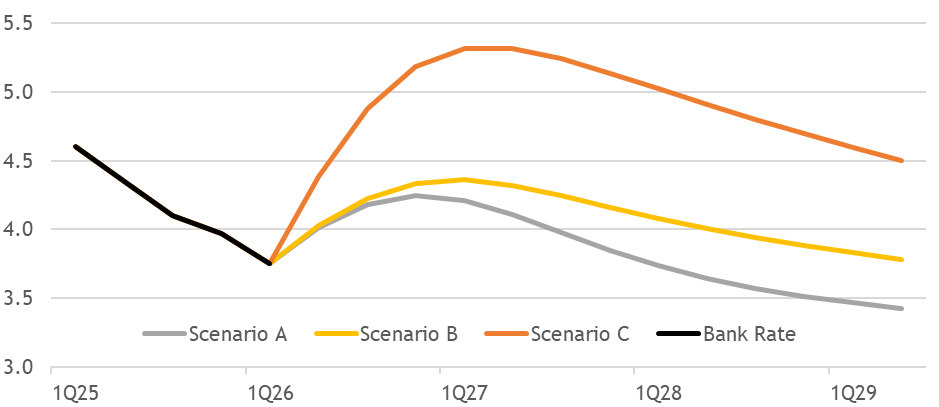
- We currently expect Greene and Mann to dissent in June. Policy scenarios show a hike, but don’t reflect the likely path when the MPC treats 2% CPI as a floor.
- Inflation is likely to exceed MPC hopes, without activity undershooting downgraded forecasts, so we expect a single hike in July, with risks skewed to another in November.
2. EA Inflation Re-Energised
- EA inflation jumped 49bp further to 3.04% in April, a tenth above the consensus but aligning with our forecast. Surging energy prices have driven a substantial step up.
- Household energy utilities, food, and anything else exposed to energy costs, remain set to rise in the months ahead. Benign core pressures may not last.
- We still see upside risks to our EA inflation forecasts, which are only slightly above the consensus. Sticking above 3% until 2027 locks the ECB out of its good place.
3. BoJ’s Hawkish Hold on Rates
- The BoJ held the policy rate at 0.75% as expected, but a 6–3 split and hawkish guidance keep further rate hikes firmly on the table.
- Growth for FY2026 was cut to 0.5% while core CPI was raised to 2.8%, tilting risks towards higher, not lower, future policy rates.
- Future hikes hinge on oil prices, wages and the yen; prolonged cost‑push inflation without recession would likely accelerate normalisation.
4. ECB On Hold, June Hike Looms
- The ECB delivers a hawkish hold, keeping rates steady but signalling a tightening‑biased reaction function amid renewed energy‑driven inflation risks.
- With upside inflation and downside growth risks, we still expect a June rate hike unless energy prices and short‑term expectations fall back quickly.
- Data on energy pass‑through, wages and inflation expectations will determine whether this pause becomes a brief prelude to further tightening or a prolonged plateau.
5. AI BUBBLE: Usage and Profitability and China’s Challenge!!
- OpenAI revealed that it failed to meet its own goals for user acquisition and sales, fueling concerns that the company may struggle to support its astronomical spending on AI infrastructure.
- Token prices have dropped by over 90% in the last year, which threatens to more than offset the increase in daily AI queries and weekly active users.
- China’s AI models continue to take market share from US counterparts. Chinese developers’ open models now account for about 17% of global downloads, surpassing US developers for the first time.
6. Asian Equities: Investing in China Necessitates a Careful and Calibrated Approach
- China is again finding favour among investors but investment in Chinese equities has to be nuanced and calibrated. Even high growth and policy beneficiary sectors have underperformed lately.
- Avoiding the victims of involution, selecting market leaders who can protect their margins and companies with overseas manufacturing bases who can protect their foreign margins seem a viable strategy.
- Latest consumption trends indicate strength in communication equipment, gold and silver jewelry, beverages and cosmetics. Precautionary buying of precious metals indicates that high dividend yield stocks could do well too.
7. Fed Split Points Higher‑for‑Longer
- The Fed held rates at 3.5–3.75% as expected; the real surprise was a rare 8–4 split, as three pushed back against an implied easing bias.
- Elevated, energy‑driven inflation and firmer near‑term expectations raise the bar for cuts and keep upside rate risks alive.
- With growth still “solid” and labour markets only slowly cooling, markets should assume a higher‑for‑longer Fed stance into 2027.
8. Asia Economics: Hormuz Crisis Imposes Fiscal Squeeze on Asia
- As the Hormuz energy crisis hits the region, Asian governments’ fiscal positions had not recovered from the pandemic-era spending, limiting their room to counter the new shock. T
- He shock will hit public finances through multiple channels simultaneously – higher subsidy and welfare bills, weaker tax receipts, and growth-dampening austerity.
- The Philippines and Indonesia are the most exposed due to their shallow domestic debt markets, weak pre-crisis baselines, and limited capacity to deliver post-crisis consolidation.
9. Active GEM Funds Give Back Early 2026 Gains. Q1 Performance Review.
- March reversal erased early gains: Active GEM funds gave back all 2026 gains in March, leaving returns near flat (+1.34%) and trailing the benchmark, with just 34.5% of funds outperforming.
- “Big Four” divergence drove outcomes: Performance was defined by a sharp split—South Korea and Taiwan contributed strongly while China & HK and India detracted
- Gains came largely from underweights in China/India names and selective North Asia exposure, while underweight TSMC—driven in part by UCITS limits—was the primary drag, highlighting structural challenges for active managers.
10. BoC Holds, Risks Split
- The Bank of Canada holds at 2.25% as expected, reinforcing a neutral stance with a high bar for either renewed cuts or fresh hikes.
- Future moves hinge on oil and CUSMA: persistent energy inflation could trigger hikes, while severe US trade shocks would argue for cuts.
- With soft growth but anchored expectations, policy is likely to stay near neutral, with only small, data‑driven rate adjustments ahead.