This weekly newsletter pulls together summaries of the top ten most-read Insights across Macro and Cross Asset Strategy on Smartkarma.
Receive this weekly newsletter keeping 45k+ investors in the loop
1. UK: Inflation Squeezes BoE Doves
- Inflation’s August rise matched final forecasts but was 0.3pp above the BoE’s view from July, with resilient services driving the upside along with energy prices.
- Airfares were surprisingly soft, perhaps skewed by sampling and imputation. Underlying price pressures more broadly are still annualising to 3% amid excessive expectations.
- Energy price rises have quadrupled since June’s temporary lows in an intensification of the hawkish shock. The dovishly biased MPC members shouldn’t block a November hike.
2. UK: Resilient Return of the LFS
- The ONS remembered to conduct the LFS again in July, and responses were resilient after two months of imputation. Unemployment held at 4.9%, contrary to dovish views.
- June’s high single-month rate reflects a cohort that leaves the survey in September, potentially cutting the UR by 0.1pp then. Fundamental signals remain broadly stable.
- Wage growth measures range from 2.9% to 5.1%, with outliers biased and the truth probably around 4%, which is too high to be consistent with the inflation target.
3. Fed: Higher Neutral, Higher Plateau
- The Fed hiked by 25bp to 3.75–4.00%, with the dots signalling at least one more increase this year and a long plateau for rates at that higher level.
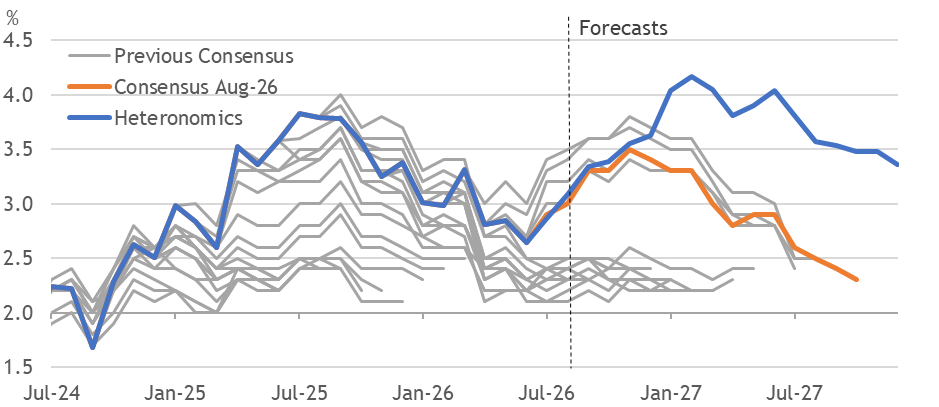
- Its median rate path is now at 4.1% for 2026–27 and 3.9% for 2028, in a hawkish shift relative to June’s dots and the consensus held until recently.
- A rise in the longer‑run rate to around 3.25% implies a structurally higher neutral 𝑟∗ that pressures peers to reciprocate. We believe the truth is likely even higher than this.
4. BoE: Too Little, Too Late
- The BoE’s reiterated 6-3 vote for no change was an unsurprising ongoing failure to rise to the challenge, unlike its peers. But at least members are on course for November.
- Reliance on a low neutral rate and expectations being anchored at 2%, despite all evidence to the contrary, are critical biases pushing the BoE’s policy failure to persist.
- QT’s expensive mistake is belatedly softened by selling gilts to the DMO, but, like a November hike, this is too little, too late. The fiscal cost could have been avoided.
5. AI THREATENS HUMANITY: World Goes to DEFCON 1 !!
- Leaders of top US AI companies have said human extinction is possible and that AI model development should be slowed.
- With upcoming IPOs and rapid market-share losses to open-source Chinese models, safety risk declarations and calls for government regulation could help these firms cement an oligopoly in the US market.
- China has read this playbook clearly, calling it “malicious competition” and pivoting its strategy: building domestic chip infrastructure, releasing ultra-cheap open-source models, and positioning itself as the open-AI champion.
6. CHINA AI: Are US AI Giants Pushing for a Ban on Chinese Models?
- The US is desperately trying to protect its declining market share in AI. The recent declarations of safety regulations could set the stage for a ban on Chinese AI models.
- Current AI safety discussions follow many measures the US has taken to stifle the rise of Chinese AI models, including export restrictions, accusations of illegal distillation, and global loyalty pledges.
- The US is faced with a dilemma: whether to protect its domestic AI players and risk lowering economic productivity or allow an open market where Chinese AI models may dominate
7. BoJ: Hike Disappoints Markets
- The BoJ’s 25bp hike to 1.25%, in line with consensus, came with an ongoing cautious tightening bias as inflation nears 2% and FX risks stay elevated.
- A 7–2 split vote and below‑target core CPI argue for gradual, data‑dependent hikes rather than a rapid or front‑loaded rate path.
- Yen weakness after the decision shows markets still see BoJ as lagging behind necessary action, leaving pressure for further rate rises if inflation and FX prove problematic.
8. Korea To Introduce 50%+1 Mandatory Tender Offer Rule: Taking 1 Step Back on Reducing Korea Discount
- In the past several days, Korea’s National Assembly passed an amendment to the Capital Markets Act, codifying a bipartisan compromise known as the “50%+1” rule for tender offers.
- I do not like the new 50%+1 tender offer system in Korea, although it is slightly better than the existing tender offer system in Korea.
- What about the remaining 49.99% of the minority shareholders? Clearly, these remaining minority shareholders are not treated fairly.
9. HEW: Hawkish Peer Pressure
- UK inflation and unemployment data confirmed a significant hawkish drift in the BoE’s forecast, but its reluctance to respond disappointed overly hawkish market pricing.
- The Fed and BOJ both hiked like the ECB and are likely to go again, although FX traders also punished the BOJ’s caution. Doves were beaten by peer pressure.
- Next week is the turn of the Norges Bank, SNB and Riksbank to announce their policy decisions, with the latter two being some of the increasingly rare dovish holdouts.
10. Hong Kong’s IPO Boom Is Becoming an Equity Absorption Problem
- Hong Kong’s IPO + placement pipeline has created an estimated HK$1.2trn of net absorbable supply, equivalent to ~5% of free float.
- Thin floats, six-month lock-ups and rising rates are weakening IPO absorption, while A/H discounts point to venue-specific liquidity stress.
- Positioning: favour A-shares, HK cash-returners and HKD cash; underweight the 2026 IPO cohort until supply exhaustion becomes visible.