This weekly newsletter pulls together summaries of the top ten most-read Insights across Macro and Cross Asset Strategy on Smartkarma.
Receive this weekly newsletter keeping 45k+ investors in the loop
1. Activity Defies Dovish Biases
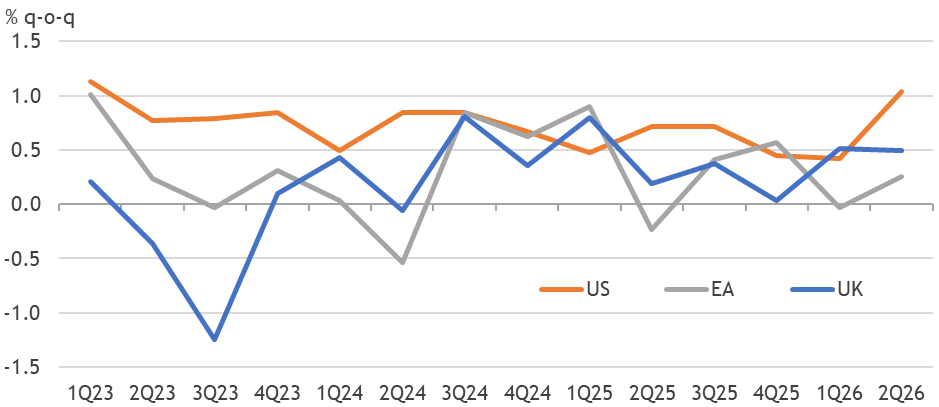
- Upwardly revised headline EA GDP in Q2 didn’t stop it from underperforming peers in H1, including in the labour market, but global activity has been remarkably resilient.
- There is broad balance in countries reporting higher unemployment rates as lower, which suggests slack and monetary conditions are both broadly neutral now.
- Dovish BoE assumptions leave it accommodating high inflation and credit growth, while the decisive ECB stopped the drift. One BoE hike is not enough, but is all that is likely.
2. Reliance On A Warm Winter
- Gas inventories are accumulating too slowly, so storage levels are at their lowest for the time of year and leaving little buffer against historically experienced drawdowns.
- The location of storage matters to energy security, and yet the UK has the lowest level and fullness of storage in Europe, despite its relative vulnerability to being cut off.
- A cold winter would squeeze prices much higher to destroy less sensitive demand, but that would be unusual for an El Niño year, trimming the probability of this painful risk.
3. HEW: Energy Squeezes Tighter
- Sunken Iranian tankers in the Strait of Hormuz and Houthi control of Bab-el-Mandeb are compounding the energy supply shock, squeezing prices to highs as hopes hit lows.
- Activity is still remarkably resilient, so the trade-off screams hawkish, causing the ECB to hike and probably go again in December. The BoE seemingly prays for a warm winter.
- Another 6-3 BoE vote to hold is likely, but with two more members open to a November hike. The BOJ is set to hike, and the Fed likely will too.
4. US Treasuries: The Battle for Price Discovery Versus Financial Repression
- The premium that bond investors are willing to pay for US Treasury securities has fallen since the end of the COVID-19 pandemic due to concerns about monetary and fiscal policy.
- Quantitative easing (QE) by the Fed and below-target inflation persuaded US politicians not to end profligate fiscal policy conduct. QE has sobering legacy issues involving rising inflation and government debt.
- Bond investors and US policymakers disagree about the pricing of Treasury securities as bad fiscal policy conduct is being increasingly factored into valuations as investors seek appropriate price discovery.
5. Sentiment Matters: Buy Side Sentiment Tracker
- We aggregate the published asset-allocation views of more than 50 asset managers across 70+ assets, highlighting where buy-side consensus is building or breaking down.
- Risk appetite: Four of five RoRo indicators rose, taking the aggregate to the third-highest level in Tracker history, while equity sentiment hit a record +81% net bullish.
- Still not all-in: EM equities, Tech and EM FX are very popular, but safe-haven positioning is less extreme; the Swiss franc is the least popular asset at -46% net bearish.
6. Portfolio Update: Selective in Global Stocks, Commodities, Underweight Bonds
- Global equities and commodities contributed to gains throughout our portfolio suite, driven by positive selection effects.
- Aggressive strategies continue to outperform their respective benchmarks YTD, especially as tech and crypto stabilize.
- Positioning carries over into September, maintaining an underweight to bonds and overweights to global stocks and commodities.
7. Asian Equities: Foreigners Are Buying Korea and Taiwan Again; India and Thailand Being Sold
- Recent spike in oil prices and US yields is not deterring foreigners from buying Asian equities. After buying US$4.8bn of Asian Equities in August, FIIs have bought US$1.8bn in September.
- In August FIIs bought Taiwan (US$11bn) and India (US$3.1bn) and sold Korea (-US$8.5bn). In September they have bought Taiwan (US$2bn) and Korea (US$1bn) and have sold India (-US$1.25bn).
- We believe foreign buying shall bounce back in tech-heavy Korea and Taiwan. FIIs would likely buy India too, but in smaller measure than North Asia. We are cautious about ASEAN.
8. ECB: No-Brainer Hike Is Not The Last
- The ECB’s unsurprising unanimous 25bp rate hike was dubbed a no-brainer by President Lagarde amid upside news on both activity and pipeline inflation pressures.
- Staff forecasts settle above target through the medium term, with upside risks and news since the forecast’s cut-off, signalling a strong case for another hike in December.
- Stale neutral rate estimates aren’t restraining the ECB like they are at the BoE, so its three hikes can achieve the target while the BoE’s one perpetuates its policy failure.
9. CTA Trend Picks in Taiwan, South Korea, and Japan
- CTAs are positioned in Asia uptrends, but the stocks that support it are losing momentum.
- We uncovered stocks that sit outside the CTA trade that may be less vulnerable to outflows.
- Tech uptrends remain intact, just lower their weight and make room for less volatile trends in financials.
10. Walker’s Weekly: Dr. Jim’s Summary of Key Global Macro Developments – 11 Sep 2026
- It was with a large pang of sadness this week that we saw the news of the passing of Tung Chee-hua, the first chief executive of Hong Kong post 1997. We were sad not because he was a particularly good leader and that everything in Hong Kong was rosy under his administration, but because he was a perfectly good man with the territory’s best interests at heart.
- On the other hand, the current US Treasury Secretary, Scott Bessent simply leaves the impression of being arrogant and egotistical. He challenges the markets to take him on as regards what he’s going to do with the bond market and more so with the yen. He says “Don’t mess with my Yen agenda”, but seems to forget he is US Treasury Secretary, not the Finance Minister of Japan (or a hedge fund manager).
- We published a Peregrinations report earlier this week, called Japan: Through AI Glasses. It forms part of the argument behind our long yen call, which at the moment is working because markets are frightened of Bessent and intervention. But it won’t work long term unless the yield differential closes. In our view, the way that it will close is through an accelerated hiking pace by the BoJ, not the way that most analysts expected.