
Receive this weekly newsletter keeping 45k+ investors in the loop
1. Fed Holds as Hike Debate Grows
- The Fed held rates at 3.5–3.75% in a 9-3 vote as hawkish dissents crystallised. Debate centres on whether hikes are needed to restore 2% inflation and credibility.
- Rising real yields and AI capex make financial conditions and productivity payoffs pivotal for any decision to raise rates.
- The five‑year-long inflation overshoot, and counting, keeps hike risk live; cuts are unlikely until disinflation and expectations are firmly anchored.
2. Shaming by Naming Korean Companies with Low PBRs
- On 28 July, the Financial Services Commission and the Korea Exchange announced the detailed criteria for this system of publicly identifying companies with low PBRs.
- This is a “shaming by naming” those companies with low PBRs to address situations where companies with low PBRs neglect efforts to boost shareholder value by publicly identifying them.
- I provide a list of 150 stocks in KOSPI that could be included in this list.
3. Credit Boom Before Burnham’s Burn
- A resurgence in the UK’s monetary data for June built on strength from policy overly accommodating the energy shock. Wage inflation has dominated higher lending rates.
- Recent lending growth is trending up by 6-8% on an annualised basis, devaluing the currency’s purchasing power to a point unlikely to be consistent with the CPI target.
- Fear of higher tax rates should slow loan demand, while the potential abolition of stamp duty should encourage transaction delays. We still see one BoE rate hike in September.
4. The Heat Is On: News Flow and Sentiment in CHINA / HONG KONG (July 2026)
- The Hong Kong market has seen a rebound in July, while North Asian markets declined sharply as the global AI/semiconductor sectors de-rated.
- The financials sector has outperformed over the last 8 weeks, while the tech sector has shown increased strength and momentum.
- MGM China (2282 HK) share price rebounded over the last week before its August Q226 earnings announcement. The company has increased its share of the mass-market gaming in Macau.
5. BoE: Dual Drift As Doves Bed In
- The MPC’s 6-3 vote matched our relatively hawkish view, but the numerical drift toward hiking was more than matched by a dovish drift among the broader committee.
- Most members are patiently awaiting proof of second-round effects before considering a move, making them reactive, not proactive, and compounding inflation risks.
- Our conviction in a persistently excessive UK inflation outlook is increased, but the majority’s reaction function delays a still-likely rate hike to at least November.
6. Technically Speaking Breakouts & Breakdowns – HONG KONG (July 2026)
- The Hong Kong market bounced off its long-term support levels in June and has outperformed the region in July, benefiting from rotational and southbound buying.
- In a positive sign, the financials sector has rallied this month and is the second-best-performing sector YTD at +11%. Value and dividend factors continue to perform well.
- Youran Dairy (9858 HK) had a Descending Trendline Breakout after the company announced that Inner Mongolia Yili Industrial Group (A) (600887 CH) acquired a significant stake in the company.
7. Indonesia Economics: Pressures Are Accumulating After Short-Term Reprieve
- Markets have stabilised since mid-June as Hormuz de-escalation and domestic policy repair buy Indonesia additional time, even as the underlying credibility deficit remains unresolved.
- With external conditions now re-entering a more dangerous phase, pressure is growing both on Indonesia’s trade balance and domestic demand. Policy buffers are also thinner.
- The institutional guardrails against policy mistakes have also been degraded. Intensifying intra-elite infighting also severely compromises the already-febrile business climate.
8. Sentiment Matters: The Biggest Consensus Longs and Shorts
- Technology, US equities and Brazil are now consensus longs—but where has optimism become most vulnerable?
- CAD, sovereign bonds and Consumer Discretionary are deeply unpopular. Which offers the clearest contrarian opportunity?
- Sentiment extremes are not automatic signals. Momentum and narrative vulnerabilities help separate crowded trades from genuine opportunities.
9. Asian Equities: Relentless Foreign Selling in Asia; Most of the Leading Markets Are Now Oversold
- In July foreigners sold US$34.8bn in Asia, the third worst in recent times, after March (US$69.9bn selling) and June (US$55.8bn). Taiwan (US$25.2bn) was the most sold, followed by Korea (US$11.3bn).
- India was bought (US$1.62bn), reversing last four month’s trend. Indonesia and Thailand’s July data is awaited. Till June, Thailand (+889m) is the only market bought this year. Indonesia sold (US$4.27bn).
- Our proprietary indicator of 6-monthly cumulative trade as proportion of market cap indicates Korea, India, Indonesia are oversold. Taiwan nearly there. FIIs beginning to buy India, correcting the oversold stance.
10. CX Daily: Billionaire Founder of Chinese Broker Futu Faces His Toughest Test
- In Profile: Billionaire Founder of Chinese Broker Futu Faces His Toughest Test From an early engineer at Tencent Holdings Ltd. to the billionaire founder of Futu Holdings Ltd., Li Hua built one of China’s most prominent online brokerages.
-
Now, the cross-border business model that powered Futu’s rise has exposed the 49-year-old entrepreneur to the most serious regulatory and legal challenge of his career.
- A third defendant seeking to unfreeze assets in a more than $100 million U.S. insider trading lawsuit shares a name with an investor whose Hong Kong corporate takeover collapsed days after a U.S. court order.
Receive this weekly newsletter keeping 45k+ investors in the loop
1. UK: Frontloaded Disinflation
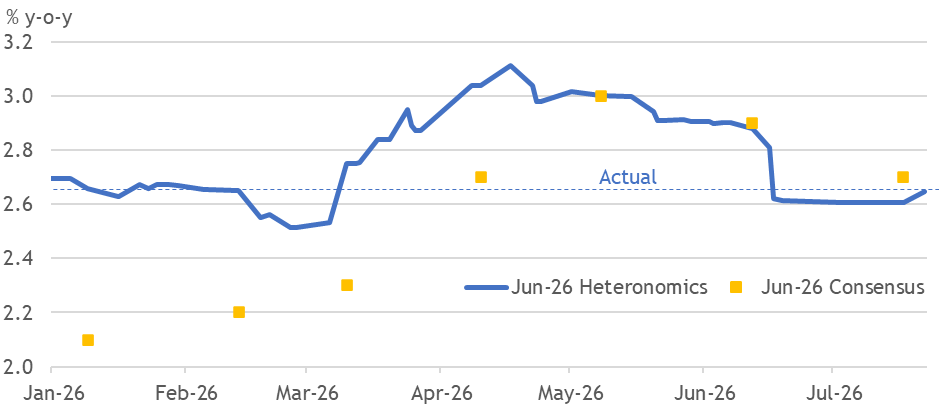
- A third downside inflation surprise to the consensus matched us but split hairs from 2.646%. It will also be a temporary trough as energy optimism was invalidated.
- Netting energy utility price falls, petrol price rises, and food price stability aligns with our pre-war forecast but is ~0.3pp above the consensus amid underlying strength.
- Cost passthrough to food, airfares, etc will occur later, while resurgent energy prices are raising the postponed peak in 2027. We still expect a BoE rate hike in September.
2. CHINA AI: Moonshot’s Kimi K3 Just Spoiled the Semiconductor Party !!
- Moonshot unveiled its Kimi K3 AI model, which rivals the top US frontier models in intelligence at a fraction of the run cost. Kimi K3 ranks third on the AAII.
- The rapid adoption of Chinese AI open-weight models using MoE architecture could bring the semiconductor supply/demand balance forward. Weekly token share of Chinese models by US firms now exceeds 50%.
- The Token Expenditure Index may be an early indicator that the MoE model token efficiency is reducing the growth rate of token demand and affecting the semiconductor ecosystem going forward.
3. UK: Jobs Better Than Distorted Data
- Headline surprises were mixed in the UK’s labour market report. The unemployment rate almost rounded lower, rather than increasing as the consensus expected.
- The ONS imputed responses it forgot to collect in telephone surveys, biasing outcomes to no change, with analysis revealing unemployment would have been lower without it.
- Bonuses disappointed, but total pay growth remains 4%+ with payrolls-based measures 4.5%. Only the ex-bonus ones offer dovish excuses, but they seem spuriously low.
4. HEW: Re-Entering Bad Theatres
- The supply shock intensified this week as the war theatre expanded to affect already impeded traffic through the Red Sea, and as President Trump renewed his trade war.
- Inflationary pressures are rebuilding, making June releases transitory relief, with good news frontloaded. The ECB recognised the change and signalled a September hike.
- Next week’s BoE and Fed decisions are unlikely to offer such a strong presumption, but a 6-3 MPC vote would help build momentum towards a BoE hike in September.
5. Hong Kong Market Catches a Bid: What’s Going On? (July 20)
- The Hong Kong market has advanced this month, while Japan, Korea, and Taiwan have declined in a mean-reversion move sparked by apparent short covering.
- Rising turnover, a supportive tech narrative from Beijing and increased southbound flows indicate that the rally may have legs. Consumer discretionary and energy sectors have been the top sector performers.
- There is evidence that some short covering catalyzed the rally during the normal June/July tight liquidity period, with low volatility and quality factors outperforming in the broader market.
6. The Long Climb in JGB Yields Is Nearly Over
- Most of the historic rise in JGB yields between 2022-26 came from long-run inflation expectation change and a normalization of term premia (TP) as BoJ lifted its unconventional easing.
- TP across the yield curve has largely finished its normalization process, in particular at the longest end. TP at 10-year has a moderate room to expand further.
- We think the hiking cycle in Japan is already in a late phase. Typically, the longer end of the yield curve starts to decline in a late cycle.
7. THE REAL AI BOTTLENECK: Why Data Centers, Not Chips, Limit Rollout
- Given the projected influx of AI chips into the US market, there will be a shortfall of data centers to support them, exceeding current data center capacity.
- Constraints on data center rollout include power infrastructure & grid interconnection, regulatory & permitting friction, supply chain bottlenecks, labor shortages, and growing real estate & local opposition/protests.
- Entities that control power-backed, permitted, and construction-ready data center capacity will hold a durable competitive advantage that capital alone cannot compete against.
8. ECB: Presumptive September Hike
- Surprisingly strong signals beyond the ECB’s hawkish hold now carry a clear presumption of a 25bp September hike, driven by resurgent energy costs and upside inflation risks.
- Press‑conference remarks revealed some Governors are already on the cusp of voting for a hike, with a higher burden of proof to back down after the MOU proved flimsy.
- A second and final hike in September is now our base case. Further hikes would need a more severe energy shock and clearer second‑round effects in prices and wages.
9. BUY/SELL/HOLD: Hong Kong Market Update (7/22/26)
- The Hong Kong market has bounced strongly in July as northern Asian markets decline amid the global AI/semiconductor sell-off.
- The materials, energy, and healthcare sectors are the top performers in July. Value, dividend yield, and large-cap factors have been top investment factors in the HK market this year.
- Precision Tsugami (China) (1651 HK) released its FY26 results, prompting price target and rating upgrades from analysts benefiting from downstream sectors such as NEVs, advanced equipment, and AI.
10. Sentiment Matters: Heatmap Update
- Investor sentiment is clearly in net bullish territory, but remains well below previous peaks and even further below the levels that have historically sent reliable warning signals.
- The Trade Risk Premium remains low…too low? Deep dive into the Trade Policy Uncertainty indicator.
- Heatmaps visualising Investor Sentiment across 600+ indicators and 48 asset classes

Receive this weekly newsletter keeping 45k+ investors in the loop
1. SK Hynix: The Leveraged ETF Tail Is About to Wag the Dog
- SK Hynix (SKHY US) ADR was introduced amid heavy media and analyst hype, underpinned by unquestioned management claims.
- SK Hynix-leveraged ETFs have skyrocketed and now trade at a higher nominal turnover than the underlying stock, dramatically increasing SK Hynix’s volatility in 2026.
- This precarious and unprecedented setup results in single-stock ETFs controlling the fate of SK Hynix as they buy and sell to adjust their exposure at the end of each day.
2. Sentiment Matters: Buy-Side Sentiment Tracker – July 2026
- Views from 50 top asset managers across 73 assets, based on 1,400+ individual views.
- Grinding more bullish: Buy-side sentiment continued to rise in July. The broader message is one of underlying bullishness, but difficult to describe positioning as extreme.
- Max contrarian: The buy side is most bullish on Infrastructure, Industrial Metals and Tech. It is most bearish on Consumer Staples, Real Estate and CHF.
3. US: Disinflation Flipped The V
- A 0.7pp drop in US CPI inflation to 3.5% went 0.3pp further than the consensus forecast to deliver an inverted V-shaped recovery from US energy prices normalising.
- Weakness was broad-based, with the core services impulse falling by 0.2% m-o-m in an abrupt turn from May’s 0.55% surge. Unfortunately, this good news may be an outlier.
- Energy prices rebounded in July, but the US excess relative to the UK will fade swiftly, which would support our view that the BoE will tighten more than the Fed.
4. UK: Spurious GDP Strength Slowing
- UK GDP’s resilience has persisted to a slightly greater-than-usual extent in Q2, but it is slowing. We expect payback and revisions to deliver Q2 at 0.3% q-o-q, half Q1’s pace.
- May gained the greatest support from seasonal adjustment factors in a decade, besides the pandemic years, further raising the risk of revisions to slightly less spurious norms.
- Slowing in the next two releases should not be sufficient to block a September BoE rate hike amid persistently excessive inflation, but we still see that as a one-and-done move.
5. KOSPI: Don’t Underestimate Korea’s Ability to Blow Up Its Market!
- Korea experienced a leveraged “melt-up” in its market in 2002. Then, margin debt ballooned to historic levels. This time, leverage is further amplified by single-stock ETFs.
- Technical analysis points to further pressure on the market as this massive leverage is unwound. Korean retail investors stand to have substantial losses from the leveraged ETFs launched in May.
- The Financial Services Commission has just rolled out a number of measures, including an immediate ban on new single-stock ETFs and increases in margin requirements, starting in August.
6. TSMC: The Next Semi Stock to Fall!
- TSMC delivered Q2 net income of NT$706.6 billion (+77%YoY), a record quarter that exceeded analysts’ consensus by ~13%. Management raised FY2026 revenue growth guidance to “slightly above 40%” (from >30%).
- TSMC shares have held up, even as semiconductor sector share prices have entered a bear market. Since June, the shares have moved higher with declining momentum, a negative technical signal.
- The bear case for TSMC is not a single catalyst — it is a confluence of weaker token expenditure for AI, margin compression, valuation de-rating, and demand concentration risk.
7. GOLD: The West Sells, the East and Central Banks Buy — Capitulation at a 28% Discount
- Our June call played out: the US$4,250–4,320 triangle floor broke and gold slid to US$3,993 yesterday, -28% from the January ATH, including June’s largest monthly drop since late 2008.
- Positioning reflects capitulation: North America recorded its weakest ETF H1 since 2013 while Asia achieved its strongest ever. Meanwhile, COMEX net longs rose 16% m/m as institutions bought retail selling.
- Maintain BULISH with TP of US$4,780. Accumulate US$3,700–4,000 in tranches. Catalysts this week: Chair Warsh’s first Congressional testimony (14 Jul) and June CPI.
8. Artificial Intelligence Adoption and Fed Policy Conduct: Multiple Forces in Play
- The idea that artificial intelligence (AI) adoption will raise the neutral policy rate (r*) due to higher productivity growth has gained acceptance amongst most central bankers.
- Rising uncertainty about labour displacement could increase precautionary savings that puts downward pressure on the neutral policy rate. Higher productivity will increase the US tax base and enhance fiscal sustainability.
- AI has produced inflationary pressures in technology segments. Under less guidance, perceived changes in the Fed’s policy reaction function could become more important than any single policy rate decision.
9. HEW: Discount Disinflationary Dip
- Ongoing attacks are accumulating a greater energy supply shock, renewing upside pressures on inflation and European policymakers more than the Fed.
- Disinflationary news in the US and EA June prints focuses on a concentrated soft patch from the temporary drop in energy prices, so this good news should be discounted.
- Next week’s ECB decision should sustain its hawkish bias without acting upon it again so soon. Meanwhile, it’s the UK’s turn to report its disinflationary blip from June.
10. Asian Equities: China’s Tepid Domestic Growth and Skyrocketing Exports Presents Interesting Options
- China’s disappointing April-June GDP growth underscores domestic consumption weakness. Exports continue to skyrocket. Export resilience in power and automobiles, along with higher overseas margins benefit companies with sustainable foreign revenues.
- In 2026, technology, industrials, energy have outperformed. The first two fit the theme of advanced manufacturing and technology-enablers. Combining this with robust overseas revenues, a set of stocks stand out.
- Among these stocks, CATL, Geely, Weichai Power and CNOOC figure in our Model Portfolio.
Receive this weekly newsletter keeping 45k+ investors in the loop
1. HEM: Jul-26 Views & Challenges
- Energy supply remains constrained, but the market has moved on thematically. High oil product prices quietly sustain the shock.
- ECB action helps EA inflation back to 2% in 2027, while UK excesses persist and the US outlook sits in between.
- We see a BoE hike and the ECB/Fed on hold. Market pricing for the BoE/Fed spread is inconsistent with fundamentals and can reverse.
2. BoE Pricing Is Too Fed Up
- Market pricing embraced our long-held view that the Fed could hike this year, but in fading BoE moves, has ended up with too much tightening priced relative to the BoE.
- The UK’s structurally rising unemployment rate has passed, and is no longer much worse than a year ago. The monetary setting is not obviously tight or tighter in the UK.
- Inflation is a more persistently excessive problem in the UK, compounded by another energy shock. Incoming fiscal loosening also justifies a tighter BoE than Fed path.
3. HEW: Re-Energised Supply Shock
- Renewed attacks in the Gulf and Trump’s assertion that the ceasefire is dead reversed the MOU-related decline in gas and electricity prices, although oil remains cheap.
- Rate expectations have increased in response to the intensified energy supply shock, especially in Europe, but we still see the BoE as underpriced relative to the Fed.
- Next week’s US inflation data should show good news from oil price falls, while the final EA release can confirm it. Policy decisions will come in Canada and Korea.
4. LEVERAGED ETFs: “Pigs Get Fed, Hogs Get Slaughtered”
- The global leveraged ETF market has grown to an historically high level in both AUM and trading volume, increasing risks and volatility for global equity markets.
- Long and Inverse ETF product analysis shows that investors are actually holding leveraged long ETF positions in single stocks and markets, no longer using the products for trading and positioning.
- The problem for markets is not only the parabolic rise in leveraged ETFs feeding through to stocks and markets via rebalancing, but also the overall net positioning being heavily long.
5. Asian Equities: Second Highest Ever Foreign Selling in June; Nascent Recovery in India and ASEAN
- In June, foreign institutions sold US$54.7bn of Asian equities, second only to the US$69.9bn selling in March. FIIs sold US$30.7bn in Korea, US$19bn in Taiwan and US$5.2bn in India.
- In H12026, foreigners have sold US$157bn Asian equities – the most concentrated bout of selling ever. They sold US$96bn in Korea alone, US$29.8bn in Taiwan and US$29.3bn in India.
- We identified India and Korea as oversold markets. India is now being bought back by the FIIs – US$312m in July till date, but Korea continues to be sold heavily.
6. RBNZ Starts Cautious Tightening
- The RBNZ’s 25bp OCR hike to 2.50% begins a cautious tightening phase, aimed at returning inflation sustainably to the 2% target midpoint.
- The decision aligned with the headline consensus but disappointed the dovish minority, reinforcing a bias towards higher rates as neutral is seen near 3%.
- Future OCR moves will be data‑dependent, driven by medium‑term inflation pressures, domestic price‑setting behaviour, spare capacity and the exchange rate path.
7. Vietnam Economics: Another Strong but Uneven Quarter for GDP Growth
- Capital formation, including precautionary stockbuilding, helped Vietnam maintain a strong rate of GDP growth in Q2 2026.
- Softer growth in services points to domestic demand headwinds as higher energy prices erode real purchasing power.
- The year-to-date performance, however, leaves Hanoi’s full-year growth target out of reach. The quality of growth will also be more uneven than the headlines imply.
8. US Economic and Funding Conditions Remain Resilient, but Limited Scope for Improvement
- Despite the energy shock due to hostilities in the Middle East, US economic activity has remained resilient, but business and consumer sentiment remain below pre-conflict levels.
- US funding conditions remain favourable during 2026 despite the geopolitical backdrop, but scope for further improvement is limited. The Fed’s latest stress tests suggests banks are in decent financial shape.
- Fiscal policy plays an important role in determining funding conditions via banks and the repo market. The fiscal outlook is complicated by uncertainty about tax revenues associated with expiring tariffs.
9. CX Daily: How a South China Port Is Redrawing the Regional Logistics Map
- In Depth: How a South China Port Is Redrawing the Regional Logistics Map
- In Depth: China’s Inbound Tourism Rebounds, but Supply Gaps Cloud Outlook
- Analysis: Gold Caught in a Tug-of-War Between Asian Bulls and a Hawkish Fed
10. CX Daily: The AI Token Takeover in China
- Cover Story: The AI Token Takeover in China
- China Overhauls Stock Trading Rules to Boost Efficiency, Curb Speculation
- Guotai Haitong Becomes First Chinese Brokerage to Trade Offshore Yuan in Shanghai FTZ
Receive this weekly newsletter keeping 45k+ investors in the loop
1. Indonesia: Record Lows But Not Abandoned
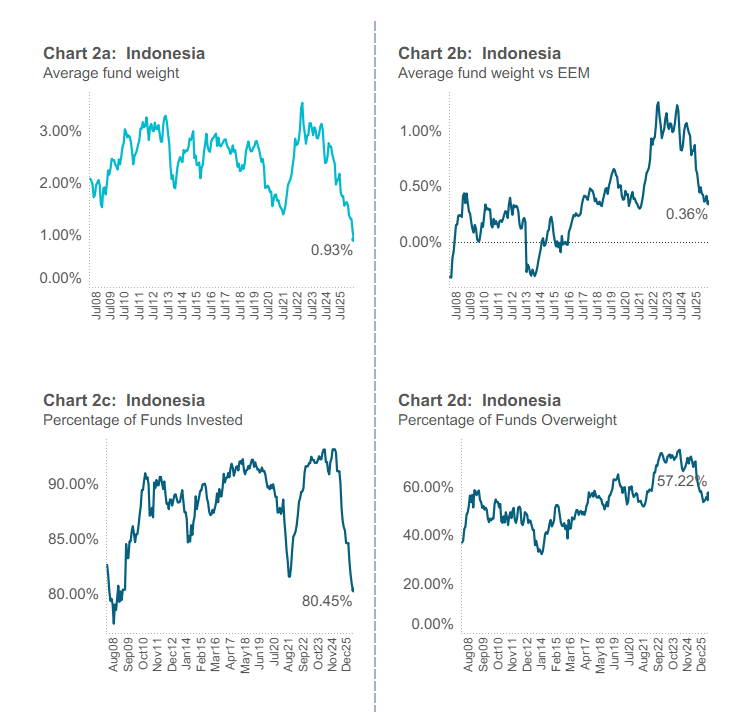
- Average weights have fallen to an all-time low of 0.93%, with fund participation at a 15-year low of 80.45% — yet the majority of active EM managers remain invested.
- Selling has been concentrated in domestic banks, with Bank Central Asia seeing the largest outright closures, while ASEAN allocations as a whole have dropped to their lowest level on record.
- With MSCI’s verdict on Indonesia’s EM status still pending, the country sits firmly in negative momentum territory, but for many funds, much of the pain may already be behind them.
2. HEW: Cooling Hawkish Heels
- Data releases didn’t deliver the pressure needed to prompt more rate hikes, offering enough softness to cool hawkish heels without wrinkling them into a dovish story.
- US and EA unemployment fell again, but a drop in the US labour force and disappointing payrolls offset that signal. EA inflation matched our 0.2pp below-consensus call at 2.8%.
- Next week’s calendar is thin for releases, with a potential hike from the RBNZ one of the few highlights. We also await the BoE’s FSR and stress test results.
3. Credit Accommodating Strait Shock
- A further strengthening in EA bank lending suggests monetary conditions accommodated the war shock, despite policy rate hikes, reducing concerns for demand destruction.
- UK credit was also resilient, but mortgage approvals took a hit in May despite the first fall in outstanding loan rates in four years, as households refinance at cheaper rates.
- New rates are only up slightly relative to the previous few months. Sentiment ahead of another socialist slide with the PM changing is likely discouraging decisions like moving.
4. EA: Fading Inflation And Hikes
- EA inflation’s 37bp fall to 2.8% in June undershot the consensus by 0.2pp but precisely matched our forecast. Energy prices drove the rise and the fall with their reversal.
- The consensus is embarrassingly slow to update when substantial shocks occur, but it will be forced to close some of the gap to our forecast by cutting after this release.
- With the first-round inflation shock fading and the second-round effects contained by prompt action, our conviction is rising in our call (since March) for only one ECB hike.
5. HONG KONG ALPHA PORTFOLIO: (June 2026)
- The Hong Kong Alpha portfolio beat the Hong Kong indexes in June and was flat to its benchmark with a loss of 6.98%.
- The Hong Kong market experienced heavy selling in the second half of June, as both foreign and mainland investors reduced their exposure.
- At the end of June, we sold positions in the electric utilities, technology, consumer, and property sectors. We added positions in the broker, biotech, telecom, and industrial sectors.
6. Indonesia Economics: Equities Avoid Market Downgrade, Revised Law Creates More Governance Risks
- Indonesia avoided an immediate equity market downgrade but faces a November decision where reclassification to frontier market status remains live. Market indicators suggest investors are unconvinced by the holding pattern.
- The revised financial sector law expands Bank Indonesia’s mandate with growth and employment objectives while making parliamentary oversight and recommendations binding — creating channels for political subordination of monetary policy.
- Patriot bonds” and “red-white bonds” issued by the sovereign fund are shielded from criminal prosecution, civil suits, and tax scrutiny, placing contingent government liabilities beyond any meaningful market accountability.
7. Asian Equities: Nascent Emergence of New Earnings Gainers
- The recent wobble in Asian equities has been driven by a multitude of factors including AI capex uncertainty, USD spike and concerns about US interest rate trajectory.
- Asian earnings estimates continued to rise over the past month. Estimates for Korea and Taiwan continue to increase. India now joins them, marking a departure from last two year’s trend.
- It’s still early days, but particularly encouraging about the Indian earnings revival is the breadth of participating sectors. Five Indian sectors figure in the list of top 20 earnings gainers.
8. The Heat Is On: News Flow and Sentiment in CHINA / HONG KONG (June 2026)
- The HSI broke support at the 24500 level as market breadth and momentum declined. Southbound net buying turned negative in June as the Beijing strengthened enforcement efforts on overseas investments.
- The industrials sector is the top performing sector in Hong Kong YTD, up 16%. Kingboard (148 HK) is the best performing stock in the sector since the Iran war ceasefire.
- WuXi AppTec (2359 HK) rallied along with the entire biotech sector as investors scooped up shares in the IPO of Alebund Pharmaceuticals Jiangsu (APJ HK), which doubled on its debut.
9. Consensus Holdings: The Most Widely Owned Stocks Across Active Equity Funds
- What are the most widely owned companies across active Global, EM, Asia Ex-Japan, MSCI China and China A-Share funds?
- The USA runs the Global fund universe: thirteen of the top twenty most widely held stocks are American, with Europe and EM sharing the remaining seven between them.
- South Korean and Taiwan names drawf key China holdings in terms of weight, despite being held by a similar number of funds.
10. Walker’s Weekly: Dr. Jim’s Summary of Key Global Macro Developments – 26 June 2026
-
Bank of Thailand kept interest rates unchanged at 1%, one of the few Asian central banks that hold interest rates at a very low level.
-
But given how strong the Baht has been over the course of last year, interest rate rises in Thailand would further overvalue the currency and that’s not what BoT wants to see.
-
US Fed kept interest rates steady at the moment but Chairman Warsh was talking about raising interest rates, that is because the inflation has entered the pipeline. In Wednesday’s WeeBits note we looked at import price, producer price and consumer price trends YoY, six month annualised and three month annualised. All are showing inflation is pretty severe and rising in the United States.
Receive this weekly newsletter keeping 45k+ investors in the loop
1. UK Politics: Burnham Down The House
- Andy Burnham seems set to become UK Prime Minister next month after Keir Starmer resigned and Wes Streeting decided to back Burnham instead of launching a campaign.
- Labour’s hopes are higher, but the self-styled King of the North faces the same lack of support for specific changes. A core vote strategy would extend the slide to socialism.
- The fiscal rules now have rolling horizons, allowing more deficit-fuelled spending and even nationalisation. Labour’s death throes can hit harder with Burnham in charge.
2. NPS: Net Seller of Korean Stocks in the Past Month (What Is It Buying and Selling?)
- NPS and other local pension funds net sold approximately 2.5 trillion won in KOSPI included stocks in the past month (as of 23 June).
- Top stocks net sold by the NPS and local pension funds in the past one month include Samsung Electro Mechanics, SK Square, and Mirae Asset Securities.
- Top stocks net purchased by the NPS and local pension funds in the past one month include Naver, SK Hynix, and Hyundai Mobis.
3. BUY/SELL/HOLD: Hong Kong Market Update (6/22/26)
- The Hong Kong market continued its downtrend over the last month. The technology, materials, consumer, and healthcare sectors have declined in 2026, with the industrials sector showing the best performance.
- Dividend and value factors have outperformed in 2026, while growth and momentum have declined.
- Contemporary Amperex Technology (3750 HK) was initiated as OVERWEIGHT by Barclays, with a target price implying 35% upside.
4. Sentiment On Yo-Yo Diet
- Services sentiment rebounded in 5/8 of the flash PMIs, converging the cumulative fall since February with the hit from the 2025 tariff shock, but UK depression deepened.
- Revisions will probably raise these values again, but political turmoil will keep weighing on the UK, even if sentiment loses the same ground each month, like a yo-yo diet.
- Global unemployment data has been stable so far, signalling demand destruction is insufficient to balance the excess inflation, supporting recent rate hike decisions.
5. CHINA/US: Trump Wages Another Losing War, This Time in Tech!
- The Trump Administration is determined to continue and wage a “tech war” against China. The battlefield has expanded beyond the chips to power AI and the equipment to produce them.
- The Pentagon’s Section 1260H “Chinese Military Company” (CMC) list expanded significantly in early 2026, now encompassing some of China’s most prominent technology and platform companies.
- In response to US actions, China added 10 US defense contractors to its export control list, targeting drone, robotics, aerospace, and strategic minerals sectors to prohibit exports of rare earths.
6. Technically Speaking Breakouts & Breakdowns – HONG KONG (June 2026)
- The Hong Kong market continues to underperform as investors focus on semiconductor investments in North Asian markets. The market continues to trade at a significant valuation discount to other markets.
- Dividend yield and value factors have outperformed YTD, while growth stocks have declined the most. The industrials sector is the best-performing YTD, while tech, healthcare, and consumer sectors decline.
- Dongyue (189 HK) share price relative to the MSCI All Asia index has broken new highs. The surge in shares is attributed to President Trump’s easing of hydrofluorocarbon (HFC) regulations.
7. Walker’s Weekly: Dr. Jim’s Summary of Key Global Macro Developments – 19 June 2026
- The Federal Reserve kept interest rates at 3.75%, but it was a surprise that new Fed chairman, Kevin Warsh, struck a relatively hawkish tone in the post-meeting press conference, suggesting that inflation was still a problem. In the mean time, the Taiwanese central bank again left interest rates at 2% despite the fact that money supply growth is way above the target range.
- Bank of Japan, Bank Indonesia, and the Philippines Central Bank all raised interest rates by 25pbs this week. Bank of Japan is seriously behind the curve while Bank Indonesia and Philippines central bank are in trouble with both inflation and exchange rate pressures.
- A few Chinese data points are showing signs of softening. Retail sales fell 0.6% YoY in May, a pause after a strong start of this year. Property investment continued to contract, by 16% YoY in May which is pretty significant number in a sector that really should be stabilizing by now, but continues to weaken.
8. Thailand: Holding Through The Shock
- The BOT held the policy rate at 1.00% as expected, while signalling a high bar for near‑term hikes despite a temporary inflation overshoot.
- Sub‑trend, uneven growth and weak SME credit make the MPC favour an accommodative stance while watching inflation expectations closely.
- Future rate moves hinge on cost‑push shocks, baht‑driven imported inflation and whether disinflation turns the real policy rate too restrictive.
9. HEW: Leveraged Vibes
- Vibes are driving markets, with retail monkeys seemingly set to destroy Korean equities next, fuelled by leverage. Meanwhile, Iranian attacks are ignored as old news.
- Physical oil products remain expensive, even as financial investors price the problem out. Sentiment is recovering too, although the UK suffers from its socialist slide.
- Next week’s unemployment data in the US and EA, plus flash HICP, are the main events. Lending data from the ECB and BoE, and Friday’s DMP, are our second-tier highlights.
10. Banxico Pauses, Caution Prevails
- Banxico paused at 6.50%, matching consensus, signalling a shift to a higher‑for‑longer stance as core inflation eases only gradually.
- With upside inflation risks and expectations still above target, further cuts hinge on sustained core disinflation and a stable peso.
- Future rate moves will track services inflation, global conditions and Fed policy, keeping Mexico’s real rates restrictive for now.
Receive this weekly newsletter keeping 45k+ investors in the loop
1. UK: Good Relief
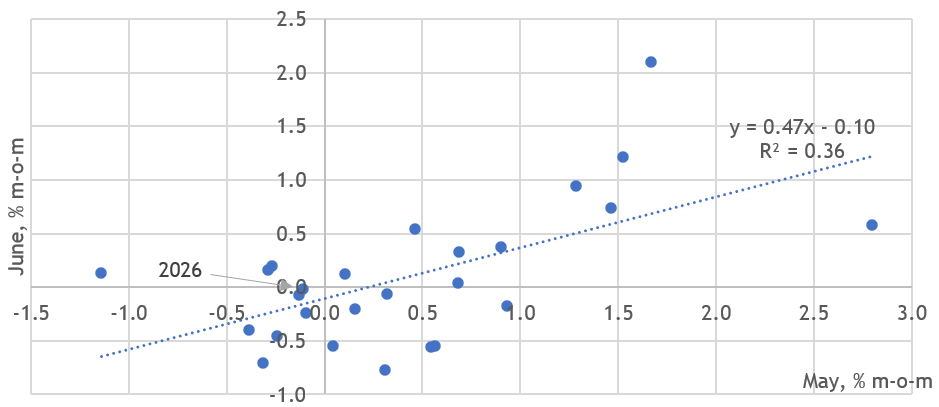
- A second downside inflation surprise narrowly kept the UK CPI at 2.8% (2.848%). Services were resurgent, but goods provided relief, despite their high energy content.
- Fertiliser shortages made us see upside risks to food. The stability of small changes and soft PPIs suggests it will stay like that, as UK margins take the strain again.
- High labour costs pushing up domestic service prices remain the problem. 3%+ inflation has become normal, but not acceptable, despite the BoE’s bias to assume it away.
2. Fed Dots Defy Market Doves
- The Fed holds rates at 3.5–3.75%, but the dots now flag at least one 2026 hike, in contrast to the firm consensus for an unchanged median path.
- SEP lifts 2026–28 inflation and funds‑rate medians, signalling higher‑for‑longer policy as strong growth and investment sustain demand.
- This outcome broadly validates our “fundamentals over politics” view and argues for a more cautious stance on US rates and risk assets.
3. UK: Tightening Labour Market Trends
- Another bullish surprise in the labour market report lowered the unemployment rate to 4.9% and signalled a trend improvement since December worth ~0.1pp quarterly.
- Weakness remains concentrated among those banned from competing for work on price, compounding the hawkish pressure of the implied labour market tightening.
- Pay growth also beat expectations. Private pay remains a flimsy dovish straw for doves, while measures less sensitive to bias are broadly 4-5%, inconsistent with the target.
4. US EQUITY OVERSUPPLY: When the Public Buyers Become the Greater Fools
- The US market is undergoing a rapid and significant shift from “de-equitization” to “re-equitization”. Firms are quickly foregoing buybacks and instead increasing debt issuance, convertible issuance, and secondary equity offerings.
- AI capex is driving the change and potentially crowding out capital with technology sector mega-IPOs and secondary offerings projected to offload trillions of dollars of equity in the coming years.
- The rush to issue equity comes at a time when retail investor buying has resurfaced as a significant source of market support, accounting for 20% of overall volume.
5. Iran: A Dream of Spring
- The Iran-US MOU is a welcome step that reduces escalation risk and may reopen the Strait of Hormuz for outbound traffic soon, but vessels won’t return without a real deal.
- Production can’t normalise until ships return in months. Benchmark prices for physical oil products have only fallen to 2022 levels, despite the move in financial markets.
- Our inflation forecast peak is ~0.3pp lower, but at 3.8% on UK CPI, and the target elusive, hawkish pressure persists, even with the BoE’s bias to be too stimulative.
6. BoE: Poised For Finely Balanced Votes
- Megan Greene joined Huw Pill’s hawkish dissent, but Catherine Mann waited, despite seeing hawkish activism needed in either scenario. She seems set to support a July hike.
- The MPC’s centre has hardly moved since April, but dovish belief in a softening labour market, while excess inflation persists, makes a hike likely in September instead.
- Votes seem set to become increasingly finely balanced again as the MPC grudgingly grinds towards a hike. Unfortunately, an ongoing inflation overshoot is not a close call.
7. HEW: Odd One Out
- The BoE became the odd one out in resisting rate hikes, despite the UK suffering a worse inflation problem than peers who are broadly either hiking or warning they will.
- UK labour market data beat expectations again, but the biased BoE always focuses on the worst points. Stable inflation amid temporarily soft food prices also eased pressure.
- Next week’s calendar is much thinner, with the flash PMIs providing the main highlight. Potential moves to oust the UK’s PM after Burnham’s by-election will also be watched.
8. BoJ Hike After FX Squeeze
- After April’s no‑hike misstep and costly yen intervention, a June move to 1% became effectively unavoidable for the BoJ.
- Guidance points to further gradual hikes if core inflation and wages stay firm, with bond buying used to cap curve volatility.
- Future rates hinge on core inflation, wage‑price dynamics and FX stability, making the path beyond 1% highly data‑dependent.
9. Iran Deal Imminent: The Trade That Most Portfolios Are Completely Unprepared For
- Prediction markets price US–Iran deal at 75–80% probability; draft MoU exchanged 12 June. Signing expected within weeks. Base case: treat it as done and position accordingly.
- Iran’s return adds 1.5–2.5mb/d to global supply within 18 months. Brent’s structural ceiling collapses to US$60–75/bbl. Energy importers win; OPEC+ pricing discipline is broken permanently.
- China captures the reconstruction dividend — not the West. Surgical longs: SLB, TotalEnergies, Airbus, Standard Chartered. Avoid binary oil shorts; the nuance is in the value chain.
10. EA: Fading Follow-Up ECB Hike
- A slight downward revision to May inflation coincides with an abrupt reversal of pressures. Second-round effects have not yet shown signs of emerging in the EA.
- Food prices have shrugged off the cost shock so far, and underlying inflation measures have slowed recently rather than rising to levels that might threaten the target.
- May is likely the peak, with a drop back below 3% imminent and 2% looking achievable in 2027 without hikes. So, we still see June’s hike as the only one.
Receive this weekly newsletter keeping 45k+ investors in the loop
1. US: CPI Builds Bullish Case To Hike
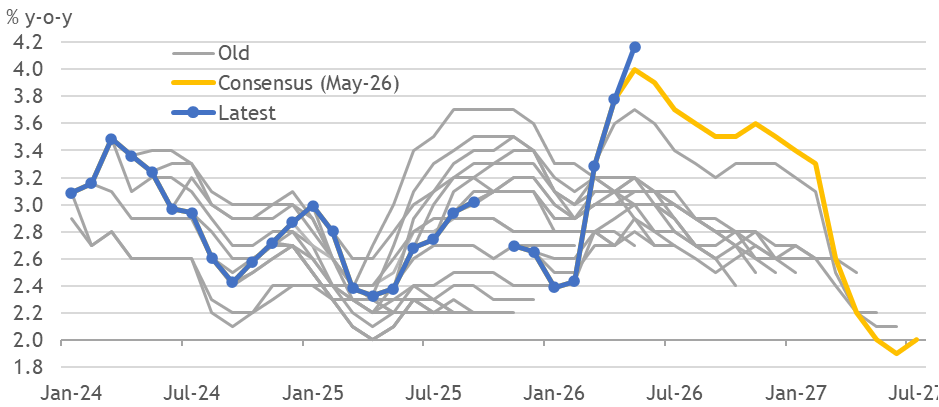
- Another rise in US inflation to 4.2% matched final forecasts, but continued a fierce drift up from earlier expectations as the inflation shock is proving worse than feared.
- The core services impulse also rose again to hit 0.55% m-o-m (6.8% annualised) as the underlying inflation problem stops being remotely consistent with the target.
- We still don’t believe the Fed can ignore the fundamentals. Chair Warsh should talk up the bullish developments that Trump can welcome, creating space to hike if needed.
2. HEW: Long Goodbyes
- Hopes that the war-related disruption might end soon are challenged by the experience of continual delays. Meanwhile, Starmer’s long goodbye got a kick from resignations.
- Thursday’s by-election won’t yield improvement, as Burnham adds his socialist mess to longstanding inconsistencies in the UK political platform and the BoE’s policy failure.
- Nonetheless, we expect another two dissents at next week’s BoE decision to dampen overly dovish pricing. UK inflation’s rise and unemployment data are other highlights.
3. CHINA Vs U.S. TECH IPOs: WHY CHINA IS OUTPERFORMING (June 2026)
- Chinese technology IPOs continue to outperform US tech sector IPOs in 2026. China has instituted supportive policies to help its tech companies list on both the A- and H-share markets.
- The CSI Information and Technology index has outperformed Nasdaq this year, even though China’s largest chip makers have only a small fraction of the market capitalization of their global peers.
- China’s self-reliance policies, AI breakthroughs, USD weakness, and Hong Kong’s international role continue to support the strong performance of China’s tech IPOs this year.
4. ECB: Hiking With Nots
- In an outlook full of uncertainty, the ECB’s unanimous delivery of a June hike was reassuringly unsurprising. Comments primarily focused on what the decision was not.
- President Lagarde didn’t provide explicit guidance on the outlook and pushed back firmly against the notion that this was an insurance or pre-emptive move.
- This open guidance matched our view, so we still see no more ECB hikes. However, a sustained lack of gas inventory could squeeze inflation and rates up again in September.
5. CHARTING COURSE: Trump Begs Iran for Ceasefire, and S&P Needs Leap of Faith (JUNE 9)
- President Trump is struggling to maintain a ceasefire in the Middle East as he mediates between Israel and Iran. Meanwhile, the prospects for lasting peace are declining.
- The US economy is increasingly unbalanced, with government spending and AI infrastructure trying to prop up growth while consumption flatlines.
- The S&P index is increasingly dependent on a small percentage of outperformers. Without these stocks, the equal-weighted index would have declined by 16% over the last 5 years.
6. BoC Holds: Two‑Way Rate Risks
- The BoC held rates at 2.25% as expected, balancing weak growth against energy‑driven inflation and keeping a flexible stance on future rate moves.
- Future hikes hinge on energy costs feeding into core inflation, wages and expectations; otherwise, the Bank can tolerate headline CPI near 3% temporarily.
- Significant US tariffs or deeper domestic slack could trigger cuts, but markets currently price a flat path near 2.25% with only modest hikes after 2026.
7. ADL Breadth Technical Starting to Break Down for KOSPI + RIA Accounts Surpasses 4 Trillion Won
- Concerns about delays in data center construction, lack of profitability at OpenAI, increasing competition, and mega IPOs are all causing concerns about whether KOSPI’s super bull run could continue.
- Important technical (such as KOSPI’s ADL line) is also starting to break down.
- All in all, the overall risk profile of the Korean stock market (especially among the major tech stocks) have risen materially higher now as compared to 6-12 months ago.
8. US MARKET EXHAUSTION (June 26)
- The US market is showing signs of buyer exhaustion. High valuations, declining breadth, single-stock option skew, extreme momentum crowding, and lofty analyst earnings projections present risks to the bull market.
- Wall Street earnings upgrades in April were almost entirely in the tech sector and were heavily dependent on a historically high estimate of S&P operating margins.
- Rushed mega-IPOs and equity placements by hyperscalers pose another risk to the market as liquidity requirements for the tech sector grow rapidly.
9. GOLD: Pulling Back to Reload — Three Headwinds, but Direction Still Points Higher
- Gold has been underperforming the broader market (flat YTD) and plunged last week (-5.2% WoW) on blowout US jobs data, investor liquidity needs, and Iran war stalemate.
- AI equity rotation is the dominant structural headwind: tech ETFs posted their largest monthly inflow since 2024, displacing gold. Fed hike probability now ~60%; two-cut base case is dead.
- Maintain BUY; TP cut to US$4,780/oz (from US$5,400/oz). Central bank buying continues uninterrupted. US $3.4tn CBO deficit, de-dollarisation, and inflation theses narratives are all intact. Accumulate on weakness.
10. Walker’s Weekly: Dr. Jim’s Summary of Key Global Macro Developments – 5 June 2026
-
It’s the first week of the month, all eyes were on the PMIs and everything seemed pretty rosy in the garden, only Malaysia’s PMI reading was below the 50 boom-bust line. However, that could be deceiving. Take the US ISM as an example, one of the components is price paid, the prices paid index in May was 82.1 and it was slightly lower than the April reading of 84, both basically recorded high levels for prices paid in the United States.
-
Korean export numbers came in at 52.3% YoY growth in May and the April figure was up 48% YoY, these are stunning numbers for a mature economy. Nevertheless, the export price number also came in at 41% YoY growth. Export prices, over the course of the last decade, haven’t changed that dramatically from year to year but now they’re totally out of whack.
-
In Vietnam, the latest May CPI number was up 5.6% year on year, and that’s an increase in inflation from around about the 3% mark during 2024 and 2025. Currently, the upper end of the central bank’s inflation target is 4.5%, and there’s only one thing you can do when inflation’s running at 5.6%, raise interest rates.
Receive this weekly newsletter keeping 45k+ investors in the loop
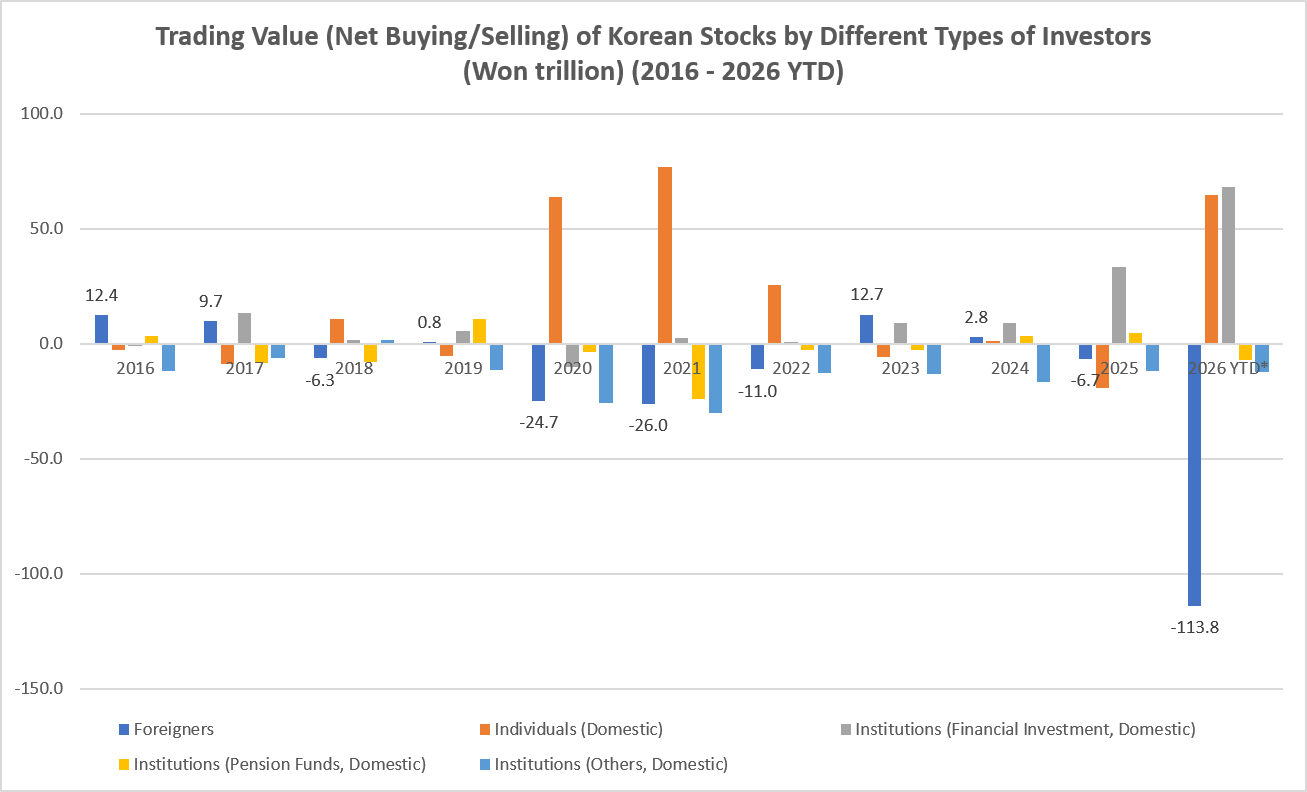
1. Massive Net Selling of Korean Stocks by Foreign Investors in 2026: Having Significant Impact on FX
- Amid record rallies in the Korean stock market and the major semiconductor stocks in particular, there has been a massive net selling of Korean stocks by foreign investors this year.
- In this insight, I discuss the following three major items including net selling/buying of Korean stocks by foreign investors, domestic institutions, and domestic retail in the past 10 years.
- I also discuss percentage change in foreign ownership among the top 20 stocks in Korea and impact of the net selling of Korean stocks by foreigners on the KRW/USD rates.
2. HEM: Jun-26 Views & Challenges
- The Strait of Hormuz remains closed, increasing the supply shock, but markets are functioning, allowing pricing to relax bullishly.
- We still expect only one hike from the ECB and BoE. A reignited conflict would help raise that response to be like 2003, not 2022.
- Dovishly biased assumptions at the BoE leave it accommodating too much excess, delivering persistently above target inflation.
3. Policymakers Tuning Lambda
- Excess inflation risks are more contained by the ceasefire, while demand destruction is becoming clearer, justifying less tightening, although pricing is largely oil-driven.
- Policymakers are increasingly referring to this trade-off, including factors that influence the optimal so-called lambda, like second-round effects and news coverage.
- Megan Greene’s use of the framework is consistent with her voting to hike in June. We still expect a majority to reach a similar conclusion for the 30 July decision.
4. EA Inflation Lifts ECB Rates
- EA inflation rose by 16bp to 3.19% in May, only 2bps above our forecast, but less painful than the consensus expected in recent weeks. National releases may have cut calls.
- Surprises were broadly small, with more downside ones averaging 0.1pp, balanced by bigger country strength. Upside was in services while downside was in energy.
- The ECB is set to demonstrate its commitment to the target with an 11 June hike. This rise provides no excuse not to, but demand destruction urges restraint beyond that.
5. HONG KONG ALPHA PORTFOLIO: (May 2026)
- The Hong Kong Alpha portfolio gained 9.7% in May, outperforming its benchmark by 10.57%. The portfolio has outperformed Hong Kong indexes by 57% to 75% since its inception in 10/2024.
- The portfolio has a Sharpe ratio of 1.37 since its inception, with a mean excess annualized return of 21% and a beta of 1.2.
- At the end of May, we sold our remaining positions in the mining and materials sectors and added positions in the power, consumer and property sectors.
6. HEW: How Soon Is Now?
- Bumper US payrolls data reiterate the burgeoning case to hike, not cut, yet Fed policy is frozen harder than the glacial ceasefire progress towards a mooted deal coming “soon”.
- June is too soon for the BoE, with the DMP revealing no urgency. Still, EA inflation is high enough for the ECB to say now is soon enough to hike.
- We expect the ECB to resist offering explicit support for tightening beyond that, while leaving the door open. US CPI data should ratchet the hawkish pressure by rising again.
7. Asian Equities: Another Month of Huge Foreign Selling; Taiwan and Thailand the Only Exceptions
- In May, foreign investors sold US$24.17bn of Asian equities, US$28.17bn in Korea, US$3.45bn in India and US$151m in Philippines. They bought US$7.5bn in Taiwan and US$104m in Thailand.
- This is the heaviest FII selling episode. In 2026 YTD, FIIs have sold US$102.2bn in Asia-6, after US$45.3bn selling in 2025. In 2022, the worst year recently, FIIs sold US$52.14bn
- Our indicator of cumulative 6-month selling as percentage of market cap indicates that Korea, India and Indonesia are clearly oversold. Taiwan recently bounced back from oversold territory.
8. THE MEGA IPOs: A Rising Tide Lifts A.I. Boats !!
- The three mega IPOs are coming in 2026. SpaceX (SPCX US) is slated to start trading this month with a valuation in the neighborhood of $2 trillion.
- Anthropic and OpenAI are the largest AI-focused firms preparing to go public soon. Anthropic’s valuation reached $965 billion in its last funding round, versus OpenAI’s $850 billion valuation.
- Going forward, AI competition will focus on efficient large-scale deployment and less on peak model intelligence. As compute costs increase, financial strength and access to infrastructure will determine future success.
9. The iEdge Singapore Next 50: From Index Creation to Investability
- The Next 50 is undergoing early-stage re-rating driven by liquidity and visibility, reflecting a market in discovery rather than maturity.
- Liquidity has improved but remains concentrated, highlighting a gap between tradability and true institutional investability across the index.
- The index is evolving into a pipeline for future blue chips, offering exposure to a meaningful slice of Singapore’s mid-cap universe with structural tailwinds from index inclusion, but where stock-specific dynamics still continue to drive returns and dispersion to date.
10. CHARTING COURSE: Japan Takes AI Trade Baton from Korea/Taiwan, and Bye, Bye Bitcoin! (June 4)
- Japan is seeing increased interest from foreign investors as the AI trade matures. Korea and Taiwan have seen investment outflows.
- Japan still faces fiscal challenges as reflected in the precarious simultaneous weakening of the JPY and JGB markets. Investors will turn their attention to those factors as AI speculation corrects.
- Bitcoin declined as Strategy (MSTR US) began selling some of its token holdings. Bitcoin faces headwinds as the cost of capital increases and alternatives gain traction.
Receive this weekly newsletter keeping 45k+ investors in the loop
1. UK Politics: The Wrong Trousers
- Policy is shifting activity from the private to the public sector, with little austerity, while lower immigration is all about workers avoiding the UK, while shirkers still come.
- Reversing Brexit is not possible, and the concessions needed won’t realistically find support. A little socialism was bad; more socialism under Burnham would be worse.
- Starmer is the least bad option for the economy as Labour faces its own Thucydides Trap. A weak leader can’t do as much damage during their death throes.
2. RBNZ Hold With Hawkish Tilt
- The RBNZ held its cash rate at 2.25% on a knife‑edge vote, decided by the new Governor, but signals hikes will come sooner and go further than its February track.
- The energy‑driven inflation shock shifts risks: upside for inflation, downside for growth, reinforcing a hawkish, data‑dependent reaction function.
- Multiple future rate hikes hinge on 2‑year inflation expectations, wage dynamics, firms’ pricing power and evidence of slack constraining pass‑through.
3. Technically Speaking Breakouts & Breakdowns – HONG KONG (May 2026)
- The Hong Kong market has been range-trading over the last month, with pockets of strength in the AI-related sectors. Korea and Taiwan markets are the star performers in Asia YTD.
- Value and dividend yield factors have been the best-performing in the market, with the growth factor showing negative returns. Energy, industrials, and conglomerates are the best-performing sectors YTD.
- Huaneng Power International (902 HK) broke out to new highs. The company has rapidly expanded its renewable energy segment and has benefited from AI/datacenter demand.
4. Asian Equities: Above-Average Valuations Tell Us Asia Is Fully Valued; Few RV Trades Look Appealing
- Forward PE and forward P/BV multiples for Asia ex Japan, especially the latter, are significantly above their long-term averages. Though earnings estimates continue to rise, some caution is warranted.
- Historically, Asia and each of the constituent markets have been driven predominantly by earnings. Currently, upgrades to forward EPS are robust, but the AxJ index has overshot the underlying EPS.
- EPS estimates for India and China are rolling over. On growth-adjusted PE and ROE-adjusted P/BV, India, Taiwan, Onshore China appear overvalued. Korea, HK, Indonesia, Philippines appear undervalued on both parameters.
5. BUY/SELL/HOLD: Hong Kong Market Update (5/27/26)
- The Hong Kong market continues to trade sideways, with pockets of AI-themed stocks surging. IPO activity remains robust in the technology sector.
- Growth and momentum factors have underperformed so far in 2026, as stagnation in mainland domestic consumption is reflected in the underperformance of the consumer discretionary and staples sectors.
- Baidu (9888 HK) received a BUY rating from Deutsche Bank with a target price of $186. The company’s cloud infrastructure revenue rose 79% in 1Q26.
6. CHARTING COURSE: From TACOs to NACHOs, China’s Nasdaq Smackdown (May 23)
- US/Iran negotiations are centered on opening the Strait of Hormuz (SOH), a problem that did not exist before the US launched its war against Iran.
- Iran is controlling the negotiations and will extract concessions from the US to partially open the SOH in the near term as the ceasefire is extended for further negotiations.
- China is cracking down on illegal overseas stock trading accounts held by mainland investors to stem hot money outflows, increase tax compliance, and redirect investments toward its domestic markets.
7. US-Iran De-Escalation: Looking Beyond Risk Premiums
- Potential de-escalation may compress risk premiums, but Treasury yields around 4.5–5.0% still compete with equities, suggesting broader participation may remain selective near term.
- Aluminium increasingly stands out as inventories declined approximately 7–8% and physical conditions tightened, while copper remains broadly consistent with surplus expectations.
- Evidence remains more supportive for energy security and infrastructure themes, including uranium, AI infrastructure and offshore rigs, while coal and lithium still require clearer signs of tightening.
8. Korea Edges Towards Rate Hikes
- BOK holds its base rate at 2.50% as expected, but a hawkish tone and dissenting votes to hike raise the odds of tightening soon.
- Upgraded growth and inflation forecasts, plus household debt and housing risks, have shifted the bias from easing to data‑driven rate hikes.
- Future moves hinge on inflation, semiconductor‑led growth and financial stability; market pricing should lean towards gradual hikes.
9. HEW: Neither Over Nor Out
- Hopes have risen over a US-Iran MOU to extend the ceasefire and reopen the Strait of Hormuz. Even if vessels leave the region, the energy shock builds until more return.
- We remain concerned that carriers will be unwilling to risk encumbering more assets in the Gulf. Also, how the UK Labour leadership hopefuls are blind to socialist blunders.
- June begins with EA inflation data set to rise again ahead of an ECB hike. US payrolls and the BoE’s decision maker panel survey are our other highlights next week.
10. Indian Fund Positioning — the Micro Picture
- HDFC Bank is held by 67.7% of EM funds — yet 9.6% of funds closed ICICI Bank and 8.5% closed Tata Consultancy Services over the last twelve months
- Bharti Airtel and Mahindra & Mahindra sit at all-time ownership highs, bucking the country-level trend and pointing to selective conviction rather than wholesale retreat
- A new cohort of rising stars — Bharat Electronics, Ashok Leyland, APL Apollo Tubes — is quietly building an institutional investor base well below the mainstream radar