
Receive this weekly newsletter keeping 45k+ investors in the loop
1. UK: Flying Less High In April
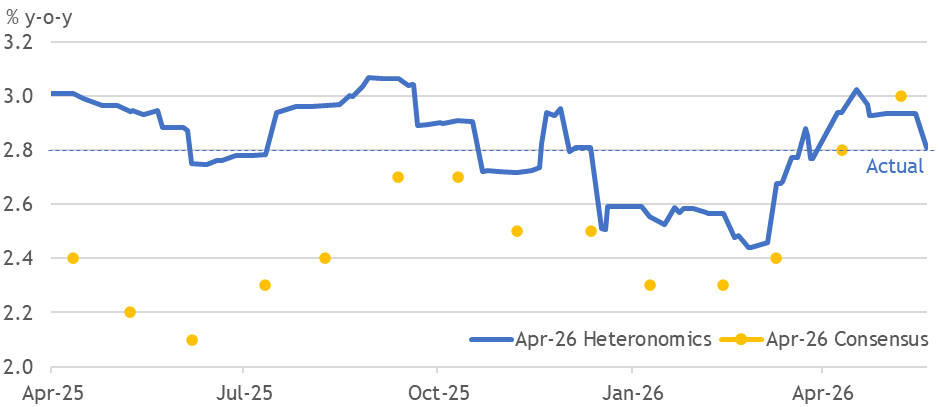
- Inflation slowed further in April than the latest over-inflated consensus, but exceeded all profiles before April. It also undershot our view by 13-15bp on the CPI and RPI.
- A rare airfares decline drove this and a shocking 0.6pp RPI consensus miss, but it was not much weaker than usual given the timing of Easter relative to index dates.
- Underlying inflation pressures are stuck ~3%, and passthrough of the latest shock is coming. The BoE has another excuse to hold in June, but we still expect a July hike.
2. UK: ONS Upscales Unemployment
- Unemployment partly reversed its shock drop with a rise to 5% in March, as the labour force recovered as we forecast. There was still a slight underlying improvement in Q1.
- March’s weakness arose from the ONS’s statistical adjustments, not raw responses, and seems to have been narrowly triggered by a student failing to find flexible work.
- Pay data were mixed, with weakness in private pay, ex-bonuses, providing an excuse to hold rates in June. But other measures are 4-5% and rising, encouraging a July rate hike.
3. HEW: Dampening Hawkish Urges
- There was broad weakness in European news over the past week, with broadly dismal PMI surveys outside the US, plus lower inflation and higher unemployment in the UK.
- Policymakers are prepared to lean against second-round effects, but are likely to be cautious. We still see single rate hikes from the ECB in June and the BoE in July.
- It’s a quiet, bank holiday-shortened week ahead in the UK and US, plus it’s Eid in the Muslim world. With little data scheduled, the RBNZ and BOK become unusual highlights.
4. The Oil Shock of 2026 : Why It Is Not a Repeat of the 1970s
- Today’s oil shock is serious, but inventories, shale production, and lower energy dependence make the global economy far more resilient than in the 1970s
- If today’s oil shock were truly worse than the 1970s, prices should be far higher. Oil quadrupled then, implying crude could approach $260/barrel by July if history repeated
- For the US economy specifically, fears that higher oil prices will derail the AI capex boom appears overstated. Data centres run on electricity and not crude oil
5. Services Scrape Post-Pandemic Lows
- Weakness in the services sector deepened and broadened in the flash PMIs for May. The EA is still underperforming, but the UK caught up with a crash amid political turmoil.
- Australia and Japan remain less exposed, while the US is shrugging off the shock, and India keeps booming. The demand hit is broadly worse than last year’s tariff shock.
- The average flash balance matches the 2022-23 lows, but France is worryingly closer to its Great Recession lows. The ECB should be cautious about hiking much beyond June.
6. EA: Inflating To a Hike
- EA inflation was confirmed at 3% in April, with housing and transport driving the 48bps increase amid ongoing passthrough of the energy supply shock from the Middle East.
- The monthly impulse in underlying inflation pressures is otherwise mostly marginally above the target, except in France. The UK still suffers the worst inflationary trend.
- Another rise is likely in May, despite government efforts to limit the shock. We still see upside risks to our forecast. A June ECB rate hike helps with second-round effects.
7. Global Economics: Bill From Hormuz Crisis Is Already Due and May Grow Larger
- The Hormuz closure has lasted long enough that a significant share of the economic damage is already locked in, regardless of when a diplomatic resolution enables a reopening.
- Structural obstacles, namely Washington’s credibility deficit after dismantling the JCPOA and sunk-cost logic, inhibit previous and current efforts to reach a negotiated settlement.
- The crisis is transmitting across multiple channels simultaneously—energy supply scarring, agricultural input shortages, disruptions in global trade, and tighter financial conditions.
8. BI’s Hawkish Hike To 5.25%
- BI’s surprise 50bp hike to 5.25% exceeds the consensus, demonstrating a shift to a hawkish bias focused on Rupiah and risk premia.
- Future rate moves hinge on FX stability, imported inflation from higher oil and administered prices, and resilience of portfolio inflows.
- An eventual return to cuts is contingent on calmer global conditions, a firmer Rupiah and contained inflation; macroprudential easing offsets growth risks.
9. BoJ Himino: A Blunt Critique of US Digital Finance Strategy
- No monetary policy signal. Himino’s speech was entirely focused on digital finance and payment system architecture. This reduces the probability of a June rate hike, in my view.
- He described Scott Bessent’s stablecoin vision as designed to “induce people around the world to finance the US fiscal deficit”, taking a mild jab at the credibility of US dollar.
- Japan will not follow the US toward lighter-touch crypto regulation. Himino’s explicit reference to anonymity of crypto use as a “problematic motive” signals his weariness about crypto.
10. Ominous Core Inflation Developments in the Fed’s Preferred Measure
- The Fed’s preferred core inflation gauge has accelerated since November in contrast to the equivalent consumer price index (CPI) measure based on three-month annualised and twelve-month core changes.
- Accelerating price increases for information processing equipment and software related to the AI infrastructure buildout is partly responsible for the core PCE deflator acceleration versus the CPI.
- Elevated readings for the core PCE deflator make Fed policy rate reductions difficult to justify in the current environment. Any rate reduction would probably require demand destruction and higher unemployment.
Receive this weekly newsletter keeping 45k+ investors in the loop
1. ‘It’s the Liquidity, Stupid’ | Protect the Pile Episode 11
- SP 500 at all-time high, up 8% year to date despite Iran conflict
- NASDAQ also at all-time high, up 12.5% year to date
- Liquidity driving market, Fed balance sheet growing at 6-7% annually, leading to market growth
This content is sourced through publicly available sources and has been machine generated. Information displayed is for general informational purposes only.
2. EM Fixed Income: Parsing peace talks and payrolls
- US and Iran reportedly in talks to end war with a short memorandum
- Market reaction to announcements and risk-reward analysis in various asset classes
- Focus on EMFX trading stronger on hopes of resolution, with underlying fundamentals supporting EM growth and positioning clearing out
This content is sourced through publicly available sources and has been machine generated. Information displayed is for general informational purposes only.
3. US: Awkwardly Overinflated Again
- US inflation surged beyond expectations in April to exceed levels that the consensus forecast at the height of its tariff concerns last year, as these costs cannot be avoided.
- Core services inflation trended up to an annualised 4.7%, matching the highs of 2025, to indicate excessive underlying inflationary pressures and possible second-round effects.
- Inflation is stuck above the target, presenting a greater case to hike than cut. If this builds, we still don’t believe Trump’s new Chair will ignore the hawkish fundamentals.
4. Rates: Temporal Decay Inverted
- Markets price BoE hikes while the consensus forecasts cuts. Some of this is because risks skew to higher inflation and rates, raising the mean (market) over modal forecasts.
- Each day of supply disruption deepens the shock, crystallising some risk, and pulling the modal forecasts towards market pricing in an inversion of the usual temporal decay.
- Energy prices, not macro, currently drive rate pricing, and we see supply normalisation priced too quickly. We are more hawkish than the consensus and see upside risks.
5. “National Dividend” For Excess Profits from Korean Semiconductor Companies? Karl Marx Would Be Proud
- KOSPI declined by 2.3% on Monday (11 May), mainly due to concerns about imposing “national dividend” for excess profits from AI/semiconductor related companies in Korea (Samsung Electronics and SK Hynix).
- In the near term (1-2 years), it is highly UNLIKELY for the Korean government to suddenly provide national dividends for excess profits from major AI/semiconductor companies in Korea.
- However, when the AGI becomes a reality, the idea of providing “national dividend” or by another name Universal Basic Income (UBI) could become a reality in 5-10 years.
6. HONG KONG ALPHA PORTFOLIO: (April 2026)
- The Hong Kong Alpha portfolio posted a -0.5% return for April. Since its inception, the HK Alpha portfolio has outperformed the HK indexes by 38.69% to 60.42%.
- Overall alpha generation remains at 64% of overall returns. The Sharpe ratio for the portfolio is 1.15, compared with 0.89 for the benchmark.
- As the US retreats from its war in Iran, we have repositioned the portfolio by adding exposure to the AI-related tech sector, including platform, agentic, and hardware.
7. CHARTING COURSE: China Summit Between the Lines and Trumpflation! (May 15)
- President Xi began the China summit with a warning on Taiwan. The statement reveals the extent to which US soft power has declined.
- Agreements from the summit were mostly perfunctory and did not result in any meaningful changes in China’s support for Iran and opposition to the war.
- Trumpflation is here, as PPI surges in April and consumers pay the highest gasoline prices in 4 years. Treasury yields are on the move with the 2-year above 4%.
8. UK: GDP Reaches Seasonal Peak Again
- UK GDP ended Q1 on a high, with 0.3% m-o-m growth instead of a contraction delivering 0.6% q-o-q. We maintain our call for April-May weakness to slow Q2 to 0.1%.
- The monthly profile is following the seasonal path of the past four years, but the 5yr sample in ONS analysis means they won’t find it until 2027, prolonging the problem.
- Underlying activity has filled in some of the Q1 hole, and the smaller rebound into Q2 doesn’t fundamentally matter beyond providing doves with an excuse to hike less.
9. EA Crawls In Tight Space
- Confirmation of a Q1 slowing in the Euro area exaggerates the 5bps change in a region that has long crawled forward slowly. Ireland’s volatility drove the latest change.
- The EA’s performance looks particularly pathetic relative to its peers, but the UK’s Q1 surge is residual seasonality, and the US strength is longstanding.
- Unproductive defence spending is not the hoped-for panacea, so the EA doesn’t need to grow fast to build excess demand with inflation that is leading the ECB to hike.
10. Lower Korean Stock Market on 15 May = NPS’s Plan on 28 May + Profit Taking on AI/Tech Stocks?
- On 15 May, the NPS (the big whale) announced that it plans to finalize the mid-term asset allocation plan on 28 May.
- All in all, the NPS is likely to raise the 5% limit for strategic and tactical asset allocation.
- The exact amount that it raises by remains uncertain. If NPS does not raise this limit enough, that could result in a major BEARISH pressure on the Korean stock market.
Receive this weekly newsletter keeping 45k+ investors in the loop
1. HEM: May-26 Views & Challenges
- April’s ceasefire helped unwind some of March’s moves. Economist views decay towards more hawkish pricing.
- The supply shock keeps growing, raising pressure to hike, but a forceful cycle would be more like 2003 than 2022.
- Dovishly biased assumptions at the BoE skew risks and surprises higher, sustaining persistent excess inflation.
2. RBA Hikes Not Decisively Above Neutral
- The RBA’s 25bp hike to 4.35% was broadly expected; upside inflation risks and energy shocks keep a tightening bias in place for 2026.
- New forecasts show inflation above target to mid‑2027 and a higher terminal rate path near 4.7%, raising the bar for any early easing.
- Future moves hinge on energy prices, inflation expectations and demand: data must undershoot forecasts for the RBA to pause, let alone cut.
3. Uneven Fallout of Middle East Conflict on Emerging Markets, but Asia More Vulnerable to Stagflation
- The impact of the US/Israel-Iran conflict has been uneven across emerging markets (EMs), largely determined by the reliance on Middle East-sourced energy.
- The endgame for corporate sectors in EMs will depend on their exposure to Middle East energy supply constraints and higher energy costs, as well as the pricing power of companies.
- Corporations in Malaysia and Thailand face the largest potential corporate credit stress stemming from a prolonged Middle East conflict, while Chilean and Mexican companies lead the way in Latin America.
4. Banxico Cuts to 6.50% as Cycle Ends
- Banxico cut by 25bp to 6.50%, in line with consensus expectations, and signalled the end of the easing cycle with a high‑for‑longer stance.
- Above‑target inflation, upside risks and only gradual convergence to 3% limit scope for further cuts despite weaker growth.
- Future moves hinge on durable disinflation, persistence of slack and Fed policy; markets should focus on the duration of the pause, not new easing.
5. Norges Bank’s Hawkish May Move
- Norges Bank’s earlier‑than‑expected 25bp hike to 4.25% demonstrates a strong anti‑inflation bias and reinforces its restrictive policy stance.
- Future moves hinge on CPI‑ATE, wage growth, NOK and commodity prices; current guidance still allows for another hike later in 2026.
- Downside growth risks argue for caution, but policy will stay tight until durable disinflation reduces concern about de‑anchored expectations.
6. Supply Chain Cold War
- The announcement at the end of April that the UAE (and others) need to access US dollar swap lines has potentially huge implications for the illiquid parts of US$ asset markets.
- If they try and redeem, price discovery could be brutal, but even if they don’t, where is the cornerstone funding going to come from to keep the show on the road?
- The only answer is governments, i.e. taxpayers.
7. Asian Equities: Nascent Revival in FII Flows in April, but a Long Way to Go
- We argued that Asia was oversold in March. In April FIIs bought back a little, US$1.58bn, predominantly in Taiwan (US$7.83bn). They bought US$493m in Korea and sold US$6.47bn in India.
- Our study of last 20 years FII investment shows that the present episode is the largest quantum of FII selling in Asia in a short period.
- The large Asian markets, Korea, Taiwan and India, are all near their troughs in terms of 6-monthly cumulative FII selling as percentage of market cap. India could get sold more.
8. Asian Equities: The Earnings Juggernaut Is Rolling on and Getting Broad-Based
- Asian earnings estimates are being revised up stupendously. Over past 6 months, 2026 consensus EPS is up 16%. 63 market-sectors out of 159 saw upgrades, vs 30 few months ago.
- While the main drivers are Korean and Taiwanese tech, the spill-over from tech into consumption sentiment and investment propensity are visible. Korean retail, financials, Taiwanese financials have had significant upgrades.
- The pedestrian upgrade to China’s EPS and the downgrade to Hong Kong’s are surprising. Our preferences remain on Korean tech, industrials, defense, financials, Taiwanese tech, Chinese basic materials, HK financials.
9. HEW: Trump’s Salsa Turns Policy Tighter
- Trump is leading a salsa dance for security in the Middle East as the conflict steps back and forth, with central bankers forced to dance along to the accumulating shock.
- The Norges Bank surprised with an early hike, while the RBA delivered another hike, and Banxico brought its cutting cycle to an end. Payrolls beat again, offset by the details.
- Next week’s releases include US inflation, Euro area GDP and employment, plus what is set to be another spurious Q1 surge in UK GDP amid residual seasonality.
10. Riksbank Holds, Risks Skew Up
- The Riksbank holds at 1.75% as expected, in a data‑dependent pause with a mild hawkish bias given rising energy‑driven inflation risks.
- Weaker‑than‑forecast growth and sub‑target core inflation argue against near‑term hikes, but limit any case for easing.
- Future moves hinge on war‑related energy shocks, global policy rates and the krona’s role in imported inflation.
Receive this weekly newsletter keeping 45k+ investors in the loop
1. BoE: No Longer Ready, But Leaning
- The MPC’s brief unanimity broke with a hawkish dissent, but there wasn’t enough to back overextended expectations, especially as “stand ready” references were pulled.
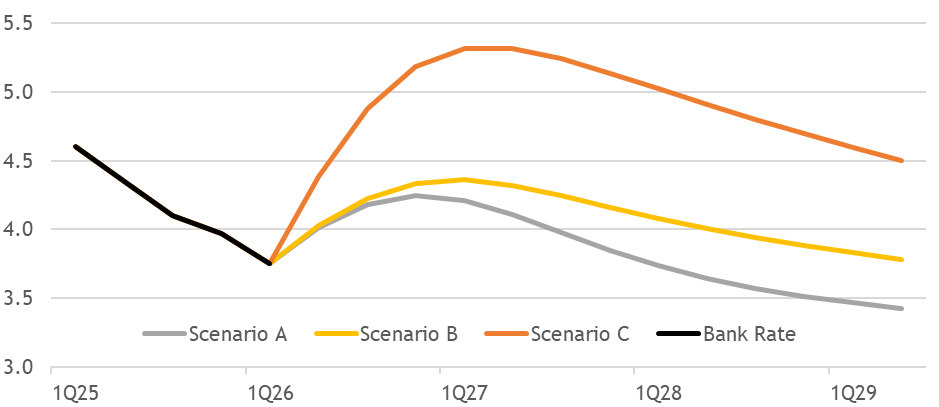
- We currently expect Greene and Mann to dissent in June. Policy scenarios show a hike, but don’t reflect the likely path when the MPC treats 2% CPI as a floor.
- Inflation is likely to exceed MPC hopes, without activity undershooting downgraded forecasts, so we expect a single hike in July, with risks skewed to another in November.
2. EA Inflation Re-Energised
- EA inflation jumped 49bp further to 3.04% in April, a tenth above the consensus but aligning with our forecast. Surging energy prices have driven a substantial step up.
- Household energy utilities, food, and anything else exposed to energy costs, remain set to rise in the months ahead. Benign core pressures may not last.
- We still see upside risks to our EA inflation forecasts, which are only slightly above the consensus. Sticking above 3% until 2027 locks the ECB out of its good place.
3. BoJ’s Hawkish Hold on Rates
- The BoJ held the policy rate at 0.75% as expected, but a 6–3 split and hawkish guidance keep further rate hikes firmly on the table.
- Growth for FY2026 was cut to 0.5% while core CPI was raised to 2.8%, tilting risks towards higher, not lower, future policy rates.
- Future hikes hinge on oil prices, wages and the yen; prolonged cost‑push inflation without recession would likely accelerate normalisation.
4. ECB On Hold, June Hike Looms
- The ECB delivers a hawkish hold, keeping rates steady but signalling a tightening‑biased reaction function amid renewed energy‑driven inflation risks.
- With upside inflation and downside growth risks, we still expect a June rate hike unless energy prices and short‑term expectations fall back quickly.
- Data on energy pass‑through, wages and inflation expectations will determine whether this pause becomes a brief prelude to further tightening or a prolonged plateau.
5. AI BUBBLE: Usage and Profitability and China’s Challenge!!
- OpenAI revealed that it failed to meet its own goals for user acquisition and sales, fueling concerns that the company may struggle to support its astronomical spending on AI infrastructure.
- Token prices have dropped by over 90% in the last year, which threatens to more than offset the increase in daily AI queries and weekly active users.
- China’s AI models continue to take market share from US counterparts. Chinese developers’ open models now account for about 17% of global downloads, surpassing US developers for the first time.
6. Asian Equities: Investing in China Necessitates a Careful and Calibrated Approach
- China is again finding favour among investors but investment in Chinese equities has to be nuanced and calibrated. Even high growth and policy beneficiary sectors have underperformed lately.
- Avoiding the victims of involution, selecting market leaders who can protect their margins and companies with overseas manufacturing bases who can protect their foreign margins seem a viable strategy.
- Latest consumption trends indicate strength in communication equipment, gold and silver jewelry, beverages and cosmetics. Precautionary buying of precious metals indicates that high dividend yield stocks could do well too.
7. Fed Split Points Higher‑for‑Longer
- The Fed held rates at 3.5–3.75% as expected; the real surprise was a rare 8–4 split, as three pushed back against an implied easing bias.
- Elevated, energy‑driven inflation and firmer near‑term expectations raise the bar for cuts and keep upside rate risks alive.
- With growth still “solid” and labour markets only slowly cooling, markets should assume a higher‑for‑longer Fed stance into 2027.
8. Asia Economics: Hormuz Crisis Imposes Fiscal Squeeze on Asia
- As the Hormuz energy crisis hits the region, Asian governments’ fiscal positions had not recovered from the pandemic-era spending, limiting their room to counter the new shock. T
- He shock will hit public finances through multiple channels simultaneously – higher subsidy and welfare bills, weaker tax receipts, and growth-dampening austerity.
- The Philippines and Indonesia are the most exposed due to their shallow domestic debt markets, weak pre-crisis baselines, and limited capacity to deliver post-crisis consolidation.
9. Active GEM Funds Give Back Early 2026 Gains. Q1 Performance Review.
- March reversal erased early gains: Active GEM funds gave back all 2026 gains in March, leaving returns near flat (+1.34%) and trailing the benchmark, with just 34.5% of funds outperforming.
- “Big Four” divergence drove outcomes: Performance was defined by a sharp split—South Korea and Taiwan contributed strongly while China & HK and India detracted
- Gains came largely from underweights in China/India names and selective North Asia exposure, while underweight TSMC—driven in part by UCITS limits—was the primary drag, highlighting structural challenges for active managers.
10. BoC Holds, Risks Split
- The Bank of Canada holds at 2.25% as expected, reinforcing a neutral stance with a high bar for either renewed cuts or fresh hikes.
- Future moves hinge on oil and CUSMA: persistent energy inflation could trigger hikes, while severe US trade shocks would argue for cuts.
- With soft growth but anchored expectations, policy is likely to stay near neutral, with only small, data‑driven rate adjustments ahead.
Receive this weekly newsletter keeping 45k+ investors in the loop
1. UK: Refuelling Inflation Excess
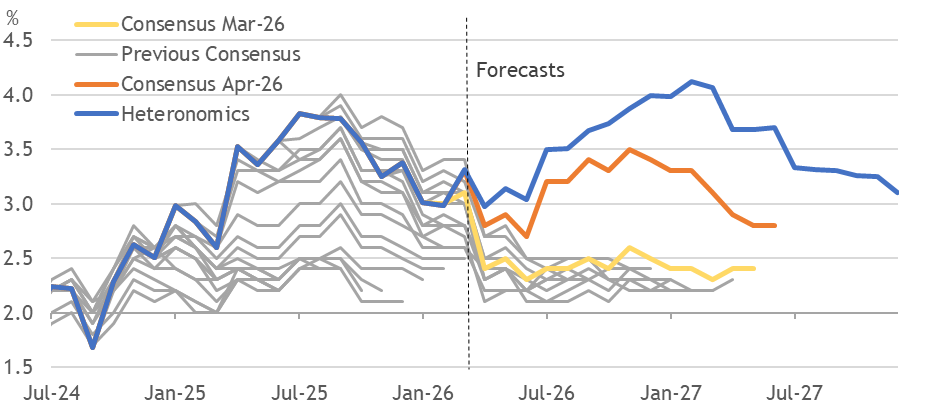
- Surging fuel prices helped push UK inflation back up to 3.3% in March, with the dip in April looking increasingly small, despite no passthrough to energy utility bills until July.
- The inflationary hump has shrunk with energy futures retracing rises, but our forecast remains relatively high, aided by airfares, and we still see upside risks to our profile.
- Those risks justify a more hawkish market path than our modal view for steady policy rates, while persistent excess is inconsistent with dovish consensus hopes for cuts.
2. UK: Spuriously Beyond Steady
- A shock drop in the headline unemployment rate to 4.9% in February clashes with previous dovish narratives, especially with the single-month rate at 4.55% lows.
- A shrinking labour force drove the move, encouraging us to discount the hawkish signal. Underlying changes among cohorts, payrolls, and vacancies also suggest stability.
- Wages were stronger than expected, mainly because of bonus revisions, but the downward trends survive, preserving an excuse for the MPC to hold rates steady.
3. Demand Destroyed in Euro PMIs
- PMIs signal a deeper demand destruction in Europe, even as the shock fades in the UK and US. The EA is often the worst performer during times of macro stress.
- Manufacturing surveys have stayed solid, rising since the war began, partly supported by the perverse boost from longer delivery times. But the EA still underperforms.
- The ECB’s greater weight on excess inflation than supply does not mean it ignores demand destruction. A gloomy shift in the trade-off reduces the risk of multiple hikes.
4. HEW: Squeezing The BoE
- Falling unemployment, rapid retail sales, recovering PMIs (despite EA weakness), and a jump in excess inflation hawkishly squeeze the BoE from both sides of its trade-off.
- We expect the BoE to hold rates next week, standing ready, but their noisy signalling could surprise. The ECB gears up to hike in June, while the Fed holds.
- In Heteronomics news, I was pleased to win the Focus Economics 2026 award for the most accurate UK inflation forecasts, supporting the Consensus Economics assessment.
5. Technically Speaking Breakouts & Breakdowns – HONG KONG (April 2026)
- The Hong Kong market has recovered from its drawdown during the Iran war and is now trading above its long-term support levels. Energy remains the top-performing sector YTD.
- Value and dividend factors continue to provide the best returns in Hong Kong; momentum has returned since the beginning of April.
- Lenovo (992 HK) had a reversal breakout technical pattern from a U-shaped bottom. The company is benefiting from growth in both the AI and data center industries.
6. CHARTING COURSE: Oil Price Discovery Moves West & Another FOMO Rally (April 20)
- As over 100 oil tankers head to the US coast, the prices of physical and contract oil are beginning to converge below $100 bbl.
- Even if the Strait of Hormuz opens soon, it will take many months to normalize the flow of ships transiting in and out of the Gulf.
- The unusual rally in the S&P this month appears to be a mix of FOMO and chasing the Mag-7 stocks.
7. Asian Equities: Headline Indices Back to Pre-War, but Not All Markets or Sectors Are
- Asian headline indices are almost at pre-war levels. However, Philippines, Indonesia, Thailand and Korea are significantly below and Taiwan significantly above the pre-war peaks. Hong Kong, Singapore are at parity.
- Utilities, consumer services, consumer durables are prominent decliners. Industrials, health tech (pharmaceuticals), process industries and technology are above pre-war levels. The market seems concerned about fuel and industrial input shortage.
- After this relative valuation churn, Korea, Indonesia and Philippines appear the cheapest on PE vs EPS growth and P/BV vs ROE. We remain overweight Korea, HK/China and Singapore.
8. HONG KONG IPO WATCH: Follow the Leader Strategy (April 2026)
- Hong Kong is on track to complete $40 billion in IPOs this year, with demand coming from unicorn tech companies and A-share firms seeking dual listings.
- AI, new energy technology, and healthcare will be the leading IPO sectors. There are 450 companies that have filed for IPOs in Hong Kong in 2026.
- With IPO oversubscriptions extremely high, investors are buying peer companies in the same industry, benefiting from spillover or halo effects.
9. Repatriation Investment Account (RIA) Surpasses 1 Trillion Won in One Month in Korea
- Repatriation Investment Account (RIA) has surpassed 1 trillion won ($690 million) since its launch about a month ago in Korea.
- Total amount of overseas listed investments by Korean investors increased from $27 billion at the end of 2020 to $131.7 billion as of 22 April 2026.
- RIA account is aiming to slow down this aggressive growth of overseas stock investments by Korean investors and rather try to repatriate these overseas investments into the Korean stock market.
10. The Heat Is On: News Flow and Sentiment in CHINA / HONG KONG (April 2026)
- The Hong Kong market has bounced on the back of the “risk-on” trade in Asia following the Iran ceasefire. The energy sector has pulled back hard, and technology has advanced.
- Hong Kong and China have seen lackluster ETF flows YTD, but mainland investors remain significant net buyers of HK shares via the southbound connect platform.
- Contemporary Amperex Technology (CATL) (3750 HK) reported outstanding earnings for the 4th quarter with improved guidance for 2026. The company’s H-shares trade at a substantial premium to its A-shares.
Receive this weekly newsletter keeping 45k+ investors in the loop
1. EM Fixed Income: Will EM markets keep trading Iran conflict de-escalation?
- Discussion on implications of potential ceasefire on different parts of EM asset class
- Relief rally seen in EM currencies, credit, and local rates following announcement of two-week ceasefire
- Potential for negotiated off ramp and lower risk of recession for global economy if ceasefire holds
This content is sourced through publicly available sources and has been machine generated. Information displayed is for general informational purposes only.
2. UK Burns Bridges to FDI
- The UK’s defence of its Gulf allies was weak (i.e. only 4 Typhoons in Qatar) and failed in Cyprus, where EU states did more and quicker, devaluing UK security guarantees.
- Without reliable ballistic missile defences or a functioning nuclear deterrent, the UK relies more on the US, yet Starmer punishes allies and energy bill payers to snub Trump.
- FDI from the Gulf (e.g. Qatar £40bn+) should partially unwind, just as the UK’s security promises did, feeding a structural underperformance of UK assets, including Sterling.
3. UK Q1 Residual Seasonality Returns
- Resurgent GDP in February, after an upwardly revised January, doubles tracking estimates of Q1 growth to 0.6% q-o-q. But this is merely a return of residual seasonality.
- We still expect growth to be heavily frontloaded into Q1 with stagnation through H2, but the initial real income squeeze is likely to stall Q2 more than usual.
- The biased BoE responds asymmetrically. It will likely discount Q1 as spurious rather than hike, yet still see subsequent weakness as a cause for caution, keeping it on hold.
4. HEW: Rallying into the Void
- No news was good enough news for risk assets to keep rallying, but even a benign end to the US-Iran war will not negate the inflation shock lifting policy rates.
- EA inflation recovered some of its downside surprise in its final March print, but the UK’s international stature can’t recover. It failed to defend its investing allies.
- Next week is packed with news for the UK, where the rise in its inflation data is our highlight, with its labour market and global flash PMIs other notable releases.
5. FOOD FOR THOUGHT: Commodity War Scars and Coming Inflation
- Agricultural commodity prices have been tame so far, but rising fertilizer, energy, and transportation costs portend coming inflation. Farming margins are getting squeezed as costs rise and grain prices stagnate.
- Closure of the Strait of Hormuz has led to a surge in fertilizer prices, heating oil, and diesel, all of which will eventually bleed into food price inflation.
- Europe and Asia have maintained ample grain inventories, which have kept prices low since the war began; these are only temporary buffers.
6. EA: HICP and Politicians Energised
- EA inflation was revised up by 3bps, rounding to 2.6% and partly reversing the downside flash surprise. Surging auto fuel drives inflation, with broader pressures still to transmit.
- Politicians are attempting to moderate the shock, with a current focus on auto fuel, usually with tax cuts. Some energy utility measures are taken, but more will follow.
- Underlying pressures were more benign than the headline surge, depriving the ECB of evidence to support a rate hike yet. We still expect that to come in June instead.
7. BUY/SELL/HOLD: Hong Kong Market Update (4/14/26)
- The Hong Kong market joined other Asian markets during the post-war sell-off. The HSI easily held its long-term support levels, and the overall market breadth remains above 60.
- The materials sector has lost momentum as the energy sector emerged as the standout winner in the first quarter of 2026. Value and dividend yield factors continue to outperform.
- Xinjiang Goldwind Science & Technology (2208 HK) has been upgraded by JP Morgan, along with a target price rise from DBS. The company is experiencing a surge in international orders.
8. 257: Beyond The Magnificent Seven: Discovering Equity Opportunities in The S&P 493
- Historic concentration in the S&P 500 due to the dominance of tech and AI adjacent companies
- Top 10 stocks currently make up 40% of the index, the most concentrated period in history
- Opportunity to look beyond the “Magnificent Seven” and consider underexposed, innovative companies in the index
This content is sourced through publicly available sources and has been machine generated. Information displayed is for general informational purposes only.
9. Asia Economics: Damage from Iran Crisis Now Baked In
- The failure of the first round of US-Iran negotiations reflects the substantial difficulties that lie in the way of bridging the structural gap between the two sides.
- Even if further talks eventually produce a settlement, energy prices will not revert to pre-crisis levels given the damage to oil production. Risk premiums will also remain elevated as well.
- Asian economies face a double hit: domestic demand destruction through higher energy costs triggering public and private austerity, compounded by a looming trade slowdown.
10. Asian Equities: Higher Earnings Estimates, Lower Stock Prices – Nine Notable Sectors
- The resilience of Asian earnings is surprising. Consensus 2026 EPS estimate of Asia-ex-Japan (Factset Market Index) is up 3% over the past month and 10% over the past 3 months.
- 29 market-sectors have had robust upgrades over 1-month, 3-month and 6-month timeframes. Energy and basic materials and the prominent AI beneficiaries, Korean and Taiwanese tech, figure prominently among earnings gainers.
- Among the earnings winners, nine sectors have declined significantly since the beginning of the war. The HK/Chinese, Korean and Indonesian basic materials and Korean financials and Thai communications stand out.
Receive this weekly newsletter keeping 45k+ investors in the loop
1. Q2 Outlook – Asian Equity Markets
- We first review at Q1 performance in the major markets we follow
- The worst may be over in but news flow will drive markets in the short-term
- We look at foreign positioning and fund flow data to assess risks
2. HEW: Ceasefire Relief Reversal
- Ceasefire has trimmed the dark tails and risk premia, partially reversing recent gloomy market moves, but the relief affects the mean more than our modal economic outlook.
- Next week’s calendar is only slightly less bare of releases, with UK GDP and final EA inflation data our highlights. There are plenty of policymaker speeches, though.
- As our flow of research resumes after the Easter lull, I’m honoured to accept the Consensus Economics award for most accurate forecaster of the UK economy in 2025.
3. PRIVATE CREDIT FUNDS: “Where Are the Customer’s Yachts?”
- The private credit market is under renewed pressure with redemption requests surging in 1Q2026. BDC stock prices are declining as risks mount in the industry.
- Managers are using Payment-In-Kind and Amend-and-Extend methods to restructure loans and delay delinquencies and defaults. Price-to-NAV ratios are declining to historical lows as managers are gating redemption requests beyond 5%.
- The private credit market has grown 60% over the last three years, now totals $1.8 trillion, and could pose a risk of financial contagion if underlying asset values deteriorate quickly.
4. APOCALYPSE POSTPONED: Can Trump Save Himself From Himself?
- President Trump proposed a “Double-Sided Ceasefire”, even though Israel will also need to sign off. The ceasefire, which was not agreed to, has already been broken by Israel and Iran.
- President Trump has introduced a failed tariff policy into the peace plan, proposing 50% tariffs on any country supplying weapons to Iran. The Supreme Court declared these tariffs illegal.
- Another mounting pressure to quickly end the war is the rapid depletion of U.S. weapons stockpiles. Are there enough weapons to “blast Iran back to the Stone Age?”
5. Charting Course: TACO TUESDAY, INVESTORS SEEKING “BOMB SHELTERS” – (April 8th)
- President Trump announced a 2-week ceasefire after Pakistan’s Prime Minister presented a 10-point proposal for negotiation with Iran. There are significant differences between parties as to what was agreed.
- Brent and WTI quickly fell below $100 BBL again after Iran stated it would allow ships to navigate the Strait of Hormuz following military processing.
- There were few places to find shelter other than the energy sector since the war began. Dividend yield and low-volatility factors have performed best in the US market.
6. RBNZ Holds Fire Amid Oil Shock
- The RBNZ held its official cash rate at 2.25%, broadly in line with expectations, but framed as a conditional pause amid an oil‑driven inflation shock.
- Future hikes hinge on second‑round effects, core inflation and inflation expectations; persistent oil or wage gains would trigger decisive tightening.
- Weak demand, tighter markets and spare capacity argue for patience; a sharper growth slowdown could delay or temper any normalisation path.
7. Thinking about Stagflation (again)
-
The Oil markets have been in record backwardation – which basically means that Oil traders are pricing oil in 12 months time over $30 below prices one month ahead.
-
Bond markets however are already pricing a Ukraine style inflation impulse – even if things were resolved tomorrow.
-
Equities were less aggressively positioned than last April before the tariff sell-down and have steadily sagged rather than crashed, with a little end month/quarter bounce to add further uncertainty as only short term traders are engaged right now.
8. BOK Holds: Oil Shock and Rates
- The BOK held the base rate at 2.50% as unanimously expected, signalling a prolonged, data‑dependent pause in the face of war‑related uncertainty.
- Inflation is now projected to exceed the February 2.2% forecast, keeping rate‑cut odds low unless oil and FX pressures ease decisively.
- Growth is set to undershoot earlier forecasts, but FX and inflation risks mean the policy bias remains towards extended holding.
9. US Corporate Profit Expectations Remain Resilient, as Global Credit Conditions Become Less Benign
- Despite geopolitical upheavals in the Middle East, US corporate profit expectations for 2026 have remained resilient. The correction in US equity prices in 2026 has been attributable to P/E compression.
- Higher energy prices will increase the demand for liquidity in the real economy, thereby exerting pressure on financial markets. Credit markets are currently more concerned about inflation risks than recession.
- Rising sovereign bond yields reflect hawkish short-term interest rate expectations. High reliance on Middle East oil supplies in the Asia-Pacific region raise stagflation risks in the event of protracted hostilities.
10. US-Iran: Scenarios for Escalation Remain Dominant, with Deal Prospects Obscure
- While Trump has promised Iran’s ‘civilisation will end tonight’ in the absence of Iran agreeing to a peace deal on US terms, the likelier US focus will be opening Hormuz.
- Kharg island is Iran’s economic lifeline, Qeshm the strategic key to holding Hormuz Straits. US likely to focus on these (plus Tunb and Abu Musa for UAE), not bombing infrastructure.
- Both will prolong market pain. TACO (Trump Always Chickens Out) remains a low probability outcome, despite last-minute pleas from Pakistan. Stay cautious, focused on commodities, metals and high-yield stocks.
Receive this weekly newsletter keeping 45k+ investors in the loop
1. HEM: Apr-26 Views & Challenges
- War with Iran has upended market pricing. An end should provide relief, but downside risks darken benign hopes.
- Damaged energy infrastructure would warrant hikes to partly reverse past easing, like in 2003, not 2022.
- The BoE suffers a dovish bias in its assumptions that lead it to over-inflate, which remains likely for any outlook.
2. EA: Soft Goods Ease Hawkish Pressure
- EA inflation jumped to 2.52% in March, far above earlier expectations, but below the latest views. Soft goods prices caused the downside news here and in the 2.26% core.
- Services inflation is sticky at 3.23%, 22bp less than a year ago. Further energy price rises are set to drive the headline rate above 3% over the next two months.
- Downside news to the ECB’s forecast eases hawkish pressure in the short term, raising the likelihood of no change in April. We still expect it to hike rates in June.
3. Asian Equities: Getting into Oversold Territory, After Heaviest Ever Monthly FII Selling in March
- In March till date, FIIs have sold an enormous US$58.6bn of Asian equities – the highest ever monthly sale – US$26bn in Taiwan, US$20.25bn in Korea and US$12.3bn in India.
- On 6-monthly cumulative buying/selling as proportion of market cap, Asia is near its “most-sold” level. The ongoing Middle-East conflict could drive more selling, but Asia is rapidly entering oversold territory.
- Korea is oversold, Taiwan is nearly there and India is not quite in oversold territory. ASEAN markets are far from oversold, implying that they could see lot more FII selling.
4. Asia’s Growth Risks Are Compounding
- The Middle East war is tightening energy supplies, worsening terms of trade, and narrowing the policy space to cushion the blow simultaneously.
- In the short-term, the downside risks are highest for the Philippines, Vietnam, India and Thailand.
- A prolonged supply interruption extending beyond four to five months will likely amplify recessions risks for Singapore, Thailand, S Korea, Japan and Taiwan.
5. South Korea’s National Assembly Ready to Finally Approve the Cornerstone System for IPOs
- On 2 April, South Korea’s National Assembly Political Affairs Committee held a Bill Review Subcommittee meeting and passed the amendment to the Capital Markets Act for the cornerstone system introduction.
- The main purpose of the cornerstone system is encourage institutional investors to pledge to hold the shares for at least six months after listing.
- The Korean National Assembly is likely to finally pass the allowance of the cornerstone system for IPOs in Korea.
6. Donald-In-Wonderland: SEPARATING NOISE FROM SIGNAL
- Sorting out the noise from true market signals is challenging in the current environment, with conflicting media accounts on the war in Iran.
- Peace negotiations and daily oil price fluctuations are noise, while Hormuz crossings, treasury yields, long-term oil prices, and stock market technical indicators are investment signals.
- Global markets remain hopeful of a quick resolution to the war and return to normal oil and gas shipments from the Gulf; however, investment signals are diverging from that view.
7. Asian Alpha Hedge Portfolio (March, 2026)
- The Asian Alpha Hedge Portfolio performance in 1Q26 was +17.83% versus its benchmark performance of +1.79% for an outperformance of 16.04%.
- Over the last year, AAHP’s Sharpe ratio is 4.39 with a mean excess annualized return of 69%. The portfolio has a gross and net exposure of 132% and +30%, respectively.
- The war has changed outlooks for economies and markets in the region. Accordingly, we reduced risk in the portfolio and adjusted our long/short exposures to reflect this new reality.
8. OIL: When a Short-Term Spike Becomes Long-Term Reality
- So far, global markets remain optimistic that the damage from the war in Iran will be repaired relatively soon; however, that will change as the war enters its second month.
- Asian countries are highly dependent on oil and gas shipments from the Middle East, with airlines, petrochemical companies, and gas distribution companies all negatively affected.
- Iran now controls when the flow of energy from the Middle East starts and thereby when the war stops. Gulf countries will not allow Iran to be the Straits gatekeeper.
9. HONG KONG ALPHA PORTFOLIO: (March 2026)
- The Hong Kong Alpha portfolio’s March performance was -11.25%, compared with -7.75% for the benchmark index. The Hang Seng Index lost 6.92% for the month.
- Performance was hurt by its exposure to the oil equipment and fertilizer sectors, which normally benefit from higher energy prices. China imposed price and export restrictions in the energy sector.
- At the end of March, we positioned the portfolio to better cope with the difficulties in China’s economy and in the global market due to persistently high energy prices.
10. Some Final Words on the Market Outlook
- Our base-case intermediate outlook for equities is bullish, based on our base-case scenario of an orderly wind-up of the war.
- Focus on a barbell portfolio of U.S. large-cap growth and non-U.S. value for equity portfolios, and make a greater allocation to commodities in the normal bond part of the portfolio.
- The key risk is that the Gulf conflict spirals out of control and raises the risk of a global recession.
Receive this weekly newsletter keeping 45k+ investors in the loop
1. UK Airfares Fly Further, Later
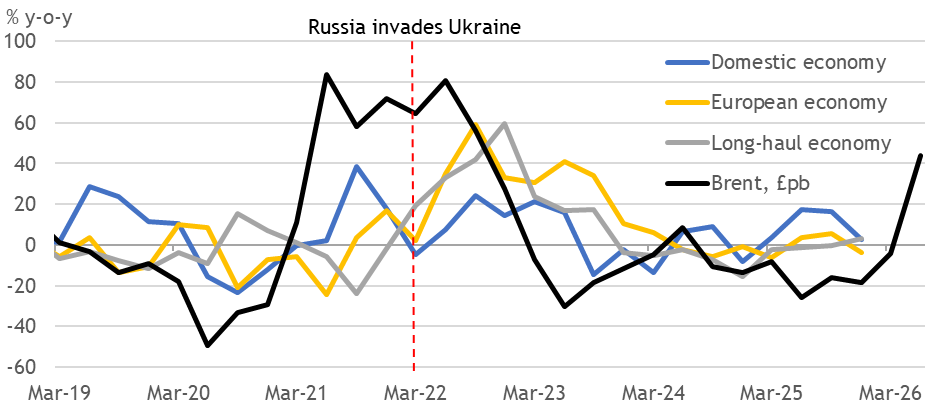
- Airfares are energy-intensive, so they will trend higher with oil prices, especially now that domestic flights are almost irrelevant and long-haul’s weight is up 15pp since 2020.
- Prices are being sampled earlier, postponing much of the impact until the summer holidays and beyond, with larger rises and smaller seasonal falls than otherwise.
- Index date quirks will still dominate in a soft April and resurgent December, but we see airfares up 21% by Feb-27, similar to the aftermath of Russia’s invasion of Ukraine.
2. UK: CPI Outlook Embarrasses the BoE
- UK inflation stayed at 3% in February, while the core rate rose to 3.23%, leaving only 30bps of progress over the past year. Underlying pressures keep exceeding BoE hopes.
- Surging energy prices should broadly return the Ofgem cap to Feb-24 levels, but take the CPI above 3.5% after averaging 2.9% in the gap when costs were temporarily low.
- We see inflation peaking around 4% in 2026 and slowing to 3% in 2027. Whatever happens, the BoE’s inflationary bias is set to keep the CPI trending above its target.
3. US BEAR MARKET: Stage Two – ANGER
- The U.S. stock market is entering a new stage of its bear market. It never fully recovered from the Liberation Day drawdown, instead allowing the dollar to absorb the losses.
- The market has entered its 5th month of sub-2% monthly gains, a pattern that has historically preceded bear markets.
- Household dependence on stock market gains for consumption is at historically high levels. Increased inflation resulting from higher oil prices exacerbates a vicious downward spiral in consumption and the market.
4. Activity Resisting Energy Shock
- Flash PMIs for March reveal a broad weakening concentrated in the services sector, but of a similarly benign size to the shock from Trump’s tariff announcement last April.
- The starting point is more robust now, and that momentum should help carry the global economy through the supply shock, although the damage will accelerate with time.
- Monetary policymakers should feel more comfortable focusing on the inflationary risk while the demand side of the stagflationary shock is proving so benign.
5. Asian Equities: Relative Value Trades After This Dislocation
- Sharp dislocations in Asian markets have opened up relative value trade opportunities. Many Asian markets’ valuations are near long-term averages, but some are far more expensive, and some far cheaper.
- Going by likely mean reversion, we conclude that Taiwan should correct more while Korea should rerate. The other markets are close to their long-term means, and hence, difficult to call.
- In ASEAN, going long Indonesia and Philippines and shorting Singapore could be profitable. Shorting Thailand could be an option too, from the perspective of earnings pressure due to tourism slowdown.
6. HEW: War Lays an Egg for Easter
- War with Iran is making little progress between waves of tension, although Trump lost his ladder to climb down as Iran seeks to retain control of the Strait of Hormuz.
- This hurts Europe and Asia the most, and to an increasing extent over time, so their central bankers made screeching hawkish turns. But Latam remains relatively dovish.
- Next weekend is Easter, so this publication will take a customary break, returning on 10 April. EA and US inflation for March, plus nonfarm payrolls, are the main releases.
7. Chile’s Policy Pivot to a Risk‑Management Hold
- The Central Bank of Chile holds rates at 4.5% as expected, shifting from an easing bias to a data‑dependent, risk‑management pause for longer.
- Oil‑driven shock pushes forecast inflation to ~4% near term, so upside inflation risks now outweigh growth in rate decisions.
- Future moves hinge on expectations staying near 3%; anchored views support a hold, de‑anchoring would likely trigger tightening.
8. CHARTING COURSE: U.S. Waves the White Flag, “Lucky Trades”, and the War’s Inflation Tax (3/26/26)
- The war’s unintended consequences are creating global risks in energy and shipping, which may extend beyond the near term. Truce negotiations will be protracted with no quick resolution in sight.
- Prediction markets show that the probability of oil prices remaining high through year-end is increasing, while the probability of a quick war resolution is declining. Iran now controls the Strait.
- Price pressures are mounting as import prices showed the highest monthly increases since 2022.
9. US: Iran War Isn’t About to End Despite the Improved Atmospherics from Trump
- The worst case scenario (of tit-for-tat attacks on energy infrastructure) has abated for the week ahead. Pezeshkian-Trump deal via intermediaries will be fiendishly difficult to implement as IRGC/Basij will resist.
- Despite decapitation of Iran’s leadership, IRGC/Basij’s fight persists, like Iraq’s Ba’athists peopling Iraq’s Sunni militias 2003-13. Israel has forced Iran’s retreat from Syria-Lebanon-Gaza; reformist Azeri-Kurd Pezeshkian could countenance regime change.
- Iran’s intransigent forces won’t capitulate without gaining an end to sanctions. US-Israel will demand a final end to Iran’s nuclear-bomb capability. There’s many a slip ‘twixt cup&lip. Stay cautious.
10. The Heat Is On: News Flow and Sentiment in CHINA / HONG KONG (March 23)
- The Hong Kong market is experiencing its worst February/March period in 10 years. Although the market has corrected amid risk-off sentiment, we expect it to hold long-term support at 24000.
- The energy sector has been the clear beneficiary this year, with coal companies outperforming.
- Semiconductor Manufacturing International Corp (SMIC) (981 HK) share price has tumbled since the start of the war, amid questions about helium supply and prices following the bombing of Qatar facilities.
Receive this weekly newsletter keeping 45k+ investors in the loop
1. UK: Inflation Intensities Re-Weighted
- The near-term inflation outlook is swinging with the fundamental news about supply disruption in the Middle East, but there is a statistical element to how that hits the CPI.
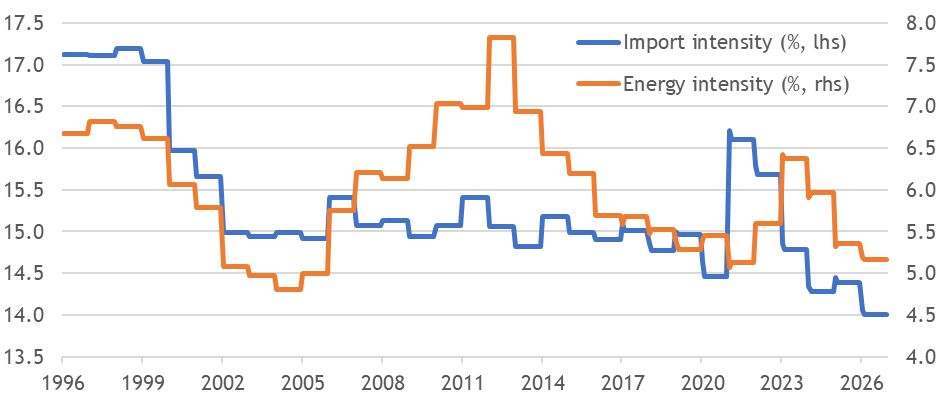
- Updated weights for 2026 have derated gas to record lows, conveniently trimming that passthrough, but the CPI’s indirect energy intensity has held steady at 1.65%.
- A deflated gas weight is easily captured, but core passthrough may prove surprisingly strong again, especially if excessive inflation expectations power second-round effects.
2. BoE: Hawkish Wind Blows Doves Away
- The MPC found rare unanimity in its on-hold decision for March after the energy shock blew the doves away from votes that they signalled would otherwise have survived.
- At least five members are explicitly standing ready to act if necessary. The persistence of the war’s hit to energy supply and prices will be clearer at the April meeting.
- Evidence of second-round effects would take longer to accumulate. If the shock is ongoing in July, contrary to our call, a rate hike is likely to be needed and delivered.
3. EA: HICP Exploding Out Of 2026 Trough
- EA inflation’s surprise rise to 1.9% in February was confirmed in Eurostat’s final print, with the underlying monthly impulses broadly aligned at the 2% target.
- Energy prices have exploded higher since the US attacked Iran, driving a massive shock that the consensus currently misses. Surprises usually correlate with energy prices.
- The ECB should stay hawkishly vigilant, enjoying the good starting place, without actively tightening unless high energy prices persist or second-round effects emerge.
4. UK: Pre-War Employment Steadies
- Underlying cohort responses corroborated a surprisingly bullish start to 2026 for employment, while a return to payroll growth signals the tax shock has passed.
- Vacancies remain worryingly stagnant, but half of the redundancy shock has already faded. Private sector pay remains an outlying, gloomy signal that doves can cling to.
- The inflationary energy price shock should keep the BoE on hold, but accommodating it will probably secure excessive pressures beyond inflation’s unavoidable direct hump.
5. HEW: Escalating Hawkish Pressures
- Attacks on energy infrastructure are raising the risk that the supply shock persists even if the conflict ends swiftly, stoking hawkish pressures for action at the BoE and ECB.
- Our inflation forecasts are accumulating a substantial hump, now breaching 4% on UK CPI. Second-round effects are central to calibrating the global monetary response.
- Next week is calmer for policy, with only Norway, Chile and Mexico announcing. We will be watching UK inflation, flash PMIs, and developments in the Middle East most closely.
6. Asian Equities: Risks Not Adequately Factored in Asian Markets, IERP Tells Us
- We study Implied Equity Risk Premium (IERP) of Asian markets over the past 20 years to assess whether the markets are adequately factoring in the present risks or not.
- In most markets, risk perceptions were much higher during the COVID pandemic or during the Russia-Ukraine conflict. It seems Asia is hoping for a quick resolution to the Middle-East conflict.
- In particular, we think investors are complacent, reflected in low IERP, in Taiwan and Singapore. IERP’s in these markets are near their lowest ever.
7. Korean Regulators to Create a Two-Tier KOSDAQ Market
- On 18 March, the Korean financial regulators announced that they are seeking to create a two-tier KOSDAQ market.
- KOSDAQ will be divided into two tier system, including the premium market for large companies and the standard market for promising companies.
- The introduction of a two-tier KOSDAQ system would have significant implications for valuation dynamics, raising valuations of companies included in the premium market and lowering valuations in standard market.
8. Fed Holds: Higher for Longer?
- Fed holds at 3.5–3.75% as expected. The SEP shows stronger growth and higher inflation, reinforcing a cautious, higher‑for‑longer rate stance.
- Median dots still pencil in only gradual cuts to 3.4% end‑2026, with a higher 3.1% long‑run rate signalling a structural limit to loosening.
- Oil‑driven inflation and a softening labour market will determine the timing of another possible cut, with risks skewed to later, not faster, easing.
9. The Complexity of the Oil Trade
- USO, an oil ETF, has experienced volatility and resurgence, prompting discussion on alternative energy investments and complexities in the oil trade
This content is sourced through publicly available sources and has been machine generated. Information displayed is for general informational purposes only.
10. From the River to the Reservoir to the Lake: China’s De-Dollarisation Story
- PBOC’s declining holdings of US Treasuries is often equated with the de-dollarisation of the Chinese economy. Less known is that USD assets remain substantial and systemically embedded in Chinese banks
- Chinese data shows their domestic banks are increasingly net long USD, with positions expanding alongside weaker domestic opportunities—especially from the property downturn—reinforcing demand for dollar assets
- A forward-adjusted FX proxy shows RMB pressures remain driven by dollar flows, suggesting de-dollarisation narratives are overstated and China’s system still responds primarily to USD liquidity conditions